Built to Exit - Leadership Systems

Built to Exit helps founders build a company that runs without them. Clean CRM architecture, four revenue engines, and AI built on defined...
Port Saint Lucie, US
•Created byProfile pictureDean DeVries
Profile picture
Dean DeVriesProfile picture@systemsjunkie·8h

Otherwise it's a document

The best system in the world starts to decay the day nobody owns it.


After over 200 HubSpot builds, the pattern is clear. The build is rarely what breaks. Ownership is.


Nobody did anything wrong. The founder was busy. The sales manager was selling. The system just had no one whose job it was to keep it true.


This shows up far past the CRM. A meeting rhythm with no owner becomes optional. A comp plan with no owner becomes a fight every quarter. A hiring process with no owner becomes "we'll figure it out when we need someone."


If you're building a company that can run without you, every system you install needs a named owner. Someone who closes out the week, catches what broke, and tells leadership what the numbers are really saying.


Otherwise it's a document. And a document doesn't answer a buyer, cover a vacation, or keep the pipeline honest while you're gone.


Your turn: which system in your business has no owner with a name on it? Drop it below.
Profile picture
Dean DeVriesProfile picture@systemsjunkie·3d

Does your revenue need you?

A buyer's first question isn't about your revenue. It's about whether your revenue needs you.


In this community, we work from the five questions buyers ask in diligence. The first is the one founders least want to hear: does revenue depend on the founder?


I learned how to answer it before I ever used the word exit.


From 2018 to 2023 I was Chief Revenue Officer for Rob Dial. I led the front-end and back-end revenue teams, and we generated over $20M in coaching fees.


We ran "sales pushes," something I brought with me from my Cutco days: an all-out two-week sprint to see what was really possible.


I quietly dreaded them. I always felt responsible for leading in sales and finishing on top, and I told myself "if I can do it, you can too" was good leadership.


Then, during one push, I made a different commitment. I spent the hours I would have spent selling leaning into my team instead.


It became the biggest two weeks in sales in the company's history. Performance went up, the culture got tighter and profitability took off. Most important, it gave my future sales director room to grow.


I didn't need to be the rabbit they were chasing. I needed to be the guide beside them, and then get out of their way.


A team closes without the founder when three things are true:


  1. The sales process is written down, so a new rep sells the way your best rep does.

  2. The CRM shows who is closing, so you can prove it's the team and not you.

  3. The founder coaches the team instead of covering for it.


None of that is really about selling the company. It's what lets you step back without the pipeline going quiet, and a buyer just happens to pay for the same thing.


Your turn: if you stepped away for 30 days, which part of your revenue would stop first? Drop it in the comments, and we'll work through a few of them together.

Profile picture
Dean DeVriesProfile picture@deandevries1·Oct 24

Founder dependence is a discount on your company

Founder dependence is a discount on your company


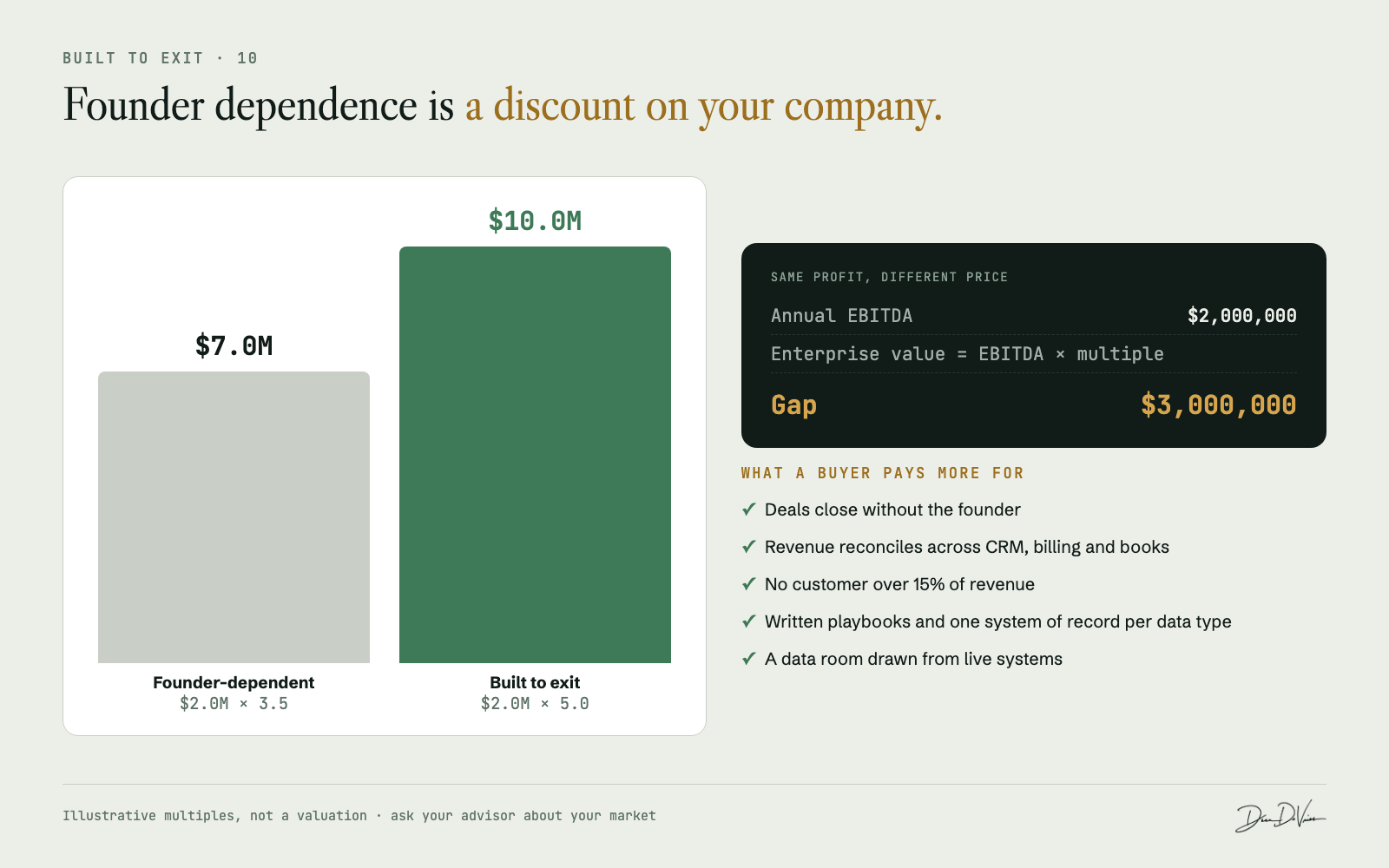
Two companies with the same profit can sell for very different prices.


A buyer pays for earnings they believe will continue after you leave. If the biggest customers are your personal relationships, if deals don't close without you on the call, and if the numbers live in your head, the buyer prices in that risk. It shows up as a lower multiple.


The graphic is illustrative, not a valuation, but the shape is real. The same earnings, with a documented sales process, verifiable data and a team that runs without the founder, are worth more to a buyer.


The work that raises that value is the same work that lets you step out of the day-to-day. Either way you exit, it pays.


If you left for 90 days, which part of the business would struggle first?

Profile picture
Dean DeVriesProfile picture@deandevries1·Oct 23

The conversation you're avoiding has a price tag

The conversation you're avoiding has a price tag


Every leader has one. The underperformer you keep giving one more quarter. The partner conversation you keep postponing.


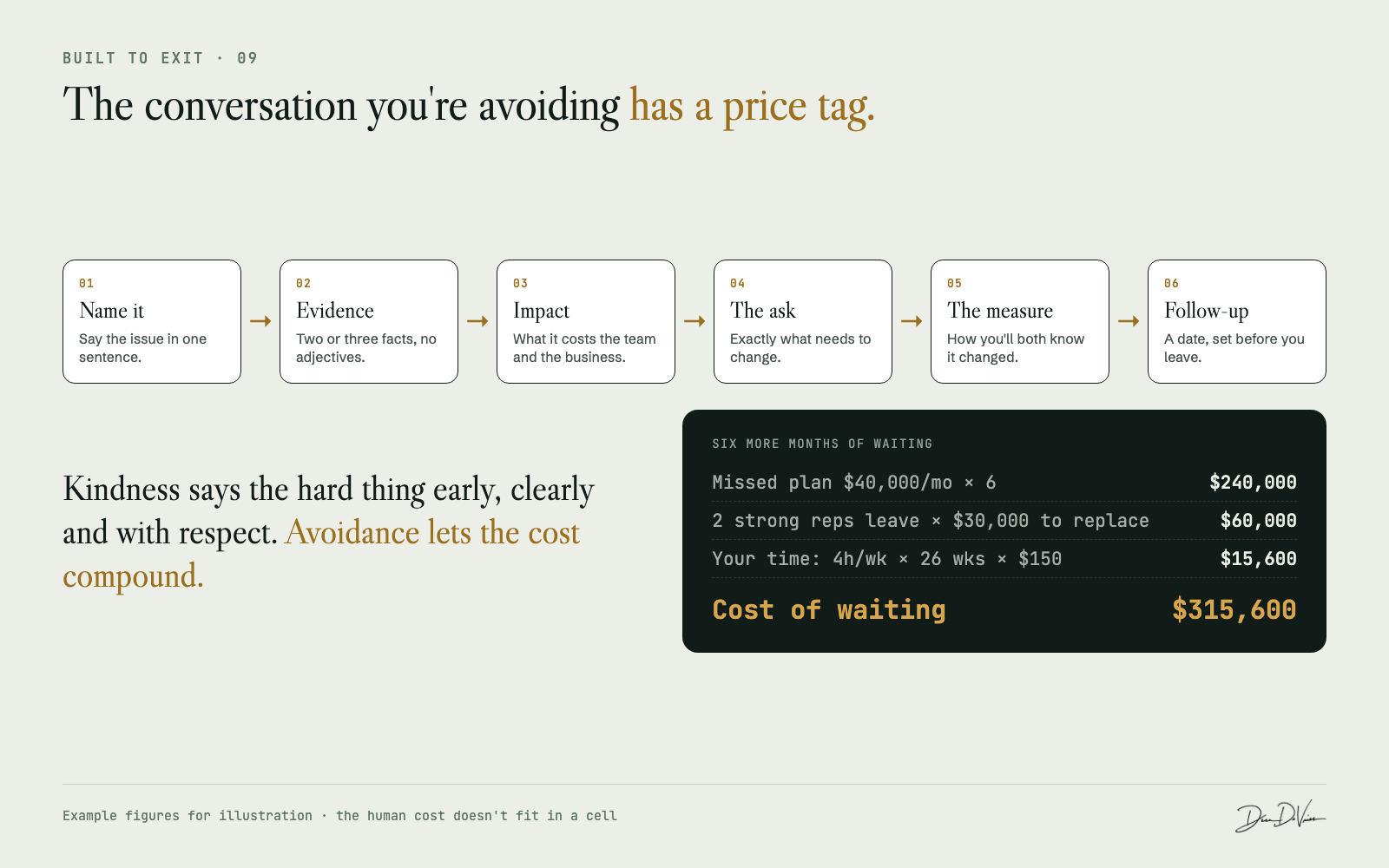
We tell ourselves we're being kind. Usually we're being comfortable. Kindness says the hard thing early, clearly, and with respect. Avoidance lets the cost compound, for the business and for the person who deserves to know where they stand.


The graphic puts an example number on six months of waiting, and lays out a structure that makes the conversation easier to start: name it, show the evidence, explain the impact, make a clear ask, agree on how you'll both measure it, and set the follow-up date before you leave the room.


You don't need to have it perfectly. You need to have it this week.


What's the conversation you've been putting off?

Profile picture
Dean DeVriesProfile picture@deandevries1·Oct 22

From hero to architect

From hero to architect


For a lot of us, being needed became part of who we are.


You're the one who fixes the big deal, calms the upset client, finds the bug in the spreadsheet at 11pm. It feels like leadership. It's also why the company can't grow past you, and why you can't take a real week off.


The hardest part of building a company that runs without you isn't the systems. It's the question underneath: if I'm not the hero, what am I worth?


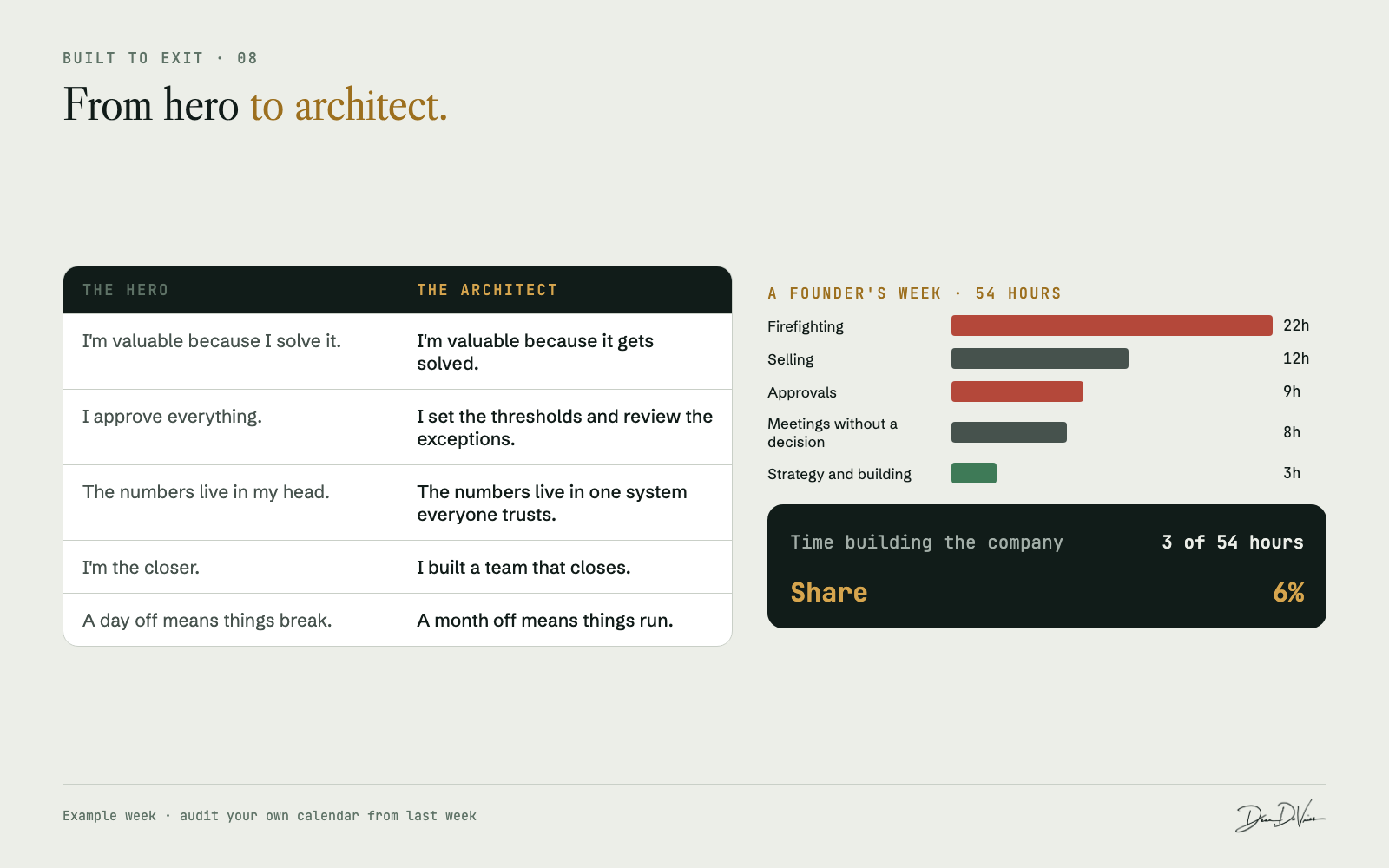
The answer I keep coming back to: your value moves from solving the problem to designing a company where it gets solved. Less visible. Far more durable.


The graphic shows the shift, and a simple audit of where a founder's week actually goes. Try it on your own calendar. Where did your hours go last week?

Profile picture
Dean DeVriesProfile picture@deandevries1·Oct 21

AI will confidently repeat your mess

AI will confidently repeat your mess


Everyone wants AI in the sales process. Very few companies are ready for it, and the reason is almost always the data.


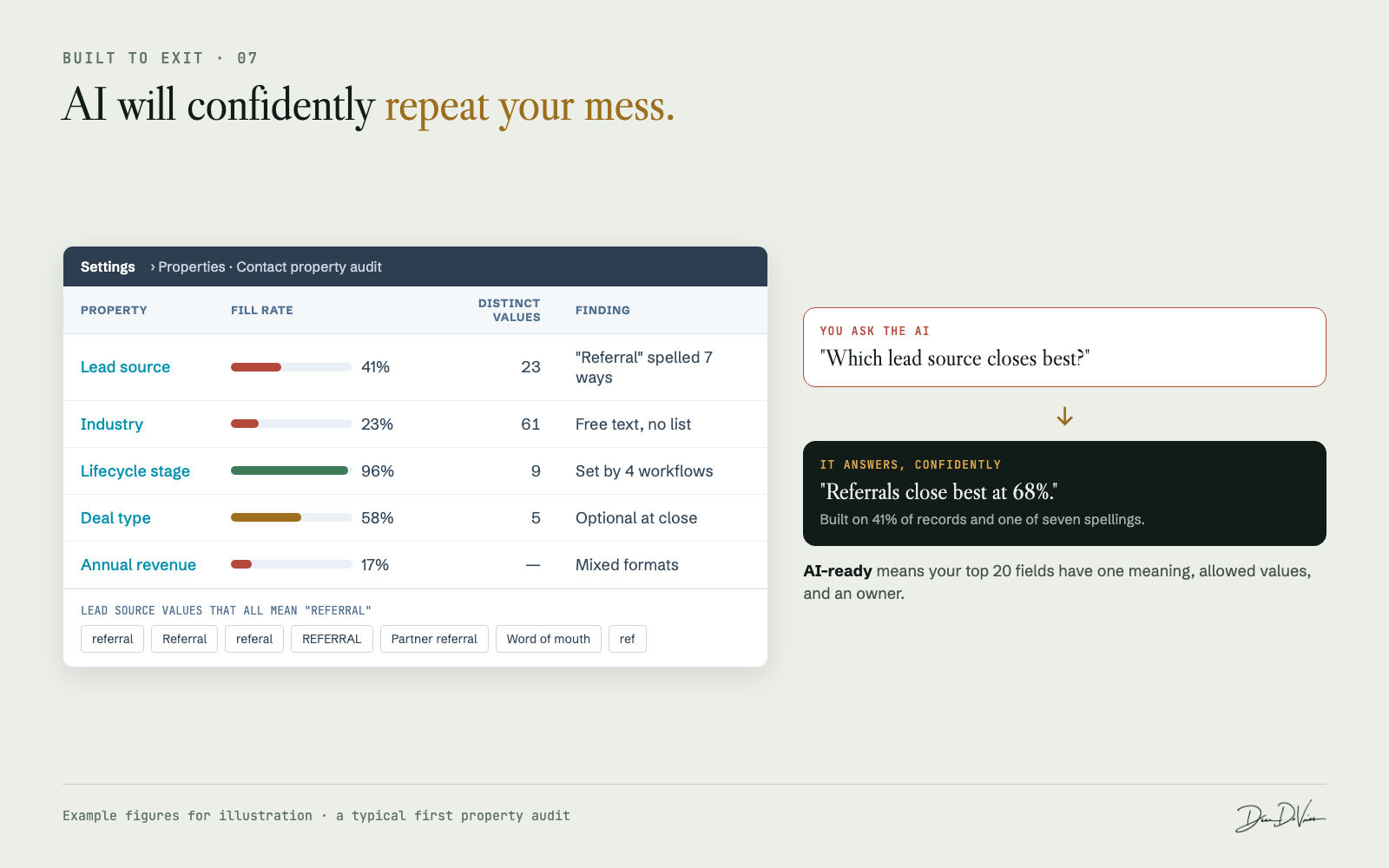
Ask an AI assistant "which lead source closes best?" and it will give you a clean, confident answer. It will read a "Lead source" field that's filled in on 41% of records and spelled seven different ways. The answer will look great and be wrong.


The graphic is what a property audit usually finds. Before you buy another AI tool, define your top 20 fields: one meaning, allowed values, and who's allowed to change them. That's the difference between AI that helps and AI that misleads you faster.


Clean, defined data is what "AI-ready" actually means.


What's one field in your CRM that means something different to sales and to marketing?

Profile picture
Dean DeVriesProfile picture@deandevries1·Oct 20

The cheapest revenue you'll find this quarter

The cheapest revenue you'll find this quarter


Your CRM is holding revenue you already paid to generate.


Deals that went quiet. Prospects who said "not now." Proposals that never got a no. Most companies never go back to them, and the reason is mostly human. Calling someone who ghosted you feels like rejection, so reps chase new leads instead.


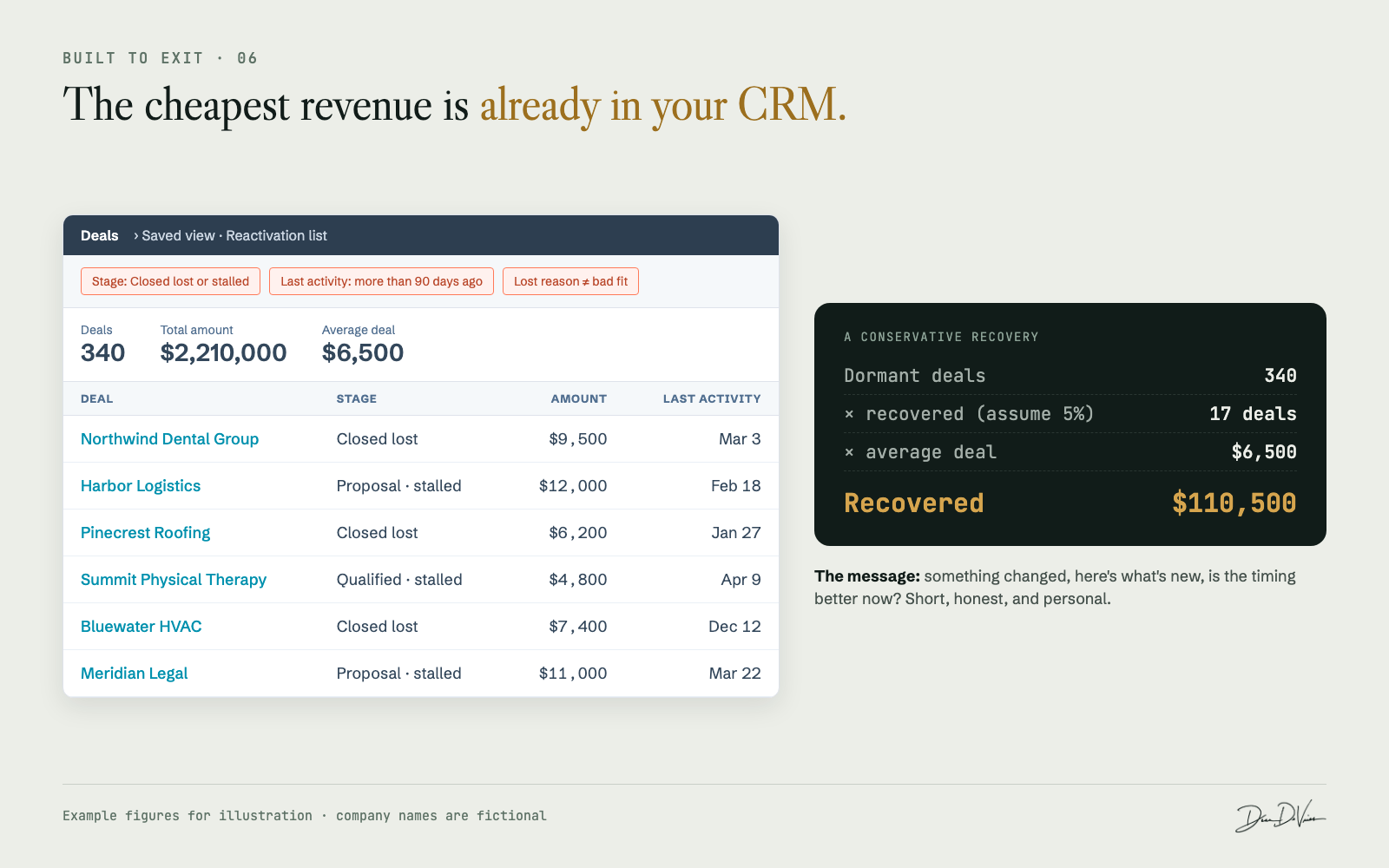
Give the team a reason to reach back out and a list to work from. A filtered view of closed-lost and stalled deals with no activity in 90 days. A short, honest message: something changed, here's what's new, is the timing better now?


The graphic runs the math on an example portal. Even a small recovery rate on a list you already own beats most new campaigns, because you've already paid for the lead.


When did your team last look at closed-lost on purpose?

Profile picture
Dean DeVriesProfile picture@deandevries1·Oct 19

Your forecast is a mood ring

Your forecast is a mood ring


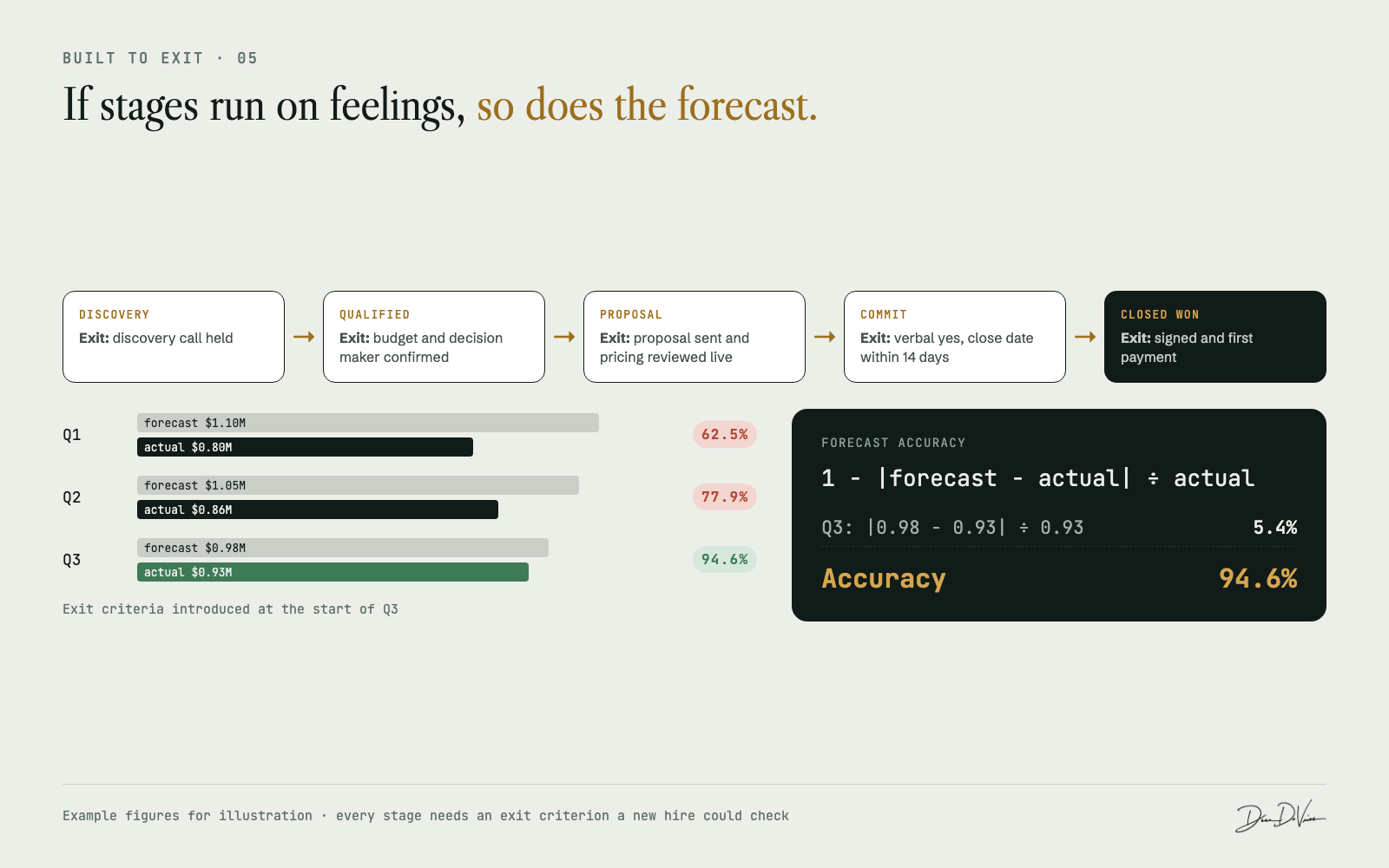
If a deal moves stages because a rep "feels good about it," your forecast measures optimism.


Every pipeline stage needs an exit criterion you can check: discovery call held, budget confirmed, decision maker named, proposal sent. No criterion, no stage change.


Reps will push back at first. It feels like more admin. What they get in return is a forecast that stops getting them in trouble at the end of the quarter.


The example in the graphic shows how forecast accuracy typically moves once stages mean something. Accuracy is one minus the miss, divided by actual. Track it every quarter and post it where the team can see it.


What's the exit criterion for your "Qualified" stage? Could a new hire tell?

Profile picture
Dean DeVriesProfile picture@deandevries1·Oct 18

Three systems, three revenue numbers

Three systems, three revenue numbers


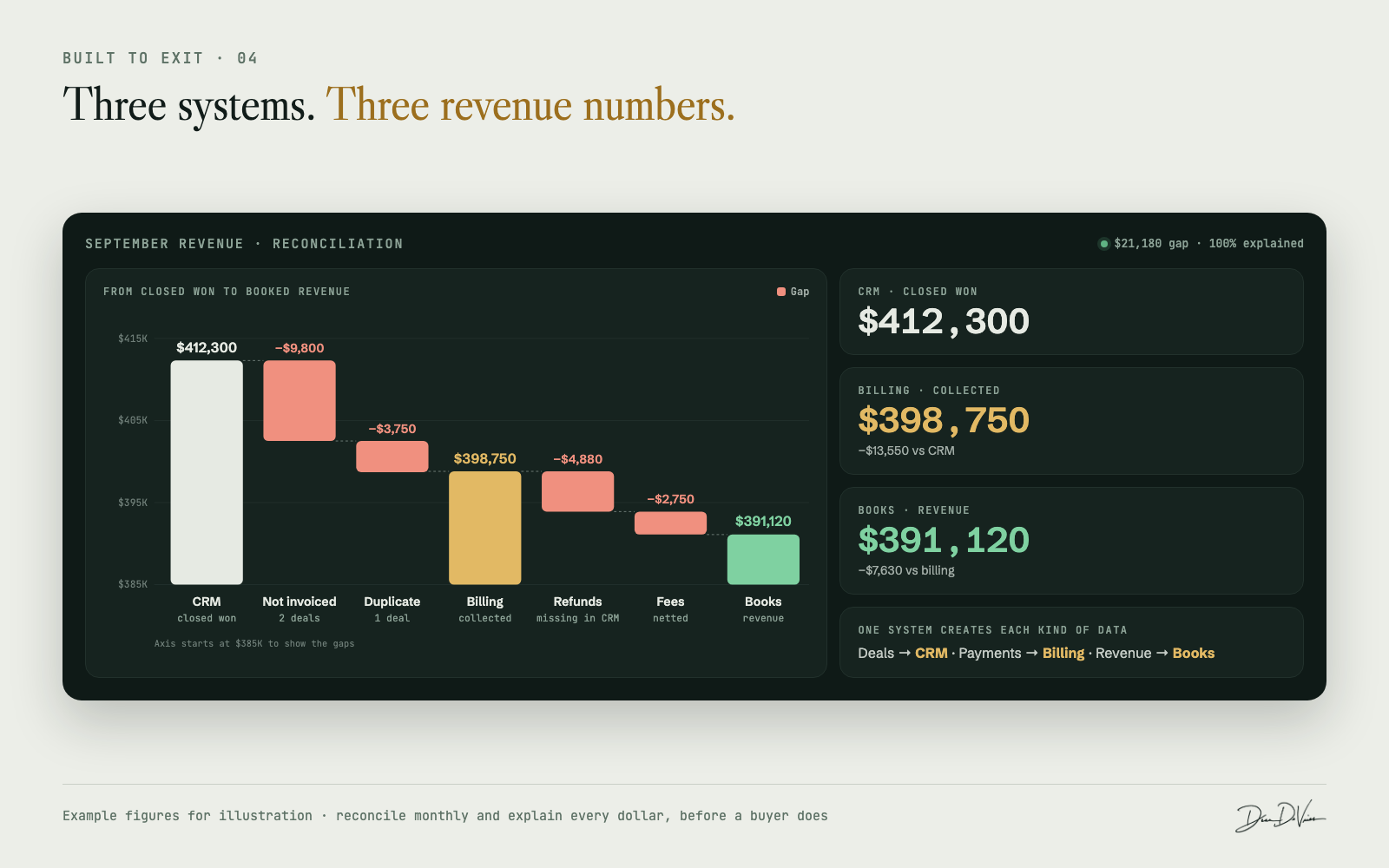
Ask your CRM, your billing system and your books what you made last month. If you get three different answers, you're not alone.


Here's what that costs, beyond the accounting. Every leadership meeting turns into a debate about whose number is right. The sales leader trusts the CRM. The controller trusts the books. You end up trusting your gut, and the team learns that numbers are negotiable.


The fix is a rule more than a tool: every kind of data gets exactly one system that creates it. Payments are born in billing. Deals are born in the CRM. Everything else reads from the owner. Then you reconcile once a month and explain every dollar of difference.


A buyer will do this reconciliation in diligence. It's better if you've already done it.


How many of your systems can create a "customer" today?

Profile picture
Dean DeVriesProfile picture@deandevries1·Oct 17

Your calendar is lying to you

Your calendar is lying to you


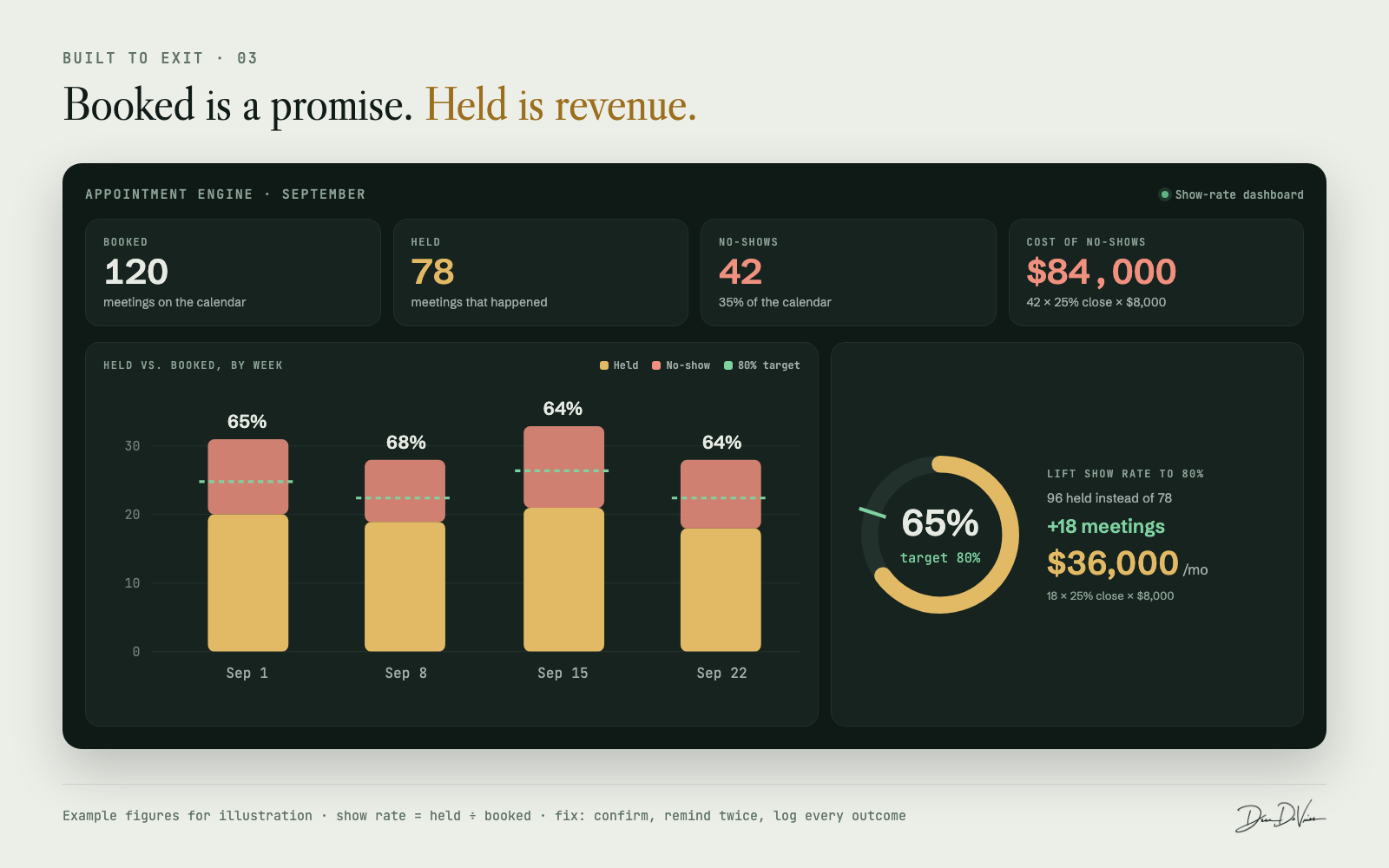
A full calendar feels like a healthy pipeline. Then a third of the meetings don't happen.


Booked meetings are a promise. Held meetings are revenue. If you only report the first number, you're managing a feeling.


The sheet in the graphic is the one formula I want every sales leader to know: held divided by booked. Then put a dollar figure on the gap, so the team sees what a no-show actually costs.


The fix is unglamorous and it works: a confirmation right after booking, a reminder the day before, another an hour before, and an easy way to reschedule instead of disappearing. Then log an outcome on every meeting within 24 hours.


What's your show rate this month? Held divided by booked. No rounding up.