EDUbasis

Amsterdam, NL
•Created byProfile pictureYuri
5 joined
Profile picture
YuriProfile picture@yurisneg·Jul 3

Every video you've ever watched maintains one illusion without exception — that it isn't a constructed object at all, just something happening in front of you.

Breaking that illusion, even once, produces one of the strongest reactions available to an editor — precisely because almost nothing else ever does it. It's the last pattern in the book for a reason: there's nowhere left to go after you acknowledge the format itself.

That's Pattern 50, Meta-Awareness — the closing mechanism in a book of 50. Free preview of the first one, free:
📖

Profile picture
YuriProfile picture@yurisneg·Jul 3

Cutting to the payoff the second it's ready is usually a mistake.

Holding it a few extra seconds — through a cutaway, a reaction, anything but the answer itself — makes the eventual release land harder, because anticipation itself carries reward value before the payoff even arrives. Most editors cut away from tension the instant they're allowed to. The ones who don't get a stronger reaction for it.

Pattern 18, Tension Before Release — one of 50 patterns broken down with the psychology, a case study, and a DaVinci workflow. Free preview:
📖

Profile picture
YuriProfile picture@yurisneg·Jul 3

The loudest moment in a lot of high-retention videos is total silence.

Cut the music and the ambience hard, right before a reveal, and the sudden quiet reads as more intense than anything you could have scored over it — because contrast, not volume, is what actually carries emphasis. Most editors reach for a bigger sound cue instead. It's usually the wrong move.

This is Pattern 13, Silence as Punctuation — one of 50 documented mechanisms behind why certain cuts hit and others don't. Free preview:
📖

Profile picture
YuriProfile picture@yurisneg·Jul 3

There's a shot early in some of the highest-retention videos ever made that means almost nothing on first viewing — and everything on the second.

It's called Chekhov's Cut: plant an unremarkable detail early, pay it off later, and the viewer's brain rewards the recognition with a stronger reaction than if you'd shown it for the first time at the payoff. Documentary editors have used it for decades. Almost nobody's written down why it works.

We did — along with 49 other mechanisms like it. Free preview:
📖

Profile picture
Lumivault @lumivault69·Jul 3

https://whop.com/lumivault-c637/turn-1-piece-of-content-into-30

Profile picture
YuriProfile picture@yurisneg·Jul 3

Your thumb decides in under half a second whether to keep scrolling.

That decision isn't made consciously — it's made by a part of your brain that only checks one thing: does this break the pattern of everything I've already seen today. Every thumbnail before yours already trained the viewer what "normal" looks like.

Pattern Interrupt is the first pattern in the book for exactly this reason — it's the one that has to work before anything else you do even gets seen.

50 patterns like this, each with the psychology, a real case study, and a DaVinci workflow. Free preview:
📖

Profile picture
YuriProfile picture@yurisneg·Jul 3

If you edit — for yourself or for clients — you already know the feeling of a cut that just works and one that doesn't, without being able to say why.

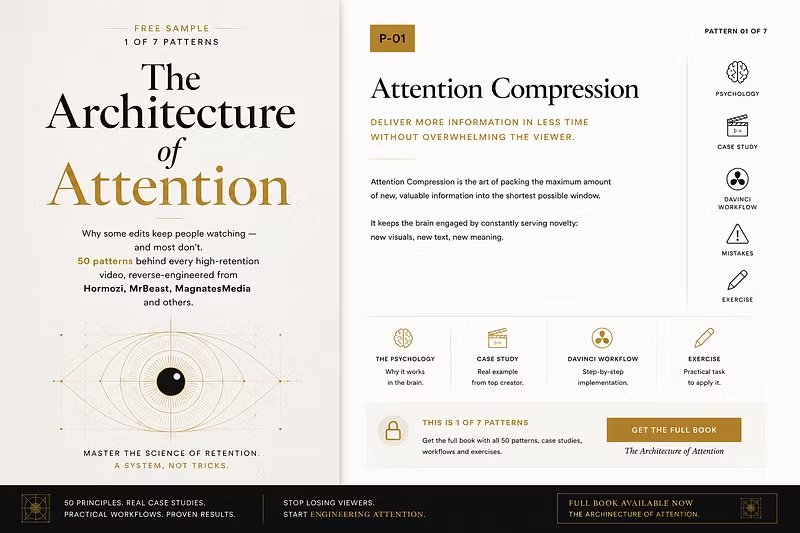
We spent months turning that instinct into 50 documented patterns: the psychology behind each one, a real case study from creators who use it, a DaVinci workflow to apply it, and an exercise to drill it.

This isn't a "10 new DaVinci tricks" post. It's the reasoning underneath every high-retention edit — and it doesn't expire when the software updates.

Free preview, first pattern in full:
👉

Profile picture
YuriProfile picture@yurisneg·Jul 3

"A specific, stated promise lowers the perceived risk of continuing to watch."
— Pattern 04, The Promise Frame

Four seconds into a video, your brain has already decided whether it's worth the rest of the runtime.

Most creators lose viewers right there — not because the content is bad, but because nothing told the viewer what they were about to get.

50 patterns like this. Free preview:

Profile picture
YuriProfile picture@yurisneg·Jul 3

Most editing content teaches you which button to press.

Nobody teaches you why a cut on the beat feels invisible, why silence right after a build hits harder than music, or why the same footage edited two ways gets completely different retention.

We broke down 50 of these mechanisms — the actual reasons edits work, not just the techniques — reverse-engineered from Hormozi, MrBeast, MagnatesMedia and others.

Free preview, no catch:
📖

Profile picture
YuriProfile picture@yurisneg·Jul 3

"One new piece of visual information can retroactively change the meaning of everything already watched."
— Pattern 26, The Twist Frame

A single shot, placed right, can rewrite everything that came before it in the viewer's mind — same footage, completely different meaning.

Most editors do this by instinct, if at all. There's an actual mechanism behind why it works, and once you see it, you start noticing every video that's using it — and every one that's leaving it on the table.

50 patterns like this, each with the psychology, a real case study, and a DaVinci workflow. Free preview:

Profile picture
YuriProfile picture@yurisneg·Jul 3

"The brain disengages when expected information arrives too slowly."
— Pattern 01, Information Density

This is the whole reason some edits hold you and others don't. Not talent. Not better footage. Just the rate at which new information arrives relative to what your brain is already predicting.

Hormozi's editors know this. So do MrBeast's. Most people trying to learn editing don't — because nobody's written it down as a mechanism before.

We reverse-engineered 50 of these from the editors who actually use them.

📖 Get the free preview: