Can I earn money through writing articles from this platform??
GeoPulse
2 joined
A
Amish Anand G @amishanand·Jun 12
@amishanand·Jun 121 vote
A
Amish Anand G@amishanand·Jun 8
@amishanand·Jun 8The Hidden Insect Empire: Inside Australia’s Record-Breaking 100,000-Cockroach Biosecurity Bust
In June 2026, Australian authorities announced a law-enforcement operation that sounded more like the punchline of a joke than a serious criminal investigation.
More than 100,000 illegal cockroaches had been seized from a secret breeding facility in New South Wales.
The story quickly spread across international media. To many readers, the headline seemed absurd. Why would governments devote significant resources to hunting down exotic insects?
For Australian biosecurity officials, however, this wasn't a quirky animal story.
It was an environmental emergency.
The operation uncovered what authorities described as the country's largest-ever seizure of illegal exotic invertebrates—a sophisticated breeding enterprise worth more than AUD $200,000 on the black market. Behind the strange headline lay a much bigger story about invasive species, wildlife trafficking, and the constant battle to protect one of Earth's most unique ecosystems.
---
The Discovery of a Hidden Empire
The raid took place near Bathurst, a regional city west of Sydney.
Acting on intelligence about illegal wildlife trafficking, biosecurity officers and police executed a search warrant on a residential property. What they found exceeded even their expectations.
Inside were thousands of breeding colonies housed in climate-controlled facilities designed for mass production. Investigators estimated that the total population exceeded 100,000 cockroaches, all belonging to species that are prohibited under Australian biosecurity laws.
This wasn't the collection of an eccentric hobbyist.
It was an industrial-scale operation.
The sheer number of insects revealed an organized business with established supply chains, interstate customers, and a steady revenue stream. Authorities immediately classified the seizure as a landmark victory in Australia's ongoing fight against illegal wildlife imports.
---
Why These Cockroaches Were So Valuable
The facility primarily bred two highly sought-after species:
Madagascar Hissing Cockroach
Native to the island of Madagascar, the Madagascar Hissing Cockroach (Gromphadorhina portentosa) is among the largest cockroach species in the world.
Unlike the household pests people associate with the word "cockroach," these insects are surprisingly impressive creatures. They are wingless, heavily armored, and capable of producing a distinctive hissing sound by forcing air through specialized breathing pores.
Because of their unusual appearance and relatively docile behavior, they have become popular exotic pets worldwide.
In Australia, however, owning them without proper authorization is illegal.
Dubia Cockroach
The second species, the Dubia Cockroach (Blaptica dubia), originates from Central and South America.
Its popularity comes from an entirely different market.
Dubia cockroaches are widely considered one of the best feeder insects for reptiles, amphibians, and large arachnids. Compared with crickets, they are quieter, easier to maintain, highly nutritious, and reproduce rapidly.
For reptile breeders, they are essentially the gold standard of live animal feed.
The Bathurst operation appears to have been supplying this underground market on a massive scale.
---
Why Australia Takes Bugs So Seriously
To outsiders, the intense response may seem excessive.
After all, they're just insects.
But Australia has learned a painful lesson over the last two centuries: small introductions can create enormous disasters.
Australia's biosecurity laws are among the strictest in the world because the continent's ecosystems evolved in relative isolation for tens of millions of years.
That isolation created extraordinary biodiversity.
It also created vulnerability.
Many Australian species evolved without exposure to the predators, competitors, diseases, and parasites commonly found elsewhere in the world. As a result, introduced species can spread rapidly and cause devastating ecological damage.
This is why Australia regulates the importation of living organisms so aggressively.
Every species must undergo extensive environmental risk assessments before it can legally enter the country.
Neither the Madagascar Hissing Cockroach nor the Dubia Cockroach has ever received approval for unrestricted importation.
---
History Explains the Fear
Australia's caution is not based on hypothetical scenarios.
It's based on experience.
The Rabbit Catastrophe
In 1859, European settler Thomas Austin released just 24 rabbits in Victoria for recreational hunting.
Within decades, those rabbits multiplied into hundreds of millions.
The animals stripped vegetation, accelerated soil erosion, damaged farmland, and pushed native species toward extinction.
What began as a seemingly harmless introduction became one of the world's most famous ecological disasters.
The Cane Toad Disaster
In 1935, authorities introduced cane toads to Queensland in an attempt to control agricultural pests.
The plan failed spectacularly.
The toads largely ignored the insects they were supposed to eliminate and instead spread across northern Australia. Their powerful toxins poisoned native predators, triggering widespread ecological disruption that continues today.
Feral Cats and Foxes
Perhaps the most destructive introductions of all were feral cats and red foxes.
These predators have contributed to the extinction of numerous native mammals and continue to kill millions of native animals every day.
For Australia, invasive species are not theoretical threats.
They are historical realities.
---
What Could Have Happened If They Escaped?
The seizure of 100,000 exotic cockroaches wasn't alarming because of what the insects were doing inside the facility.
It was alarming because of what they might have done outside it.
Ecological Competition
Australia is home to hundreds of native cockroach species that play important ecological roles.
Many act as decomposers, breaking down dead vegetation and recycling nutrients back into the soil.
An invasive cockroach species with no natural predators could potentially outcompete native insects for resources, disrupting local ecosystems and food webs.
Disease and Pathogens
Illegal breeding operations operate outside quarantine systems.
Exotic insects can carry bacteria, mites, fungi, and parasites that native wildlife has never encountered.
Introducing a new pathogen into an isolated ecosystem can have consequences far beyond the original host species.
Agricultural Risks
Australia's agricultural industry depends heavily on maintaining its reputation as a supplier of pest-free products.
The establishment of an invasive species can trigger export restrictions, quarantines, and costly control measures.
For a country that exports billions of dollars' worth of agricultural products each year, biosecurity failures can become economic disasters.
---
The Fate of 100,000 Cockroaches
Once authorities seized the insects, an uncomfortable question emerged:
What happens to them?
Unlike confiscated birds or reptiles, relocation wasn't a practical option.
No zoo could house 100,000 rapidly reproducing cockroaches.
Returning them to their native countries would be prohibitively expensive and biologically risky.
As a result, biosecurity protocols required complete eradication.
The insects were euthanized through approved containment procedures designed to ensure that no individuals, eggs, or parasites survived.
It may sound harsh, but officials considered it necessary to eliminate any possibility of accidental release.
---
The Bigger Picture
Authorities believe the Bathurst facility was not an isolated operation.
The scale of the breeding program suggests the existence of a broader underground market involving exotic pet collectors, reptile breeders, and wildlife traffickers.
Many smuggling operations rely on shipping insect eggs or juvenile specimens through postal networks, where their small size makes detection difficult.
Once inside the country, a handful of insects can quickly become thousands.
Law-enforcement agencies are increasingly monitoring online marketplaces, encrypted messaging platforms, and specialized hobbyist forums where these trades occur.
The goal is not merely to stop individual shipments but to dismantle entire trafficking networks.
---
Why This Story Matters
At first glance, Australia's 100,000-cockroach bust seems almost comical.
But beneath the bizarre headline lies an important lesson about conservation in an increasingly connected world.
Every day, people, goods, and living organisms move across borders at unprecedented speed. That connectivity brings enormous benefits, but it also creates opportunities for invasive species to travel far beyond their natural ranges.
For Australia, biosecurity isn't bureaucratic overreach.
It's environmental self-defense.
The seizure of 100,000 illegal cockroaches may never become as famous as the rabbit plague or the cane toad disaster. Yet it represents something equally important: a successful effort to prevent the next ecological crisis before it begins.
Sometimes protecting an ecosystem doesn't involve saving animals.
Sometimes it means stopping them from arriving in the first place.

A
Amish Anand G@amishanand·May 29
@amishanand·May 29Jonestown: How Blind Faith Led 918 People to Their Deaths
The Jonestown Massacre
The Anatomy of Cult Control, Fatal Delusion, and the Tragic Cost of Blind Faith
On the morning of November 19, 1978, an elderly woman named Hyacinth Thrash crawled out from beneath her bed inside a remote jungle settlement in Guyana.
For hours, she had hidden in silence, frozen by fear.
When she finally stepped outside into the humid tropical air, she encountered a sight almost impossible for the human mind to process.
Bodies.
Hundreds of them.
Men, women, and children lay motionless across the compound’s central clearing like abandoned mannequins. Some still held one another. Others collapsed beside metal cups. Parents lay over their children in their final instinct to protect them.
Just the evening before, a siren had echoed across the settlement.
Then came the familiar voice over the loudspeaker:
«“White Night. White Night. Everybody report to the pavilion.”»
For the residents of Jonestown, those words carried a terrifying meaning.
Within hours, more than 900 people would die.
Among them were over 300 children.
Until the September 11 attacks in 2001, Jonestown remained the largest single loss of American civilian life in a deliberate act outside natural disaster.
The tragedy raised one haunting question:
How does an entire community of ordinary people reach a point where they poison their own children — and then themselves?
The answer was not sudden madness.
It was years of manipulation, fear, isolation, emotional dependency, ideological control, and psychological conditioning orchestrated by one man:
Jim Jones.
---
The Making of Jim Jones
James Warren Jones was born in 1931 in rural Indiana during the Great Depression.
His childhood was marked by neglect, loneliness, and emotional instability. His father, a disabled World War I veteran, remained distant and chronically ill. His mother believed her son was destined for greatness and often treated him as someone extraordinary.
Young Jones grew up isolated from other children.
He became obsessed with two things:
Religion
Death
Neighbors remembered him holding mock funerals for dead animals and preaching sermons to imaginary congregations. Even as a child, he understood something powerful:
Religion could control people.
By the early 1950s, Jones had become a student pastor. Charismatic, theatrical, and emotionally intense, he quickly learned how to command attention from audiences desperate for hope.
He staged “faith healings,” claimed prophetic powers, and convinced followers he could cure diseases through divine intervention.
Many of the miracles were carefully orchestrated tricks involving planted assistants and fake medical evidence.
But to vulnerable people searching for meaning, Jones appeared miraculous.
In 1955, he founded a church in Indianapolis that would later become known as the Peoples Temple.
Unlike many churches in America at the time, the Peoples Temple openly embraced racial integration. Jones welcomed Black Americans into leadership positions during a period of severe segregation and racial tension.
This progressive image made him widely respected.
To many followers, Jim Jones did not initially appear dangerous.
He appeared revolutionary.
---
From Church Leader to Political Power Broker
During the 1960s, Jones became increasingly paranoid about nuclear war and societal collapse.
In 1965, after reading an article claiming northern California would be safer during a nuclear attack, he convinced many of his followers to relocate there.
The move transformed the Peoples Temple from a small religious movement into a rapidly expanding political organization.
By the 1970s, Jones had established major operations in San Francisco and Los Angeles.
Publicly, the church became known for:
Free food programs
Drug rehabilitation services
Housing for the elderly
Medical assistance for the poor
Politicians praised Jones as a humanitarian.
He built relationships with influential California officials and gained significant political leverage because he could mobilize thousands of loyal supporters almost instantly.
Behind closed doors, however, something darker was emerging.
Jones slowly abandoned Christianity itself.
He mocked the Bible during sermons and increasingly presented himself as the ultimate authority — greater than religion, government, or morality.
Members were pressured to surrender:
Homes
Savings
Welfare checks
Personal independence
Absolute loyalty became mandatory.
Public humiliation, emotional degradation, and physical punishments became common for anyone questioning Jones’s authority.
The Peoples Temple had evolved into something far more dangerous than a church.
It had become a system of total control.
---
The Escape to Guyana
By 1977, journalists and former members had begun exposing allegations against the Peoples Temple.
Reports described:
Physical abuse
Financial fraud
Forced confinement
Psychological manipulation
One investigation in particular terrified Jones.
A major exposé was preparing to publish detailed accusations about the organization.
Convinced the American government would destroy him, Jones activated a long-prepared contingency plan.
He relocated hundreds of followers to Guyana, a small socialist country in South America.
Deep within the jungle, the Peoples Temple established what Jones described as a utopian socialist paradise:
Jonestown.
Followers believed they were escaping racism, capitalism, fascism, and oppression.
Instead, they were walking into isolation.
---
The Reality of Jonestown
The promised paradise quickly deteriorated into a prison camp hidden in the jungle.
The land was agriculturally poor, making food production extremely difficult. Residents survived mainly on small portions of rice, beans, and watered-down soup.
Disease spread constantly.
The tropical climate, overcrowding, and malnutrition created endless outbreaks of fever and dysentery.
But the most powerful weapon in Jonestown was not physical suffering.
It was psychological control.
Isolation From the Outside World
Upon arrival, residents surrendered their passports and identification documents.
All mail was censored.
The only news available came through loudspeakers broadcasting Jim Jones’s voice for hours each day.
He claimed America had descended into fascism and racial genocide.
Followers were told there was nowhere safe to return.
Destruction of Family Identity
Jones systematically weakened traditional family bonds.
Children were separated from parents and raised communally.
Many were instructed to call Jones “Father” or “Dad.”
Loyalty to family was replaced with loyalty to the collective.
And ultimately, loyalty to Jones himself.
Punishment and Fear
Minor criticism could trigger severe punishment.
Residents endured:
Public shaming sessions
Beatings
Forced labor
Sleep deprivation
Solitary confinement
Children were psychologically terrorized for disobedience.
Fear became part of daily life.
Chemical Sedation
Anyone expressing depression, rebellion, or a desire to leave was often medicated heavily with tranquilizers and antipsychotic drugs.
Resistance itself became treated as illness.
---
The “White Nights”
In 1977, Jim Jones introduced a terrifying ritual called the “White Night.”
Whenever a siren sounded, residents were required to gather immediately at the central pavilion.
Jones would then describe an impending attack from enemies outside the settlement.
He insisted the community faced only a few possible outcomes:
Torture
Imprisonment
Fascist persecution
Or “revolutionary suicide”
To test loyalty, Jones staged fake mass suicide rehearsals.
Followers — including children — were ordered to drink liquid from cups.
After everyone consumed it, Jones announced they had supposedly ingested poison and would soon die.
People cried.
Parents held their children.
Some prayed.
Then, after prolonged panic, Jones revealed the poison was fake.
The exercise was psychological conditioning.
Each rehearsal slowly normalized the idea of dying on command.
---
Congressman Leo Ryan Arrives
By late 1978, pressure from families of former members forced the U.S. government to respond.
Congressman Leo Ryan traveled to Guyana with journalists and concerned relatives to investigate Jonestown personally.
At first, the settlement appeared calm.
Residents smiled.
Music played.
A celebratory dinner was organized.
Ryan initially remarked that many people seemed genuinely happy.
But beneath the performance, fear was spreading.
The next morning, a resident secretly slipped a note to a journalist:
«“Help us. We want to leave.”»
Soon, more residents stepped forward requesting escape.
For Jim Jones, this was catastrophic.
If defectors returned to America, the entire illusion surrounding Jonestown would collapse.
---
The Airstrip Ambush
On November 18, 1978, Congressman Ryan and several defectors departed for the nearby Port Kaituma airstrip.
Jones secretly dispatched armed loyalists to intercept them.
As the group prepared to board two planes, gunmen emerged from a tractor-trailer and opened fire.
Congressman Leo Ryan was killed.
Three journalists and one defector also died.
Several others were critically wounded.
It remains the only assassination of a sitting U.S. Congressman in American history.
Back in Jonestown, Jones understood the consequences immediately.
After the murder of a Congressman, there would be no negotiation.
No escape.
No survival.
He ordered the final White Night.
---
The Final Hours of Jonestown
Residents gathered beneath the pavilion for the last time.
A large vat filled with grape-flavored drink mix had been prepared using cyanide, sedatives, and poison.
Jones addressed the crowd through a microphone in what is now known as the “Jonestown Death Tape.”
He argued that American soldiers would soon arrive to torture their children and destroy the community.
Then came the horrifying order:
The children first.
Mothers and nurses used syringes to force poison into the mouths of infants and young children.
Witnesses described screams, convulsions, and panic spreading across the pavilion.
Some adults resisted.
One woman, Christine Miller, pleaded for the group to escape instead of dying.
She was shouted down by loyal followers.
Armed guards surrounded the pavilion carrying rifles, crossbows, and machetes.
The message was unmistakable:
There was no leaving alive.
As parents watched their children die, many surrendered psychologically.
One by one, they drank the poison.
Within minutes, cyanide shut down cellular respiration, causing suffocation from within the body itself.
The jungle eventually fell silent.
When authorities arrived days later, they discovered 918 dead.
Jim Jones was found on the pavilion stage with a gunshot wound to his head.
He had not drunk the poison himself.
---
The Legacy of Jonestown
Jonestown did not happen because hundreds of people were foolish or insane.
It happened because human beings can be manipulated gradually under the right conditions:
Isolation
Fear
Dependency
Charismatic authority
Information control
Emotional exhaustion
Many victims genuinely believed they were building a better world.
Others stayed because they feared losing family, identity, or purpose.
Some likely wanted to escape but no longer believed escape was possible.
Jonestown remains one of history’s darkest lessons about the dangers of blind faith and unchecked power.
It demonstrated how easily idealism can transform into fanaticism when one individual gains total control over truth itself.
Even decades later, the phrase “drinking the Kool-Aid” survives in popular culture as shorthand for unquestioning loyalty.
Yet the real story behind Jonestown is far more tragic than the phrase suggests.
It was not simply mass suicide.
It was the collapse of human freedom under systematic psychological domination.
And beneath the politics, ideology, and horror were hundreds of ordinary people who once believed they had found hope.

A
Amish Anand @amishanand·May 29
Great
A
Amish Anand G@amishanand·May 20
@amishanand·May 20The Edge of Existence: Why the Northern White Rhino Is Running Out of Time
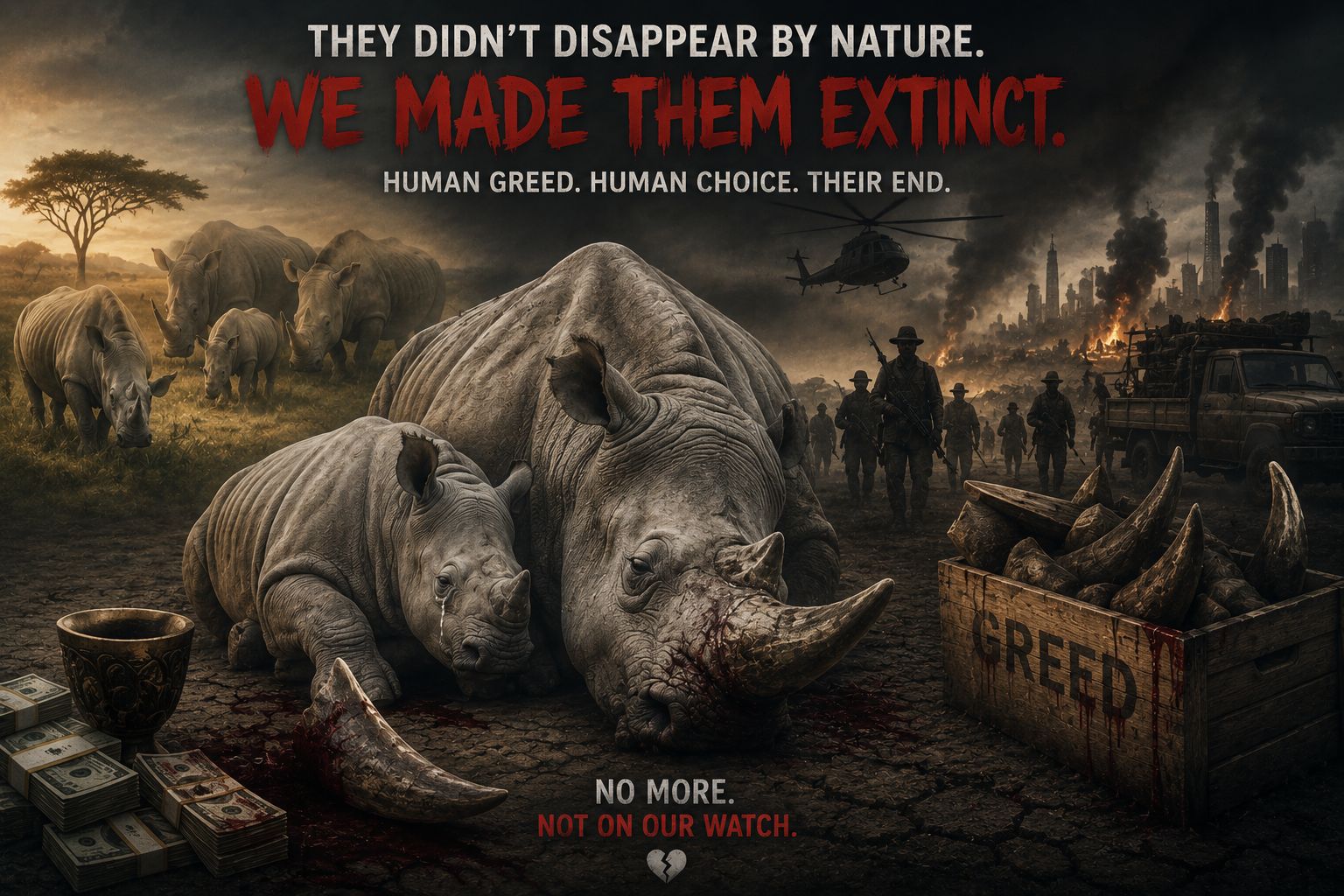
There are only two northern white rhinos left on Earth.
Not two hundred. Not twenty. Two.
A mother and daughter—Najin and Fatu—live under constant armed protection at Ol Pejeta Conservancy, carrying the final living trace of a subspecies that once roamed freely across Central and East Africa. Their survival marks one of the most tragic conservation failures of the modern age—but also one of science’s most ambitious rescue missions.
The northern white rhino (Ceratotherium simum cottoni) is now considered functionally extinct. Natural reproduction is no longer possible. Yet in laboratories across Europe and Africa, scientists are attempting something extraordinary: using advanced reproductive technology to bring this giant back from the edge.
This is the story of how humanity pushed an ancient species toward extinction—and how it may still have one final chance to survive.
---
A Collapse That Happened in a Lifetime
The northern white rhino’s disappearance did not unfold over centuries. It happened within decades.
In the 1960s, more than 2,000 northern white rhinos inhabited the grasslands and savannahs of countries including Chad, Central African Republic, Sudan, and the Democratic Republic of the Congo. They were among Africa’s dominant grazers, shaping ecosystems through their daily movements and feeding patterns.
Then came the poaching wave.
By the 1970s and 1980s, illegal hunting had devastated populations. Within just two decades, their numbers plummeted from thousands to only a few hundred. By the 1990s, only a tiny remnant remained.
There was a brief moment of hope in the early 2000s. Conservationists working in Garamba National Park managed to protect a fragile wild population of around 30 rhinos.
It didn’t last.
Civil conflict, militia activity, and renewed poaching erased that final wild refuge.
Today, not a single northern white rhino remains in the wild.
---
The Price of a Horn
The species was not driven toward extinction by climate change or disease.
It was killed for profit.
Rhino horn is made of keratin—the same material found in human hair and fingernails. Scientifically, it holds no proven medicinal value.
But myths, status, and illegal luxury markets turned it into one of the world’s most valuable black-market commodities.
At peak demand, rhino horn sold for as much as $30,000 per kilogram, sometimes even more. By weight, it rivaled or exceeded the value of gold, diamonds, and cocaine.
That price transformed poaching into an international criminal enterprise.
Organized networks equipped with military-grade weapons hunted rhinos relentlessly, often faster than conservation teams could protect them.
---
How Wealth and Tradition Fueled Demand
The Yemeni Dagger Trade
One of the earliest drivers of large-scale poaching came from North Yemen during the 1960s and 1970s.
As regional oil wealth increased, demand surged for jambia—traditional curved daggers worn as symbols of honor and status. The most prestigious jambia handles were carved from rhino horn, prized for their unique translucent sheen and aging patina.
A luxury market in one part of the world became a death sentence for rhinos in another.
The Asian Rhino Horn Market
Later, demand shifted toward China and Vietnam, where rhino horn was promoted in traditional medicine despite no scientific evidence supporting its effectiveness.
At the same time, wealthy buyers began purchasing whole horns and carved rhino horn objects as elite status symbols.
What had once been cultural demand evolved into industrial-scale wildlife trafficking.
---
When Conservation Meets Conflict
The northern white rhino’s closest relative—the southern white rhino (Ceratotherium simum simum)—offers a painful comparison.
While southern white rhinos, largely protected in South Africa, Namibia, and Zimbabwe, recovered to populations of over 16,000 individuals, northern white rhinos lived in politically unstable regions where conservation became nearly impossible.
Their final refuge, Garamba National Park, became trapped inside one of the world’s most volatile conflict zones.
Militant groups—including the Lord's Resistance Army—used rhino horn to fund their operations, trading it for weapons and supplies.
Park rangers were left fighting armed militias with limited resources.
Many lost their lives trying to defend the last rhinos.
Ultimately, the violence proved stronger than conservation efforts.
---
Sudan: The Last Male
On March 19, 2018, the world lost Sudan, the last male northern white rhino on Earth.
Sudan lived his final years at Ol Pejeta Conservancy, protected around the clock by armed guards.
He became a global symbol—not just of extinction, but of what human greed can destroy.
When age-related health complications forced veterinarians to euthanize him, the subspecies crossed a devastating threshold.
Without a living male, natural reproduction became impossible.
Only Najin, Sudan’s daughter, and Fatu, his granddaughter, remain.
Neither can carry a pregnancy.
For most species, that would be the end.
For the northern white rhino, it may be the beginning of a different kind of survival.
---
The IVF Rescue Mission
Scientists are now attempting one of the most ambitious conservation interventions ever undertaken.
The project, known as the BioRescue Initiative, is using advanced reproductive technology to create northern white rhino embryos.
The process is remarkably complex:
Harvesting Eggs
Veterinarians collect immature eggs from Fatu’s ovaries using highly specialized equipment designed specifically for rhino anatomy.
Laboratory Fertilization
The eggs are transported to a lab in Cremona, Italy, where scientists fertilize them using frozen sperm collected from deceased male northern white rhinos, including Sudan.
Embryo Preservation
Successful embryos are cryopreserved in liquid nitrogen.
Each embryo represents a potential future calf—and perhaps the future of the species.
Surrogate Mothers
Because Najin and Fatu cannot carry pregnancies, scientists plan to implant these embryos into southern white rhino females, whose biology is similar enough to act as surrogate mothers.
Recently, researchers achieved a major breakthrough: the world’s first successful rhino pregnancy through embryo transfer, proving the method can work.
The next step is transferring a true northern white rhino embryo.
If successful, it would mark one of conservation science’s greatest achievements.
---
Should We Bring Them Back?
The effort raises difficult ethical questions.
Should millions of dollars be spent saving one nearly lost subspecies when countless others are still declining?
Can a species revived through laboratory intervention truly return to the wild?
What happens if the habitats they once occupied remain unstable or unsafe?
Critics argue that technology cannot replace habitat protection.
Supporters counter that humanity has a moral obligation to repair damage it caused.
They also note that the scientific breakthroughs developed for the northern white rhino could help save other endangered species—from Sumatran rhinos to endangered elephants.
The northern white rhino may be a test case for the future of conservation itself.
---
A Species Frozen Between Loss and Hope
The northern white rhino stands at an extraordinary threshold.
Its natural future has ended.
Its scientific future is just beginning.
Najin and Fatu may be the last living members of their kind, but they are also symbols of resilience—living bridges between extinction and possibility.
The fate of their species now rests not in the wild, but in frozen embryos, surgical precision, and human determination.
The tragedy of the northern white rhino is a reminder of how quickly humanity can destroy what took millions of years to evolve.
But perhaps, just perhaps, it can also become proof that we are capable of trying to undo that damage.
The clock is ticking.
For the northern white rhino, hope now lives in a laboratory freezer—and in the hands of those refusing to let its story end.
S
Drique @sudasd·May 20
Get this Blueprint for a discounted price
35% OFF only for today.
First watch the video to understand well
https://whop.com/drique-sd/the-solo-ceo-blueprint/
A
Amish Anand G@amishanand·May 19
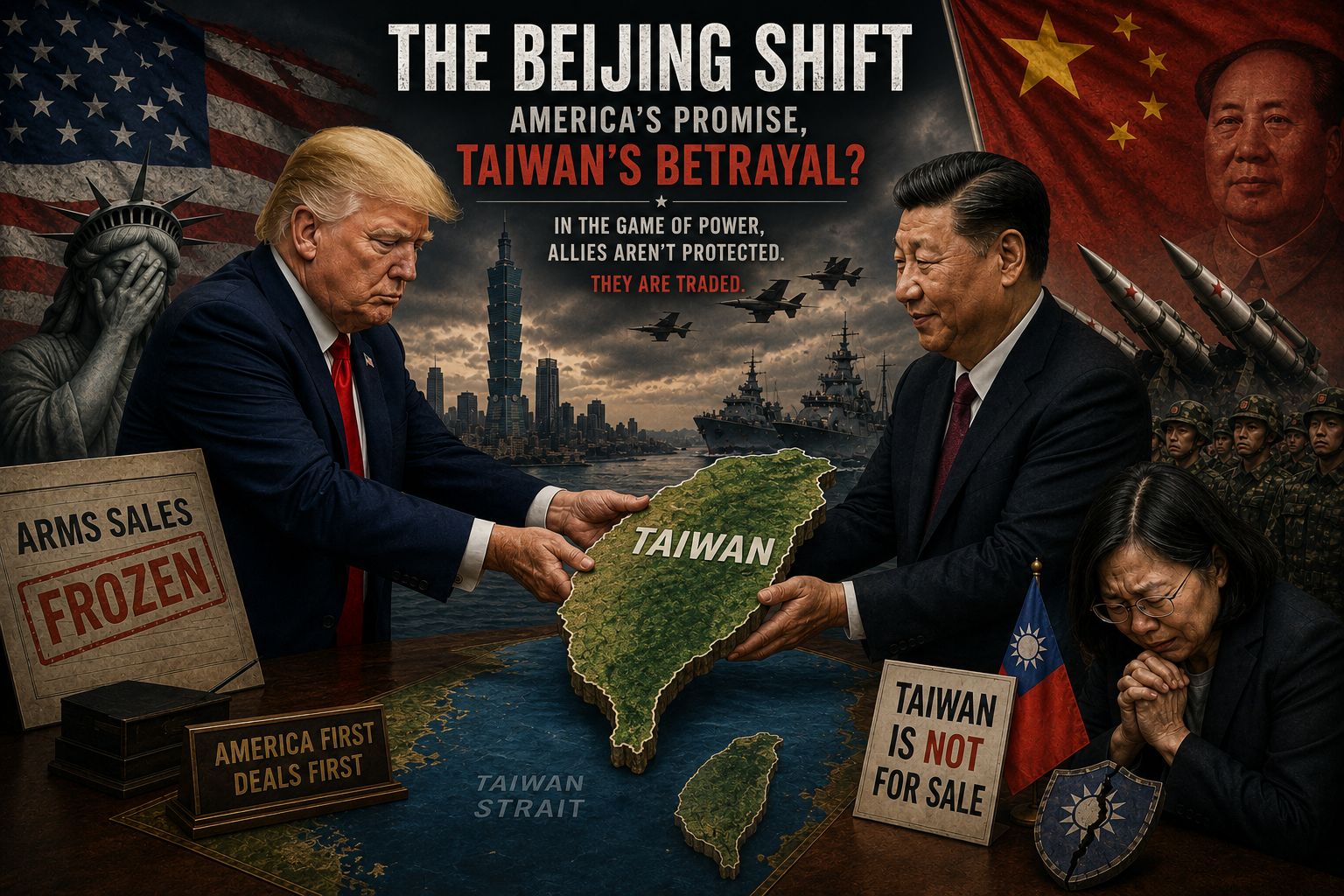
@amishanand·May 19Is America Surrendering Taiwan to China?
The Beijing Shift: How Donald Trump, Taiwan, and China Are Reshaping the Global Order
Why Taiwan May Be Entering Its Most Dangerous Era
For more than half a century, American foreign policy rested on a simple but powerful promise: allies could depend on Washington.
From the frozen plains of Europe to the tense waters of the Indo-Pacific, countries like Japan, India, Ukraine, and especially Taiwan built their security doctrines around the assumption that the United States would stand by them in moments of crisis.
Today, that assumption is being questioned.
Following a high-stakes summit in Beijing between former U.S. President Donald Trump and Chinese President Xi Jinping, Taiwan appears to have shifted—from strategic ally to geopolitical bargaining chip.
The implications are enormous.
And perhaps more disturbing than any policy shift is this growing realization: Taiwan may ultimately have to rely on itself alone for survival.
Some analysts now argue that Taiwan’s only guaranteed path to long-term security may be the one option it has avoided for decades—developing nuclear weapons.
Is that an extreme conclusion?
Perhaps.
But in a rapidly changing geopolitical order, extreme conclusions are increasingly becoming realistic scenarios.
---
The Beijing Summit That Changed Everything
Trump’s Strategic Reversal
Immediately after concluding talks with Xi Jinping, Donald Trump reportedly ordered a freeze on over $12 billion in previously approved arms sales to Taiwan.
For decades, American administrations—Republican and Democrat alike—treated military support for Taiwan as non-negotiable.
China objected. Washington ignored.
That was the balance.
Trump appears to have changed that equation.
Instead of viewing Taiwan’s defense as a strategic obligation, his administration reportedly began treating arms shipments as a negotiation tool—something to exchange for trade concessions or broader diplomatic gains from Beijing.
That is not merely a policy adjustment.
It is a fundamental rewriting of American credibility.
For Taipei, the message was chilling:
Your security may now be negotiable.
---
The Death of Reagan’s “Six Assurances”
The End of a 44-Year Strategic Promise
To understand why this shocked policymakers, we must go back to 1982.
Then-U.S. President Ronald Reagan issued what became known as the Six Assurances to Taiwan.
One of the most important guarantees was this:
The United States would never consult Beijing in advance about arms sales to Taiwan.
Why?
Because doing so would effectively give China veto power over Taiwan’s ability to defend itself.
For decades, this principle held.
But during Trump’s Beijing visit, reports suggest he openly discussed Taiwan-related military arrangements with Xi.
That may sound procedural.
It is not.
Strategically, it signals something profound:
Washington may no longer view Taiwan’s security as independent of Chinese approval.
For Taiwan, that changes everything.
---
Strategic Ambiguity Is Breaking Down
The Dangerous Weakening of Deterrence
For decades, peace in the Taiwan Strait was maintained through a carefully engineered policy called Strategic Ambiguity.
The idea was simple:
China never knew whether America would intervene militarily.
Taiwan never knew for certain either.
That uncertainty prevented both sides from acting recklessly.
Why It Worked
For China:
An invasion could trigger war with the world’s strongest military.
For Taiwan:
Declaring formal independence without guaranteed American support would be too risky.
This delicate balance kept peace.
But Trump’s recent public comments may have shattered that deterrent.
When asked whether the U.S. would defend Taiwan in the event of invasion, he reportedly emphasized how difficult it would be to defend an island “so far away.”
He also warned Taiwan against “yelling independence.”
For Beijing, that may sound like hesitation.
For Taipei, it sounds like abandonment.
And in geopolitics, perceived hesitation can invite aggression.
---
The Illusion of Trump’s Beijing Victory
Two Summits, Two Narratives
Trump returned from Beijing declaring major victories:
China would buy 750 Boeing aircraft
Massive purchases of American soybeans
Cooperation on Middle East stability
Joint pressure on Iran regarding the Strait of Hormuz
It sounded like a diplomatic triumph.
Then reality intervened.
Chinese state media and official statements quickly contradicted much of what Trump had announced.
Several promised agreements appeared exaggerated—or entirely absent.
The contrast was striking.
Trump celebrated.
Beijing stayed silent.
That asymmetry suggests a troubling possibility:
China may have extracted real strategic concessions while offering little in return.
And Taiwan may have been the price.
---
China’s Quiet Confidence
Why Beijing No Longer Needs America
One of the most revealing developments came in technology.
Despite Washington easing restrictions on advanced AI chip exports—particularly those from NVIDIA—Chinese firms signaled they may reduce dependence on American semiconductors.
That matters.
For years, U.S. export controls were viewed as strategic leverage.
China now appears determined to eliminate that leverage entirely.
Beijing is accelerating:
Domestic semiconductor development
Independent AI infrastructure
Reduced reliance on Western technology
Strategic economic decoupling
Xi’s long-term goal is clear:
Build a China that cannot be pressured.
And if China no longer fears American economic pressure, its willingness to act militarily may grow.
---
Why Taiwan Matters More Than Most People Realize
The Legacy of the Two Chinas
Taiwan’s origins lie in the unresolved aftermath of the Chinese Civil War.
In 1949, after defeat by communist forces led by Mao Zedong, nationalist leader Chiang Kai-shek fled to Taiwan and re-established the Republic of China (ROC).
Meanwhile, Mao founded the People’s Republic of China (PRC) on the mainland.
Both claimed legitimacy.
Only one gained global recognition.
Today, Taiwan is:
A functioning democracy
Home to 23 million people
One of the world’s largest economies
Militarily self-governing
Politically independent in practice
Yet diplomatically isolated.
Only a handful of countries officially recognize it.
China’s One China Principle ensures that.
---
The Strategy of Shi: China’s Invisible War
Winning Without Fighting
Chinese strategic thought often revolves around a concept called Shi (势).
There is no perfect English translation.
It roughly means:
Creating overwhelming strategic momentum so that resistance becomes futile.
This is how Beijing approaches Taiwan.
Not necessarily through immediate invasion.
But through gradual inevitability.
Economic Dependence
Taiwan’s economy is deeply tied to mainland China.
Billions in trade. Corporate investments. Supply chain integration.
Separation would be painful.
Political Influence
China’s United Front Work Department actively influences Taiwanese media, business groups, and political networks.
Its goal:
Shape public opinion toward acceptance of eventual reunification.
Psychological Pressure
Military drills. Airspace violations. Naval patrols.
These actions normalize fear.
The message:
Resistance is exhausting. Surrender is easier.
---
The Silicon Shield: Why the World Cannot Lose Taiwan
The Power of Taiwan Semiconductor Manufacturing Company
Taiwan’s greatest strategic asset is not its military.
It is silicon.
TSMC manufactures more than 90% of the world’s most advanced semiconductor chips.
Without them:
Apple iPhones stop shipping
AMD and NVIDIA AI systems slow dramatically
Cars, airplanes, and defense systems face shortages
Global technology markets collapse
Taiwan is not just an island.
It is a technological choke point.
This has created what analysts call the Silicon Shield—the belief that Taiwan’s semiconductor importance makes invasion too costly for everyone.
But is that enough?
Not necessarily.
China may eventually decide controlling that supply is worth the risk.
---
Taiwan’s Porcupine Strategy
Making Invasion Too Painful
Taiwan knows it cannot defeat China in conventional war.
Its answer is the Porcupine Defense.
The idea:
Become impossible to swallow.
Key elements include:
Mobile Missile Systems
Thousands of hidden anti-ship and anti-air missiles.
Naval Mines
Transforming the Taiwan Strait into a lethal obstacle.
Decentralized Resistance
Training local units for guerrilla warfare.
Taiwan’s message is simple:
You may conquer us—but it will cost you dearly.
---
The Nuclear Question: Taiwan’s Ultimate Survival Option?
Should Taiwan Build Nuclear Weapons?
This is the uncomfortable debate many experts avoid publicly.
But it deserves honest examination.
Taiwan once pursued nuclear capabilities.
It abandoned them under American pressure.
Today, circumstances are different.
America’s security guarantees appear less certain.
China’s military capabilities are stronger.
Time may be running out.
Why Nuclear Weapons Could Deter China
A Taiwanese nuclear arsenal could fundamentally change Beijing’s calculations.
China may tolerate conventional resistance.
It cannot ignore nuclear retaliation.
Even a small deterrent could make invasion politically impossible.
The Risks
However, nuclear development carries immense danger:
China may launch preemptive strikes
The U.S. may oppose it strongly
Regional arms races could follow
Japan and South Korea may reconsider their own nuclear positions
It could destabilize Asia.
But from Taiwan’s perspective, the question may be brutally simple:
If no one is guaranteed to save us, how do we guarantee our own survival?
For some strategists, the answer is increasingly obvious.
---
Why India Should Pay Attention
Taiwan Today, the Himalayas Tomorrow?
For many in India, Taiwan feels distant.
It should not.
If China successfully absorbs Taiwan without meaningful resistance, the global taboo against territorial expansion weakens dramatically.
That matters for India.
China already pressures India through:
Ladakh and Demchok
Continued military infrastructure near the Line of Actual Control.
Arunachal Pradesh
Persistent claims that the region is “South Tibet.”
Shaksgam Valley
Strategic expansion near the sensitive Siachen Glacier zone.
A victorious China emboldened by Taiwan could redirect greater focus toward the Himalayas.
India must understand:
Taiwan’s fate is not isolated.
It may be a preview.
---
The Age of Self-Reliance Has Begun
The Hard Lesson for Small Democracies
The Taiwan crisis reveals a harsh truth of modern geopolitics:
Security guarantees are only as reliable as the interests behind them.
Alliances matter.
But national survival cannot depend solely on them.
For Taiwan, that means:
Strengthening domestic defense
Expanding technological resilience
Hardening infrastructure
Preparing society for long-term resistance
Possibly reconsidering nuclear deterrence
For India, it means accelerating Aatmanirbharta in defense and semiconductor production.
For the world, it signals the end of predictable strategic order.
---
Final Thought: The Coming Reckoning
Taiwan now stands at the center of the world’s most dangerous geopolitical fault line.
Its choices will define not only its own future—but perhaps the future of Asia.
If Washington’s commitment is weakening…
If Beijing’s confidence is rising…
If deterrence is eroding…
Then Taiwan may soon confront the ultimate strategic question:
Can a democracy survive beside an authoritarian superpower without possessing the ultimate weapon?
History may soon provide the answer.
And the world may not like it.
S
SaiSai@sai789·May 19
If you're beginner clippers who wants to learn more about clipping while earning.
We have a free training course for you and you can start clipping and earning right away
We already prepared a campaign for you that have a $1.5cpm with $6500 budget and $2 cpm with $10,000 budget.
A
Amish Anand G@amishanand·May 17
@amishanand·May 17.
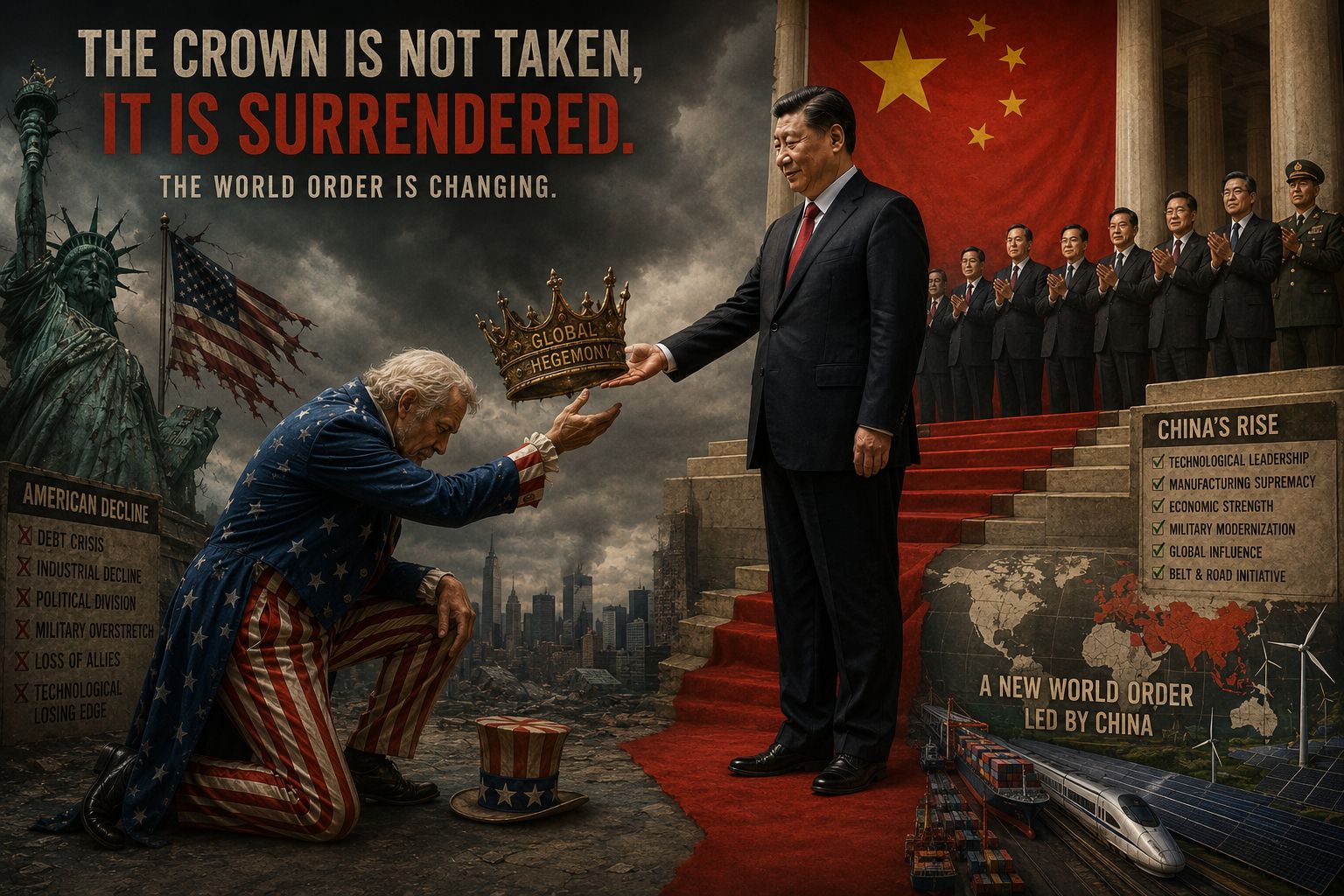
The Changing Global Order: Is America Surrendering Its Crown to China?
For more than half a century, the United States stood as the world’s unchallenged superpower—shaping global trade, technological innovation, and military alliances. But today, the geopolitical balance appears to be shifting. A growing body of evidence suggests that China is no longer merely rising—it is actively reshaping the international order.
Recent diplomatic developments, including high-profile meetings between Donald Trump and Xi Jinping, accompanied by some of America’s most influential business leaders, have fueled speculation that Washington may be negotiating from a position of increasing weakness rather than dominance.
While America still retains enormous power, the era of uncontested U.S. supremacy may be ending. The question is no longer whether China has become a peer competitor, but whether it is beginning to surpass America in critical domains.
China’s Technological Leap: From Imitator to Innovator
For decades, China was dismissed as the world’s factory—a nation known for cheap manufacturing and imitation. That perception is now outdated.
Patent Power and Innovation Dominance
China has emerged as a global innovation powerhouse, becoming the first nation to surpass 5 million active invention patents. More importantly, a majority of these patents are concentrated in strategic sectors such as:
Artificial Intelligence
Robotics
Green Energy
Advanced Manufacturing
In AI alone, China reportedly holds around 60% of global patent filings, signaling its ambition to dominate the technologies that will define the future.
Artificial Intelligence and Advanced Computing
China’s AI ecosystem is expanding rapidly.
More than 6,000 AI-focused companies operate across the country.
Its domestic AI industry is valued at over $75 billion.
Over 600 million Chinese citizens are using generative AI tools—more than the entire population of the United States.
Chinese startups are also challenging Western dominance in advanced AI, developing powerful models despite restrictions on access to high-end American chips.
Space, Quantum Computing, and Robotics
China is also pushing boundaries in frontier technologies:
Quantum Computing: Machines like Jiuzhang 504 place China among the global leaders in quantum research.
Satellite Technology: Chinese firms are achieving ultra-high-speed satellite communication breakthroughs.
Robotics: China now files two-thirds of the world’s robot patents, while companies like Unitree Robotics are leading in humanoid robot development.
America still leads in cutting-edge semiconductor design through companies like Nvidia and TSMC, but China’s massive research investment suggests this advantage may not last forever.
---
Military Modernization: Quietly Closing the Gap
Historically, U.S. global dominance has rested heavily on military superiority. China, however, has spent decades modernizing its armed forces with strategic patience.
Advanced Weapons and Strategic Deterrence
Recent military showcases have revealed an increasingly sophisticated Chinese arsenal, including:
Long-range intercontinental ballistic missiles (ICBMs)
Hypersonic anti-ship weapons
AI-powered stealth drones
Autonomous underwater military systems
China is also reportedly advancing rapidly in 6th-generation fighter jet development, an area where global powers are competing intensely.
America’s Strategic Vulnerabilities
Recent conflicts and prolonged military commitments have exposed strains on U.S. defense resources, including depleted missile stockpiles and supply chain vulnerabilities.
One critical weakness is America’s dependence on Chinese-controlled supply chains for strategic materials—particularly rare earth minerals, which are essential for advanced weapons systems.
---
The Economic Reality: Beyond Nominal GDP
The United States remains the world’s largest economy by nominal GDP, with roughly $30 trillion, compared to China’s $20 trillion.
But nominal numbers tell only part of the story.
Purchasing Power and Real Production
When measured by Purchasing Power Parity (PPP)—which reflects actual productive capacity—China has already overtaken the United States.
China (PPP GDP): ~$40 trillion
United States (PPP GDP): ~$30 trillion
China’s economic model is still deeply rooted in physical production, exports, and industrial scale.
Manufacturing Supremacy
China now accounts for approximately 30% of global manufacturing output, an extraordinary concentration of industrial power.
This dominance explains why even major American corporations remain heavily dependent on China:
Tesla’s Shanghai Gigafactory produces a large share of the company’s global vehicles.
Apple still relies on China for most of its iPhone assembly despite diversification efforts.
In manufacturing, supply chains, and industrial resilience, China holds a strategic advantage that few nations can challenge.
---
Rare Earths: China’s Quiet Strategic Weapon
One of Beijing’s strongest leverage points lies in rare earth processing, where it controls over 90% of global refining capacity.
These minerals are indispensable for:
Fighter jets
Missile systems
Electric vehicles
Renewable energy technologies
Consumer electronics
This gives China enormous geopolitical leverage, especially over nations trying to reduce dependence on its supply chains while still requiring its resources.
---
Diplomacy and Global Influence
China’s rise is not just technological or economic—it is diplomatic.
The Belt and Road Strategy
Through its Belt and Road Initiative (BRI), China has built economic and political influence across more than 150 countries, funding infrastructure, ports, railways, and energy projects throughout Asia, Africa, and Latin America.
America’s Diplomatic Challenges
At the same time, the U.S. has faced growing tensions with traditional allies and increasing skepticism about its long-term strategic consistency.
As Washington’s diplomacy becomes more unpredictable, many nations are choosing a pragmatic approach—maintaining ties with the United States while deepening economic engagement with China.
---
Conclusion: A New Multipolar Era
Has America officially surrendered its global crown? Not yet.
The United States still possesses major advantages:
The world’s strongest alliance network
Military reach across multiple continents
The dominance of the U.S. dollar
Leadership in foundational software and higher education
Greater political freedoms and institutional resilience
But the momentum is clearly shifting.
China has transformed itself from a developing nation into a global technological, industrial, and geopolitical powerhouse in just four decades. It dominates manufacturing, leads in critical technologies, and increasingly shapes the rules of international engagement.
The age of unipolar American dominance may be ending. What emerges next is likely a multipolar world, where Washington no longer writes the rules alone—and Beijing plays an equally powerful role in defining the future of global order.
A
Amish Anand @amishanand·May 17
Great
A
Amish Anand G@amishanand·May 11
@amishanand·May 11The Tragic Evolution of Light: Why Fireflies Are Quietly Disappearing from Our World
When was the last time you saw a firefly?
For many people born before the 2000s, the answer may bring back a vivid childhood
memory—warm summer evenings, dark open fields, and tiny living lanterns flickering in the
air like fallen stars. Fireflies were more than insects; they were symbols of wonder,
romance, and magic.
But for an entire generation growing up today, fireflies may become something they only
encounter in photographs, animated movies, or old stories told by their parents.
Their disappearance is not simply a case of declining insect populations. It is something far
more tragic: a story of an extraordinary species whose entire evolutionary design depends
on light—and whose ancient language is being drowned out by the modern world.
What appears to us as a beautiful nighttime spectacle is, in reality, a desperate biological
drama. Every flash carries urgency. Every glow is a signal sent against time. Every
illuminated moment represents a final attempt to survive through reproduction.
And humanity may be unintentionally silencing that signal forever.
The Language of Living Light
Fireflies communicate through one of nature’s most astonishing abilities:
bioluminescence.
Unlike ordinary light, bioluminescence is produced by chemical reactions inside living
organisms. In fireflies, this glowing light is generated with remarkable efficiency—almost no energy is wasted as heat. It is often called “cold light,” one of the most elegant biological
innovations evolution has ever produced.
But this glow is not decorative.
It is language.
Each species of firefly has its own unique flashing pattern—a coded message used
primarily to find a mate.
At night, male fireflies rise into the darkness, flying slowly through fields and forests,
blinking rhythmic signals into the air. They are searching for females hidden below, waiting
in the grass or perched on leaves.
The females respond with carefully timed flashes.
A conversation begins.
To human eyes, it looks poetic—tiny stars communicating in silence.
For the fireflies, it is a life-or-death exchange.
If the male does not see the female’s response, he moves on.
If the female’s signal goes unnoticed, her chance to reproduce may vanish.
Every flash matters. Evolution Built Entire Lives Around This Moment
What makes the firefly’s story especially tragic is how much they have sacrificed for this
one glowing ritual.
Their entire biology has been shaped around reproduction.
And evolution has demanded extraordinary compromises.
The Female Who Gave Up Flight
Female fireflies cannot fly.
Unlike their winged male counterparts, many female fireflies remain grounded for their
entire adult lives. Over thousands of generations, they evolved to lose their wings—or never
develop them fully.
Why?
Because wings require energy.
Muscles require energy.
Flight requires energy. Evolution decided that for female fireflies, that energy would be better spent elsewhere:
producing eggs.
By sacrificing flight, females can allocate more biological resources toward reproduction,
increasing the chances that their genes will continue.
It is a profound evolutionary bargain.
Freedom was traded for fertility.
Mobility was exchanged for motherhood.
The female firefly waits in darkness, unable to search for a mate herself, entirely dependent
on her light being seen.
She can only glow and hope.
The Male Who Sacrificed the Ability to Eat
If the female’s sacrifice is dramatic, the male’s may be even more extreme.
A firefly spends most of its life underground.
For nearly two years, it exists as a larva, living in soil, hunting small prey, and storing energy
as fat.
This larval phase is long and practical. It eats.
It grows.
It prepares.
Then, after years of hidden development, it transforms into the glowing adult we recognize.
And in doing so, something astonishing happens.
It loses its mouth.
It loses its digestive system.
The adult male firefly cannot eat.
Not at all.
Its entire feeding apparatus disappears because evolution no longer considers food
important.
Once adulthood begins, there is only one remaining mission:
Find a mate. The energy stored during those two larval years becomes the only fuel for its final journey.
The clock starts ticking immediately.
A Life Measured in Days
Adult male fireflies typically live only 7 to 21 days.
That is all.
A few brief weeks to complete the single task their entire existence has been preparing for.
They cannot stop to eat.
They cannot replenish their strength.
Every flight burns precious energy.
Every flash drains limited reserves.
Every night without success brings them closer to death.
Imagine spending two years preparing for an exam, only to be given a single week to pass it.
That is the firefly’s life. A race against starvation.
A countdown toward extinction.
And now, even this final chance is being stolen.
How Humans Are Breaking Their Ancient Language
For millions of years, fireflies evolved under predictable darkness.
Night was truly dark.
Their glowing signals stood out clearly.
Communication worked.
Reproduction happened.
The cycle continued.
Then humans changed the night.
Streetlights.
Billboards. Car headlights.
Apartment towers.
LED screens.
Floodlights.
Cities now produce so much artificial illumination that scientists call it light pollution—a
growing environmental problem often ignored because it seems harmless.
But for fireflies, it is catastrophic.
Their light is subtle.
Soft.
Delicate.
It was designed for darkness.
Against the overwhelming brightness of modern human civilization, their glow becomes
invisible.
A female may flash her signal from the grass.
The male never sees it. A male may search endlessly through illuminated streets and suburban gardens.
Every artificial light becomes a false beacon.
Every electric bulb becomes noise.
Their conversation is interrupted.
Their language is scrambled.
Their reproduction fails.
The female sacrificed her wings for a signal that can no longer be heard.
The male sacrificed his ability to eat for a mission he can no longer complete.
Evolution prepared them perfectly for a world that no longer exists.
The Cruel Irony of Progress
Human development often celebrates illumination.
We associate bright cities with advancement, safety, and prosperity.
Darkness is treated as something to eliminate. Yet in doing so, we may be erasing entire forms of life.
The firefly’s disappearance reveals a painful truth:
Not all environmental destruction is dramatic.
Sometimes extinction happens quietly.
No explosions.
No headlines.
No visible catastrophe.
Just fewer flashes each summer.
Then fewer still.
Until one day, the night is simply empty.
And no one notices what has been lost.
More Than Just Fireflies
The decline of fireflies is not an isolated event. It is part of a broader global insect collapse.
Habitat destruction, pesticides, climate change, and pollution are all contributing to rapid
biodiversity loss.
But fireflies feel different.
Perhaps because they glow.
Perhaps because their disappearance is visible.
Or perhaps because they remind us of something deeply human: the need to be seen.
Their light is a message.
A plea.
An attempt to connect in darkness.
And our own lights are drowning it out.
Can We Bring Back the Darkness?
The good news is that fireflies can recover—if we choose to help. Unlike some environmental problems, light pollution can be reduced almost immediately.
Simple actions can make a difference:
Turn off unnecessary outdoor lights.
Use warm-colored, low-intensity bulbs.
Install motion sensors instead of constant lighting.
Protect natural habitats like wetlands and forests.
Avoid pesticide use in gardens and parks.
Most importantly, allow parts of the night to remain dark.
Darkness is not emptiness.
Darkness is habitat.
Darkness is communication.
Darkness is survival.
A Final Flash The next time you think about fireflies, don’t imagine them merely as symbols of romance
or childhood nostalgia.
Think of what each flash represents.
A female waiting, unable to move, trusting her signal will be seen.
A starving male, spending the last energy of his life searching through artificial stars.
A species that gave everything—wings, food, time—for one final chance to reproduce.
And a world becoming too bright for their light to matter.
Perhaps the tragedy of the firefly is not just that they are disappearing.
Perhaps it is that they are disappearing while still trying to speak.
Still flashing.
Still calling.
Still hoping someone can see them.
Before the night goes completely silent.

A
Amish Anand G@amishanand·May 11
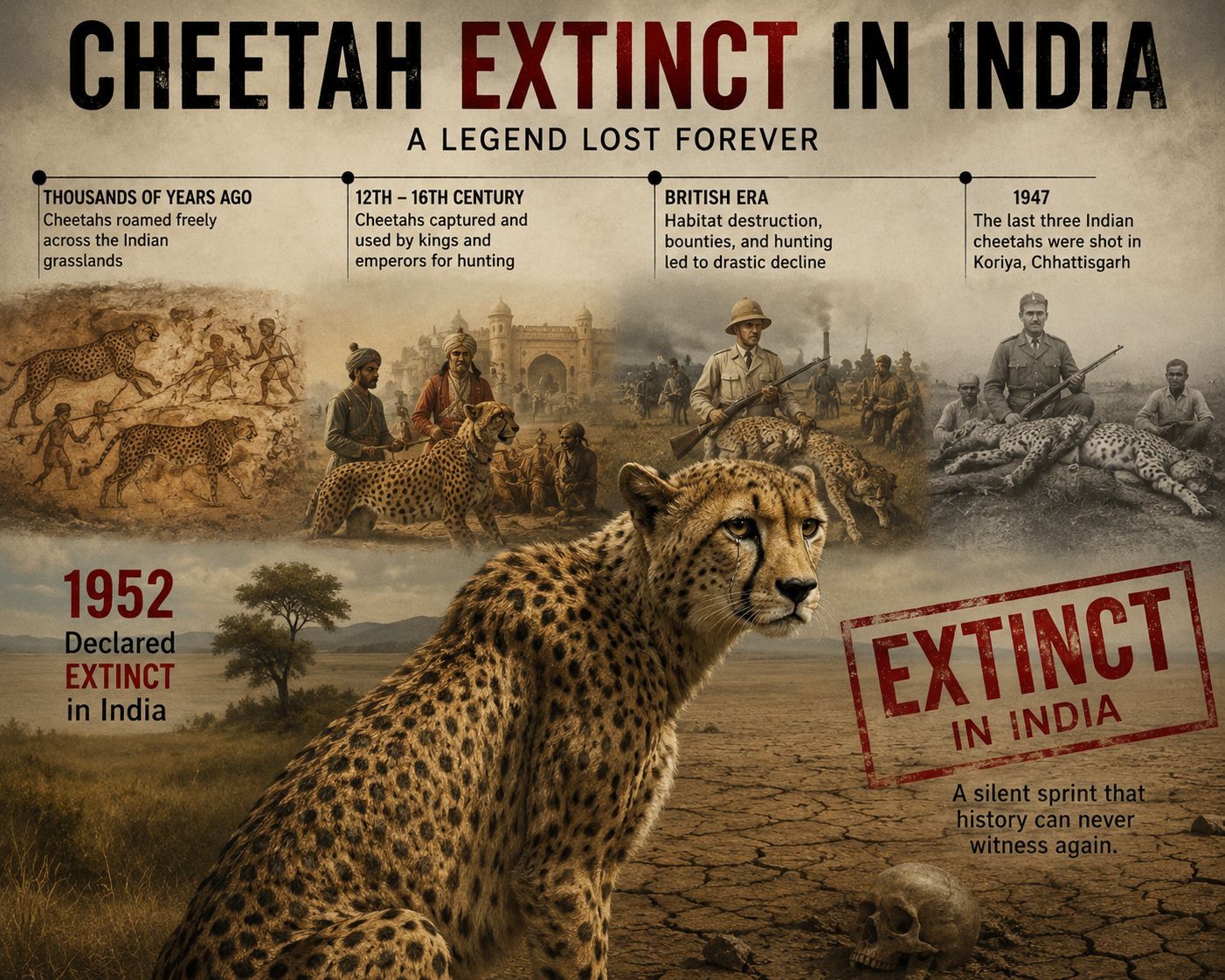
@amishanand·May 11The Silent sprint: tragic death of cheetah in India.
How India Lost Its Fastest Predator—and What Its Disappearance Reveals About Human
Ambition, Ecological Neglect, and the Cost of Progress
There was a time when the grasslands of India trembled under the swift footsteps of a predator
unlike any other.
Long before the roar of engines and the crack of rifles echoed across the subcontinent, another
sound ruled the open plains: the near-silent sprint of the cheetah.
It moved like lightning.
Not with the brute power of the tiger. Not with the regal dominance of the lion.
But with speed.
Pure, breathtaking speed.
For thousands of years, the Indian cheetah was a symbol of elegance and efficiency—an apex
hunter perfectly designed by evolution to chase down prey across India’s vast grasslands.
And then, it vanished.
Not because of a natural disaster. Not because of climate collapse.
But because humans slowly erased it.
The extinction of the Indian cheetah is not merely a story about a lost species. It is a story about
how civilization can destroy what it admires. It is about kings who turned predators into pets,
colonizers who transformed ecosystems into commodities, and governments that sanctioned
extermination in the name of safety and progress.
It is one of India’s greatest ecological tragedies.
And perhaps one of its most important lessons.
---
Chapter 1: When the Cheetah Belonged to India
Most Indians today associate cheetahs with Africa. The golden savannah. The acacia trees. The endless documentaries narrated in calm British
voices.
Few realize that for millennia, India was also a cheetah land.
The Asiatic cheetah (Acinonyx jubatus venaticus) once roamed widely across the Indian
subcontinent—from Rajasthan’s dry plains to the grasslands of Madhya Pradesh, from the
Deccan plateau to parts of modern-day Chhattisgarh.
Archaeological evidence confirms their ancient presence.
Cave paintings discovered in Khairabad and parts of the Chambal Valley, some dating back
nearly 4,500 years, depict spotted cats with unmistakable cheetah-like features.
These are not accidental drawings.
They are proof.
Proof that humans and cheetahs shared this landscape long before kingdoms rose and empires
fell.
The cheetah was not an outsider.
It was native. It belonged.
India’s open forests and grasslands once provided ideal habitat:
Vast hunting grounds
Abundant prey like blackbuck and chinkara
Minimal competition compared to dense tiger territories
Unlike the stealthy tiger hiding in forests, the cheetah was a creature of openness.
It needed space.
It needed visibility.
It needed freedom.
And for centuries, India gave it exactly that.
Until humans decided to control it. Chapter 2: From Apex Predator to Royal Accessory
The Indian cheetah’s downfall began not with hatred.
But with admiration.
Unlike lions or tigers, cheetahs possess a surprisingly calm temperament.
They are shy. Less aggressive. Easier to tame.
Indian rulers quickly recognized this.
Rather than fearing the cheetah, they captured it.
And turned it into a hunting tool.
This practice was known as coursing.
In coursing, trained cheetahs were transported to hunting grounds, blindfolded and restrained.
Once prey—usually blackbuck or deer—was spotted, the blindfold was removed.
Then came the sprint.
The cheetah would explode into motion.
Within seconds, the prey was caught.
The spectators applauded.
Royal entertainment was complete.
The earliest known documentation of this practice appears in the 12th century, under King
Someshwara III of the Chalukya dynasty.
But what began as occasional royal sport soon evolved into an obsession.
---
Chapter 3: Akbar’s Thousand Captives
No one institutionalized cheetah captivity more aggressively than Akbar.
The Mughal emperor was fascinated by cheetahs.
Historical accounts suggest that at any given time, Akbar maintained around 1,000 cheetahs in
his royal menagerie. Across his 49-year reign, more than 9,000 cheetahs may have passed through imperial hands.
Think about that.
Nine thousand wild predators removed from nature.
Not for survival.
Not for conservation.
For sport.
Every single cheetah had to be captured from the wild.
And this is where biology turned against the species.
---
Chapter 4: The Biological Trap
Unlike many captive animals, cheetahs rarely breed successfully in confinement.
Even today, modern zoos struggle.
Stress affects fertility. Social dynamics are complex. Cub survival is low.
Centuries ago, royal stables had no understanding of conservation biology.
They only knew one thing:
When one cheetah died, another had to be captured.
Again. And again. And again.
This created a devastating extraction cycle.
Healthy adult cheetahs—the very animals needed to sustain wild populations—were
systematically removed.
Breeding pools shrank.
Genetic diversity collapsed.
Population recovery became impossible.
It was ecological slow bleeding. Invisible at first.
Fatal in the end.
The Mughal emperors probably never intended extinction.
But intention matters little when impact is irreversible.
---
Chapter 5: A Landscape Begins to Change
Even if royal hunting had stopped, the cheetah might still have survived.
But another enemy was emerging.
Empire.
When the British Raj consolidated control over India, ecological priorities changed dramatically.
Land was no longer viewed as habitat.
It became economic machinery.
Grasslands—often dismissed as “wastelands”—were converted into farmland.
Massive areas were cleared for:
Indigo plantations
Opium cultivation
Commercial agriculture
Expanding settlements
Railway infrastructure
For humans, this meant prosperity.
For cheetahs, it meant homelessness.
Grasslands are among the world’s most misunderstood ecosystems.
People often assume forests are the only “valuable” natural spaces. But cheetahs do not thrive in dense forests.
They need open horizons.
As India’s grasslands disappeared, so did the prey species that sustained cheetahs.
Blackbuck populations declined.
Chinkara numbers fell.
The food chain fractured.
And then came the final blow.
---
Chapter 6: Declared an Enemy
In 1880, a dramatic event changed the cheetah’s fate forever.
A captive cheetah reportedly killed a British official in Visakhapatnam.
The colonial administration reacted predictably.
Fear turned into policy.
The cheetah was labeled a dangerous beast.
Government bounties were announced.
Money for every dead cheetah.
What followed was slaughter.
Farmers. Hunters. Opportunists.
Anyone could profit.
The same animal once treasured by kings was now treated as vermin.
A pest.
A threat.
An inconvenience. This transformation—from admired hunter to extermination target—sealed the cheetah’s destiny.
---
Chapter 7: The Ghost Years
By the early 20th century, wild cheetahs in India had nearly disappeared.
Sightings became rare.
Tracks vanished.
Silence spread across former hunting grounds.
Ironically, India’s elites still wanted cheetahs.
But now they had a problem.
There were none left to capture.
So they began importing them.
From Africa.
States such as Bhavnagar and Kolhapur imported African cheetahs between 1918 and 1939.
It was perhaps the first large-scale carnivore translocation effort in history.
But it was not conservation.
It was nostalgia.
An attempt to preserve a royal tradition long after the original species had vanished.
The imported animals were substitutes.
Living reminders of what India had already lost.
India’s Modern Cheetah Reintroduction Experiment: Can a Lost Predator Truly Return?
In 2022, India launched one of the most ambitious wildlife restoration projects in modern
history:
Project Cheetah.
Its goal was extraordinary: To bring cheetahs back to India after 70 years of extinction.
Not by rediscovering hidden survivors.
Not by cloning extinct animals.
But by importing African cheetahs and attempting to rebuild a living, breeding population in
Indian grasslands.
---
Why African cheetahs, not Asiatic cheetahs?
India’s original cheetah was the Asiatic cheetah (Acinonyx jubatus venaticus).
Unfortunately, that subspecies is now critically endangered, with only a tiny population
surviving in Iran.
Using them for reintroduction was not possible.
So India chose the African cheetah, the closest living relative.
Scientists argued that although they are not identical, African cheetahs could still restore the
ecological role once played by their extinct Indian cousins.
This sparked debate.
Some conservationists called it ecological restoration.
Others called it “species substitution.”
---
The First Arrival: September 2022
The world watched as eight cheetahs from Namibia landed in India and were released into Kuno
National Park.
It was historic for two reasons:
First cheetahs in India since extinction
First-ever intercontinental translocation of a large wild carnivore
Later, more cheetahs arrived from South Africa and Botswana, expanding the founder
population. Why Kuno National Park?
Kuno was chosen because it offers:
Open woodland and grassland habitat
Adequate prey such as chital and blackbuck
Protected territory
Existing conservation infrastructure
It had originally been prepared decades ago for relocating Asiatic lion, making it ready for
another big-cat experiment.
---
Early Challenges: Deaths and Criticism
The project did not begin smoothly.
Several cheetahs died in the first years.
Causes included:
Kidney disease
Heat stress
Parasite infections
Collar-related skin injuries
Adaptation difficulties
Critics quickly questioned whether India’s environment was suitable. Some argued that grassland
size and prey availability were insufficient.
The deaths triggered intense public debate:
Was Project Cheetah conservation… or symbolism? Signs of Success: Cubs Born in India
Then came hope.
Female cheetahs began giving birth.
And not just once.
By early 2026, India’s cheetah population had grown significantly through successful breeding.
Reports indicate multiple litters and the first wild birth by an India-born cheetah, a major
milestone toward creating a self-sustaining population.
Recent reports suggest the population may now have reached more than 50 individuals, including
many cubs.
That changes everything.
Birth means adaptation.
Birth means survival.
Birth means the experiment may actually work.
---
Expansion Beyond Kuno
India is now planning additional cheetah landscapes.
New efforts include:
Gandhi Sagar Wildlife Sanctuary as a second major release site
New cheetah-related initiatives in Karnataka
Proposed habitat corridors in Gujarat
The long-term vision is not a single park.
It is a network.
A future where cheetahs once again belong to India.
---
The Ethical Questions Project Cheetah remains controversial.
Important questions remain:
Is this true restoration?
These are African cheetahs, not the extinct Asiatic population.
Can replacing one with the other truly heal ecological loss?
---
Can people and cheetahs coexist?
Some nearby villagers report livestock losses and frustration over compensation. Conservation
success must include local communities—not just wildlife.
---
Is habitat enough?
India’s grasslands are still shrinking.
Without protecting landscapes, releasing animals may not be enough.
---
A Chance at Redemption
The extinction of the Indian cheetah was caused by humans.
Its return is also being attempted by humans.
That makes this project more than science.
It is a moral test.
Can a nation undo part of its ecological past?
Can extinction ever be partially reversed?
No one knows yet.
But for the first time in seventy years, somewhere in the grasslands of Madhya Pradesh, a spotted
cat is running again. And that alone feels historic.
A
Amish Anand G@amishanand·May 10
@amishanand·May 10The Majestic Sentinels of India: A Journey Through the State Animals That Define a Nation
India is often celebrated for its ancient civilizations, vibrant cultures, and breathtaking landscapes. Yet one of its greatest treasures lies beyond its monuments and traditions—in its extraordinary biodiversity. From the frozen heights of the Himalayas to the lush rainforests of the Western Ghats, India is home to an astonishing variety of wildlife, each species playing a vital role in the country’s ecological balance.
To honor this natural wealth, every Indian state and union territory has adopted an official State Animal—a living emblem that reflects the spirit, geography, and ecological identity of its homeland.
Much like the Royal Bengal Tiger, India’s national animal, symbolizes the nation’s strength and pride, these state animals represent regional ecosystems and remind citizens of their responsibility to protect the wild spaces they inhabit.
This journey across India’s state animals is more than a catalog of species—it is a journey through the soul of the nation itself.
---
Why State Animals Matter
State animals are not chosen randomly. They often represent:
Ecological uniqueness of the region
Cultural or spiritual significance to local communities
Conservation priorities, especially for endangered species
Regional pride and identity
By recognizing these animals, states create awareness about biodiversity and inspire conservation efforts.
Each animal tells a story—not just of survival, but of adaptation, resilience, and coexistence with humanity.
---
Guardians of the Himalayas: The Wild Spirits of the North
The northern reaches of India are among the harshest habitats on Earth. Towering mountains, icy winds, and rugged landscapes have shaped animals capable of surviving extreme conditions.
Ladakh & Himachal Pradesh: The Snow Leopard
Known as the “Ghost of the Mountains,” the Snow Leopard is one of the world’s most elusive big cats.
With its thick fur, powerful limbs, and unmatched stealth, this predator thrives in the rocky high-altitude regions of the Himalayas. Spotting one in the wild is considered a rare privilege.
The Snow Leopard symbolizes mystery, endurance, and the untouched grandeur of India’s mountain wilderness.
---
Jammu & Kashmir: Hangul (Kashmiri Stag)
The Hangul, or Kashmiri stag, is one of India’s most endangered deer species.
Once widespread across the region, it now survives mainly in Dachigam National Park. Its majestic antlers and graceful movement make it a symbol of Kashmir’s fragile beauty.
The Hangul represents both pride and urgency—a reminder that some treasures can disappear if not protected.
---
Uttarakhand: Alpine Musk Deer
Hidden in the birch forests of the Himalayas, the Alpine Musk Deer is shy and rarely seen.
Famous for the musk gland found in males—which has historically made it a target for poachers—this small deer has become a symbol of conservation challenges in mountain ecosystems.
Its quiet presence reflects the delicate balance of high-altitude biodiversity.
---
The Northern Plains: Strength and Elegance on Open Land
As the mountains descend into fertile plains and scrub forests, the state animals shift from mountain specialists to fast runners and adaptable survivors.
Punjab & Haryana: Blackbuck
The Blackbuck is one of India’s most elegant antelopes.
With spiral horns and extraordinary speed, it once roamed vast grasslands across northern India. Today, it stands as a symbol of restoration and resilience.
Its graceful leaps across open fields capture the spirit of freedom.
---
Delhi: Nilgai
The Nilgai, or blue bull, is the largest antelope in Asia.
Despite rapid urbanization, it continues to survive in the scrublands surrounding India’s capital.
Its ability to coexist near human settlements symbolizes adaptation in an increasingly modern world.
---
Chandigarh: Indian Grey Mongoose
Small but fearless, the Indian Grey Mongoose is famous for its ability to confront venomous snakes.
Its sharp instincts and bold nature make it a symbol of courage and intelligence.
---
Northeast India: A Living Biodiversity Treasure
The northeastern states of India are among the richest biodiversity hotspots in the world. Dense forests, high rainfall, and unique geography have created habitats for species found nowhere else.
Sikkim: Red Panda
Few animals are as charming as the Red Panda.
With reddish-brown fur and a ringed tail, this arboreal mammal moves effortlessly through bamboo forests.
Though often overshadowed by its giant black-and-white cousin, the Red Panda is one of India’s most beloved endangered species.
It symbolizes gentleness and ecological fragility.
---
Assam: One-Horned Rhinoceros
The Indian One-Horned Rhinoceros is Assam’s pride.
Found primarily in Kaziranga National Park, this prehistoric-looking giant represents one of the world’s greatest conservation success stories.
Once nearly extinct, rhino populations have rebounded through dedicated protection efforts.
The rhinoceros stands for strength, survival, and hope.
---
Arunachal Pradesh & Nagaland: Mithun (Gayal)
The Mithun is not just an animal—it is deeply woven into tribal culture.
A large semi-domesticated bovine, it symbolizes wealth, prestige, and social status among indigenous communities.
Its selection highlights the powerful connection between people and nature in Northeast India.
---
Manipur: Sangai (Brow-Antlered Deer)
Known as the “Dancing Deer,” the Sangai is found only in Keibul Lamjao National Park, the world’s only floating national park.
Its delicate movements across floating wetlands make it one of India’s most unique animals.
The Sangai represents grace and ecological wonder.
---
Meghalaya: Clouded Leopard
The Clouded Leopard is a beautiful and mysterious forest predator.
Its cloud-like markings and climbing abilities make it one of Asia’s most fascinating big cats.
As a bridge between small and large cats, it symbolizes the hidden wonders of dense forests.
---
Tripura: Phayre’s Leaf Monkey
This rare primate is instantly recognizable by the white rings around its eyes, resembling spectacles.
Playful and social, it reflects the vibrant rainforest ecosystems of Tripura.
---
Central and Western India: The Land of Giants
The heart of India is dominated by vast forests and grasslands that shelter powerful mammals and iconic species.
Gujarat: Asiatic Lion
The Asiatic Lion is among India’s greatest conservation triumphs.
Once spread across Asia, it now survives only in Gir Forest.
Smaller than its African relative but equally majestic, the Asiatic Lion symbolizes pride, leadership, and resilience.
---
Madhya Pradesh & Uttar Pradesh: Barasingha (Swamp Deer)
Named for its “twelve-tined” antlers, the Barasingha is a symbol of wetland and grassland recovery.
Conservation programs have helped restore this magnificent deer from near extinction.
Its story is proof that wildlife recovery is possible.
---
Rajasthan: Chinkara
The Chinkara, or Indian Gazelle, thrives in the deserts and arid plains of western India.
Elegant and fast, it survives where few animals can.
It symbolizes endurance in harsh conditions.
---
Maharashtra: Indian Giant Squirrel
Brightly colored and surprisingly large, the Indian Giant Squirrel is one of the most visually stunning mammals in India.
Living high in the forests of the Western Ghats, it reminds us that beauty often hides above our heads.
---
Chhattisgarh: Wild Water Buffalo
Powerful and imposing, the Wild Water Buffalo represents raw wilderness.
Its shrinking population makes it one of India’s conservation priorities.
---
Southern India: Giants, Hills, and Sacred Connections
Southern India’s biodiversity is shaped by tropical forests, rolling hills, and ancient human-animal relationships.
Karnataka, Kerala & Jharkhand: Indian Elephant
Few animals are as culturally significant in India as the Indian Elephant.
Associated with wisdom, divinity, and strength, elephants are deeply connected to Indian religion and tradition.
Beyond symbolism, they are ecological engineers—shaping forests and dispersing seeds across landscapes.
Their presence defines the forests of southern and eastern India.
---
Tamil Nadu: Nilgiri Tahr
The Nilgiri Tahr is a mountain goat found only in the Western Ghats.
Adapted to steep cliffs and cool mountain air, it is a symbol of South India’s unique highland ecosystems.
---
Andhra Pradesh: Blackbuck
Sharing its state animal with Punjab and Haryana, Andhra Pradesh’s Blackbuck reflects the importance of grassland conservation across India.
---
Telangana: Spotted Deer (Chital)
The Chital, with its striking white spots and graceful appearance, is perhaps India’s most recognizable deer.
It symbolizes beauty, gentleness, and harmony.
---
Eastern India: Forest Strength and Wetland Mysteries
Bihar & Goa: Gaur (Indian Bison)
The Gaur is the world’s largest wild bovine.
Massive yet surprisingly agile, it symbolizes power and untamed vitality.
---
West Bengal: Fishing Cat
Unlike most felines, the Fishing Cat is a wetland specialist.
It hunts fish, thrives in marshes, and represents the fragile ecosystems of Bengal’s wetlands.
Its survival depends on protecting disappearing water habitats.
---
Odisha: Sambar Deer
India’s largest deer, the Sambar, is a quiet giant of dense forests.
Its strong presence reflects Odisha’s vast woodland heritage.
---
More Than Symbols: Why These Animals Need Protection
India’s state animals are not merely emblems printed in textbooks or government documents.
Many of them are endangered.
They face threats from:
Habitat destruction
Climate change
Poaching
Human-wildlife conflict
Pollution and deforestation
Protecting these species means protecting entire ecosystems.
When a Snow Leopard survives, the Himalayas remain healthy.
When a Fishing Cat thrives, wetlands stay alive.
When elephants roam freely, forests continue to regenerate.
Conservation is not just about animals—it is about safeguarding India’s environmental future.
---
A Shared Responsibility
India’s state animals remind us that every region has a guardian.
Whether it is the Snow Leopard in Ladakh, the Red Panda in Sikkim, the Asiatic Lion in Gujarat, or the Indian Elephant in Jharkhand, each animal tells a story of place, identity, and survival.
Recognizing your state animal is more than learning a fact.
It is the first step toward becoming a guardian of your own environment.
Because in protecting these majestic sentinels, we are ultimately protecting India itself.
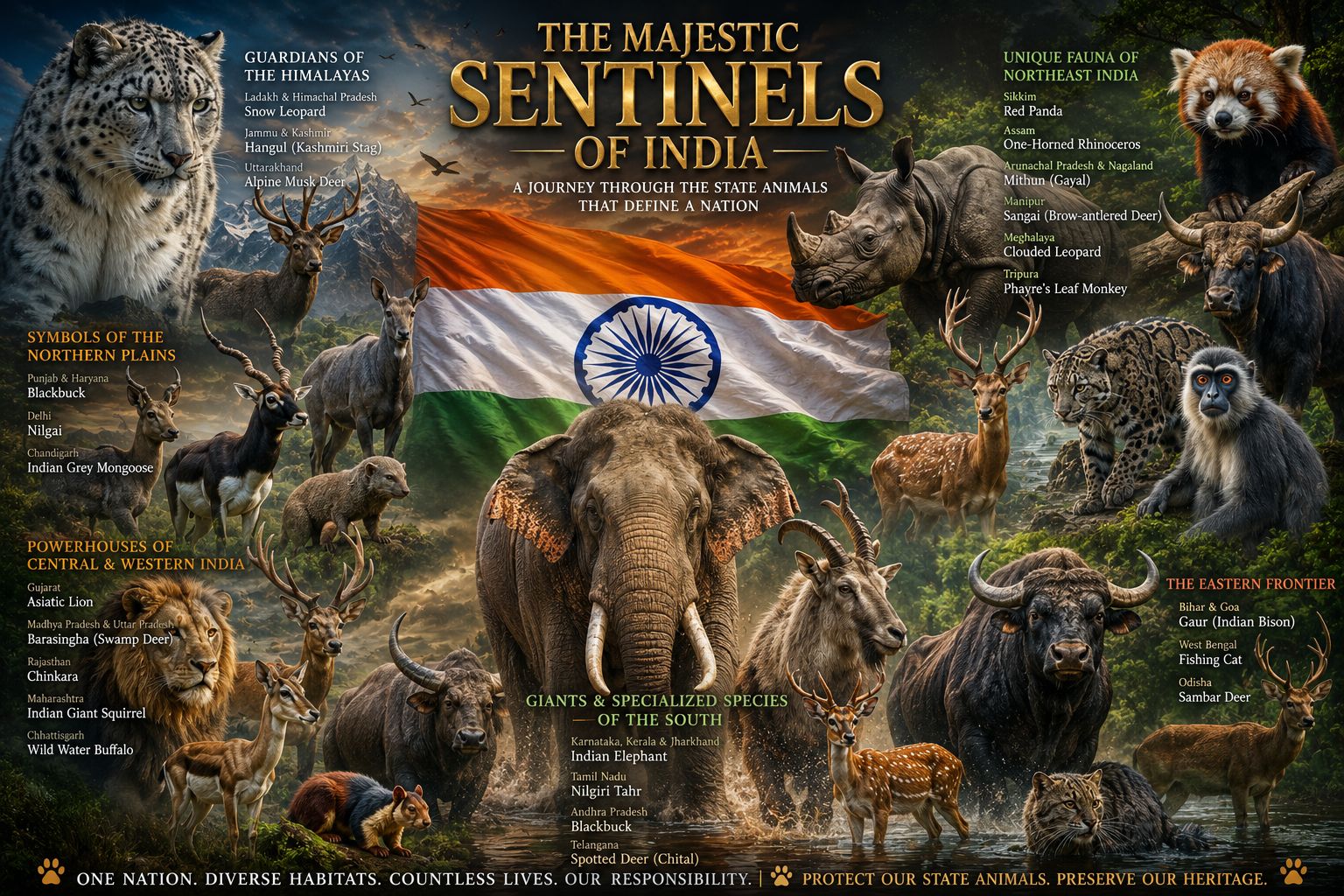
A
Amish Anand G@amishanand·May 10
@amishanand·May 10The Apple Economy: How a Tech Giant Really Makes Its Trillions.
For years, the story of Apple has been told through a single product: the iPhone. To most people, Apple’s fortune seems simple—design a sleek smartphone, sell millions of units, and watch the cash pile up.
But Apple’s real economic engine is far more sophisticated.
In 2026, Apple is no longer just a hardware company. It has transformed into something much larger: a digital ecosystem that blends technology, finance, entertainment, and luxury retail into one tightly controlled network. The iPhone may still be the company’s most recognizable product, but it’s only the gateway into what might be the most profitable business ecosystem ever built.
To understand how Apple really makes its trillions, you have to look beyond the phone.
The iPhone Is Still King—But Its Crown Is Changing
Yes, Apple still makes most of its money from the iPhone.
In fiscal 2025, the iPhone generated over $205 billion, accounting for roughly 51% of Apple’s total revenue. That’s an enormous number—but also a sign of change.
A decade ago, Apple depended much more heavily on iPhone sales. Today, the company has deliberately reduced that dependency by building multiple revenue streams around the device.
The iPhone is no longer just a product.
It’s Apple’s customer acquisition strategy.
Buy the phone, and you enter the ecosystem.
The Silent Giant: Apple’s Services Business
If the iPhone is Apple’s front door, Services is its financial powerhouse.
This segment has become one of the most important parts of Apple’s business, generating an estimated $109 billion in revenue in 2025.
It includes:
App Store — Apple takes a 15% to 30% commission on digital purchases.
iCloud+ — Monthly subscriptions for extra storage.
Apple Music, Apple TV+, and Apple Arcade — Recurring entertainment subscriptions.
Apple Pay — Transaction fees every time users tap to pay.
What makes Services especially valuable isn’t just revenue—it’s profit margin.
Building hardware requires factories, logistics, raw materials, and labor.
Letting someone store photos in iCloud or subscribe to Apple TV+ costs Apple comparatively little.
That’s why Services can deliver margins above 70%, far higher than hardware.
Apple doesn’t just want to sell you a device.
It wants to charge you monthly for living inside that device.
Accessories: The Billion-Dollar Add-Ons
Apple’s Wearables, Home, and Accessories business has quietly become massive—large enough to be a Fortune 500 company on its own.
This is where Apple’s ecosystem strategy becomes especially clear.
The Attach-Rate Machine
Apple doesn’t stop after selling you an iPhone.
It sells everything around it.
AirPods are the perfect example. By removing the headphone jack, Apple created an entirely new wireless audio market and positioned itself at the center of it.
In 2025 alone, Apple reportedly sold around 80 million AirPods.
Then comes the Apple Watch.
Once you own one, switching away from the iPhone becomes harder. Apple Watch only works with Apple devices, strengthening what many analysts call ecosystem lock-in.
Even smaller products contribute significantly:
MagSafe chargers
Silicone cases
Replacement cables
Premium accessories
These high-margin items may seem minor individually, but together they generate tens of billions in annual revenue.
Why Apple Releases a New iPhone Every Year
At first glance, annual iPhone launches can seem repetitive.
Do we really need a new model every twelve months?
For Apple, the answer is absolutely yes.
Capturing the Upgrade Cycle
Not everyone upgrades at the same time.
Some users buy a new phone every two years. Others wait four or five.
By launching a new model every year, Apple ensures that whenever a customer decides to upgrade, there’s always something new waiting.
No gap.
No chance to drift toward Android.
The Pricing Ladder Strategy
Apple doesn’t just sell one iPhone.
It sells multiple price points at once.
A typical lineup might look like:
iPhone SE — Budget entry point
Older flagship models — Discounted options
Current standard iPhone — Mainstream premium
Pro and Pro Max models — Luxury tier
This creates a pricing ladder that keeps users inside Apple’s ecosystem regardless of budget.
Feeding Wall Street
Apple is a publicly traded company.
Investors expect consistent growth.
Annual launches create predictable revenue spikes—especially during the holiday quarter—which helps sustain investor confidence and stock performance.
Innovation matters.
But predictable cash flow matters too.
Apple’s Second Life Strategy: Selling the Same Phone Twice
Apple doesn’t stop making money when customers trade in old devices.
It often makes money again.
Refurbished Devices
When users trade in an iPhone, Apple inspects and restores it:
Hardware testing
Battery replacement
Exterior refurbishment
Resale through certified refurbished channels
That means Apple can effectively sell the same hardware twice.
A remarkably efficient model.
Recycling for Profit
For devices too damaged to resell, Apple uses specialized recycling robots like Daisy and Dave.
These machines can disassemble iPhones and recover valuable materials such as:
Gold
Cobalt
Tungsten
Rare earth elements
In 2026, Apple reported that nearly 30% of materials used in new products now come from recycled sources.
This lowers production costs while supporting the company’s 2030 carbon neutrality goals.
Sustainability, in Apple’s world, is also good business.
---
Where Apple’s Money Really Comes From
Category Revenue Source Strategic Value
iPhone Direct hardware sales Entry point into the ecosystem
Services App Store, subscriptions, payments Recurring high-margin income
Accessories AirPods, Watch, cases Ecosystem expansion and loyalty
Trade-ins & Refurbished Resale and recycling Extends product profitability
The Gilded Cage
Apple’s greatest innovation may not be the iPhone itself.
It’s the ecosystem surrounding it.
You buy an iPhone.
Then AirPods.
Then Apple Watch.
Then iCloud storage.
Then Apple Music.
Then Apple Pay becomes your default wallet.
Soon, your photos, passwords, subscriptions, and daily habits are woven so deeply into Apple’s ecosystem that leaving feels inconvenient—even painful.
That’s Apple’s true business model.
Not just selling devices.
But building a beautifully designed gilded cage that users willingly choose to stay inside.
And with more than 2.5 billion active devices worldwide, that strategy continues to generate one of the most powerful economic machines in modern history.
The real question now is this:
As Services continue to grow, is Apple still fundamentally a hardware company—or is it quietly becoming one of the world’s most profitable software businesses?