
Just made some updates to my Whop and added a new lower ticket AI & Growth consultation offer, let me know what you think
will be doing a main launch for this towards the end of the month and onboarding all my existing clients to Whop
also have made the growth advisory chat open to everyone who joins
Grow Today
16 joined
Z
Zach ZelleGT @zachzelle·May 10
@zachzelle·May 10Z
Zach ZelleGT@zachzelle·May 9
@zachzelle·May 9Pinned post
Another successful event this week ✅
the ai and frontier tech scene is about to explode in Miami
every week I’m getting send more and more pitch decks from founders building crazy startups looking to raise money or use agents to ramp up revenue
the entire scene feels electric, can’t wait to show everyone what we cook next 🧑🍳
(the Mario theme event was a fun vibe)
M
Marko Tomicic@marko-tomicic·May 9
Miami’s turning into a goldmine for builders rn
Feels like AI + Shopify/dropshipping is the next crazy wave fr the ones who tap in early gonna win big.
Mario theme sounds fun af too
Z
Zach ZelleGT@zachzelle·Apr 5
@zachzelle·Apr 5OpenAI just acquired a talk show. Here's why that matters more than their $122B raise.
Last week, OpenAI bought TBPN, a daily tech talk show on YouTube and X, making it their first media acquisition.
A company building artificial general intelligence… bought a talk show.
Not another AI lab. Not another model. A media brand.
Why? Because Sam Altman understands something most founders don't:
Technology doesn't win. Distribution does.
TBPN is on track to do $30M+ this year. It's where Zuckerberg, Nadella, and Benioff go to talk shop. It's the "SportsCenter of tech." OpenAI didn't buy revenue - they bought the microphone.
Now pair that with their $122 billion raise last week, the largest private round in history. $852B valuation. Backed by Amazon, NVIDIA, SoftBank, Microsoft, Sequoia, a16z, and dozens more.
Here's the pattern most founders miss:
OpenAI's flywheel isn't just AI models → it's:
Capital (venture) to fund compute and R&D
Distribution (ChatGPT, TBPN, developer APIs) to reach billions
Capital fuels distribution. Distribution justifies more capital. Repeat.
They said it themselves in their fundraise announcement: "Consumer adoption, enterprise deployment, developer usage, and compute form a reinforcing flywheel that translates capability into economic impact."
This is the framework.
Whether you're raising $500K or $500M, the investors writing checks are asking one question: "How does this compound?"
Your pitch can't just be "we built something cool." It has to be:
Here's our unfair distribution advantage
Here's how capital accelerates it
Here's the flywheel that makes both defensible
OpenAI didn't need a talk show. They needed the narrative layer that makes their entire ecosystem stickier.
What's yours?
---
Comment "W" below and I'll send you a discount code for a 1:1 Fundraising Strategy Session with me. I help founders structure their raise around venture + distribution so the capital actually compounds. Let's build your flywheel.
Z
Zach ZelleGT@zachzelle·Mar 23
@zachzelle·Mar 23Why Your Pitch Deck Isn't Getting Meetings (And the 60-Second Fix)
I've reviewed hundreds of pitch decks. The ones that fail almost always make the same mistake in the first 30 seconds.
They open with the problem.
"$4.2 trillion market... fragmented industry... legacy systems..." — investors tune out immediately. They've heard it a thousand times. You lost them before slide 3.
The fix: Open with traction.
The first thing out of your mouth — or on your first slide — should be the most impressive thing your company has done. Period.
"We hit $40K MRR in 5 months with zero paid acquisition."
"We have 12,000 users and 68% monthly retention."
"We closed 3 enterprise pilots worth $180K in pipeline."
If you don't have traction yet, open with the insight — the thing you know that nobody else in the room knows. The reason you're the one to build this.
Here's the framework I use with every founder I advise:
Slide 1: Traction or insight (earn 60 more seconds of attention)
Slide 2: What you do in one sentence (not your mission statement — what the product actually does)
Slide 3: Why now (market timing, not market size)
Slide 4: How it works (demo or 3-step visual)
Slide 5: Business model (how you make money, unit economics)
Slide 6: Growth (acquisition channels, what's working)
Slide 7: Team (why you specifically will win)
Slide 8: The ask (amount, use of funds, milestones it unlocks)
That's it. 8 slides. Investors will ask for more if they want it — that's the point. You want them leaning in, not checking email.
The biggest mistake after the deck? Spraying it to 200 investors on AngelList. That's not a strategy, it's spam.
Target 40-60 investors max. Research every single one. Know their portfolio, their thesis, their recent tweets. Your outreach should feel like a warm intro even when it's cold.
---
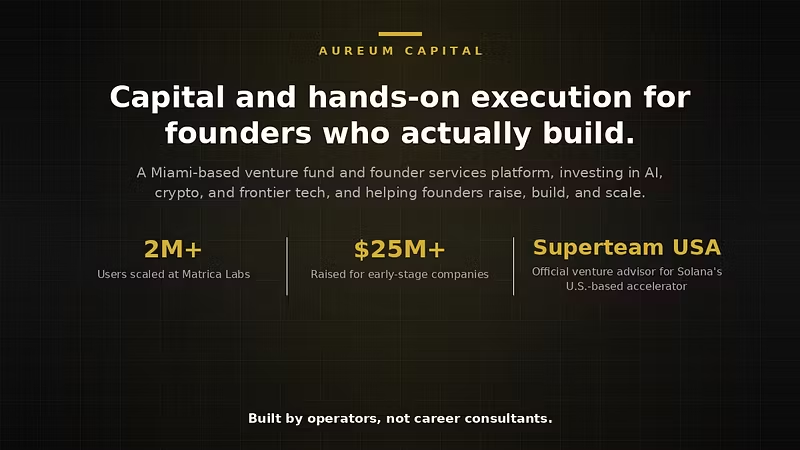
If you're actively building a deck or about to start pitching, I put together a free framework that covers this entire process end-to-end — the same system behind $25M+ raised across multiple companies.
Questions? Drop them in the comments.
Z
Zach ZelleGT@zachzelle·Mar 22
@zachzelle·Mar 22The 3 Growth Levers That Actually Move the Needle (And Why Most Founders Ignore Them)
Most founders chase vanity metrics. Downloads. Followers. "Impressions." None of that pays your team or closes your round.
After scaling Matrica to 2M+ users and helping raise $25M+, I've seen the same three levers drive real growth every single time:
1. Activation > Acquisition
Stop obsessing over top-of-funnel. If your activation rate is below 40%, you're pouring water into a broken bucket. Before you spend another dollar on ads, fix the first 5 minutes of your user experience. Map every step from signup to "aha moment" and eliminate friction ruthlessly.
At Matrica, we doubled our 30-day retention by cutting our onboarding from 7 steps to 3. That single change was worth more than any campaign we ever ran.
2. Revenue Per User > Total Users
A startup with 1,000 users paying $200/mo is in a stronger position than one with 100,000 free users trying to figure out monetization. Investors know this. Your LTV:CAC ratio is the single most important metric when you're raising — it proves your business model works.
If you're pre-revenue or under $10K MRR, your entire focus should be on getting 10 customers to pay you enough that you understand exactly what they value.
3. Distribution Moats > Product Features
Features get copied in weeks. Distribution is nearly impossible to replicate. Think: referral loops, embedded virality, community-driven growth, strategic partnerships. These compound over time while feature advantages decay.
Every company I've helped raise successfully had at least one distribution moat they could articulate clearly to investors. If you can't explain yours in one sentence, that's your homework this week.
---
The fundraising connection: Investors don't fund products. They fund growth engines. If you can show a clear activation funnel, strong unit economics, and a defensible distribution channel — you're not pitching, you're negotiating.
If you're working on any of these right now, drop a comment. Happy to give specific feedback on what I'm seeing work in Q1 2026.
Z
Zach ZelleGT@zachzelle·Mar 21
@zachzelle·Mar 21🔔 Reminder: Two Free Guides Are Sitting Here Waiting For You
Quick reminder if you haven't grabbed these yet — both are completely free and they're the same frameworks I used to raise $25M+ and grow Matrica to 2M+ users.
1. Free Fundraising Framework
The exact 5-step process behind every raise I've helped close. If you're a founder planning to raise capital in the next 6-12 months, this is your starting point. Not theory — this is the actual playbook.
2. Free AI Growth Playbook
The framework the top 6% use to dominate growth with AI. If you're still doing things manually that AI can 10x, you're leaving money and time on the table.
No email gates. No upsell traps. Just the frameworks — use them.
Once you've gone through them, drop a comment below with your biggest takeaway or question. I read everything and I'll point you in the right direction.
Z
Zach ZelleGT@zachzelle·Mar 21
@zachzelle·Mar 21How I Helped Raise $25M+ and Grew a Platform to 2M Users — Now I'm Helping Founders Do the Same
I'm Zach Zelle. Here's the short version of why I built Grow Today.
The Track Record
Alameda Research - Worked at one of the largest trading firms in crypto before it imploded. Learned more about growth, risk, and fundraising in that environment than most people learn in a decade.
Matrica Labs - 2M+ users - Led growth from early stage to over two million users. Built the acquisition funnels, referral loops, and retention systems that made Matrica a standard in crypto.
$25M+ raised for companies - Helped multiple startups close rounds by building their narratives, structuring their decks, targeting the right investors, and creating urgency that gets term sheets signed.
Why Grow Today Exists
Most founders are building great products but struggling with two things: getting users and getting funded. I've done both at scale, and I got tired of watching talented builders fail at the business side.
So I packaged everything I know into actionable frameworks and direct consulting:
Free Fundraising Framework - The exact 5-step process behind $25M+ in raises. Download it, no strings attached.
Growth Inner Circle ($197/mo) - Async access to me and a private group of serious founders. Ask questions, get feedback on decks, growth strategies, and positioning - usually within 24 hours.
1-on-1 Strategy Sessions ($1,000–$2,500) - Deep-dive calls for founders who need hands-on help with fundraising, growth architecture, or go-to-market. You leave with a concrete plan, not vague advice.
What I Actually Help With
Fundraising strategy & investor targeting
Pitch deck structure & narrative
User acquisition funnels & growth loops
Retention & engagement systems
Go-to-market positioning
AI-powered growth automation
Start Here
If you're a founder trying to raise capital or scale users - you're in the right place. Grab the free framework, join the Inner Circle, or book a session. Every offer here is built on real experience, not theory.
Drop a comment below if you have questions. I read everything.