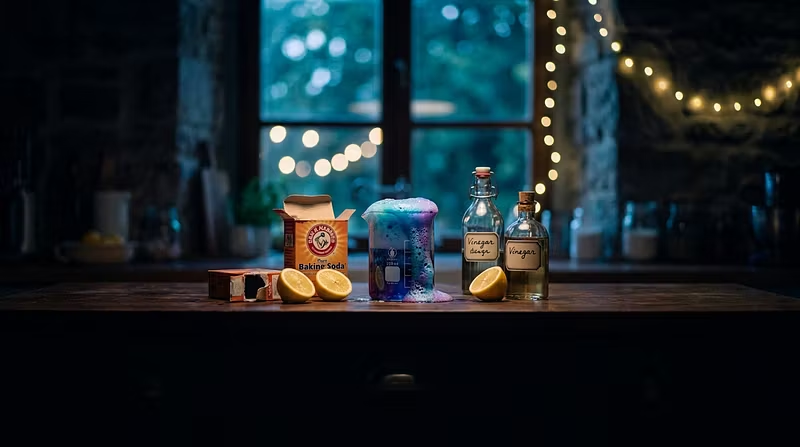


Why Does Baking Soda + Vinegar Explode? (The Physics Your Teacher Skipped)
Everyone's seen it — the volcano at the science fair. But almost nobody can explain what's actually happening at the molecular level. Let's fix that.
The 30-Second Physics Breakdown
When acetic acid (vinegar, CH₃COOH) meets sodium bicarbonate (baking soda, NaHCO₃), a proton transfer occurs:
The acetic acid donates a hydrogen ion (H⁺) to the bicarbonate ion
This forms carbonic acid (H₂CO₃) — which is unstable
The carbonic acid instantly decomposes into water + carbon dioxide gas
The CO₂ has nowhere to go → pressure builds → eruption
That "explosion" is really just a gas desperately escaping a liquid. The reaction itself is an acid-base neutralization — one of the most fundamental processes in chemistry and physics.
The Part Nobody Talks About
The rate of this reaction depends on three variables you can control in your kitchen:
Temperature — warm vinegar reacts faster (more molecular kinetic energy)
Concentration — cleaning vinegar (6% acidity) vs. regular (5%) gives a noticeably bigger reaction
Surface area — crushed baking soda reacts faster than a solid lump
This is reaction kinetics — the same physics governing everything from rocket engines to how your stomach digests food.
Try This Tonight
Put 2 tablespoons of baking soda in a glass. Pour in ¼ cup of cold vinegar, then repeat with warm vinegar. Watch the difference in reaction speed. You just demonstrated the relationship between thermal energy and reaction rate — on your kitchen counter.
I teach a full course on kitchen acid-base physics — 12 lessons, live demos, and a community of curious minds. Link in bio if you want to go deeper. 🔬