

AgencyMargin Pro:
The pricing mistake that quietly destroys AI agency margins
A lot of AI automation services are priced from the outside in:
“What are other agencies charging?”
“What will the client accept?”
“What sounds reasonable for this automation?”
The problem is that none of those questions tells you whether the engagement actually makes economic sense.
The calculation should start with the work required to deliver it.
Setup delivery cost
Discovery, solution design, workflow building, integration, testing, implementation, training, and handover.
+ Recurring delivery cost
AI/API usage, software, telephony, monitoring, reporting, support, contractor work, and maintenance.
+ Labor economics
The actual hours required to build and support the solution, multiplied by a realistic hourly cost.
+ Overhead, contingency, and payment costs
= True delivery cost
Only then should pricing begin.
A project might sound attractive at $5,000 setup plus a $1,000 monthly retainer, but that tells you very little until you know what it costs to deliver, how much capacity it consumes, and what margin remains.
And cost is only one side of the decision.
For AI automation services, the client will often ask:
“What is this worth to us?”
That is where the analysis becomes more useful.
You may need to estimate:
Staff hours potentially saved.
Costs potentially avoided.
Additional qualified outcomes.
Recurring operational value.
Client ROI and payback based on documented assumptions.
Those numbers should never be presented as guaranteed outcomes. They are decision-support estimates that need conservative assumptions and professional judgment. AgencyMargin Pro is built around that principle.
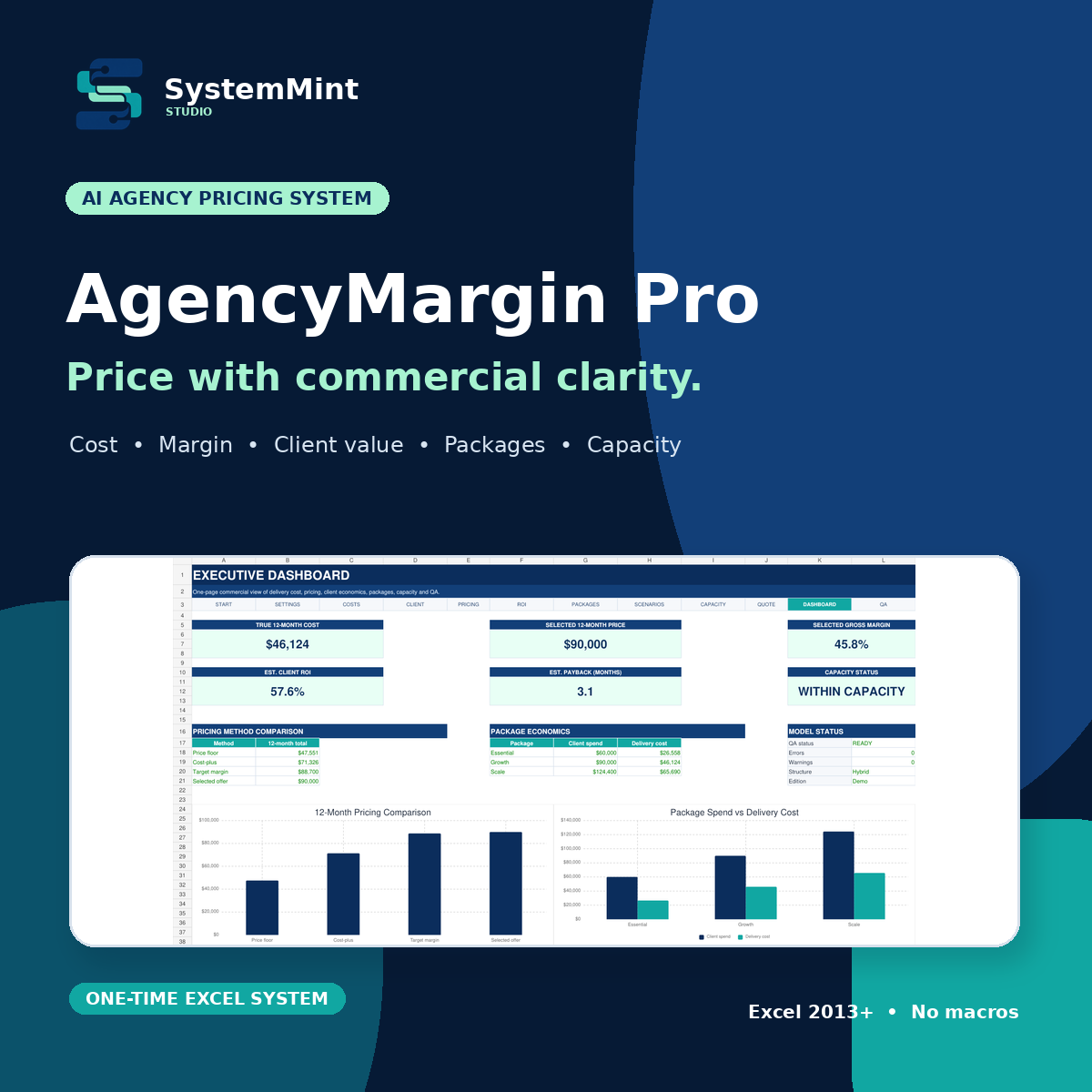
That is why I built AgencyMargin Pro, an Excel-based pricing and profitability system for AI agencies, automation consultants, and service businesses.
It helps you:
Calculate true setup and recurring delivery costs.
Compare price floor, cost-plus, and target-margin pricing.
Estimate client value, ROI, and payback.
Build Essential, Growth, and Scale packages.
Stress-test downside, base, and upside scenarios.
Check whether your planned client load fits available capacity.
Review pricing, margin, packages, ROI/payback, and capacity in one dashboard.
Prepare a quote-ready commercial summary.
The system also includes QA checks designed to surface unsupported assumptions, invalid inputs, capacity breaches, and calculation issues before you rely on the output.
No spreadsheet building is required. Enter your assumptions into the designated input cells and work through the pricing process in sequence.
If you sell AI automation services, the important question is not simply:
“How much can I charge?”
A better question is:
“What should I charge given my delivery cost, target margin, capacity, client-value assumptions, and commercial risk?”
That is the problem AgencyMargin Pro is designed to help structure.