Haelyx

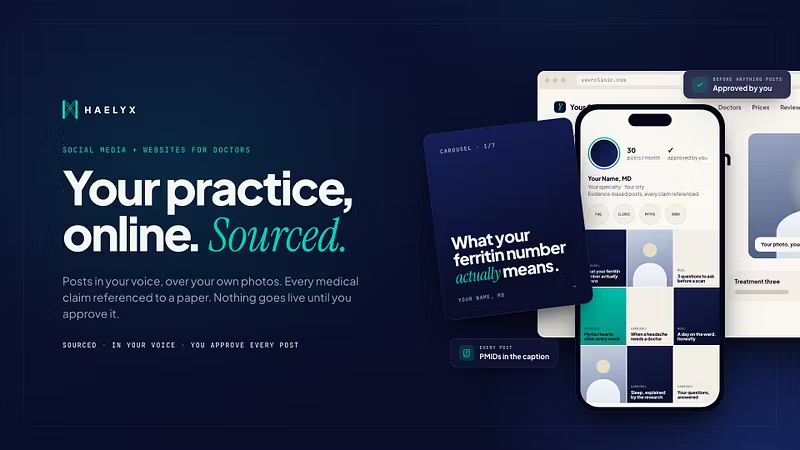
Haelyx is a done-for-you social media and website studio for doctors. We write your posts in your own voice, over your own photos, and...
25 joined
Profile picture
Mohamed ShembeshProfile picture@shembosis·3d

Myth: your patients trust TikTok more than you

Myth: your patients trust TikTok more than you.


Fact: a nationally representative US survey (HINTS 6, 2022) asked 5,842 adults how much they trust different sources of health information. 95% had high trust in doctors; only 18% had high trust in health information on social media. That's over 5x the trust.


Patients scroll the feed, but they believe their doctor. If the doctor isn't posting, the feed answers their questions instead. We write sourced posts on the questions patients actually ask, in the doctor's voice, and nothing goes live until the doctor approves it. The first post is free.


Source: Mainous AG, Sharma P, Yin L, Wang T, Johannes BL, Harrell G. Conflict among experts in health recommendations and corresponding public trust in health experts. Front Med (Lausanne) 2024;11:1430263. PMID 39131091.


Watch the reel:

Profile picture
Mohamed ShembeshProfile picture@shembosis·3d

28% of parents picked their child's doctor from ratings

28% of parents picked their child's doctor from online ratings.


A nationally representative US survey asked 1,619 parents how they choose a primary care doctor. 74% already knew the physician-rating sites. A neighbor's recommendation plus good online ratings tripled the odds of picking that doctor (adjusted OR 3.0); the same recommendation plus bad ratings cut the odds by 91% (adjusted OR 0.09).


Stars tell patients that people liked you, not how you think. We write sourced posts on the questions patients actually ask, in the doctor's voice, and nothing goes live until the doctor approves it. The first post is free.


Source: Hanauer DA, Zheng K, Singer DC, Gebremariam A, Davis MM. Parental awareness and use of online physician rating sites. Pediatrics 2014;134(4):e966-75. PMID 25246629.


Watch the reel:

Profile picture
Mohamed ShembeshProfile picture@shembosis·3d

98% of top GLP-1 TikToks weren't made by a clinician

98% of the top GLP-1 TikToks weren't made by a clinician.


Researchers scored the 400 most popular TikToks under #Ozempic, #Semaglutide, #Mounjaro and #Tirzepatide. 98% came from individual users or influencers. Their reliability-based quality score was 34.5 vs 52.3 for health care professionals, and views and likes did not track quality.


Patients watch these before the consult. We write sourced posts on the GLP-1 questions patients bring in, in the doctor's voice, and nothing goes live until the doctor approves it. The first post is free.


Source: Günaltay MM, Kartal N. TikTokfluence: The rise of GLP-1 receptor agonists in the age of social media health trends. J Am Pharm Assoc 2026;66(3):103082. PMID 41866128.


Watch the reel:

Profile picture
Mohamed ShembeshProfile picture@shembosis·3d

84% of doctors saw a statin refused over a myth

84% of doctors have seen a patient refuse a statin over a myth.


In a survey of 260 physicians, 84% had seen statin refusals driven by fear of liver damage (81% by fear of muscle damage). The doctors said misinformation about side effects drove 53% of the statin discontinuations they saw, and 96.5% already try to educate their patients.


Doctors already explain it, one patient at a time, after the myth got there first. We write sourced posts on the myths patients bring in, in the doctor's voice, and nothing goes live until the doctor approves it. The first post is free.


Source: Hendzel A, Krzyżanowski F, Kłoda K, Mastalerz-Migas A, Babicki M. Facts and myths about the use and effects of statins in patients with dyslipidaemia: a survey of physicians. Arch Med Sci 2025;22(1):56-64. PMID 42110618.


Watch the reel:

Profile picture
Mohamed ShembeshProfile picture@shembosis·3d

1 in 3 adults asked an AI chatbot about their health

1 in 3 adults has asked an AI chatbot about their health.


In a survey of 2,002 US adults, 32.6% had used an AI chatbot (LLM) for health questions, and for 14% of those users the chatbot was the first source they consulted. In a second study, 48.4% of chatbot users followed its health advice, but only 19.4% cross-checked it.


Patients get an answer whether their doctor posts or not. We write sourced posts on the questions patients already ask, in the doctor's voice, and nothing goes live until the doctor approves it. The first post is free.


Source: Mendel T, Singh N, Mann DM, Wiesenfeld B, Nov O. Laypeople's Use of and Attitudes Toward Large Language Models and Search Engines for Health Queries: Survey Study. J Med Internet Res 2025;27:e64290. PMID 39946180. doi:10.2196/64290. Yun HS, Bickmore T. Online Health Information-Seeking in the Era of Large Language Models: Cross-Sectional Web-Based Survey Study. J Med Internet Res 2025;27:e68560. PMID 40163112. doi:10.2196/68560.


Watch the reel:

Profile picture
Mohamed ShembeshProfile picture@shembosis·3d

Patients recall 49% of what was decided: send the visit home with them

Your best patient education happens after they leave the room.


Researchers followed 189 outpatient specialty visits and interviewed patients one week later. Only 49% of decisions and recommendations were recalled accurately without a prompt; 36% came back only with a prompt, and 15% were recalled wrongly or not at all. Patients with a college degree recalled 65% of items, versus 38% for patients with less than a high school education. Teach-back was rare.


A post a patient can save and reread at home is the follow-up they keep. We write it in the doctor's voice, source every claim, and nothing goes live until the doctor approves it. The first post is free.


Source: Laws MB, Lee Y, Taubin T, Rogers WH, Wilson IB. Factors associated with patient recall of key information in ambulatory specialty care visits: Results of an innovative methodology. PLoS One 2018;13(2):e0191940. PMID 29389994. doi:10.1371/journal.pone.0191940.


Watch the reel:

Profile picture
Mohamed ShembeshProfile picture@shembosis·3d

Comment your specialty: what 150 prostate cancer YouTube videos got wrong

Every specialty has a question the internet answers wrong.


Take prostate cancer. Researchers reviewed the first 150 YouTube videos on prostate cancer screening and treatment. 115 of them (77%) contained potentially misinformative or biased content, in the video or the comments, with a total reach of more than 6 million viewers. And the lower the scientific quality, the more engagement a video got.


That is the gap a doctor's own sourced post fills. Tell us your specialty and we will pick the question your patients ask most, source every claim, and send it to you to approve before it goes live. The first post is free.


Source: Loeb S, Sengupta S, Butaney M, et al. Dissemination of Misinformative and Biased Information about Prostate Cancer on YouTube. Eur Urol 2019;75(4):564-567. PMID 30502104. doi:10.1016/j.eururo.2018.10.056.


Watch the reel:

Profile picture
Mohamed ShembeshProfile picture@shembosis·3d

Website or Instagram first? What decided which surgeon patients chose

Doctors ask us this a lot: should I build a website first, or Instagram?


One survey of 384 maxillofacial surgery patients gives a useful answer. 41.7% used Google and 31.0% used Instagram. But when they actually chose a surgeon, Google was the deciding route for 19.5% and Instagram for only 2.9%. The biggest route by far: 62.2% went on a personal recommendation.


So build it in order. First a website, because that is where search lands. Then Instagram, with posts people can forward when a friend asks them for a doctor.


At Haelyx we build both for doctors: every claim sourced, and the doctor approves each post before it goes live.


Source: Abrishami M, Bayat M, Sheykhi Some E. Social Media Influence on Surgeon Selection Among Iranian Maxillofacial Patients: Cross-Sectional Survey Study. JMIR Perioper Med 2025;8:e75899. PMID 40811821. doi:10.2196/75899.


Watch the reel:

Profile picture
Mohamed ShembeshProfile picture@shembosis·4d

Why a med student built a sourced-content studio for doctors

I'm Mohamed, a final-year medical student heading into cardiology. Med school drills one rule into you: check the source.


Then I opened TikTok. In a study of the 100 most-liked English-language TikTok videos about sunscreen, none of them (0%) cited a single reference.


Your patients watch those videos. So at Haelyx we build the opposite for doctors: posts in the doctor's own voice, every claim sourced, and the doctor approves each post before it goes live.


Source: Roland-McGowan J et al. Perception, Quality, and Accuracy of Sunscreen Content on TikTok: SkinMedia Cross-Sectional Content Analysis. JMIR Dermatol 2025;8:e70010. PMID 41328483. doi:10.2196/70010.


Watch the reel:

Profile picture
Mohamed ShembeshProfile picture@shembosis·4d

The 80/20 rule for doctor content (most doctors run it backwards)

Most doctors run their content backwards. In one analysis of 300 plastic-surgery posts across Instagram, Facebook and YouTube, 83% of the Instagram posts were self-promotion, and only 16% of all posts were educational.


Patients want the opposite. In a survey of 715 adults, 59% said medical information written by the dermatologist was one of the most important parts of a dermatologist's social media.


So flip it:


  • 80%: answer what your patients actually ask

  • 20%: who you are and how to book


We write the 80% for doctors, every claim sourced, and the doctor approves each post before it goes live.


Sources: Ben Naftali Y et al., Plast Reconstr Surg Glob Open 2018. PMID 30656096. doi:10.1097/GOX.0000000000001958. Murphy EC et al., J Drugs Dermatol 2020. PMID 32484619.


Watch the reel: