
Stop Paying Monthly Fees (Lifetime License)
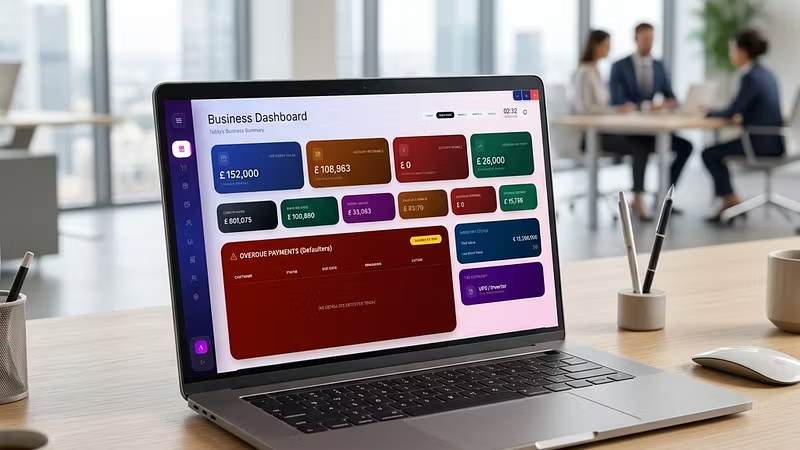
Why pay monthly SaaS fees? NexVolt offers a lifetime license for a one-time payment. Perfect for cost-conscious businesses in Pakistan looking for stable overheads. Join Now Free

 @basirasoft·May 30
Why pay monthly SaaS fees? NexVolt offers a lifetime license for a one-time payment. Perfect for cost-conscious businesses in Pakistan looking for stable overheads. Join Now Free
@basirasoft·May 21BOSS IT - Your Bank Balance
Hey “I didn’t realise how much money I was losing until I started tracking it properly…”
That’s exactly why I created BOSS IT – Your Bank Balance
A simple cash flow & money tracker designed for:
freelancers
beauty businesses
cleaners
side hustlers https://whop.com/basirasoft/cashpath-the-ultimate-personal-finance-command-center/

🚨 Clipers,editors and creators this is for you 👇
to go viral faster and easier you will need this Vault
👇 all in one Optimized Vault.
📱 Optimized for TikTok, Reels & Shorts
👤 Perfect for cliping pages
⚡️ DAILY UPDATES
The vault keeps growing constantly.
Go viral easier 📈
👉 Get access here:
@basirasoft·May 17Why pay monthly SaaS fees? NexVolt offers a lifetime license for a one-time payment. Perfect for cost-conscious businesses in Pakistan looking for stable overheads.
Internet outages and loadshedding shouldn't stop your sales. NexVolt runs locally on your PC, ensuring 100% uptime and blazing-fast performance without any web lag.
Designed specifically for local workflows. Features native Rupee (Rs) currency support, local tax configurations, and an intuitive interface optimized for local staff.
Elevate your brand with a stunning glassmorphic UI. NexVolt makes your billing counter look highly professional, impressing high-value walk-in customers.
@basirasoft·May 14Your router is more powerful than you think. 🚀
When a store has 5+ terminals, everyone asks: "How do you sync stock without the Internet?"
The answer isn't magic; it’s fundamental Networking.
Instead of relying on a distant API, we turn the shop into a Private Cloud.
The Host: A single local PC acts as the master node running PostgreSQL.
The Protocol: Using standard TCP/IP over a local Wi-Fi or Ethernet network.
The Result: Sub-millisecond data synchronization across all registers.
Postgres is a beast at handling concurrent local connections. By optimizing pg_hba.conf and leveraging local subnets, we’ve created a system that is: ✅ Faster than Fiber ✅ Immune to ISP outages ✅ 100% Private
Don't over-engineer with WebSockets and Global CDNs when a well-configured Local Area Network (LAN) solves the problem better.
#PostgreSQL #Networking #SoftwareArchitecture #BuildingInPublic #NexVolt
@basirasoft·May 14@basirasoft·May 13Join Now free click here
@basirasoft·May 13I spent 8 months building software for Pakistani shop owners nobody else was building for
Last year I looked at every POS software available in Pakistan.
They all had the same problem:
Monthly subscription fees shop owners couldn't afford
Required constant internet (load-shedding kills the business)
No installment/debt tracking (huge for local retail)
English-only interface for Urdu-speaking staff
So I stopped looking and started building.
8 months later I have a full offline POS system running on real shops here. No cloud. No monthly fee. Runs during load-shedding. Tracks customer installments. Prints thermal receipts.
The hardest part wasn't the code. It was convincing the first shop owner to trust software made by someone local over imported solutions.
He gave me a chance. Now his inventory, customer debts, and daily reports are all in one place.
For anyone building software for underserved local markets — the opportunity is massive. Nobody is building for them because everyone is chasing Western markets.
What market are you building for that big companies are ignoring?
@basirasoft·May 13Microsoft SmartScreen blocked my software and I had to explain to every user why
I released my first Windows desktop app last month.
Every single user messaged me asking: "It says Windows blocked this — is it a virus?"
It's not a virus. It's Microsoft SmartScreen flagging unsigned software. Any .exe that isn't signed with a paid certificate gets this warning.
A code signing certificate costs $80–$300/year. For a brand new indie product with zero users, that's a real barrier.
So my options were:
Buy the certificate immediately → expensive before first sale
Tell every user to click "More Info → Run Anyway" → bad experience
Distribute through a store that handles this → limited to what they allow
I went with option 2 for now and wrote a clear guide explaining exactly what the warning means and why it appears. Most users understood once I explained.
The unfair reality: big companies have certificates so their software feels "trusted." Indie developers look like threats just because they're small.
How have other indie desktop app developers handled the SmartScreen problem? Did you buy the cert early or wait until you had revenue?

“Follow me…
I follow real ones back 🔥”
@basirasoft·May 13The installer worked perfectly on my machine. It crashed on everyone else's.
Classic developer mistake.
I built a desktop app for Windows. Tested it 100 times on my own PC. Everything worked.
First person downloads it → immediate crash on launch.
The problem? My machine had PostgreSQL already installed. Theirs didn't. My app depended on a database that wasn't there and failed silently with no error message.
Lesson: Never assume your machine represents your user's machine.
What I fixed:
Added a proper error screen explaining what's missing
Wrote a setup guide with exact steps for new users
Added a database connection check before the app loads
3 hours of debugging saved every future user from the same silent crash.
If you're building desktop apps — always test on a clean machine with zero dependencies installed. The errors you find will surprise you.
Anyone else been burned by "works on my machine" syndrome?
@basirasoft·May 13I spent 8 months building software fo shop owners nobody else was building for
Last year I looked at every POS software available in Market.
They all had the same problem:
Monthly subscription fees shop owners couldn't afford
Required constant internet (load-shedding kills the business)
No installment/debt tracking (huge for local retail)
So I stopped looking and started building.
8 months later I have a full offline POS system running on real shops here. No cloud. No monthly fee. Runs during load-shedding. Tracks customer installments. Prints thermal receipts.
The hardest part wasn't the code. It was convincing the first shop owner to trust software made by someone local over imported solutions.
He gave me a chance. Now his inventory, customer debts, and daily reports are all in one place.
For anyone building software for underserved local markets — the opportunity is massive. Nobody is building for them because everyone is chasing Western markets. Try it for 14 Days Free Check Here
What market are you building for that big companies are ignoring?