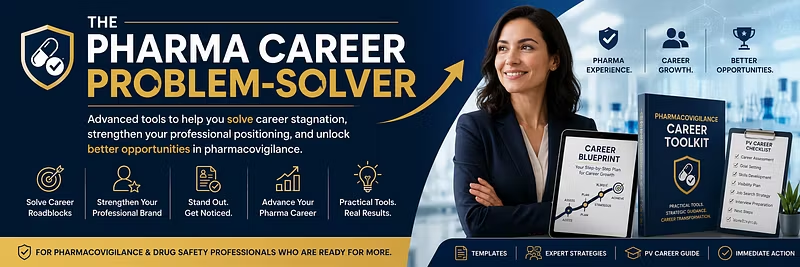
The Pharma Career Problem-Solver

Your go-to destination for practical resources, guides, and tools designed to help you navigate, grow, and succeed in the pharmaceutical ind...
Location hidden
Created byProfile pictureMarcus Elali
4 joined
Profile picture
Marcus ElaliProfile picture@buybliss·May 3

Welcome to PharmaSignal

Welcome aboard.


Here's what you get access to:


Safety Platform — Drug interaction checks, adverse event signal detection, and regulatory compliance tools. This is your daily driver.


Safety Discussion — Direct line to other DSOs, PV practitioners, and regulatory specialists. Ask questions, share case studies, flag emerging signals.


Safety Bulletins — Critical safety alerts, platform updates, and regulatory guidance pushed to you in real-time.


Start by exploring the Safety Platform. If you have questions, drop them in the discussion.


Let's keep patients safe.

Profile picture
Marcus ElaliProfile picture@buybliss·May 3

The 5 Drug Interaction Patterns Every Safety Officer Misses

After reviewing thousands of ICSRs, these are the interaction patterns that consistently slip through standard screening:


1. Temporal displacement interactions — Drug A changes the absorption window of Drug B, but both are "safe" in isolation. Standard databases flag direct interactions but miss timing-dependent ones.


2. Metabolite-level conflicts — The parent compound is clean, but its active metabolite competes for the same CYP450 pathway as a co-prescribed drug. If you're only screening parent compounds, you're blind to this.


3. Cumulative QT prolongation — Each drug alone has negligible QT impact. Stack three of them? Now you have a real signal that no single drug label warns about.


4. Renal cascade effects — Drug A mildly reduces GFR. Drug B is renally cleared. Neither is flagged in standard interaction checks, but the patient accumulates toxic levels of Drug B over weeks.


5. Formulation-specific interactions — Extended-release vs. immediate-release versions of the same drug interact differently with co-administered compounds. Generic substitutions can silently change the risk profile.


Most of these won't show up in your standard drug interaction database. They require signal-level thinking — looking at patterns across cases, not just individual drug pairs.


This is exactly what we built PharmaSignal to catch.

Profile picture
Marcus ElaliProfile picture@buybliss·May 3
Pinned post

Welcome to PharmaSignal

Welcome to The Pharma Career Problem-Solver 🛡️


We're building the next generation of pharmacovigilance tools — purpose-built for safety teams who need to move fast without sacrificing compliance.


What's Inside


Safety Signal Detection

  • Proportional Reporting Ratio (PRR) scoring

  • Real-time signal monitoring and assessment workflow

  • Collaborative evaluation with full audit trail


ICSR Case Management

  • Structured adverse event reporting (E2B-ready format)

  • Patient, reporter, suspect drug, and event detail tracking

  • Status workflow: New → Under Review → Assessed → Closed


Regulatory Reporting

  • Case narratives and seriousness classification

  • Priority-based triage system

  • Complete case history and assessment records


Getting Started


Once you subscribe, you'll have immediate access to the Safety Platform. Start by creating your first signal or case from the dashboard.


Questions? Drop them in the Safety Discussion chat — we're here to help.


— The Pharma Career Problem-Solver Team