

Why Greek Myths Still Map the Modern Mind — And How Coaches Can Use Them
There's a reason therapists and coaches keep returning to mythology.
Carl Jung understood it. Joseph Campbell mapped it. But somewhere along the way, the practical application got buried under academic theory.
Here's what I've found after years of coaching work: the 12 Olympians aren't just stories — they're personality architectures.
When a client is stuck in perfectionism, they're often trapped in an Athena pattern — strategic, controlled, unable to surrender. When someone can't stop self-sabotaging their relationships, there's frequently a Poseidon dynamic — deep emotion with no container.
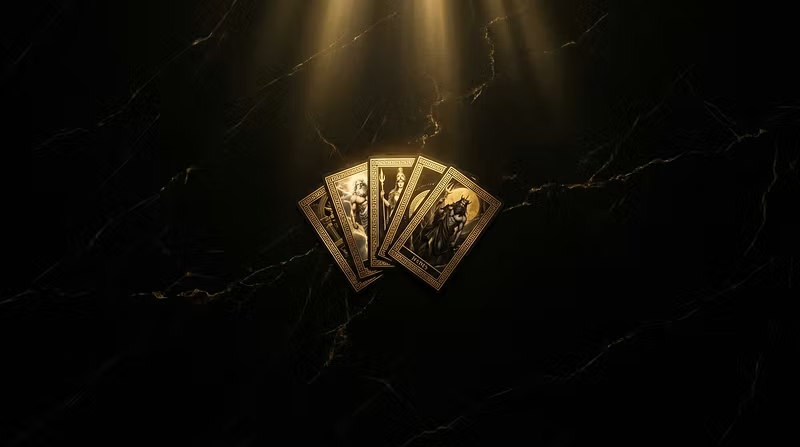
The Olympic Mindscape framework assigns each of the major Greek archetypes to a card. 54 cards total. Each one represents a psychological state, a challenge, or a transformative pathway.
Here's how a session might work:
The client draws 3 cards — representing their present state, core tension, and growth edge
You use the accompanying guidebook to unpack the mythological narrative behind each card
Together, you build a "map" of their inner landscape using the Greek pantheon as language
The client walks away with a concrete, visual framework they can reference between sessions
This isn't fortune-telling. It's structured metaphor work — and it gives clients language for experiences they couldn't articulate before.
I built Olympic Mindscape because I was tired of abstract frameworks that didn't stick. Myth sticks. Story sticks. And when your client can say "I'm in my Hades phase" instead of "I feel depressed," something shifts.
The card deck and companion book are in pre-launch now. If you're a life coach or hypnotherapist looking for a differentiated methodology, this is what I built for you.