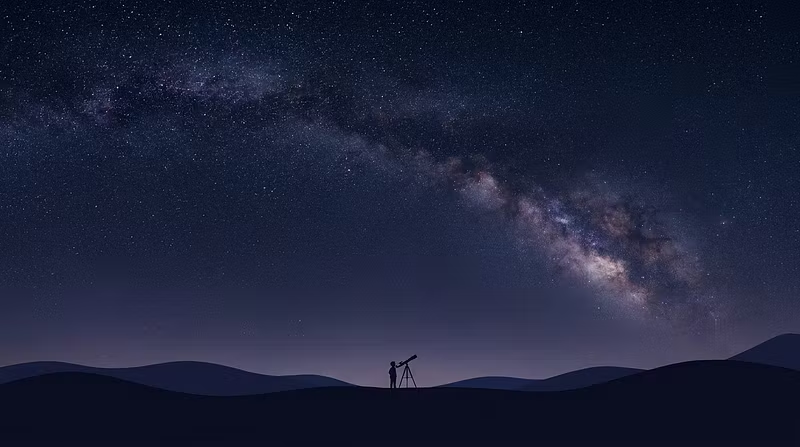


The one trick that made stargazing actually click for me: stop looking for objects, learn the pointer stars first
Most beginner astronomy advice starts with "here's how to find Orion" or "here's how to find Saturn" — but if you don't already have a reference point in the sky, that advice is nearly useless. You end up just staring at a wall of stars with no idea where to start.
The fix that actually worked: learn ONE pointer system before anything else. For most of the Northern Hemisphere, that's the Big Dipper → Polaris (North Star) line. Once you can reliably trace those two "pointer stars" on the front edge of the Dipper's cup out to Polaris, you have a permanent north/up anchor for every other session. Everything else — Cassiopeia, Orion, the planets — gets located relative to that one line, not memorized from scratch each time.
Two other things that made a bigger difference than gear ever did:
Checking Moon phase before I went out. A full Moon washes out almost everything except the Moon and bright planets — I wasted a lot of early nights not realizing that.
Giving my eyes 15-20 min to dark-adapt and using a red flashlight instead of my phone. Sounds minor, genuinely isn't.
None of this needs a telescope. Binoculars (or even naked eye) is enough to make this method work. Curious if others found a different "first landmark" that worked for them.