




ANTI-AInxiety — The 30-Day AI Leverage System (Founding Edition)
Stop evaluating AI tools. Decide what your company actually does with them.
Which parts of your recurring work should AI touch — and which should it never touch?
That is what this answers. Over thirty days, you finish with five documented workflow decisions, each with a named owner, a real human review point, and a recorded baseline.
Most AI adoption in growing companies starts with a tool. It feels like progress — a shortlist, a trial account, a demo booked — and it reliably wastes a quarter. The opposite failure is as common: teams burned once automate nothing, and carry the drag anyway. This replaces both with a decision.
Four weeks. Week 1 makes the recurring work visible and classified. Week 2 scores it against anchored criteria and selects five slots. Week 3 deploys what should deploy, under real review. Week 4 measures against the Day 10 baseline in the same unit and produces five written decisions.
Five documented decisions do not mean five automations. Some deploy. Some run as controlled pilots. Some are measured before anything changes. Some are redesigned first. Some formally record that work stays human. You must never create an unsafe automation to fill a slot.
Governance and human review are built in rather than added afterwards.
For founders, COOs, Heads of Operations, and senior operators in companies of roughly 10 to 100 people, where recurring work has outgrown how it is done.
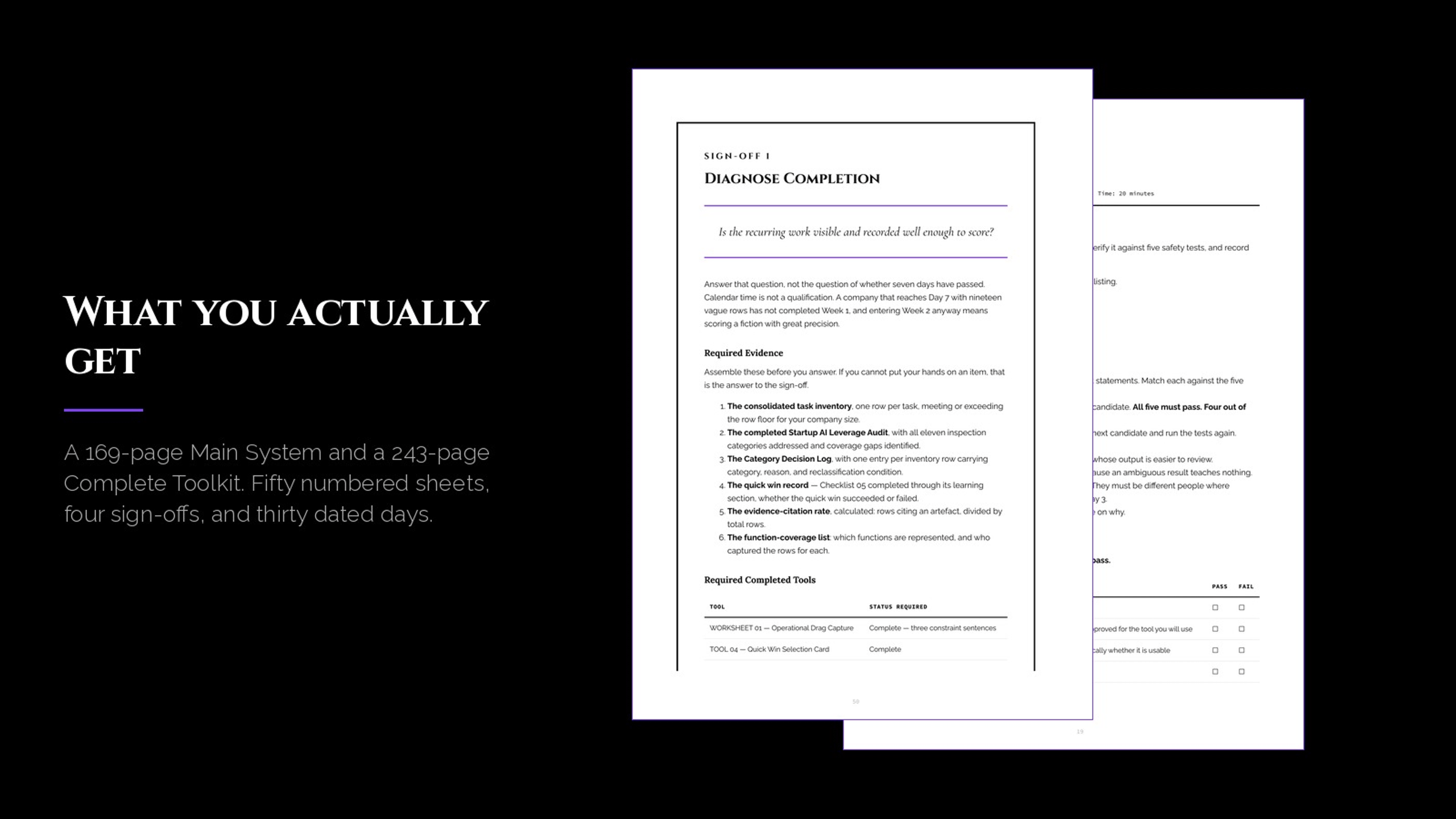
Delivered as PDFs: the main system, a toolkit of fifty numbered sheets printed separately, and the master archive. Founding Edition.