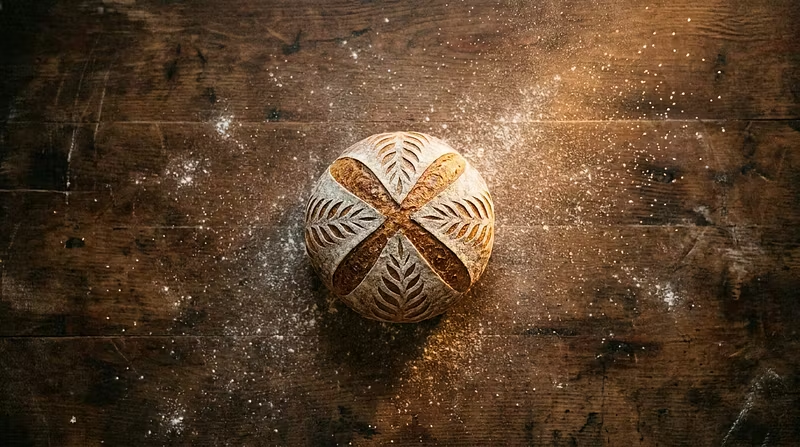


5 Scoring Mistakes That Are Ruining Your Sourdough (And How to Fix Them)
After scoring thousands of loaves and teaching hundreds of bakers, I see the same 5 mistakes over and over. Fix these and your bread will look dramatically better overnight.
1. You're scoring warm dough
This is the biggest one. If your dough is room temperature and sticky, your blade will drag, tear, and create ragged lines no matter how sharp it is.
The fix: Shape your dough, put it in a banneton, and refrigerate it for at least 1 hour (overnight is better). Cold dough is firm, the surface is taut, and your blade will glide through it like butter. Every professional baker scores from the fridge. Every single one.
2. Your blade is dull
Razor blades are designed to be disposable. If you've used the same blade for more than 3-4 loaves, it's dull — even if it still feels sharp to the touch. Bread dough contains tiny mineral particles from the flour that wear down the edge fast.
The fix: Fresh blade every 2-3 bakes. They cost pennies. This is not the place to economize.
3. You're cutting too shallow
New bakers are timid with the blade. A 1-2mm cut looks like a scratch on raw dough and completely disappears during baking. Your scores need to be deep enough to actually direct where the bread expands.
The fix: Aim for 3-5mm depth on functional cuts. You should be able to see the cut clearly gape open on the raw dough. If you can't, go deeper.
4. You're not using enough steam
Steam keeps the crust flexible during the first 15 minutes of baking. Without it, the surface hardens before your scores have a chance to open. The result: flat, sealed lines instead of dramatic, blooming cuts.
The fix: A Dutch oven with the lid on is the simplest and most effective steam method for home bakers. No spray bottles, no lava rocks — just preheat the Dutch oven, drop in the dough, lid on, 20 minutes. Then remove the lid to brown.
5. You're hesitating
A confident, swift cut produces a clean line. A slow, uncertain cut produces a torn, jagged mess. Your blade should move quickly — one smooth motion per line.
The fix: Practice your motion in the air before touching the dough. Plan your design ahead of time (sketch it on paper if it's complex). When you go in, commit fully. One stroke. No going back over the same line.
---
If you want to master scoring from foundations to advanced artistic patterns, check out my course The Art of Scoring — it covers blade technique, essential cuts, geometric and floral designs, oven science, and how to develop your own signature style.