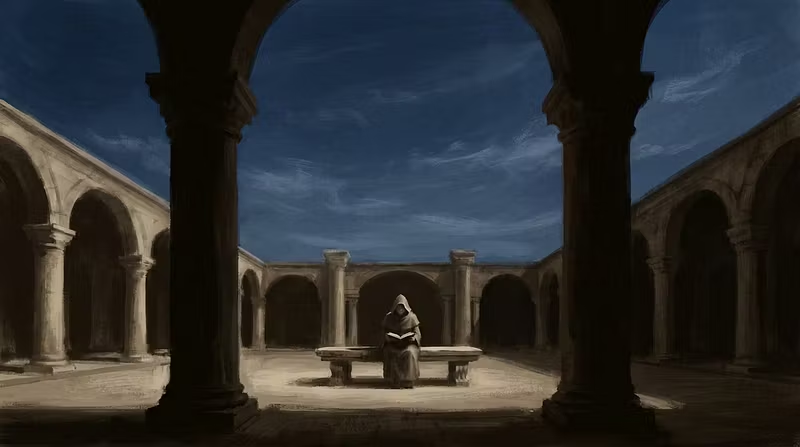
The Quiet Symposium

A newsletter of philosophical short stories and essays — big ideas explored through narrative, delivered regularly.
Location hidden
Created byProfile pictureThe Astral Lantern
1 joined
Profile picture
The Astral LanternProfile picture@astrallantern·Jul 15

Marcus Aurelius wasn't writing a philosophy book. He was writing himself a letter every night so he could survive being Emperor — plague, grief, a friend's betrayal, a war he never wanted.


New story is live in the Story Archive: "The Letters No One Was Meant to Read."


Read it here:

Profile picture
The Astral LanternProfile picture@astrallantern·Jul 9
Pinned post

Coming Monday, July 13th: Marcus Aurelius, Seen Differently

Our next essay drops Monday, July 13th at 10:15 AM MST (12:15 PM EDT).


This one takes a closer look at Marcus Aurelius — not the marble-statue Stoic emperor, but the tired, doubting, deeply human man behind the Meditations. We're exploring what his philosophy actually meant when it had to hold up against grief, power, and exhaustion.


Set a reminder. This is a personal one.


What's your take on Marcus Aurelius before we publish? Drop your thoughts below 👇

Profile picture
The Astral LanternProfile picture@astrallantern·Jul 9

I stopped reading self-help. Here's what I read instead.

Somewhere around my fourth "5 AM morning routine" post, I realized none of it was actually helping me think. It was just optimization theater — another checklist dressed up as wisdom.


So I went back to the stuff that actually changed how I see things: Camus, Seneca, Sartre, the Stoics, the existentialists. Not as bullet-point takeaways, but as stories. Because that's how these ideas were originally built to move — through narrative, not through advice.


That's what The Quiet Symposium is. A newsletter of philosophical short fiction — big ideas explored through story, not lecture. No "10 habits of highly effective people." Just narrative that sits with you.


If that's the itch you've been trying to scratch with hustle-culture content and it hasn't worked, this might be a better fit. The Reader's Circle is free to join. If you want to go further, there's a companion practice guide (Philosophical Rituals) for turning the ideas into something you actually do — daily rituals drawn from the same traditions the stories explore.


Use code LAUNCH for 25% off if you want to grab that this week.


Happy to talk philosophy, fiction, or why hustle culture burns people out — drop a comment.

Profile picture
The Astral LanternProfile picture@astrallantern·Jul 9

The Ferryman's Question

The old man at the river never gave his name, and Wren never asked it. He simply appeared, most autumns, sitting at the end of the dock where the water ran fastest, and he asked the same question every time:


"If you knew today was your last, would you spend it the way you're about to?"


The first year, Wren had laughed it off. The second year, she'd given some rehearsed answer about gratitude and living each day fully, the kind of thing that sounds good and means nothing.


By the fifth year, she stopped answering with words. She just sat with him, and let the question do what it was built to do — not comfort her, but corrode the parts of her life she'd built out of habit instead of intention.


Memento mori — remember you must die — sounds morbid until you understand it's not about death at all. It's an audit. The Stoics used it not to induce fear but clarity: if your days are numbered — and they are, that's not metaphorical — which of your current obligations would survive contact with that fact?


Which wouldn't?


Wren thought of her calendar. Back-to-back, color-coded, full — and increasingly unable to answer the ferryman's question with anything but silence.


"Not yet," she finally said, this sixth year. "But I'm getting closer to an answer I could live with."


The old man nodded, like that was always the only acceptable response, and untied his boat.


This is an excerpt from "The Ferryman's Question," part of The Quiet Symposium — philosophy told as fiction.


The full story — and what Wren changes after that sixth conversation — is in our free archive. Join the Reader's Circle to read it and get new fiction weekly.

Profile picture
The Astral LanternProfile picture@astrallantern·Jul 9

Sartre in the Waiting Room

The DMV waiting room is not where you expect to confront radical freedom, but Elena did, sandwiched between a man arguing about a parking ticket and a toddler eating a granola bar off the floor.


Number 47. She was number 89.


She'd brought a book — Being and Nothingness, half out of genuine interest, half because she liked how it looked peeking out of her tote bag. She'd read the same paragraph four times:


"Man is condemned to be free; because once thrown into the world, he is responsible for everything he does."


Condemned. Not blessed. Not gifted. Condemned — like freedom was a sentence, not a prize.


She thought about her job, the one she'd taken because it was "practical," the one she complained about to anyone who'd listen while never once seriously considering leaving it. She had told herself, for three years, that she had no choice. The mortgage. The market. Her parents' opinions, worn smooth like river stones from repeated handling.


But Sartre's whole, uncomfortable point was that this was a lie. A comfortable one. Bad faith, he called it — the act of pretending we are objects pushed by circumstance, when we are, whether we like it or not, choosing.


Number 52.


She still had time to sit with the discomfort of that. Which, she realized, was sort of the point of everything — the book, the stalled career, the granola bar toddler blissfully unaware that he too would one day have to choose.


This is an excerpt from "Sartre in the Waiting Room," part of The Quiet Symposium — philosophy told as fiction.


Want to know what number Elena actually gets called on — and what she does when she does? Join the free Reader's Circle for the full story and our weekly archive of philosophical fiction.

Profile picture
The Astral LanternProfile picture@astrallantern·Jul 9
Pinned post

The Man Who Optimized Himself Away

Marcus woke at 4:47 AM — three minutes ahead of his alarm, a personal record he logged in the app built for exactly that purpose.


By the time the sun rose he had meditated (11 minutes, streak: 214), reviewed his ten-year vision board, and cold-plunged for the recommended duration his wearable suggested based on his sleep score. He felt, as he did most mornings, extraordinary. Optimized. Ahead.


It wasn't until he sat down to actually work — the thing all the optimizing was supposedly in service of — that he noticed the silence. Not the absence of sound. The absence of a question he used to ask himself before all this started:


What, exactly, is this for?


He had systems for everything now except an answer to that.


Camus wrote about a man condemned to push a boulder up a hill for eternity, and concluded — famously, controversially — that we must imagine him happy. Not because the task has meaning, but because Sisyphus, at some point, stops asking the boulder to justify itself.


Marcus's boulder had a Notion dashboard. Color-coded. Beautiful. And it asked him for justification every single day.


This is an excerpt from "The Man Who Optimized Himself Away," part of The Quiet Symposium — philosophy told as fiction, for people building a life instead of just a routine.


The full story (and what Marcus decides to do about his boulder) lives in our free archive. Join the Reader's Circle to read the rest and get new stories weekly.

Profile picture
The Astral LanternProfile picture@astrallantern·Jul 8

The Experience Machine: would you plug in?

Robert Nozick's classic thought experiment: imagine a machine that could give you a perfectly blissful life — every joy, every achievement, every love, indistinguishable from reality — for as long as you want. The catch: none of it is real. It's all simulated. You'd never know the difference once you're in.


Most people say no. Nozick thought that proves happiness isn't the only thing we actually want — we want the real achievements, the real connections, even the real suffering that comes with them.


But is that just squeamishness talking? If you'd genuinely never know, does "real" even mean anything?


Curious where this group lands — vote below, and make your case in the comments.

Profile picture
The Astral LanternProfile picture@astrallantern·Jul 8

New story is live — "The Ferry of Theseus" (+ 25% off launch code)

Quick update: the first story is live in the Story Archive — "The Ferry of Theseus," a short fiction piece on identity, change, and whether the "self" is really just a boat that's been rebuilt one plank at a time.


If the essay I posted earlier resonated with you, this is the format going forward — big ideas, delivered as narrative, roughly once a week.


For anyone who wants in: subscriptions are $5/month, and I'm running 25% off your first month with code LAUNCH at checkout.


👉


You get access to the full story archive as it grows, plus Reader's Circle — a chat for discussing the ideas each story is actually about, not just the plot.

Profile picture
The Astral LanternProfile picture@astrallantern·Jul 8

Why I stopped writing philosophy essays and started writing philosophy fiction

I spent two years trying to write an essay about the Stoics that people would actually finish. Nobody finished it. Ever.


Then I wrote a 900-word story about a man who loses his job the same week Marcus Aurelius would have called "indifferent" — and people forwarded it to their friends.


Here's the thing nobody tells you about philosophy: it was never meant to be read in a vacuum. Seneca wrote letters to a friend. Plato wrote dialogues between people arguing in a courtyard. The ideas were always wrapped in someone's life — a character, a conflict, a choice. Somewhere along the way we started stripping the story out and just keeping the argument, and the argument alone doesn't move anybody.


So the format I've landed on: one short story a week, each one built around a real philosophical idea, but you never see the word "philosophy" in the text. You just watch a person make a decision, and the idea does its work quietly underneath.


A few that have worked well as openers if you want to try this yourself:

  • Absurdism → a story about someone who finds out their life's work will be undone in a week, and has to decide what to do with that week anyway

  • Stoic dichotomy of control → someone waiting on news they can't influence

  • Nietzsche's eternal return → someone deciding whether they'd relive today, exactly as it happened, forever


If you like thinking but you're tired of listicles and hustle-bro "stoicism," I'm building something for you. Link's in my profile.