TrackWell

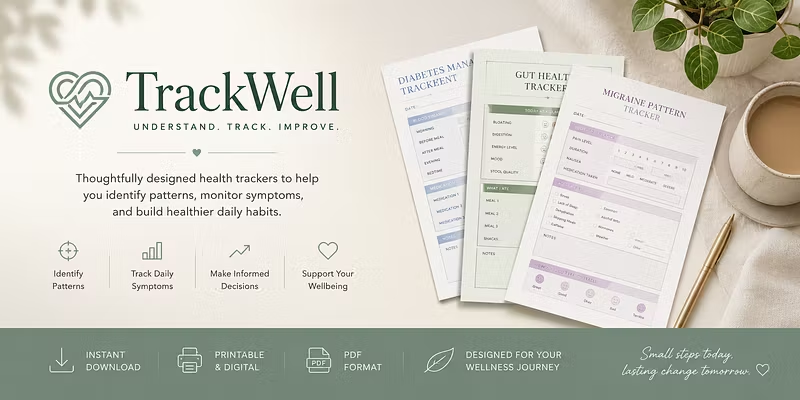
Thoughtfully designed wellness trackers that help you identify patterns, monitor symptoms, and build healthier daily habits — with clarity a...
Location hidden
Created byProfile pictureDronecius
2 joined
Profile picture
DroneciusProfile picture@dronixx·May 27

I spent four years thinking my migraines were random.

No warning. No pattern. Just waking up some mornings and knowing the day was already over.

I tracked every obvious thing. Sleep. Caffeine. Hydration. Hormones. Red wine. Screen time. All of it.

The thing nobody told me was that I was looking at the wrong day.

Migraines don't start when the headache does. There's a phase called the prodrome that begins 12 to 48 hours before — fatigue, neck tension, mood shifts, light sensitivity. Most people don't recognise it as a warning because it doesn't feel like a migraine yet. By the time the headache arrives, the trigger is already 36 hours in the past.

I was trying to trace a Thursday problem back to Thursday. It wasn't Thursday. It was Tuesday.

Once I started logging the day before instead of the day of, I found my pattern within five weeks. Four years of guessing, and the answer was in the calendar square I kept skipping.

If your migraines feel unpredictable — they're probably not. The window you're looking at is just too small.

What does your day usually look like before a migraine hits? 👇

Profile picture
DroneciusProfile picture@dronixx·May 26

something i think about sometimes is how long i spent being really good at coping and really bad at understanding.

like i got genuinely skilled at managing bad days. knowing when to cancel plans, knowing how to get through work when i was running on empty, knowing which foods to avoid on a day when things were already bad. that kind of low-grade survival instinct you develop when something's been off for long enough.

but i didn't actually know why. i had guesses. i had things i suspected. i had the vague sense that certain weeks were worse than others without being able to say what made them that way.

i think a lot of people in this community know exactly what that feels like. managing the symptom without understanding the cause. becoming an expert in the experience of something without ever getting a clear picture of what's driving it.

the thing that changed for me wasn't a new treatment or a new doctor or a new supplement. it was just having my own information in front of me, consistently, over enough time to actually see it.

that sounds almost too simple to matter. it didn't feel simple.

if you've been coping really well but understanding not very much — that's kind of what everything in this community is built around changing. 👇

Profile picture
DroneciusProfile picture@dronixx·May 23

i went to a lot of appointments where i left feeling like i'd failed some kind of test i didn't know i was sitting.

not because the doctors were bad. they weren't. but every time i tried to describe what was happening i could hear myself using words like "sometimes" and "usually" and "i think it gets worse when" and i could see that none of it was landing as anything useful. you can't do much with "i think it gets worse when."

i tried keeping notes on my phone. little voice memos when i remembered. a notes app that became a mess of half-finished observations i couldn't actually use for anything.

what i didn't understand at the time was that the problem wasn't that i wasn't paying attention. it was that i was paying attention to the wrong window. i was looking at today to explain today. and for the kind of thing i was dealing with, today had almost nothing to do with today.

the day i actually understood my own pattern was one of the stranger experiences i've had. not because it was dramatic. because it was so obvious once i could see it laid out. like one of those images where you can't see the hidden picture and then you can and you can never unsee it.

i'm not saying tracking fixes everything. it doesn't. but there's a specific kind of helpless feeling that comes from not being able to explain your own body to the people trying to help you. and that one it does fix.

anyone else have a moment where something that felt completely random suddenly made sense? 👇

Profile picture
DroneciusProfile picture@dronixx·May 21

I want to tell you something about what it feels like to sit in a rheumatologist's waiting room.

You know the appointment is coming. You've been living the last three months — the flares, the fatigue, the mornings where your hands don't work properly. And you know that when your doctor asks "how have you been?" you'll try to describe all of it in about three minutes, mostly from memory.

Most people walk out of those appointments feeling like they didn't quite say what mattered.

The RA & Joint Health Tracking Planner was built for that moment.

24 pages. Daily symptom logs covering pain, swelling, morning stiffness, fatigue, energy, mood and medications. 12-week disease activity trend analysis. Flare tracker. Lab results log. Joint status map for 15 individual joints. A doctor appointment prep page that compiles your data before you even sit down. And a full RA reference guide — DAS28 scoring, medication classes, lab markers — built into every section so you never have to Google while you're filling it in.

So next time someone asks how you've been — you can show them.

$9.99. Instant download. Print as many times as you need, forever.

Profile picture
DroneciusProfile picture@dronixx·May 20

For years I focused on the wrong end of sleep.

I tracked what time I went to bed. I obsessed over getting 8 hours. I tried every bedtime routine I could find. Some nights I got everything right and still felt awful in the morning. Some nights I slept 9 hours and woke up exhausted. I couldn't understand why the hours weren't adding up.

The thing nobody explained to me: your body doesn't run on one sleep system. It runs on two completely separate ones.

The first is sleep pressure — the tiredness that builds the longer you stay awake. You can feel this one. It's the weight behind your eyes at the end of a long day.

The second is your circadian clock — an internal timer that runs on actual clock time, completely independent of when you fell asleep. It decides when to wake you. When your cortisol rises. When your body temperature drops. And it doesn't care how late you went to bed.

When these two systems are aligned, sleep feels effortless. When they're fighting each other — because of irregular schedules, shifts, late nights, or just inconsistency — sleep becomes unpredictable in ways that feel random but aren't.

The single most powerful anchor for this system isn't your bedtime. It's your wake time. Same time every day. That locks the clock. Sleep pressure fills in behind it naturally and starts pulling you toward sleep at the right hour.

Most people spend years trying to fix their bedtime. Their body clock doesn't care about their bedtime.

Tracking both — when you actually sleep, when you wake, how you feel — is the only way to see which system is causing the problem. That's what the trackers in this community are built for.

What time do you naturally wake up without an alarm — and does it match where you actually want to be? 👇

Profile picture
DroneciusProfile picture@dronixx·May 19

For a long time I thought my bad days were random.

Some weeks were fine. Some weeks were awful. I kept waiting for someone to find the pattern for me — a doctor, a test, a diagnosis that finally explained it. I tried everything people recommended. Some things helped a little. Nothing helped consistently.

The thing nobody told me: the patterns were there the whole time. I just wasn't collecting the data.

When I started tracking properly — same metrics, same time every day, consistently — I found something I'd been missing for years. There was almost always a 48-hour delay between a specific trigger and my worst symptom days. Which meant every time I tried to figure out what caused a bad day, I was looking at the wrong 24 hours entirely.

That's not intuition. That's data. And I would never have seen it without logging it over weeks.

Here's what I've come to believe after building TrackWell:

The difference between managing a chronic health condition and actually understanding one is almost always tracking. Not the try-it-for-two-weeks-and-give-up kind. The kind where you build enough data over months to see what is genuinely happening underneath the bad days.

Most people know something is causing their flares, their sleepless nights, their migraines, their gut issues. Almost nobody has the data to confirm what it actually is.

That's what every tracker in this community was built to fix.

What's the one symptom pattern you've always suspected but never been able to prove? 👇

Profile picture
DroneciusProfile picture@dronixx·May 18

New tracker just dropped. 🎉

RA & Joint Health Tracking Planner — 24 pages built from the ground up for people managing rheumatoid arthritis.

✓ Daily symptom logs (pain, swelling, stiffness, fatigue, energy, mood, meds)

✓ 12-week disease activity analysis

✓ Flare tracker & emergency log

✓ Lab results tracker — CRP, ESR, RF, anti-CCP and more

✓ Joint status log for 15 joints across 12 weeks

✓ Doctor appointment prep guide

✓ Medication log, diet & inflammation tracker, monthly calendar

✓ Full RA reference guide built in

$9.99 | Instant download | Print unlimited copies

Grab it in the Products section.

Profile picture
DroneciusProfile picture@dronixx·May 17

I just launched the TrackWell affiliate program and wanted to share it here first.

Here's how it works:

40% commission on every sale. That's $4.00 per tracker sold at our standard price. No cap, no minimum, no time limit.

The products are four premium printable health trackers — Sleep & Insomnia, Migraine, Gut Health, and Diabetes. All designed for people managing chronic conditions. If you have an audience that overlaps with any of those — a blog, a social media account, a Reddit presence, a YouTube channel, a Facebook group, anything — this could be a straightforward fit.

You don't need a big following. You need the right one. One post to the right 500 people outperforms a generic post to 50,000.

If you're interested or want to know more before deciding, just message me directly and I'll send you everything you need to get started.

Profile picture
DroneciusProfile picture@dronixx·May 17

I ate the same meal two days in a row.

Same food. Same portion. Same time of day.

40 point difference in my blood sugar reading.

I thought my monitor was broken.

It wasn't. Here's what was actually happening:

Blood glucose response isn't just about what you eat. It's about the sleep you got the night before. Your stress levels that day. How much you moved. Even the order you ate the food in.

After a bad night's sleep your insulin sensitivity drops enough that a meal that barely moves your glucose on a normal day can spike it significantly the next morning.

I spent months adjusting my diet trying to fix readings that had nothing to do with my food.

The food wasn't the variable.

Everything around the food was.

Once I started logging the full picture — sleep quality, stress, movement, and timing alongside every meal — the unpredictable readings started making complete sense for the first time.

If your levels have ever felt random and impossible to control — they might not be random at all.

What's the most unexpected thing you've found that affects your readings?

Profile picture
DroneciusProfile picture@dronixx·May 16

I fixed my sleep without changing a single thing about my bedtime routine.

No new supplements. No blackout curtains. No white noise.

I changed one thing.

My wake time.

Same time. Every day. Including weekends. No exceptions.

That's it.

Your circadian rhythm is not set by when you go to sleep. It's anchored by when you wake up. Every time you sleep in on a Saturday you're essentially giving yourself mild jet lag going into the week.

Within three weeks of a locked wake time my sleep onset dropped from 40 minutes to under 15. I wasn't doing anything special in the evening. My brain just finally knew when morning was coming — and started preparing for sleep at the right time.

The most powerful sleep intervention is free, requires no products, and feels like the least interesting advice in the world.

What time do you actually wake up on weekdays versus weekends?