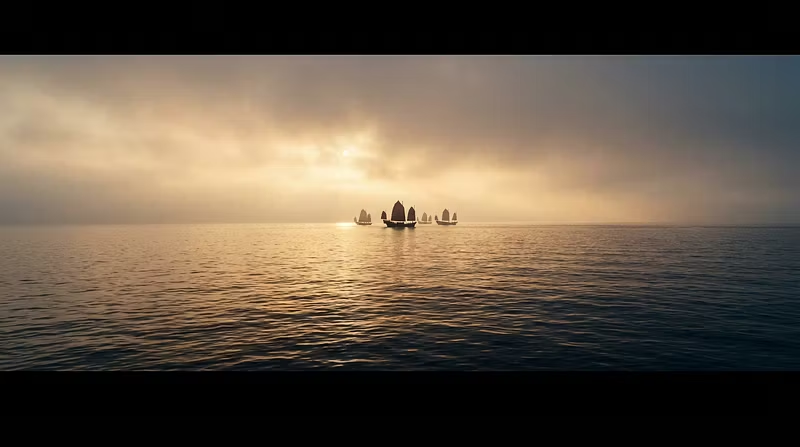


Why Did China Abandon the Greatest Navy on Earth?
In 1405, the Ming Dynasty launched the largest naval fleet the world had ever seen — 317 ships and 27,000 men — under the command of Admiral Zheng He, a Muslim eunuch who'd been captured as a boy and raised in the imperial court.
Over the next 28 years, seven voyages carried Chinese treasure ships across Southeast Asia, India, the Persian Gulf, and the coast of East Africa. These weren't warships on a mission of conquest. They were floating palaces loaded with silk, porcelain, and gold — instruments of a diplomatic strategy that reshaped the Indian Ocean world.
The Numbers Are Staggering
Detail | Zheng He's Fleet (1405) | Columbus (1492) |
|---|---|---|
Ships | 317 | 3 |
Crew | ~27,000 | ~90 |
Flagship length | ~400 ft | ~62 ft |
Voyages | 7 (1405–1433) | 4 (1492–1504) |
The largest treasure ships (baochuan) were roughly five times the length of Columbus's Santa María. They carried translators for Arabic, Tamil, and Swahili. They returned with giraffes, gems, and ambassadors from over 30 kingdoms.
Then It All Stopped
After the Yongle Emperor died in 1424, court factions turned against the voyages. Confucian officials argued the expeditions were wasteful. The Haijin — a sweeping maritime ban — was imposed. Ship designs were destroyed. The treasure fleet rotted in its harbors.
By the time Portuguese caravels rounded the Cape of Good Hope in 1498, the Indian Ocean was wide open. China had voluntarily surrendered naval dominance — a decision that arguably altered the trajectory of global power for centuries.
The Question That Haunts Historians
What if China hadn't turned inward? Would European colonialism have unfolded the same way? Would the Age of Exploration even have happened?
These are the questions I explore in depth inside The Treasure Fleet: Zheng He's Voyages & Ming Diplomacy — a full course covering all seven voyages, the tributary system, Indian Ocean trade networks, and the geopolitical consequences of China's retreat from the sea.
If maritime history, grand strategy, or "what if" questions keep you up at night, this one's for you.