

Why Arabic is Easier Than You Think (An American's Guide)
I keep hearing Americans say Arabic is "impossible to learn." After teaching hundreds of English speakers, here's what I've found — most of the difficulty is a myth.
Here are 5 things that make Arabic surprisingly logical:
1. The Root System is a Cheat Code
Arabic words are built from 3-letter roots. Learn one root, and you can guess dozens of related words. The root ك-ت-ب (k-t-b) means "writing" — from it you get كِتَاب (book), كَاتِب (writer), مَكْتَب (office), مَكْتَبَة (library). One root = an entire word family.
2. No Silent Letters
Unlike English ("knife," "psychology," "queue"), Arabic is phonetically consistent. Every letter is pronounced. What you see is what you say.
3. Only 3 Vowels
English has ~15 vowel sounds. Arabic has 3 short vowels and 3 long vowels. That's it.
4. The Alphabet Only Takes a Week
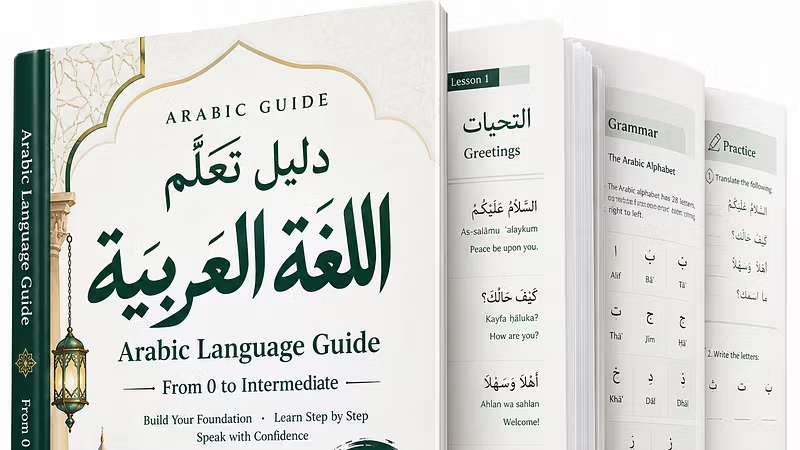
28 letters. Most share base shapes and only differ by dots. You can learn the entire alphabet in 5-7 days with focused practice.
5. Verb Patterns are Predictable
Once you learn a verb pattern, you can conjugate almost any verb that follows it. English irregular verbs (go/went/gone) are far messier.
The real barrier isn't difficulty — it's the lack of structured, beginner-friendly resources designed for English speakers. That's exactly why we built Arabic 2.0.
If you've been thinking about learning Arabic, stop overthinking it and start. The alphabet is waiting.