BeYourOwn-CFO

Big 4-trained Financial Consultant helping US founders ($500K–$10M) on how to optimize their finance operations and find the money their boo...
1 joined
Profile picture
Anjali BansalProfile picture@financeexpert·Jun 30

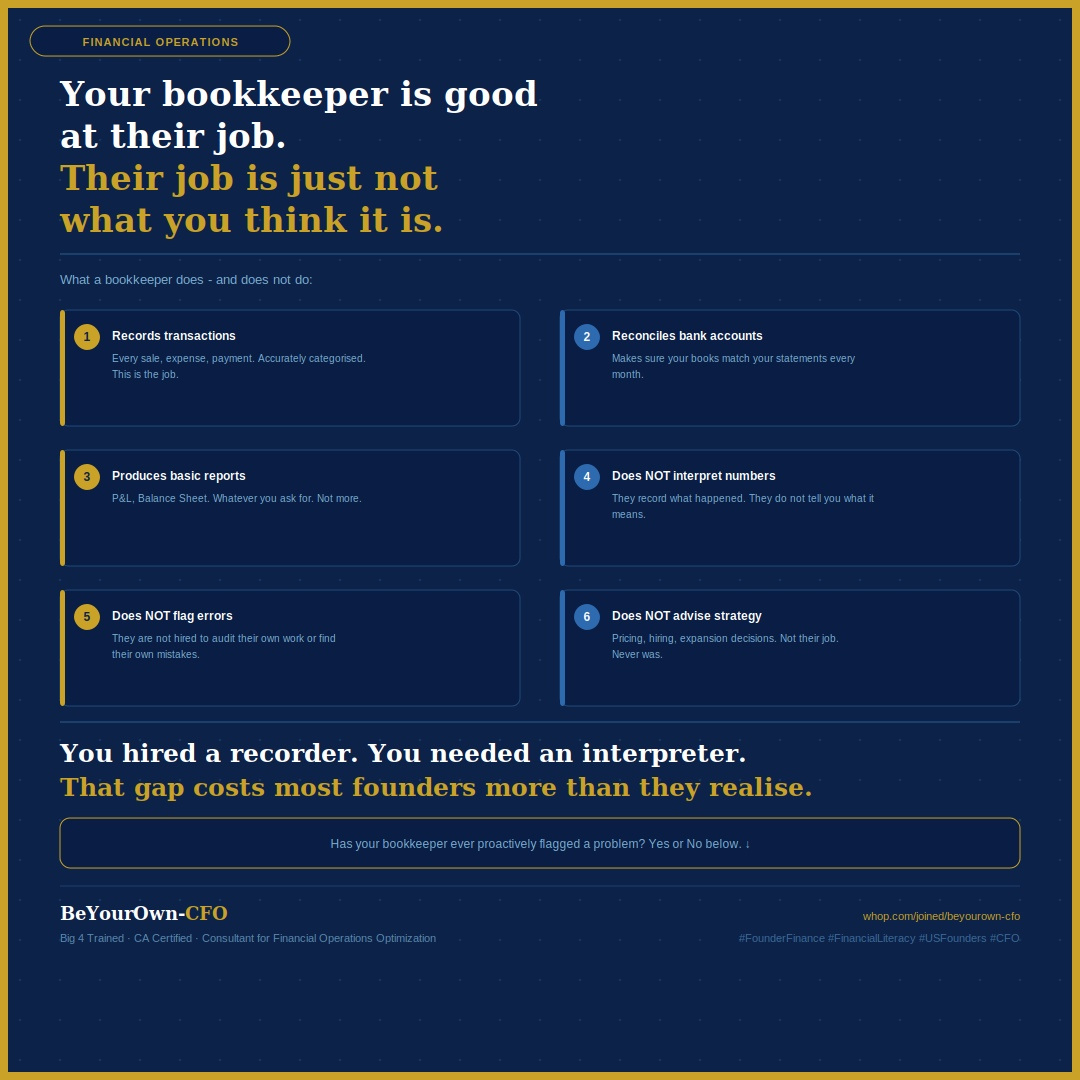
Your bookkeeper is good at their job.

Their job is just not what you think it is.

Here is the honest breakdown:

What your bookkeeper IS hired to do:

→ Record every transaction accurately
→ Reconcile your bank accounts monthly
→ Produce your P&L, Balance Sheet, and basic reports
→ Keep your books organised for your CPA at year end

What your bookkeeper is NOT hired to do:

→ Tell you what your numbers mean
→ Flag that your gross margin has been declining for 6 months
→ Catch the duplicate vendor payments sitting in your books
→ Tell you whether your bookkeeping fee is fair
→ Audit their own work for errors
→ Tell you when you need a controller or CFO

This is not a criticism of bookkeepers.

It is a description of a role.

A bookkeeper is a recorder. Not an interpreter. Not an advisor. Not an auditor.

The problem is that most founders hire a bookkeeper — and assume they have their finances covered.

They don't.

They have their transactions recorded.

Those are two completely different things.

The gap between "books recorded" and "finances managed" is where most $500K–$10M businesses lose money without ever realising it.

Has your bookkeeper ever proactively flagged a problem in your books — without you asking?

Yes or No. Drop it in the comments.

#Bookkeeping #FounderFinance #FinancialOperations #USFounders #SmallBusiness #CFO
file_ZcsQe8PMDHBYj
Profile picture
Anjali BansalProfile picture@financeexpert·Jun 26

You spent years building your business.

Then one day you walk into a room with a banker or a potential buyer.
They ask: "What's your EBITDA margin?"
You smile. You nod and explain the Net Operating Margins of the business or you have absolutely no idea what that means.

And just like that — years of hard work, summarised by a blank stare.

Here's the truth nobody tells founders:
The numbers don't just matter at tax time.
They matter in the room where the deal gets done. Or doesn't.

I've seen founders lose credibility — and negotiating power — in under 60 seconds because they couldn't walk a banker through their own financials.
Not because they built a bad business.

Because nobody ever taught them what the numbers actually mean.

So here are the 7 accounting terms every founder must know before they walk into that room:
1️⃣ EBITDA
Earnings Before Interest, Tax, Depreciation & Amortization.
Your true operating profit — stripped of financing and accounting decisions.
Bankers use it to assess whether your business can repay debt.

2️⃣ Gross Margin
Revenue minus your Cost of Goods Sold — expressed as a percentage.
It tells the room how efficiently you produce what you sell.
A declining gross margin is the first question they'll ask about.

3️⃣ Working Capital
Current Assets minus Current Liabilities.
Simply: can your business cover its short-term obligations without borrowing?
Negative working capital in a buyer meeting is a very uncomfortable conversation.

4️⃣ Accounts Receivable Aging (A/R)
Money your customers owe you — broken down by how long it's been outstanding.
The older the receivables, the harder they are to collect.
Buyers and bankers see high A/R aging as a risk. Not a revenue number.

5️⃣ Cash Flow vs Profit
This one trips up more founders than any other.
Profit is what your accounting says. Cash is what's actually in your bank.
You can be profitable on paper and completely out of cash in reality.
Know both numbers. Always.

6️⃣ Debt Service Coverage Ratio (DSCR)
Operating income divided by total debt payments.
Bankers use this one single number to decide whether to approve your loan.
Below 1.25 is typically a hard no — regardless of how good your story sounds.

7️⃣ Add-backs / Seller's Discretionary Earnings (SDE)
Personal expenses you run through the business that a new owner wouldn't have.
- Car lease. Phone. Travel. Owner's salary above market rate.
- If you don't know your add-backs before you walk in, you're leaving money on the table in the negotiation.

The founder who walks in knowing these numbers controls the room. The one who doesn't — gets controlled by it.

Hence, it is important to implement processes around it and start checking these numbers for business performance tracking and analysis purposes.

Save this post. Your future self — the one sitting across from a banker — will thank you. 👇

file_PzNhpO0Igdhyt
Profile picture
Anjali BansalProfile picture@financeexpert·Jun 25

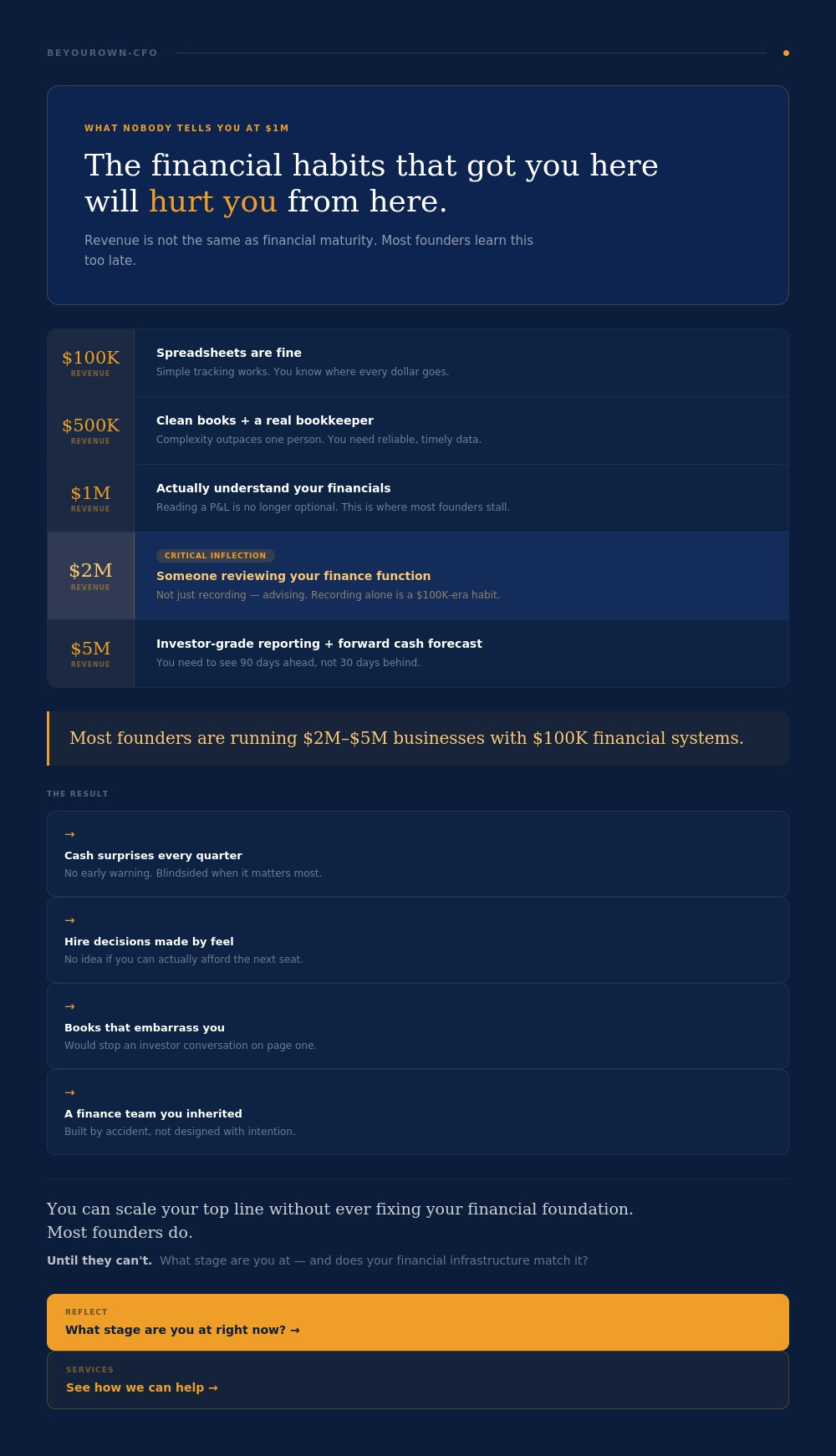
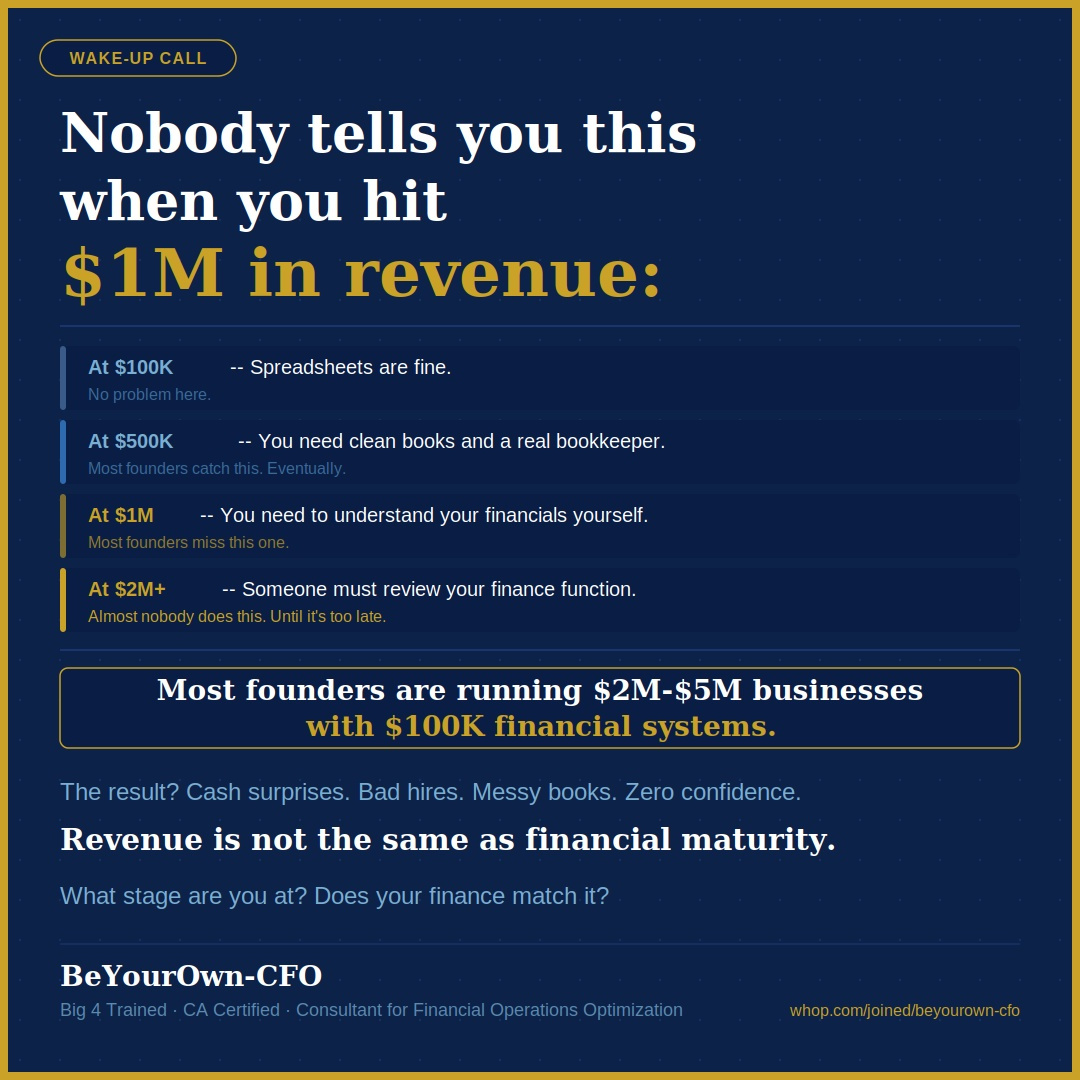
Nobody tells you this when you hit $1M in revenue:

The financial habits that got you here will hurt you from here.

At $100K — spreadsheets are fine.
At $500K — you need clean books and a real bookkeeper.
At $1M — you need to actually understand your financials.
At $2M — you need someone reviewing your finance function, not just recording it.
At $5M — you need investor-grade reporting and a forward-looking cash forecast.

Most founders are running $2M, $3M, $5M businesses with $100K financial systems.

The result?

→ Cash surprises that blindside you every quarter
→ No idea if you can actually afford that next hire
→ Books that would embarrass you in front of an investor
→ A finance team you inherited rather than intentionally built
→ Zero confidence in the numbers you're making decisions on

Revenue is not the same as financial maturity.

You can scale your top line without ever fixing your financial foundation.
Most founders do.
Until they can't.

What stage are you at right now?
And does your financial infrastructure match it?

#FounderFinance #Entrepreneurship #ScalingUp #USFounders #CFO #SmallBusiness #CashFlow

file_dFSZG8y5nr01S
Profile picture
Anjali BansalProfile picture@financeexpert·Jun 24

Three conversations I had with founders last month:

Founder A — $2.1M revenue.
Hadn't looked at her P&L in four months.
"My bookkeeper handles it."

Founder B — $3.1M revenue.
Paying his bookkeeper $1,200/month.
Didn't know the market rate was $900.

Founder C — $1.4M revenue.
Found out during a bank loan application that his books had $60K in misclassified expenses going back 18 months.
His bookkeeper didn't catch it. His CPA didn't catch it. Nobody caught it.

Three different founders.
Three different problems.
One common thread:

Nobody was watching the financial engine of their business.

Your bookkeeper records transactions.
Your CPA files your taxes.

But who is making sure you actually understand your numbers?
Who is making sure you're paying the right people the right amount?
Who is making sure your books are actually accurate?

At $500K–$10M, you are too big to run on gut feel.
And too small to afford the mistakes that come with financial blind spots.

Which of these three founders do you relate to most?
A, B, or C — drop it in the comments.

#Entrepreneurship #FounderFinance #USFounders #CFO #Bookkeeping #SmallBusiness

file_QZxYKUafGcsJg
Profile picture
Anjali BansalProfile picture@financeexpert·Jun 23

Your Month-end reports arrive.

You glance at the Profit & Loss statement.


Revenue looks good.

Expenses seem reasonable.


But then someone asks:

  • “Which product line is the most profitable?”

  • “Which customer segment generates the highest margins?”

  • “Why is profitability declining despite higher sales?”

 And suddenly the reports aren’t enough.

 
Many growing businesses receive financial reports every month. Few receive financial insights.

 
There’s a difference.

  • Reports tell you what happened.

  • Insights tell you what to do next.

 
Without the right metrics, business owners end up making decisions based on intuition rather than data.


And as businesses grow, intuition alone becomes expensive. The goal isn’t more reports. The goal is getting the right information to make faster and smarter decisions.


Are your financial reports helping you grow—or just checking a compliance box?


#BusinessStrategy #Finance #Entrepreneurship #DataDriven #Leadership ecommerce  


pdf
DOC-20260617-WA0011.pdfDocument · 146.9 kB
Profile picture
Anjali BansalProfile picture@financeexpert·Jun 22

Your bookkeeper sends you a report every month.

Your CPA files your return every year.

And you assume everything is fine.

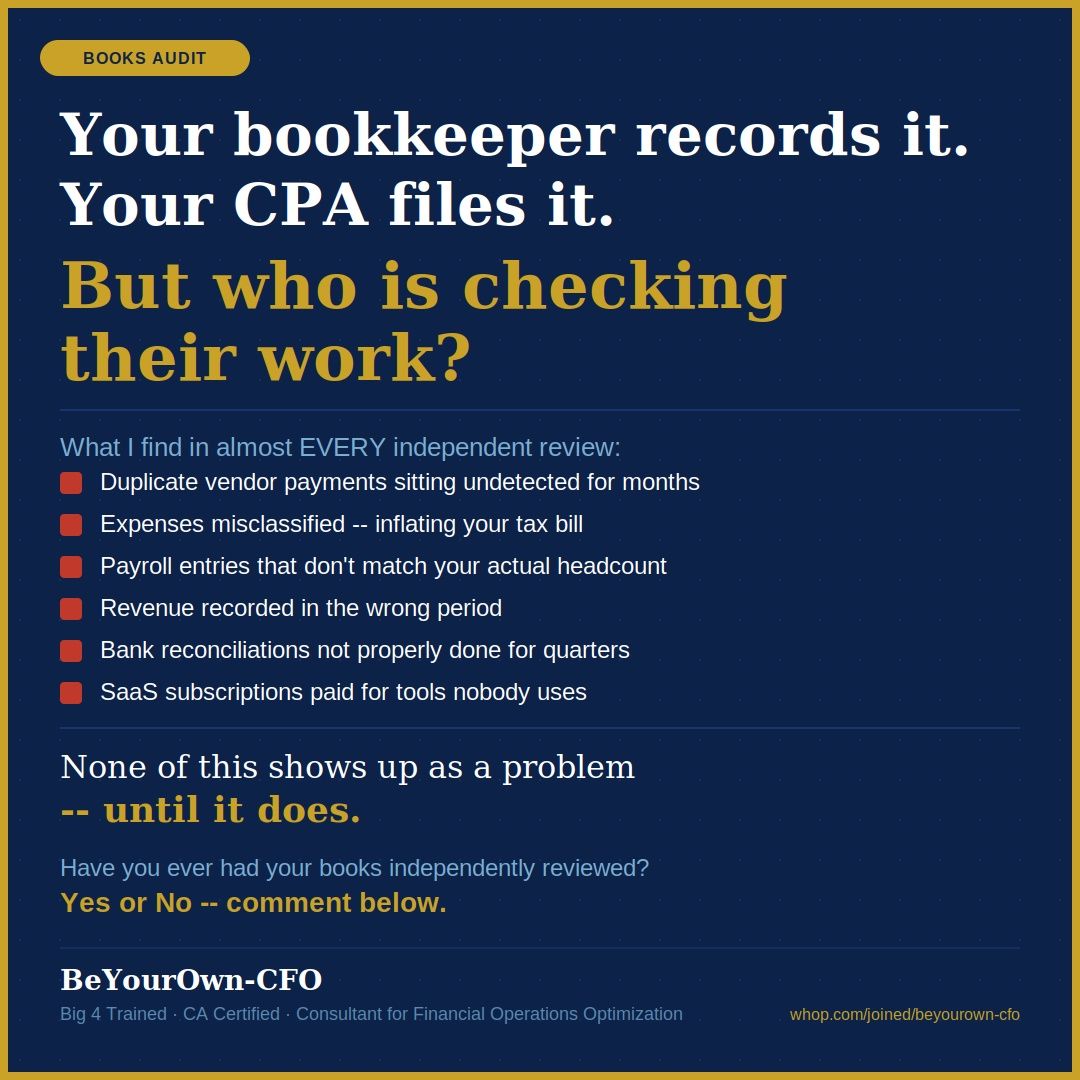
But let me ask you something: Who is checking your bookkeeper's work?

Because here's what I find — almost every time — when I do an independent review of a founder's books:

  • Duplicate vendor payments sitting undetected for months

  • Expenses misclassified in ways that inflate your tax bill

  • Payroll entries that don't reconcile with your actual headcount

  • Revenue recorded in the wrong period — distorting your true profitability

  • Bank reconciliations that haven't been properly done in quarters

  • SaaS subscriptions being paid for tools nobody uses anymore

None of this shows up as a problem — until it does.

  • Until you try to raise money and an investor's due diligence tears your books apart.

  • Until you try to sell your business and the buyer's accountant finds three years of errors.

  • Until the IRS sends you a letter.

Your bookkeeper isn't incompetent. They're just human. And nobody is checking their work.

No doctor operates without a second opinion on complex cases.
No lawyer files a major brief without another partner reviewing it.

Why are you running a $1M+ business where nobody has ever independently reviewed your books?

Have you ever had your books independently reviewed? Yes or No?

file_q3kJsiIWFfYPh
Profile picture
Anjali BansalProfile picture@financeexpert·Jun 19

I ask every founder I work with the same question:

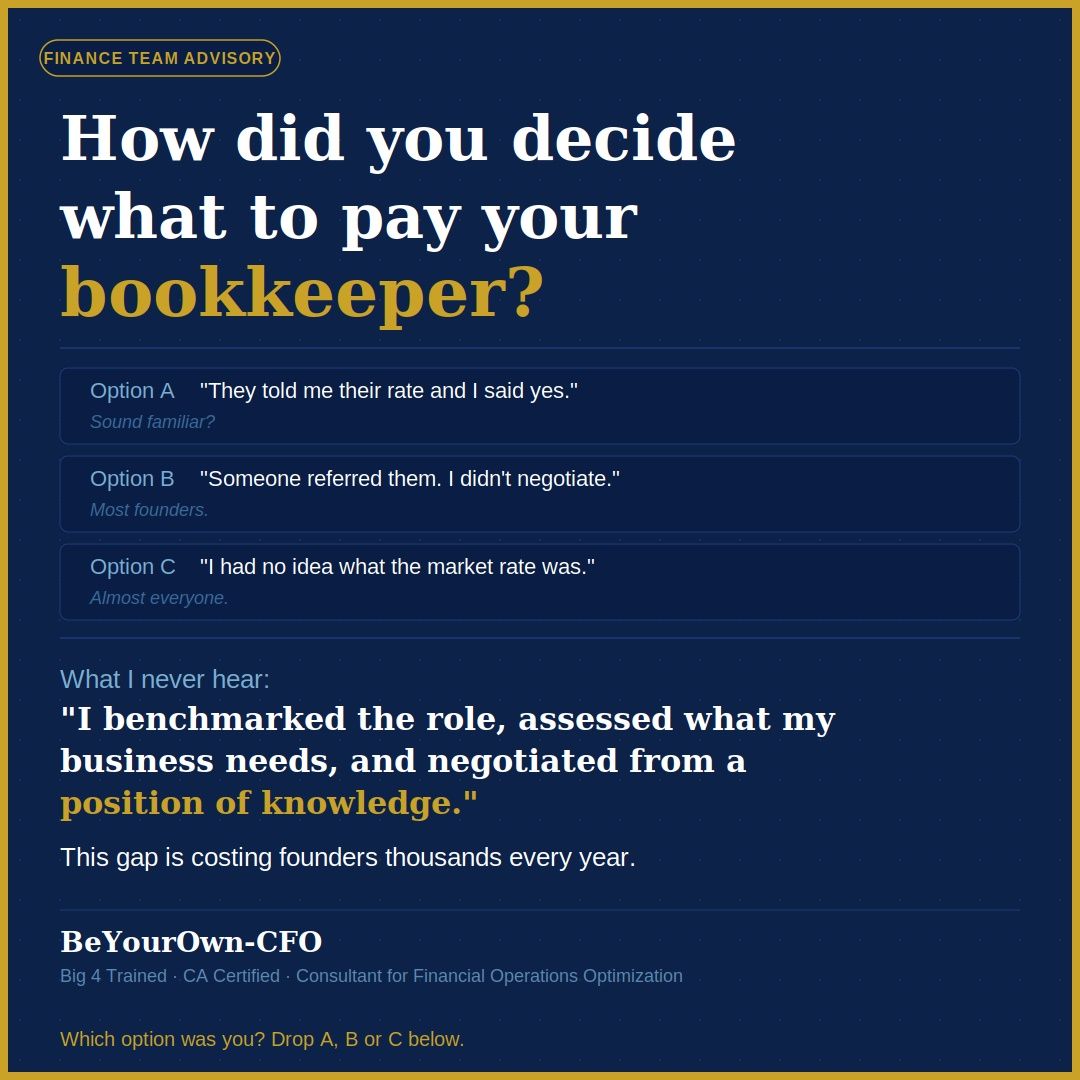
"How did you decide what to pay your bookkeeper?"

The answers are always one of three things:

  1. "They told me their rate and I said yes."

  2. "Someone referred them and I didn't want to negotiate."

  3. "I had no idea what the market rate was so I just paid it."


Not one founder has ever said:
I benchmarked the role, assessed what my business actually needs, and negotiated from a position of knowledge."

And this is costing you.

Here's what I see constantly with founders doing $500K–$10M:

  • Paying bookkeeper rates for controller-level work they're not getting

  • Paying controller rates for basic bookkeeping anyone could do

  • Hiring a full-time CFO at $180K when a part-time one at $3K/month would do the job

  • Keeping a bookkeeper who is actively producing inaccurate books — because switching feels complicated


You negotiate with vendors.
You negotiate with clients.
You negotiate with landlords.

Why are you the only person in your business who doesn't negotiate with their finance team?

What does your current bookkeeper actually cost you per month?

I bet most founders reading this don't know the answer off the top of their head.

Ecommerce  

file_xB0Yr6m8JrmOH
Profile picture
Anjali BansalProfile picture@financeexpert·Jun 18

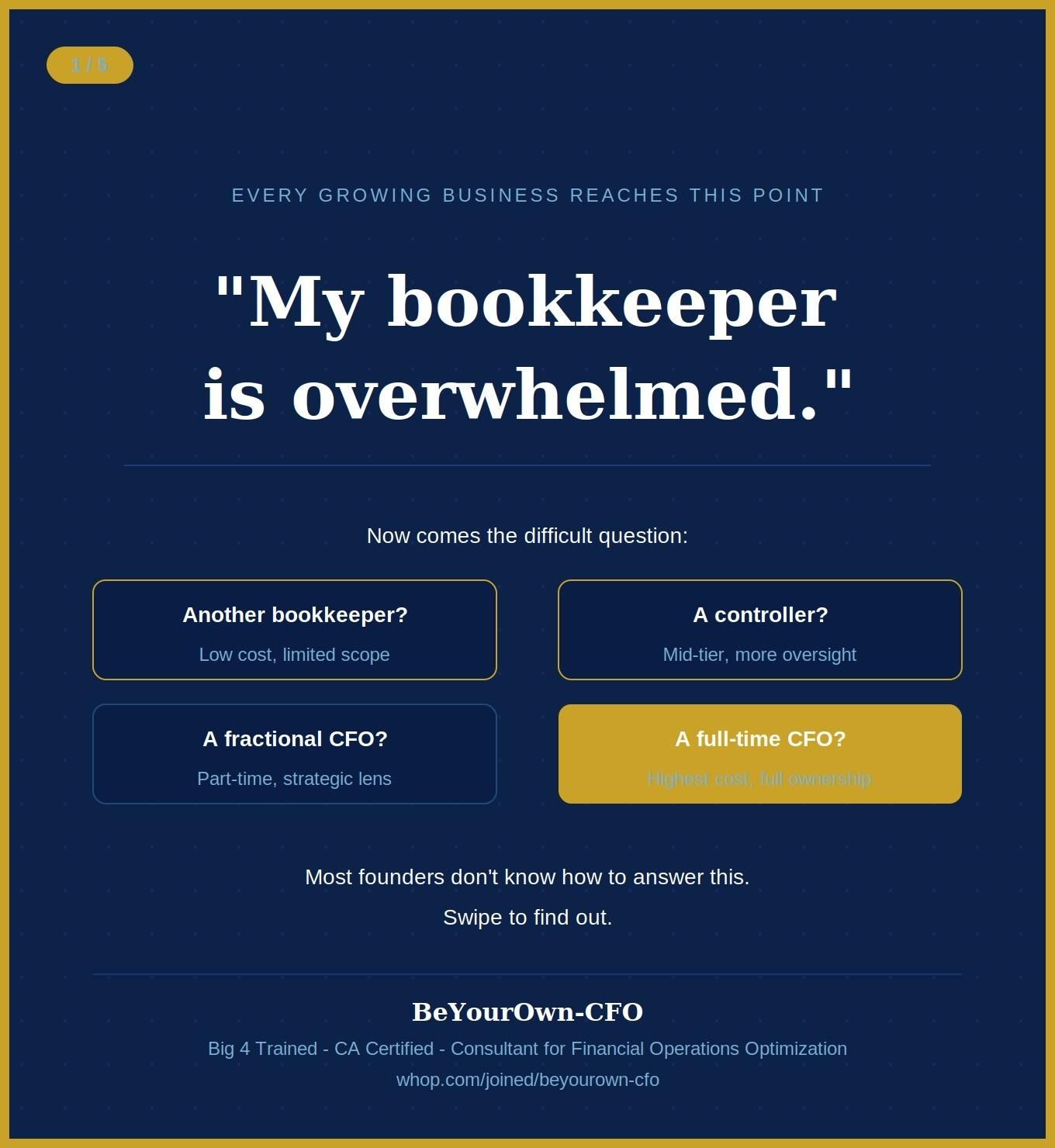
Every growing business reaches this point:

“My bookkeeper is overwhelmed.”


Now comes the difficult question:

 Do you hire another bookkeeper?

A controller?

A fractional CFO?

A full-time CFO?


Most business owners aren’t finance experts.
Yet they’re expected to make hiring decisions that can cost anywhere from $20,000 to $200,000+ per year.

Hire too early, and you’re paying for capabilities you don’t need.

Hire too late, and financial issues start slowing down growth.
The challenge isn’t finding people.
The challenge is knowing what level of financial support your business actually needs.
As businesses scale, financial complexity grows faster than most founders expect.
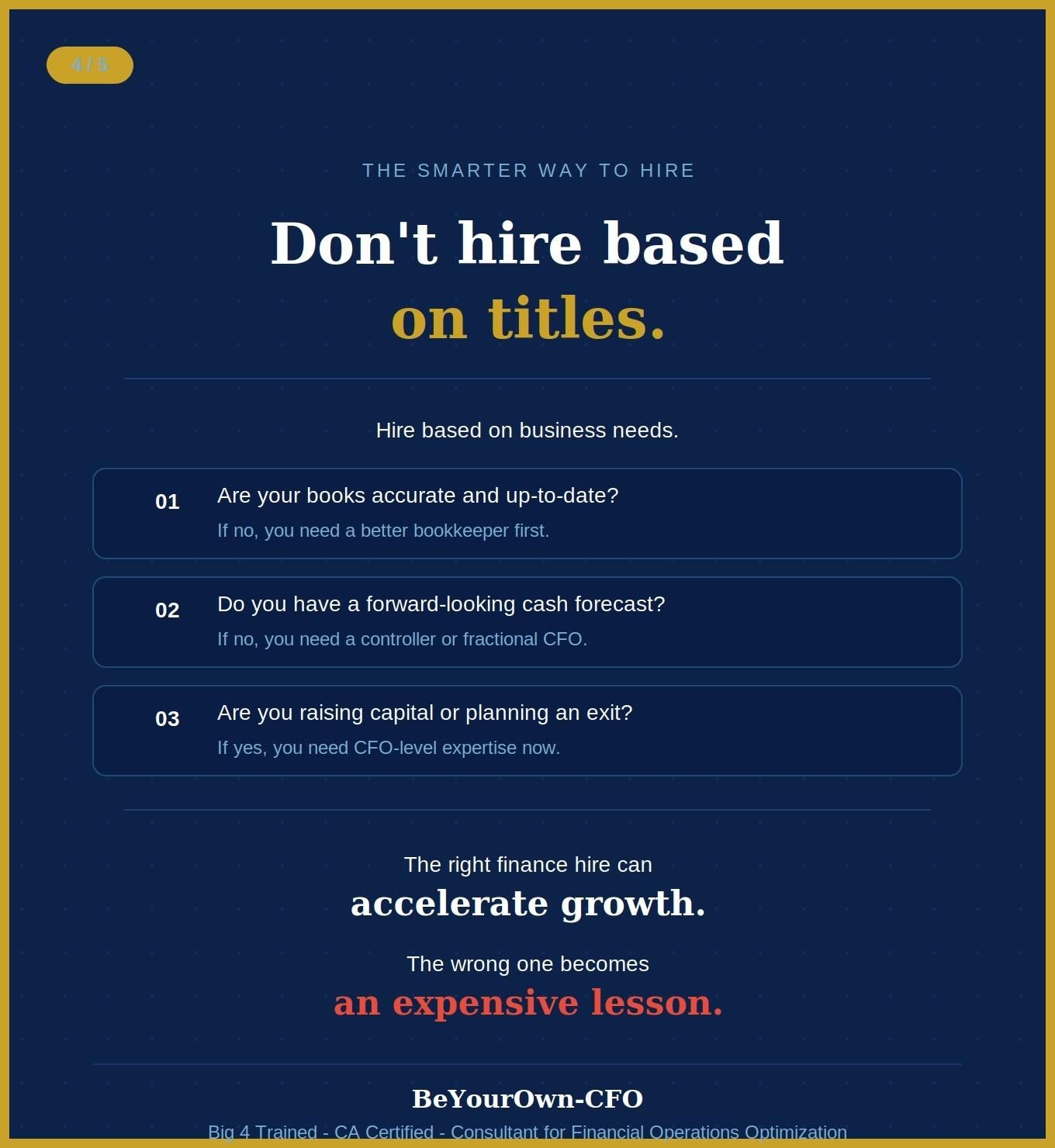
The smartest companies don’t hire based on titles.
They hire based on business needs.
The right finance hire can accelerate growth.
The wrong one becomes an expensive lesson.

 
At what stage do you think a business should bring in CFO-level expertise?

Ecommerce  


file_lFCyLPSQmrb2c
file_zgcOmeVgYg3yQ
file_aJyEN312FgN39
file_mtwh3oGIS0DrP
Profile picture
Anjali BansalProfile picture@financeexpert·Jun 17

You built a $1M business.

But can you answer these questions right now — without calling your bookkeeper?

• What is your gross margin this month?
• Is your cash balance higher or lower than 90 days ago — and why?
• Which expense category grew the most last quarter?
• Are you collecting receivables faster or slower than last year?
• What will your cash position look like in 60 days?

If you hesitated on even one — you don't have a bookkeeper problem.

You have a financial literacy gap.

And it's not your fault.

Nobody teaches founders how to read financial statements. You were busy building a product, landing clients, and managing a team.

But here's the hard truth:

Every major decision you make — hiring, pricing, expansion, fundraising — should be grounded in these numbers.

If you can't read your own financials, you're not running your business.
Your business is running you.

What's the one financial metric you wish you understood better?

file_BFiL9IFn49pnb
Profile picture
Anjali BansalProfile picture@financeexpert·Jun 4
Pinned post

The 3 Numbers Your Bookkeeper Isn't Tracking (That Will Cost You at Tax Time)


After auditing books for various listed companies at EY, and now working with US founders doing $500K–$10M — I keep seeing the same blind spots.


Your bookkeeper reconciles. Your CPA files. But nobody is watching these three things:


1. Owner's Draw vs. Salary Split


If you're an S-Corp doing $1M+ and your bookkeeper is just recording "owner's draw" without optimizing the salary/distribution split — you're likely overpaying self-employment tax by $8K–$15K/year. Your CPA should catch this, but most only look at it once a year at filing time. By then, quarterly estimates are wrong and you're playing catch-up.


What to check: Pull your last 4 quarterly payroll reports. Compare your W-2 salary to total distributions. If your salary is below "reasonable compensation" for your role, you're exposed to an IRS audit. If it's too high, you're leaving money on the table.


2. Gross Margin by Channel (Not Just Blended)


Most DTC founders I work with know their overall gross margin. Almost none track it by channel — Shopify vs. Amazon vs. wholesale vs. retail.


The problem: Amazon fees, FBA costs, and return rates can make a "profitable" product line a net negative. I've seen founders scaling a channel that was actually losing them $3–$5 per order after true COGS + fees.


What to check: Export your last 90 days. Break out revenue, COGS, shipping, platform fees, and returns by channel. If any channel is below 25% true gross margin at your scale, it needs immediate attention.


3. Cash Conversion Cycle


Revenue ≠ cash. Your P&L might say you made $200K last quarter, but if your inventory days are 60+, your receivables are 45+, and your payables are 30 — you're financing 75 days of working capital out of pocket. That's why profitable businesses run out of cash.


What to check: (Average Inventory / COGS × 365) + (Average Receivables / Revenue × 365) − (Average Payables / COGS × 365). If your number is above 45 days, you need a cash flow strategy — not just a P&L.


---


None of this is complicated. It's just not anyone's job right now. Your bookkeeper records what happened. Your CPA files what's required. Nobody's standing between them asking "but is this actually optimized?"


That's the gap I fill.


— Anjali Bansal, Chartered Accountant