The Calm Dog Blueprint

The Calm Dog Blueprint is a science-informed 8-week guide designed to help dogs feel safer when left alone. Learn how to identify triggers,...
Location hidden
โ€ขCreated byProfile pictureNoke
4 joined
Profile picture
NokeProfile picture@noke3ยทSep 11
Pinned post

Welcome to The Calm Dog Blueprint community! ๐Ÿพ

Really glad you're here โ€” and if you just bought the guide, you've already done the hardest part, which is deciding to actually do something about this instead of just hoping it gets better on its own.

A few things to know:

๐Ÿ“– The main guide is in your Products tab โ€” that's your starting point. Read it before you start training. The sequence matters more than most people expect.

๐ŸŽ 5 bonus guides are also in there โ€” Kong protocol, crate alternatives, the medication conversation, emergency management, and the neighbour guide. Grab them all.

๐Ÿ’ฌ This community is for you โ€” ask questions, share wins, vent when a session goes sideways. Everyone here is in it or has been in it. Nobody's going to judge you for having a rough week.

A heads up: progress with SA is slow and non-linear. There will be sessions that feel like you've gone backwards. That's normal and doesn't mean it's not working. Stick with it, trust the process, and use this space when you need support.

Also โ€” this is your community as much as it is mine. If there's something specific you're struggling with that isn't covered in the guide, tell me. I'm adding new content based on what people actually need, so if you want a lesson, a guide, or a deep dive on something specific โ€” just ask. If enough people need it, it's getting built. ๐Ÿ™Œ

Drop a comment and introduce yourself โ€” your dog's name, what you're dealing with, and where you're at. Would love to know who's here. ๐Ÿ‘‡

Profile picture
NokeProfile picture@noke3ยทSep 11

Hey everyone ๐Ÿ‘‹

Just dropped 5 bonus guides into the products folder โ€” go grab them whenever you're ready.

Here's what's in there:

๐Ÿฆด The Kong That Actually Works โ€” because there's a right way and a very wrong way to use food toys with an anxious dog, and most people are doing it the wrong way

๐Ÿ  When Your Dog Loses It In The Crate โ€” what to do if the crate is making things worse (spoiler: for a lot of SA dogs, it is)

๐Ÿ’Š The Medication Conversation โ€” exactly what to say to your vet, what to ask for, and how to push back if they're dismissive

๐Ÿšจ The Emergency Management Plan โ€” for the days you genuinely cannot avoid leaving and need a plan that isn't just hoping for the best

๐Ÿ˜๏ธ The Neighbour Survival Guide โ€” how to handle the awkward neighbour situation while you're working through training

These go alongside the main guide, not instead of it. Think of them as the specific problem-solvers for the situations that come up mid-training.

Head to the Products tab to download โ€” they're all in there now.

If you have questions as you work through any of it, drop them here. That's what this community is for. ๐Ÿพ

Profile picture
NokeProfile picture@noke3ยทSep 10

Your Dog's Separation Anxiety Starts Hours Before You Leave โ€” And Almost Nobody Realises It


Most people believe separation anxiety begins the moment the front door closes.

It doesn't.

For the majority of dogs with significant SA, the panic starts long before that. Sometimes twenty minutes before you leave. Sometimes an hour. Sometimes the moment you open your eyes on a weekday morning.

This is probably the single most important thing owners don't know about this condition โ€” and it explains a lot. Why your dog seems "fine when you left" but comes home to chaos. Why the Kong and the calming treats do nothing. Why the short, careful absences you've been trying still don't seem to be working.

Your dog isn't reacting to being alone. They're reacting to everything they knew was coming before they were even alone.


Your Dog Has Memorised Your Routine. All of It.

Dogs are extraordinary pattern readers. They notice things you don't even register yourself โ€” the specific sound of a particular pair of shoes, the order you do things in the morning, the way your breathing changes when you're running late, what time the alarm goes off on a Tuesday versus a Saturday.

Through repetition โ€” hundreds, sometimes thousands of times โ€” your dog has built a predictive map of your departure. They've learned that alarm at 6:45am โ†’ shower sounds โ†’ coffee machine โ†’ specific jacket โ†’ keys โ†’ you leave โ†’ they panic.

Once that map is built, your dog doesn't wait until the last step to start panicking. They start the moment the first familiar signal appears. Their brain has connected that signal to the thing they fear most, and the fear response begins.

This is called departure cue conditioning โ€” and it's why your dog is often already in a significant state of distress before you've touched the door handle.

The keys aren't just keys. To a dog who has learned this sequence hundreds of times, the keys are the beginning of a countdown to their worst experience.


The Signs That Start an Hour Before You Leave

Here's what's actually happening in the two hours before most dog owners walk out the door โ€” and why you probably haven't noticed, because you've never had a camera running that early.

The velcro phase. Somewhere in the morning โ€” triggered by the first departure cue โ€” your dog becomes your shadow. Where you go, they go. They're not being clingy because they love you (though they do). They're monitoring you, tracking your movements, because their brain has registered a threat and staying physically close to you is the only thing that reduces it.

The yawning. Not tiredness. Rapid, repeated yawning in an alert, awake dog is one of the earliest stress signals there is. If your dog is yawning while you get dressed, that's their nervous system beginning to register escalating anxiety.

The watching. You pick up your jacket. Your dog's head swivels. You pick up your bag. Their posture shifts. By the time you pick up your keys, they're already in a different mental state than they were twenty minutes ago. The body has started preparing for the emergency.

The refusal to settle. A dog tracking a departure sequence will often stop lying down. They'll follow you from room to room. They'll sit alert near the door. If they're in a crate, they may start pressing against the door. This isn't excitement. It's sustained, building anxiety.

The panting. When panting starts before any exercise, before any heat, in the middle of your morning routine โ€” that's a stress sign. It means the internal response is well underway.

By the time you say goodbye, your dog may have been in an escalating stress response for twenty to forty minutes. Which means the absence doesn't begin with a dog at their baseline. It begins with a dog already significantly compromised โ€” sometimes already at or near their limit before you've even left.


Why This Explains Everything That Hasn't Worked

Why the Kong doesn't work: When your dog is in a significant stress response, appetite shuts off. It's not that the treat isn't good enough. When the brain is registering a threat, eating is not a priority function โ€” it gets deprioritised. By the time you leave, if your dog is already in a stress response, the Kong is irrelevant. They literally cannot engage with it.

Why your "calm goodbye" doesn't help: A lot of owners try to leave quietly โ€” no fuss, no eye contact, no long goodbye โ€” because they've been told not to make it a big deal. But your dog isn't reading your body language at the door. They've been reading you for the last forty minutes. The goodbye was never the signal. The shoes were the signal. The keys were the signal. Your calm exit at the end of a forty-minute spiral doesn't undo what their brain has been doing since 7am.

Why short absences can still trigger a full response: If your dog has already been in a stress response for thirty minutes by the time you leave, a "short" five-minute absence isn't actually a short absence from their nervous system's perspective. They arrived at that absence already depleted. The well is already half-empty.


The Thing a Camera at 6am Changes

Most owners set their camera up to see what happens when they're gone. The owners who set it up at the start of their morning routine see something entirely different.

They see the moment the stress switches on.

They see exactly which cue triggered it. Sometimes it's the alarm. Sometimes it's the shower sound. Sometimes it's the specific drawer that opens. Whatever it is โ€” the moment is visible, clear, and specific. And that changes everything about how you address it.

Because you're not treating the absence anymore. You're treating the trigger sequence that starts it.


What You Can Do About It

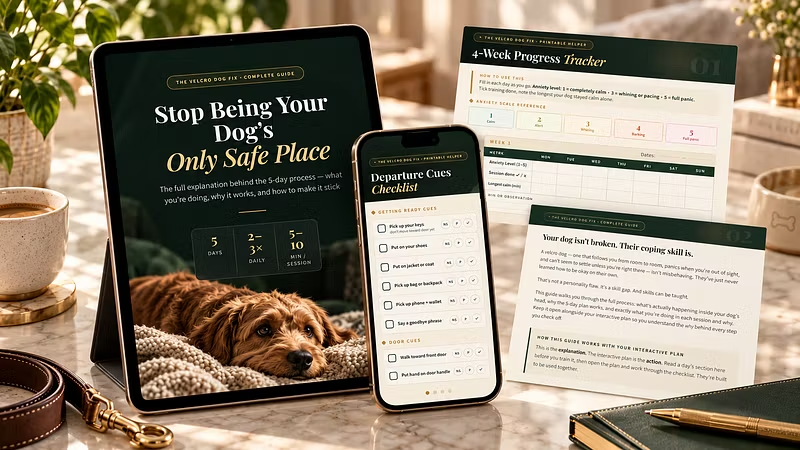
The process of addressing departure cues is called departure cue desensitisation. The concept is simple: if your dog has learned that keys โ†’ departure โ†’ panic, you break the association by picking up your keys repeatedly, in ordinary contexts, without anything following. You do it while watching TV. You do it while making coffee. You carry them to the kitchen, set them down, and walk away.

After enough repetitions of keys โ†’ nothing, the association weakens. The keys stop being the countdown.

Same with shoes. Same with the jacket. Same with the bag. Same with the morning routine itself โ€” on days off, you go through the entire sequence and then sit on the sofa.

This feels absurd. It also works.

The goal isn't to trick your dog. It's to genuinely disrupt the predictive chain their brain has built โ€” so that departure cues stop predicting the terrifying thing, and start meaning nothing in particular.

When you get there, the mornings change. The dog still knows you're leaving eventually. But the frantic shadow-following stops earlier. The panting starts later, if at all. The baseline from which each absence begins is significantly lower โ€” which means the absence itself is significantly more manageable.


The Bit Most People Only Learn After Months of Struggling

The owners who see the fastest progress in separation anxiety training are almost never the ones who started with the absence.

They're the ones who started with the departure.

They figured out โ€” usually through camera footage of their morning, or through a good SA specialist, or just through paying closer attention โ€” that their dog was already in distress before the door closed. And they addressed that first.

If your training feels like it's not gaining traction despite doing everything right, it's worth asking: how is my dog doing in the morning? What do they look like on camera while I'm still home?

The answer might change where you start.


Dog separation anxiety is one of the most treatable conditions there is โ€” but only when you understand what you're actually treating. The absence is often the least of it.

Profile picture
NokeProfile picture@noke3ยทSep 9

You're reading this because you've been Googling "dog separation anxiety" at midnight. You've come home to chewed furniture, neighbour complaints, or a dog who acts like you've been gone for three weeks every single time you leave the house for twenty minutes.

You've probably tried the Kong. The calming treats. The thunder shirt. The trainer who told you to "just be consistent." Maybe you've tried leaving your dog to cry it out, because everyone online said they'd settle eventually.

They didn't. If anything, it got worse.

Here's what nobody tells you at the start: most of the advice floating around about dog anxiety is just wrong for the specific problem you're dealing with. Not because the people giving it are bad โ€” it's just that anxiety in dogs doesn't respond to normal dog training, and most normal dog training advice is what gets handed out.

This post covers what dog anxiety actually is, why the common approaches backfire, and what genuinely helps.


First: It's Not What Most People Think It Is

When people hear "dog anxiety," they usually picture a dog that gets a bit stressed when left alone. A dog that barks for a few minutes, chews something once, then settles.

That's not what we're talking about here.

True separation anxiety is a genuine fear response. When your dog panics every time you leave, their brain isn't registering "hmm, I'm bored and would prefer company." It's registering "something is very wrong and I am not safe."

The destruction, the howling, the accidents from a house-trained dog โ€” those aren't your dog being naughty or attention-seeking. Those are the outputs of a brain that's in full panic mode with no way out.

This distinction matters enormously. Because if you treat anxiety like a behaviour problem, you'll reach for behaviour-based tools โ€” correction, distraction, duration training, crate work. And those tools will fail, because you're solving the wrong problem.

You cannot out-train terror. You can't correct it, distract it with a Kong, or wait for it to pass. What you can do is gradually teach your dog that being alone is safe โ€” through real exposure, at a pace their brain can actually absorb.


The Different Types of Dog Anxiety (They're Not All the Same)

Separation anxiety is specifically about the absence of a particular person. Your dog may be fine with a dog sitter they've never met, fine at daycare, fine with your partner โ€” but falls apart the moment you leave. The distress is tied to you specifically.

Isolation distress is broader. These dogs can't be alone at all โ€” any human presence helps. Leave them with a complete stranger and they're calm. Leave them alone and they're not. For these dogs, management options are much wider because any warm body will do.

Noise phobia is a sensitivity to specific sounds โ€” thunderstorms, fireworks, construction, traffic. Dogs with noise phobia may be completely fine on a quiet Tuesday and a disaster on New Year's Eve. This often overlaps with separation anxiety.

Generalised anxiety shows up as a dog that's just... on edge. Easily startled, constantly hypervigilant, difficulty settling even at home with you there. This one tends to make all the other types worse, because the baseline stress level is already elevated.

Knowing which one you're dealing with matters because the approach is different for each. A dog with isolation distress just needs someone to be home โ€” any management option that keeps them from being completely alone will help. A dog with true SA needs a much more structured training protocol. A dog with noise phobia might need medication support for specific events regardless of how well they're doing with alone-time training.


Why the Common Approaches Backfire

"Leave them to cry it out" โ€” this is the advice that probably caused the most damage. The theory is exposure equals tolerance. For separation anxiety, that's just not how it works. Every time your dog goes through a full panic episode alone, that experience doesn't teach them it's fine. It confirms their fear. The association between "being alone" and "something terrible is happening" gets a bit deeper each time. Most owners who've tried this for months will tell you their dog got worse, not better.

The crate โ€” crates are brilliant for many things. SA is usually not one of them. A dog who's already in panic, now locked in a small box with no ability to move, search, or cope with the fear, tends to escalate dramatically. Some dogs hurt themselves badly trying to get out. The crate wasn't wrong โ€” it was just the wrong tool for this specific thing.

The Kong and food toys โ€” here's something most people don't know: when a dog is in a full panic response, they can't eat. Their appetite systems essentially shut off. It's not that the treat wasn't good enough. They're in survival mode โ€” food genuinely doesn't register. The Kong sitting untouched when you get home isn't stubbornness. It's physiology.

Calming supplements and CBD โ€” these can take a bit of the edge off for some dogs at mild levels of anxiety. They are not going to reach a dog who is in genuine panic. They're useful as part of a broader approach, not as a standalone solution for a dog with significant SA.

Generic training advice โ€” most dog trainers are excellent at what they do. What they do is obedience and behaviour modification. Separation anxiety requires a completely different methodology โ€” one that the majority of general trainers haven't been specifically trained in. Following well-meaning but incorrect advice has cost a lot of people a lot of months. Now you know why.


What Actually Helps

Camera monitoring. This is non-negotiable. You cannot make good decisions about your dog's anxiety without being able to see what's happening when you're not there. You're not looking for destruction and howling โ€” you're looking for the subtle early signs (repeated yawning, lip licking, inability to settle) that tell you your dog is approaching their limit long before the obvious stuff starts. A basic Wyze cam, Blink, or baby monitor works perfectly well. The brand doesn't matter. The footage does.

Understanding the threshold concept. Every dog has a stress limit โ€” a line they can be pushed up to before they tip into full panic. Below that line, they're worried but coping. Their brain can take things in. Above it, they're in full panic and nothing productive is happening. The entire goal of separation anxiety training is to keep your dog below that line, consistently, during every training session. Below threshold = learning. Above threshold = reinforcing the fear. Going slowly is not the cautious approach. It's the correct approach.

Systematic desensitisation. This is the evidence-backed approach. Starting from your dog's current comfortable baseline (which might be sixty seconds, which might be five minutes โ€” wherever they actually are, not where you think they should be), you gradually extend alone time in tiny increments. Camera-monitored. Ending each session before your dog tips over the threshold. Building three consistently clean sessions at each duration before moving forward. This process is slow. It takes weeks to months depending on severity. It also works.

Departure cue desensitisation. Here's the thing most SA protocols miss: for many dogs, the panic starts before you've even left. They've learned that keys mean you're leaving. Shoes mean you're leaving. Your jacket, your bag, your morning routine โ€” all of it has become a countdown to terror. Addressing the departure cues separately โ€” by picking up your keys forty times a day without going anywhere, by going through your whole morning routine and then sitting on the sofa โ€” is an underrated and critical part of the process.

Medication when appropriate. Medication doesn't fix separation anxiety. It also doesn't mask it. For dogs with moderate to severe anxiety, it can reduce the baseline level of fear enough that the training can actually gain traction. Think of it as giving your dog enough headroom to learn, rather than spending every session fighting against a brain that's already running at maximum alert. It works best as a support tool alongside training, not instead of it. Your vet is the right person to talk to about whether it might help your specific dog.


The Stuff Nobody Says Out Loud

Living with a dog who has separation anxiety is genuinely hard in a way that's difficult to explain to people who haven't been there.

You rearrange your schedule around it. You cancel things. You feel guilty leaving to go to a medical appointment. You calculate every errand. You've probably cried in your car in a car park because you don't know what to do and you're exhausted and you love your dog but you can't keep living like this.

All of that is valid. And you're not alone โ€” it's one of the most commonly discussed topics in dog owner communities for a reason.

The other thing nobody says: it does get better. Not for every dog overnight, and not without consistent effort. But dogs who get through this โ€” and they do get through this โ€” do so because their owners didn't give up, found the right approach, and stayed the course even when the progress felt invisible.

The progress is happening even when you can't see it. It accumulates. And one day you leave the house and you're halfway to wherever you're going before you realise you forgot to check the camera.

That day is possible for your dog too.


Where to Start

If your dog is showing signs of separation anxiety, here's the practical starting point:

  1. Get a camera up. You need to see what's actually happening, not guess.

  2. Figure out your dog's real baseline โ€” the longest they can actually be alone without stress signals appearing. Run a proper test. Whatever that number is, it's your starting point.

  3. Stop punishing yourself for the absences that went wrong. You didn't know. You were doing what people told you to do.

  4. Talk to your vet. Especially if your dog's anxiety is severe. A conversation about medication support is not admitting defeat โ€” it's being a responsible owner.

  5. Find a certified SA trainer if you want support through the process. There are practitioners who work exclusively on separation anxiety, remotely, who are very good at this.


Dog anxiety is one of those problems that feels unsolvable until you understand what's actually happening. Once you do, the path forward โ€” while slow โ€” becomes clear.

You're already doing the most important thing: looking for real answers instead of accepting that this is just how it has to be.

It doesn't have to be.