
Welcome to the Application Support Forum!
Welcome! Drop your questions about job postings, resume keywords, and tailoring applications here. We are excited to help you land your next role.

 @careerflow·Oct 2
Welcome! Drop your questions about job postings, resume keywords, and tailoring applications here. We are excited to help you land your next role.
@careerflow·Oct 2If you're applying for jobs right now, this is for you.
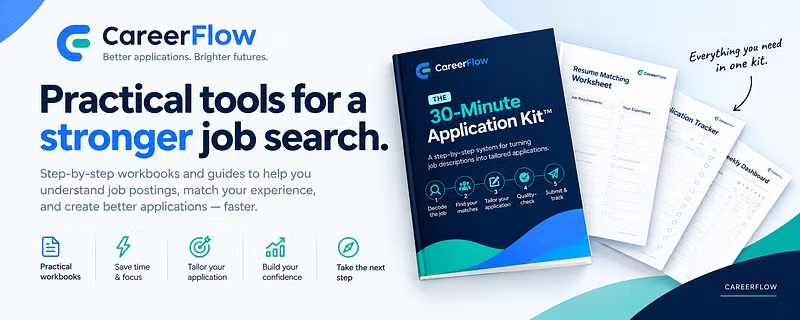
We built the 30-Minute Application Kit™ to turn the application process into a repeatable workflow.
0–5 min: DECODE
5–15 min: MATCH
15–22 min: TAILOR
22–27 min: CHECK
27–30 min: SUBMIT & TRACK
It includes the workflow, AI job-analysis prompts, checklists, matching worksheet, cover-letter guide, and application tracker.
$12.99 one-time.
And if you don't want to buy anything yet, start with the free 5-Minute Job Description Decoder™.
CareerFlow:
@careerflow·Oct 2We're building CareerFlow around one simple idea:
Job applications shouldn't feel like starting from zero every single time.
The system we're working on helps you:
→ Understand the job description
→ Find relevant experience
→ Tailor your application
→ Check your work
→ Submit
→ Track what happens next
We're still learning what job seekers struggle with most.
So tell me:
What's the worst part of applying for jobs for you?
@careerflow·Oct 2JOB SEARCH MYTH 👇
“You need to match every requirement before applying.”
Not necessarily.
A job description can contain:
• Must-haves
• Preferred qualifications
• Responsibilities
• Nice-to-have skills
The first step should be figuring out which requirements actually matter most.
Don't eliminate yourself just because you don't match every line.
@careerflow·Oct 2BEFORE CareerFlow:
Find job → stare at description → rewrite resume → write cover letter → apply → forget about it
😭
AFTER:
DECODE
↓
MATCH
↓
TAILOR
↓
CHECK
↓
SUBMIT & TRACK
Much easier when the process is actually structured.
That's the idea behind CareerFlow.
@careerflow·Oct 2Which one sounds more painful?
A: Applying to 30 jobs with the same resume.
B: Spending 90 minutes tailoring one application.
C: Applying to jobs without really understanding the requirements.
D: Forgetting where you even applied. 💀
Drop A, B, C, or D below.
I'm building CareerFlow around these exact problems, so I'm genuinely curious what people struggle with most.
@careerflow·Oct 2Hot take:
You probably shouldn't start tailoring your resume the second you find a job posting.
First:
Understand the job.
Then:
Find your relevant experience.
Then:
Tailor the application.
Otherwise you're just changing words without knowing what you're optimizing for.
That's the thinking behind CareerFlow's workflow:
DECODE → MATCH → TAILOR → CHECK → SUBMIT
@careerflow·Oct 2Try this before your next job application.
Give yourself 5 minutes.
Read the job description and write down:
→ 3 important requirements
→ 2 responsibilities
→ 1 piece of experience you have that matches
That's it.
Don't rewrite your entire resume yet.
Understand the role first.
If you want a structured version of this process, that's what our free Job Description Decoder is for.
@careerflow·Oct 2POV:
You find a job you actually want.
You open the job description.
47 requirements.
12 bullet points.
3 paragraphs of corporate language.
You stare at the screen like:
“Okay... but what do they ACTUALLY want?” 😭
This is why we built CareerFlow.
Understand the role first.
Then build the application around it.
@careerflow·Oct 2STOP reading job descriptions like a checklist.
Instead, look for 3 things:
What does this person actually need to do?
What skills keep appearing?
What experience would prove you can do it?
You don't need to match every single word.
You need to understand what actually matters.
That's one of the things CareerFlow helps you do.