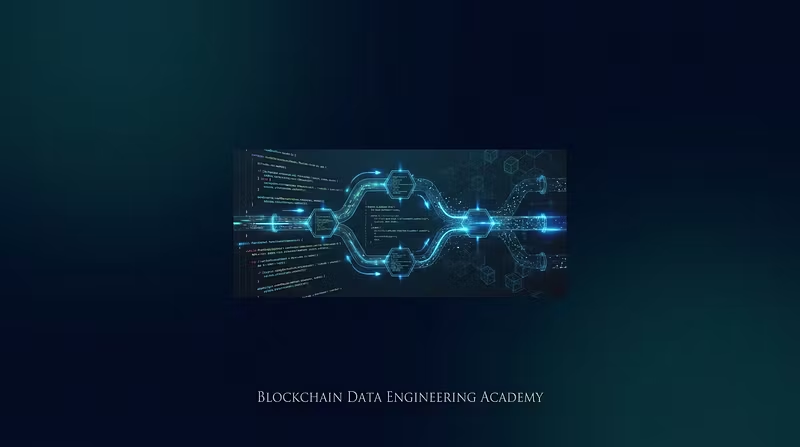


Why Scala Collections Are the Secret Weapon for Blockchain Data Pipelines
If you're building blockchain data pipelines in Python or JavaScript, you're leaving performance and reliability on the table.
Scala's collection library was designed from the ground up for exactly what on-chain analytics demands:
Immutable by default — no race conditions when processing blocks in parallel
Lazy evaluation — scan millions of event logs without loading them all into memory
Type-safe transformations — catch ABI decoding errors at compile time, not in production
Composable pipelines — chain map, flatMap, filter, fold into readable, testable stages
Native parallelism — one method call (
.par) to distribute work across all CPU cores
What I Teach at ChainScale Academy
I built a 4-chapter course that takes you from Scala collection fundamentals to building production-grade on-chain analytics:
→ Parse smart contract events (ERC-20, Uniswap V3) into typed case classes
→ Build composable pipeline stages: Ingest → Decode → Enrich → Aggregate → Output
→ Handle RPC failures with retry logic, circuit breakers, and checkpointing
→ Process block ranges in parallel with thread-safe accumulation
Every example uses real blockchain data patterns. No toy examples.
$297/week with a 1-day free trial. If you're serious about blockchain data engineering, this is the fastest path.