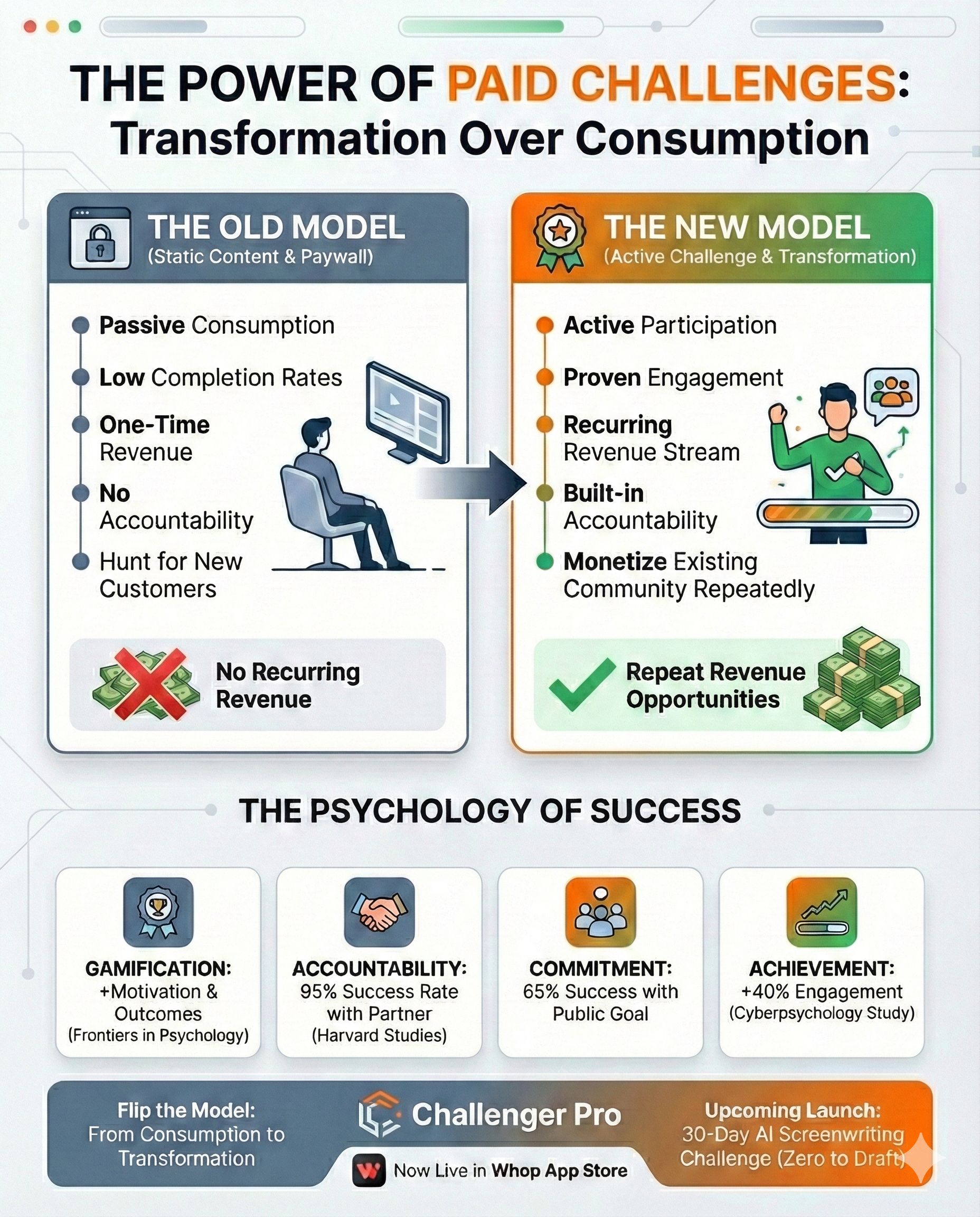


Why Challenges Work: The Psychology Behind What We're Building Here
Let me share something that happened recently.
I was consulting with a creator who had built a solid Whop.
Good content.
Nice branding.
Organized well.
But it was all static. Just content sitting behind a paywall waiting to be consumed.
When I pitched them on Challenger Pro, they pushed back with this:
"I don't understand why someone would pay for a challenge. Who wants that?"
My answer: millions of people. And decades of research prove it.
I want to share that research with you because if you're here, you're either building challenges or thinking about it.
And you should understand exactly why this model works, so you can speak to it confidently when you're selling.
The Research on Gamification
A meta-analysis published in Frontiers in Psychology looked at 41 studies involving over 5,000 participants. The finding? Gamification produces a "significant large effect size" on motivation and learning outcomes.
Another study in Education Sciences (2024) found that 56% of studies report positive effects on motivation when gamification is implemented.
Elements like progress tracking, achievements, and structured challenges positively affect competence and task meaningfulness.
People don't just feel good. They perform better.
The Research on Accountability
This is where it gets interesting.
Research published in Patient Preference and Adherence found that accountability partners help people keep commitments. Even the mere expectation of having to account to someone produces measurable changes in behavior.
Harvard reviewed 266 experiments on accountability spanning five decades. The conclusion? "Numerous desirable effects of accountability on individual decision-making and behaviors."
Here's the stat that should make you sit up straight:
Publicly committing to a goal gives you a 65% chance of success.
Add an accountability partner? That number jumps to 95%.
That's not opinion. That's data.
The Research on Challenges
The Ice Bucket Challenge reached 440 million people worldwide. 28 million participated. It raised $115 million.
75 Hard has built a massive following around a program that is intentionally difficult.
A study in Cyberpsychology, Behavior, and Social Networking found that challenges with achievement or competitive elements increase engagement by 40%.
The University of Cambridge identified the psychological recipe for why challenges go viral: social influence, clear purpose, emotional engagement, and tangible outcomes.
Humans are wired to test themselves.
We want to prove we can do hard things.
We want structure.
We want accountability.
We want transformation, not just information.
Why This Is the Future
The traditional digital product model is broken.
Create content. Put it behind a paywall. Hope people consume it. Chase new customers forever because you can only sell the same course once to the same person.
That's a treadmill. And most creators burn out on it.
Challenges flip the model:
→ Members don't passively consume. They actively prove they did the work. → Creators don't just publish and disappear. They engage, review, and coach. → Revenue isn't one-and-done. You can sell Challenge #1, then #2, then #3 to the same community.
→ Completion rates go up because accountability is built into the structure.
→ Results improve because people aren't just watching. They're doing.
The creator I consulted with? They had a $497 lifetime membership. One price. One sale. Then they have to find another customer.
With Challenger Pro, you could break that same content into ten $49 challenges. Lower barrier to entry. Higher commitment once they're in.
And you can keep creating new challenges and selling to the same audience over and over.
That's not a content library. That's a transformation engine.
What This Means for You
If you're building challenges here, you're not just following a trend. You're building on proven psychology.
When someone asks you why they should pay for a challenge, you have the answer:
Because people want structure. Because accountability works. Because transformation beats information every single time.
The research is clear. The model is sound. Now it's about execution.
Let's build something that actually changes people's lives.
Welcome to Challenger Pro.
— Mark