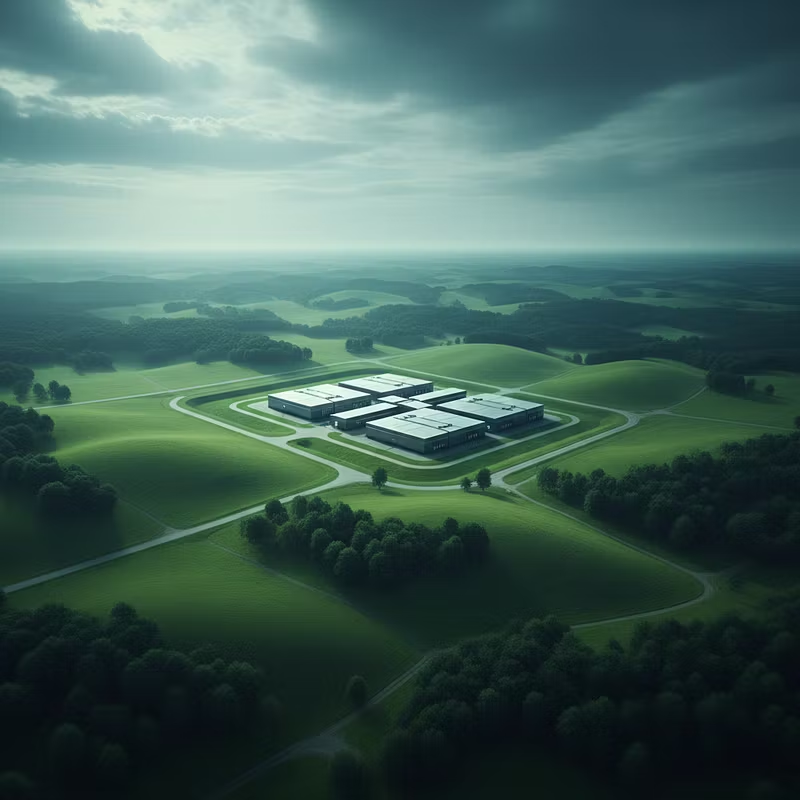


📊 Sample Report: Deep Green 24MW Data Center — Lansing, MI
Data Center Impact Assessment
Deep Green 24MW Facility — Downtown Lansing, Michigan
Sample Report | February 2026
---
Executive Summary
This assessment evaluates the environmental and financial impact of Deep Green's proposed 24-megawatt data center at Kalamazoo & Cedar Streets in Lansing's Stadium District. The $120+ million facility would occupy approximately 25,000 sq ft on 2.7 acres of currently underutilized parking lots, two blocks south of Jackson Field.
Overall Impact Score: 6.4 / 10 — Moderate net positive with significant environmental trade-offs requiring mitigation.
---
1. Financial Impact
Direct Revenue
Category | Annual Estimate |
|---|---|
Property tax revenue | $870,000+ |
BWL utility payments (grid power at $0.08/kWh) | $1,000,000+ |
BWL natural gas savings (heat donation) | $1,100,000 |
Pennies for Power contribution | $120,000 |
Total direct annual benefit | $3,090,000+ |
Capital Investment
Construction investment: $120,000,000+
On-site fuel cell plant: Paid by Deep Green, owned by BWL
Infrastructure upgrades: Deep Green covers all BWL infrastructure costs
Job Creation
Construction phase: 35+ union jobs
Permanent operations: 15+ high-tech positions
Estimated annual payroll impact: $1.5M–$2.2M (operations phase)
Risk Factor
Deep Green is a UK-based company entering its first US market. If the company ceases operations, BWL retains the fuel cell plant and infrastructure investments. However, the property tax and utility revenue streams would be at risk.
---
2. Environmental Impact
Carbon Emissions
The on-site 16MW natural gas fuel cell plant is projected to produce:
~105 million lbs (47,600 metric tons) of CO2 annually
Equivalent to emissions from 11,000+ passenger vehicles
Would require 47,773 acres of US forest to sequester — more than 9x the size of MSU's campus
Emissions Offset
Deep Green claims on-site power generation cuts expected emissions in half versus using BWL's grid for the full 24MW load. The heat donation to BWL's downtown system would:
Reduce BWL natural gas demand by 310 million cubic feet/year
Equivalent to heating ~5,000 homes
Reduce emissions equivalent to removing 3,000 cars from the road
Net Carbon Assessment
Source | Annual CO2 (metric tons) |
|---|---|
Fuel cell emissions | +47,600 |
Avoided grid emissions (vs. 100% grid) | -23,800 (est.) |
Avoided natural gas heating | -16,400 (est.) |
Net annual CO2 impact | +7,400 |
Verdict: The facility produces a net carbon increase of approximately 7,400 metric tons annually, though this is significantly lower than a conventional data center of equivalent capacity.
Water Usage
Closed-loop water-glycol cooling system
Estimated annual consumption: <500,000 gallons
Comparable to a single fast-food restaurant
No discharge into the Grand River
Rating: Minimal impact ✅
Noise
Projected exterior noise levels: 55–65 decibels
Comparable to normal conversation
Cherry Hill residential neighborhood is within blocks
Rating: Low-moderate impact ⚠️
---
3. Infrastructure & Grid Impact
Energy Load
8 MW drawn from BWL's existing grid (BWL confirms current surplus capacity)
16 MW generated by on-site fuel cell plant
BWL's existing customer rates are not expected to increase
Deep Green pays for all new infrastructure — policy ensures no cost burden on existing ratepayers
Land Use
Current use: Underutilized surface parking lots (city-owned)
Proposed use: 25,000 sq ft data center + fuel cell plant on <1 acre
Remaining 1.7+ acres available for complementary development
Requires rezoning from "urban core" to "industrial"
Note: Lansing Planning Commission previously voted down the rezoning proposal
---
4. Community Impact
Positive
Positions Lansing as a national model for sustainable data center development
First heat-reuse data center of its kind in the United States
Annual $120,000 contribution to low-income energy assistance more than doubles Pennies for Power funding
Urban infill development replacing surface parking
Concerns
Strong community opposition documented at multiple public meetings
Residents skeptical of environmental promises — most commitments are not yet contractual
Proximity to residential neighborhoods (Cherry Hill)
Fuel cells are not classified as "clean energy" under Michigan law
No fuel cell plants currently operate in the state — limited regulatory precedent
---
5. Comparative Analysis
Metric | Deep Green (Lansing) | Typical Hyperscale |
|---|---|---|
Capacity | 24 MW | 200–1,400 MW |
Land footprint | 2.7 acres | 50–250+ acres |
Water usage | <500K gal/yr | 100M+ gal/yr |
Jobs (permanent) | 15+ | 30–50 |
Capital investment | $120M | $500M–$3B |
Heat reuse | Yes | Rarely |
Location | Urban core | Rural/suburban |
---
6. Recommendation
The Deep Green proposal represents a moderate net positive for Lansing with meaningful financial benefits ($3M+/year) and an innovative heat-reuse model. However, the net carbon increase of ~7,400 metric tons/year and the lack of contractual environmental commitments present real risks.
We recommend the city:
Require binding environmental performance commitments before approval
Establish independent emissions monitoring with public reporting
Negotiate a community benefit agreement with enforceable penalties
Commission an independent noise study for the Cherry Hill neighborhood
Secure a decommissioning bond to protect taxpayers if Deep Green exits the market
---
This is a sample report from Data Center Impact. Our full assessments include detailed modeling with location-specific energy grid data, local labor market analysis, 10-year financial projections, and customized mitigation recommendations.
Ready to commission a report for your community? Contact us to get started.