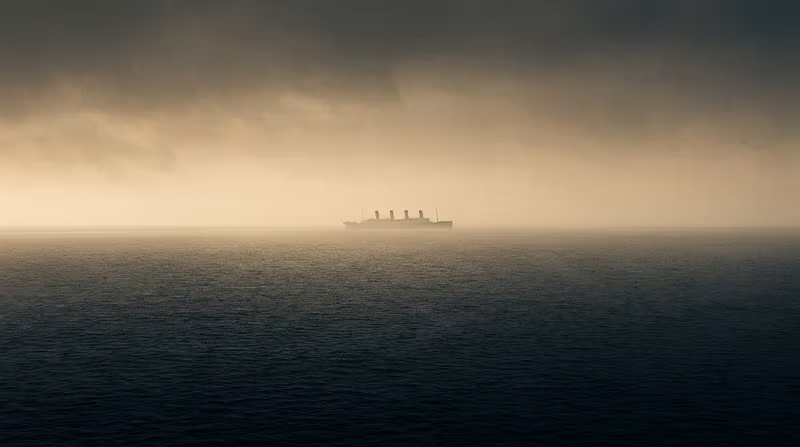


The Titanic's Third Class Survival Rate Was 25%. Here's What Nobody Tells You About Why.
Most people know the Titanic story as a romance, a hubris parable, or a disaster movie. But if you look at it the way a war correspondent looks at a conflict zone, a different story emerges — one about class, access, and who gets to survive.
The Numbers That Should Disturb You
Class | Survival Rate | Women & Children Survived |
|---|---|---|
First Class | 62% | 97% of women |
Second Class | 41% | 86% of women |
Third Class | 25% | 46% of women |
Read that last line again. Less than half of Third Class women survived. Every single First Class child survived. One Third Class child in three did not.
These aren't random outcomes. They're the result of architecture, policy, and real-time decisions made by people who valued some lives over others.
The Ship Was Designed as a Class System
The Titanic wasn't just a ship with different ticket prices. It was a physically segregated society built from steel:
Locked gates separated Third Class from upper decks — ostensibly for immigration compliance, practically for social control
No direct route existed from Third Class cabins to the boat deck where lifeboats launched
Crew members were stationed at class boundaries. Multiple survivors testified that stewards blocked Third Class passengers from ascending during the evacuation
Signage in the Third Class sections was primarily in English — aboard a ship where many steerage passengers spoke Swedish, Finnish, Arabic, or Croatian
The ship's blueprints tell the story before a single passenger boards. Third Class was below the waterline. First Class was closest to the lifeboats. This wasn't coincidence. It was design.
The War Correspondent's Lens
I study this disaster the way a war correspondent studies a battle — not for the drama, but for the systems that determined outcomes.
Every conflict zone has the same architecture:
Who has access to escape routes?
Who controls information flow during crisis?
Whose testimony gets entered into the official record afterward?
The Titanic answers all three questions the same way: the people with money and social standing.
When the British inquiry concluded there was "no discrimination against Third Class passengers," they did so after calling exactly three Third Class witnesses across both the American and British hearings. Three voices to represent 710 passengers.
One Statistic That Changed How I See Everything
There were approximately 472 empty seats across the lifeboats that launched from Titanic. The ship had enough lifeboat capacity for about 1,178 people. Only 706 survived.
472 people died not because there weren't enough lifeboats — but because the boats launched partially filled. Many of those early boats, launched from the First Class side of the ship, left with fewer than half their seats occupied.
Meanwhile, hundreds of Third Class passengers were still trying to find their way to the boat deck through a maze of corridors they'd never been allowed to enter before that night.
Those empty seats are the single most damning piece of evidence in the entire disaster. Not an iceberg problem. Not an engineering problem. A class problem.
---
This is what we study at Decks & Dispatches — the Titanic through the lens of a war correspondent, where class divisions become battle lines and deck plans become terrain maps.
If you've ever felt like the standard Titanic narrative was missing something, you're right. It was missing everyone below B Deck.