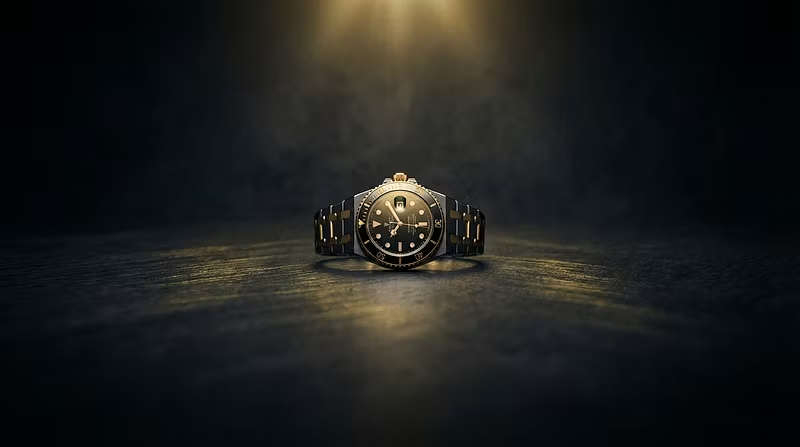


Zenith just removed the one thing everybody actually wants from this watch
GENEVA — Geneva Watch Days kicked off today, and Zenith opened with a genuinely strange move: it took its most successful modern chronograph and stripped the chronograph out of it. The new Chronomaster Solo Sport is a watch built entirely around a movement whose whole reason for existing was timing things — and it can't time anything.
The movement with the wildest survival story in watchmaking
Zenith's El Primero caliber, unveiled in 1969, was the world's first automatic, fully integrated high-frequency chronograph movement, running at a then-unheard-of 36,000 vibrations per hour (5 Hz). It nearly didn't survive the 1970s. During the quartz crisis, Zenith's own management ordered the tooling and machinery for the El Primero destroyed. A watchmaker named Charles Vermot disobeyed and hid the equipment in the manufacture's attic instead — a decision that let Zenith revive the caliber in the 1980s. That same movement later powered the Rolex Daytona through the late 1980s and '90s, before Rolex switched to its own in-house chronograph caliber.
What Zenith did instead
The Chronomaster Solo Sport houses the El Primero 3620, a three-hand variant of the 3600 chronograph movement with the pushers and subdials removed entirely. It still beats at the full 5 Hz, still runs a silicon escapement, still delivers a 60-hour power reserve, and still shows off Zenith's star-shaped rotor through the caseback. Four references launch today: three with ceramic dials and date windows in black, white, and brown, plus a no-date black version, all in a 40mm steel case rated to 200 meters — twice the water resistance of the standard Chronomaster Sport.
Pricing runs $9,800 for the no-date model and $10,900 for the three date variants.
Why cutting the chronograph is actually the interesting part
A high-frequency movement's main real-world benefit is a smoother-sweeping seconds hand — the 5 Hz beat rate divides each second into ten increments instead of the standard six or eight. Removing the chronograph doesn't hide that benefit; it isolates it. Zenith COO Romain Marietta admitted as much in interviews around the launch, framing the watch less as a stripped-down chronograph and more as a standalone statement about what the El Primero's engineering actually delivers day to day.
Why this matters if you're shopping in Rolex's shadow
The standard Chronomaster Sport has spent years being compared directly to the steel Daytona for its panda-dial chronograph layout — a comparison Zenith has actively designed away from over time. This new three-hand version sidesteps that comparison completely while staying under $11,000, well below Daytona territory on both the retail and gray markets.
A high-frequency movement is a real, measurable engineering advantage, not just a marketing number — smoother second-hand sweep is genuinely visible to the eye
Movements survive brand crises more often than you'd think. The El Primero exists today because one employee ignored a direct order to destroy it
Attainable luxury chronograph alternatives exist below $11,000 from manufactures with legitimate in-house engineering pedigree, not just quartz-crisis survivors trading on nostalgia
Zenith just bet that the engine matters more than the stopwatch built around it. Available now at Zenith boutiques and authorized retailers worldwide.
Image: Teddy Baldassarre