

If a free community could help you improve ONE thing this month, what would you choose?
Edge Theory Capital
M
Mikey SherrattEC @mikeysherratt·May 24
@mikeysherratt·May 248 votes
D
Davey Barnes@daveybarnes·May 24
I thought i knew it all till I joined here now I am learning properly.
M
Mikey SherrattEC@mikeysherratt·May 24
@mikeysherratt·May 24Most traders define their entry.
Far fewer define where the idea is wrong.
That’s why losses often become negotiations.
↳ The market gives the answer.
The trader keeps arguing.
▪︎ Moving the stop because "nothing has changed"
▪︎ Ignoring new information because the original thesis feels stronger
▪︎ Waiting for confirmation that should have arrived already
▪︎ Treating invalidation like a suggestion instead of a decision
The problem usually isn't the loss.
It's the refusal to accept that the trade no longer matches the reason it was taken.
After enough time in the market, you eventually notice that good traders are not attached to their entries.
They're attached to their conditions.
The invalidation framework
1. Define failure before entry
Every trade idea needs a point where the premise no longer exists.
For order flow traders that might be:
• Failed absorption
• A liquidity sweep that doesn't reverse
• Delta failing to confirm
• Price accepting beyond a key volume area
• Break of market structure
• Strong aggressive buying or selling against your position
If you can't define what disproves the idea, the idea isn't clear enough yet.
2. Respect new information
Many traders only trust information that supports the trade.
The market doesn't care about consistency.
When the evidence changes, the position should change with it.
Nothing extra needs to be defended.
3. Exit the idea, not the emotion
The cleanest losses happen when the decision was already made before entry.
The market reaches the invalidation point.
You leave.
No debate required.
Eventually the goal stops being prediction.
The goal becomes responding correctly.
That's a much lighter job.
Most oversized losses begin as small invalidations that were ignored.
A valid trade can lose.
An invalid trade should not stay open.
If you're still struggling to identify invalidation in real time, that's usually not a market problem.
It's an execution problem.
That's exactly what we work on every day inside our free and pro trading communities.
P.S. Which signal do you consistently see before a losing trade that you still choose to ignore?
D
Davey Barnes@daveybarnes·May 24
Super post again dude.
M
Mikey SherrattEC@mikeysherratt·May 23
@mikeysherratt·May 23What's currently stopping you from becoming consistently profitable?
11 votes
M
Mikey SherrattEC@mikeysherratt·May 22
@mikeysherratt·May 22Most traders say they want consistency.
Then they size like they need to be saved.
↳ The problem usually isn’t the setup.
It’s the pressure attached to the outcome.
▪︎ Too much size turns normal loss into emotional damage
▪︎ Emotional damage turns into revenge
▪︎ Revenge turns into account destruction
▪︎ Then the trader calls it “market conditions”
After enough time in the market, one thing becomes obvious:
Emotional Position Sizing
Money Before Skill
When money becomes the priority too early, every trade feels like a verdict.
You stop collecting reps.
You start trying to get paid before you’re stable.
Oversized Conviction
Most traders don’t oversize because the trade is better.
They oversize because they’re tired of waiting.
The market usually punishes that impatience quickly.
The 1% Rule
Risking 1% per trade won’t make you fearless.
It just keeps one decision from becoming a career-ending event.
That matters more than most traders admit.
Survival Builds Skill
You can’t develop skill if your account keeps resetting.
Small losses keep you in the game long enough to actually learn.
Discipline Removes Drama
Strict position sizing removes the need to negotiate with yourself mid-trade.
The loss is already defined.
The damage is already contained.
The trader who survives long enough starts to see it differently.
Not every trade needs to matter.
Not every loss needs a reaction.
Not every setup deserves pressure.
Most blown accounts are not caused by lack of knowledge.
They’re caused by unmanaged emotional exposure.
Risk is not just financial.
It’s behavioural.
P.S. Are you sizing for skill development, or for relief?
If you're focused on building skill before chasing returns, you'll fit right in.
Join our free trading community.
M
Mikey SherrattEC@mikeysherratt·May 8
@mikeysherratt·May 8ONDO Extends Higher One Week After Community Call, Up Roughly 65%
One week after highlighting ONDO/USDT inside the community, the setup has now delivered roughly a 65% move from the original call zone.
The interesting part wasn’t just the rally itself, it was the structure behind the move.
ONDO initially flushed below local support near $0.258 before immediately reclaiming the range. That reaction suggested sell-side liquidity was being cleared rather than true continuation weakness.
The market continues rewarding patience around confirmation rather than emotional reactions to volatility.
What’s your view on ONDO here, continuation or range extension exhaustion?
M
Mikey SherrattEC@mikeysherratt·May 7
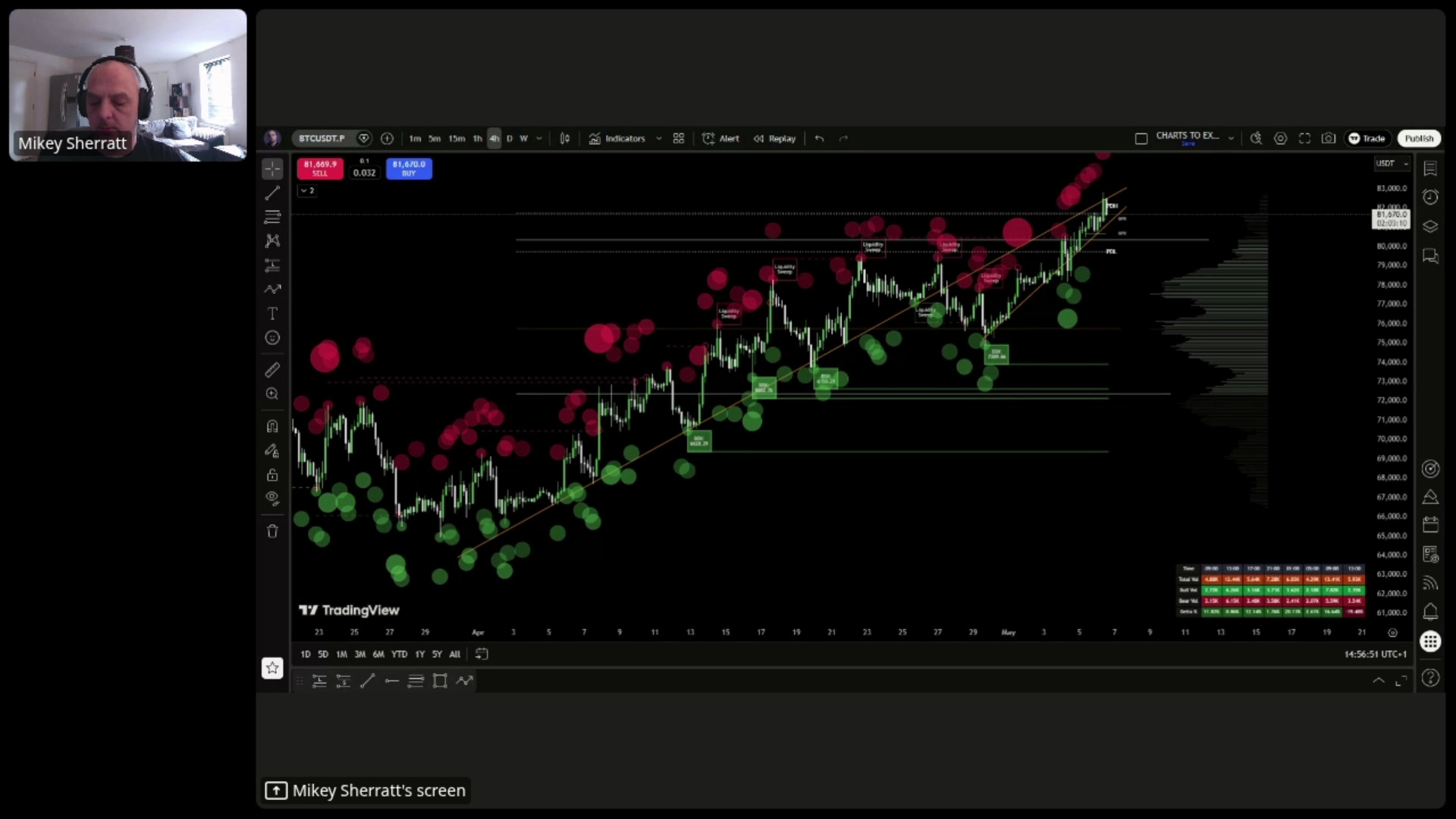
@mikeysherratt·May 7We Caught a WIN Trading Solana LIVE 👀 + Scanning Crypto Tokens
We traded Solana LIVE during today’s NY session and secured a clean winning trade while breaking down crypto market opportunities in real time.
In this livestream, we analysed SOL price action, scanned trending crypto tokens, and discussed potential setups developing across the market. No hindsight, just live execution, market reads, and real trading.
Inside today’s session:
Live Solana trading breakdown
Real trade execution and management
Crypto token analysis & watchlist discussion
NY session volatility and setups
Trading psychology and market commentary
If you enjoy transparent live trading content and real market analysis, make sure to join the free community and join the next session live today at 14:30 London time.
M
Mikey SherrattEC@mikeysherratt·May 4
@mikeysherratt·May 4Dogecoin Breaks $0.10 as Retail Momentum Builds, Outpaces Bitcoin’s Weekly Performance
_
• DOGE gained 11% over the past week and 17% in April, leading major crypto assets
• Break above $0.10 marks the first move through this level in two months
• Bitcoin posted strong monthly gains (14%) but lagged in weekly momentum
• Retail sentiment remains elevated, though slightly off peak levels
_
Dogecoin pushed through the $0.10 psychological barrier and is holding above it, signalling a shift in short-term momentum. The move positioned DOGE as the strongest weekly performer among large-cap crypto.
_
Bitcoin advanced over the month but showed relative stagnation over the past week (+0.3%), suggesting rotation into higher-beta assets. Most majors (ETH, SOL, XRP) posted mild weekly losses, reinforcing DOGE’s relative strength.
_
The move appears driven primarily by retail momentum rather than a clear fundamental catalyst. Sentiment data shows bullish positioning remains elevated, though engagement has cooled slightly from peak levels.
_
The break above $0.10 likely acted as a trigger for momentum flows and short-term participation.
_
• Key Level: $0.10 (previous resistance → current pivot)
• Structure has shifted from range-bound to short-term breakout
• Price is currently holding just above this reclaimed level
_
If $0.10 holds: Momentum structure remains intact, allowing continuation higher
If $0.10 fails: Breakout invalidates, opening a move back into the prior range
In short: DOGE’s move is a clean retail-driven breakout while Bitcoin consolidates.
_
Curious, do you see this as rotation or just a temporary spike in meme momentum?
M
Mikey SherrattEC@mikeysherratt·May 3
@mikeysherratt·May 3BTC USDT
_
Repeated rejection around 78.8k is shaping the current structure. Every push into that zone gets met with supply, and the market isn’t managing to hold above it. Instead, price keeps rotating back into the same lower range, showing a lack of acceptance at higher levels.
_
What stands out is the base forming just below, around 78.4k. Buyers have been stepping in there consistently, preventing a deeper pullback for now. This creates a tight range between support and resistance, which usually leads to expansion.
_
If 78.4k starts to give way, the structure opens up for a move lower into 78.0k, where the next pocket of liquidity sits. On the other side, reclaiming 78.8k and building acceptance above it would likely trigger a move toward 79.2k, as there’s little resistance left in between.
_
Right now, it’s a compression between two clear levels. Whichever side breaks first likely drives the next move.
_
M
Mikey SherrattEC@mikeysherratt·May 3
@mikeysherratt·May 3XRP Compresses Into Triangle Apex as Volatility Contracts, Break Imminent Near $1.45/$1.35
• XRP is trading in a tightening symmetrical triangle, nearing its apex
• Price compression signals a pending volatility expansion
• Market remains neutral within the $1.35-$1.45 range
• Breakout direction remains unconfirmed until structure resolves
XRP has transitioned from a broader downtrend into a prolonged consolidation phase, with price now coiling tightly around $1.38. The range has narrowed significantly, with lower highs and higher lows forming a clear triangle structure.
Recent price action shows reduced volatility and diminished follow-through on both bullish and bearish attempts, typical behaviour as liquidity builds ahead of a larger move.
The current move appears structurally driven rather than news-led. Compression phases like this reflect equilibrium between buyers and sellers, often preceding expansion as one side gains control.
While narratives around ETF flows and “bear trap” setups exist, there is no confirmed catalyst yet, price remains the primary signal.
• Resistance: $1.45
• Support: $1.35
XRP is trading mid-range within a mature symmetrical triangle. The structure suggests late-stage compression, with price approaching the apex—typically where breakout probability increases.
No confirmed breakout yet. Current conditions favour patience.
If price closes above $1.45:
• Structure shifts bullish → volatility expansion toward higher resistance zones
If price breaks below $1.35:
• Structure weakens → downside continuation toward prior lows
Until either level is cleared, this remains a neutral, range-bound environment prone to false moves.
In short: XRP is coiled at a decision point. The structure is clear, only the direction is missing.
What’s your read, expansion higher or breakdown first?
M
Mikey SherrattEC@mikeysherratt·May 2
@mikeysherratt·May 2WLFI Extends Selloff to New Lows as Token Sale Disclosure Fuels Pressure
WLFI drops to fresh all-time lows near $0.05 following Bloomberg report on undisclosed token sales
5.9B tokens reportedly sold privately, raising transparency and supply concerns
Ongoing legal pressure and investor lockup restrictions add to downside sentiment
Price has remained in a persistent downtrend, accelerating lower into early May with a sharp selloff breaking multiple support zones.
The latest leg saw WLFI flush below prior local support near $0.06, printing new lows before a minor bounce. Selling pressure has been consistent, with little evidence of sustained demand stepping in.
Volume clusters show reactive buying at the lows, but no structural reversal yet.
The move appears driven by a combination of:
Newly revealed private token sales increasing perceived circulating supply
Concerns around undisclosed allocations and founder-linked revenue flows
Legal overhang, including Justin Sun’s lawsuit and investor liquidity restrictions
While retail sentiment remains active, the structural narrative has weakened.
Key resistance: $0.060
Key support: $0.050
WLFI is currently trading below prior range support, confirming a breakdown from consolidation into continuation lower.
Structure remains decisively bearish, with price unable to reclaim prior breakdown levels.
If price reclaims $0.060: short-term stabilization could develop, with potential rotation back into prior range
If $0.050 fails to hold: continuation lower remains the dominant path, with limited historical support below
In short: WLFI is under sustained pressure as structural breakdown aligns with negative project-specific developments. The market is reacting to supply expansion and governance concerns, not just price action.
What’s your read, temporary dislocation, or deeper structural repricing?