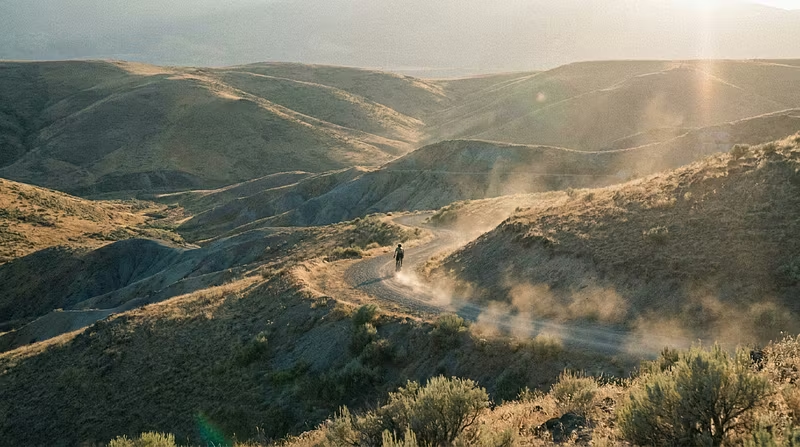
GravelGrit Endurance

Elite gravel bike endurance coaching fused with discus release mechanics and balance drill mastery. Build unstoppable power, precision, and...
1 joined
Profile picture
@cannybile7fProfile pictureJun 9
Pinned post

Welcome to GravelGrit Endurance — Start Here

Welcome, Athlete. You just made a serious investment in yourself.


This program is built around one idea: rotational power and endurance are not separate skills — they compound each other. The discus release drills you'll learn here aren't a gimmick. They train the exact hip rotation, core bracing, and balance patterns that make you devastating on loose gravel at mile 80.


How to Get Started


  1. Go to the Training Course — Work through the modules in order. Each lesson builds on the last. Don't skip ahead.

  2. Follow the weekly rhythm — Modules 1-3 cover mechanics and balance (weeks 1-6). Module 4 builds your engine (weeks 7-10). Module 5 peaks you for race day (weeks 11-12).

  3. Post your progress in Athlete Community — Film your drills, share your ride data, ask questions. This is not a passive course.

  4. Check Training Updates regularly — Weekly drill breakdowns, race recaps, and program adjustments are posted here.


Ground Rules


  • Do the balance drills. They feel easy at first. They are not optional.

  • Trust the periodization. If you're coming from a "more is more" background, this will feel different. That's the point.

  • Ask questions. There are no stupid questions — only athletes who stayed quiet and plateaued.


Let's get to work.

Profile picture
@cannybile7fProfile pictureJun 9

Why Discus Throwers Make Better Gravel Cyclists (The Biomechanics Nobody Talks About)

Most gravel cyclists train like road cyclists with wider tires. More base miles, more threshold intervals, more time in the saddle. And they plateau at exactly the same point: the final 30% of a long gravel race, when technique falls apart and power drops off a cliff.


Here's what I've learned coaching both discus athletes and endurance cyclists: the solution isn't more fitness. It's better movement patterns. And the fastest way to install those patterns comes from an unlikely place — the discus ring.


The Rotational Power Connection


When you throw a discus, power doesn't come from your arm. It comes from the ground, through your hips, through a braced core, and out through the release point. The kinetic chain is:


Foot plant → hip rotation → core transfer → upper body delivery


Now think about what happens when you're grinding up a loose gravel climb out of the saddle. Your power comes from:


Foot plant (pedal) → hip rotation (pedal stroke) → core transfer (bike stability) → upper body delivery (handlebar control)


It's the same chain. The muscles are the same. The sequencing is the same. The only difference is the implement.


Why This Matters at Mile 80


Early in a gravel race, everyone looks smooth. But fatigue doesn't just reduce your power output — it disrupts your sequencing. Your hip rotation gets lazy. Your core stops bracing. Your upper body compensates. Suddenly you're muscling the bike instead of driving it, and your watts-per-heartbeat ratio craters.


Discus drills train sequencing under fatigue better than anything else I've found. Here's why:


  • The standing throw teaches you to generate force from hip rotation alone — no momentum, no cheating. 10 minutes of standing throws lights up your glutes and obliques in exactly the pattern you need on a bike.

  • The South African drill (a half-turn entry into the throw) trains your body to maintain rotational timing when you're off-balance. This directly translates to bike handling on loose descents.

  • Balance holds between reps force your stabilizers to fire while your prime movers are fatigued. This is the exact scenario your body faces in the final hour of a race.


A Simple Test You Can Try Today


Stand on one foot. Close your eyes. Hold for 30 seconds.


If you can't do it — and most endurance athletes can't — you have a balance deficit that's costing you watts on every pedal stroke over rough terrain. Your body is spending energy stabilizing instead of propelling. That energy adds up over 100+ miles.


Now try this: do 10 standing discus throws (even without a discus — just mimic the hip rotation and release). Then repeat the single-leg balance test. Most people improve immediately, because the throws activated the stabilizer patterns that endurance training neglects.


The Takeaway


You don't need to become a discus thrower. But if you train the rotational power and balance patterns that discus athletes develop, you'll ride stronger in exactly the moments where gravel races are won — the loose climbs, the technical descents, and the brutal final hour where everyone else is falling apart.


That's the foundation of everything I coach at GravelGrit Endurance.