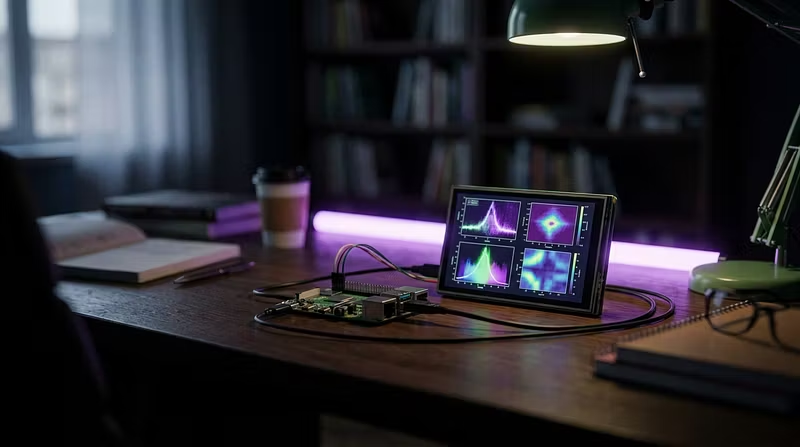


Why Julia + Raspberry Pi Is the Future of Scientific Kiosks
If you're deploying data visualization kiosks for labs, classrooms, or industrial monitoring — you've probably been stuck choosing between Python (slow rendering) or C++ (painful development).
Julia changes everything.
The Problem
Most scientific kiosk deployments are fragile. Python scripts crash under memory pressure, C++ builds take forever to iterate on, and JavaScript dashboards can't handle real computation at the edge.
The Julia Advantage on ARM64
Near-C performance with Python-like syntax
Makie.jl delivers GPU-accelerated visualizations that run natively on Pi's VideoCore GPU
First-class scientific computing — no glue code between your math and your display
Composable packages — DataFrames.jl, DifferentialEquations.jl, and Measurements.jl all work together seamlessly
What I Teach in This Course
I've shipped Julia kiosks in university labs and environmental monitoring stations. In the Julia Pi Kiosk Masterclass, I walk you through the entire stack:
→ Julia on ARM64 setup & optimization
→ Real-time sensor data pipelines
→ Live Makie.jl dashboards in fullscreen
→ systemd watchdogs & read-only filesystem hardening
→ GPIO integration for hardware sensors
If you're an engineer, scientist, or hobbyist ready to ship production kiosks — this course will save you months of trial and error.
Check out the course and join the community. 👇