Luca Moretti

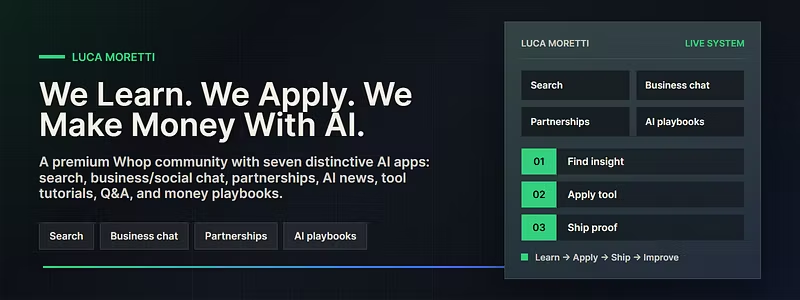
Private Luca Moretti AI execution community built around seven premium apps: Search Tool indexes useful knowledge across the room; Chat For...
Location hidden
Created byProfile pictureLuca Moretti
Profile picture
Luca MorettiProfile picture@lucamoretti99·Jul 10

15-minute AI workflow audit checklist


Pick one workflow your team repeats every week. Do not start with tools. Start a timer and write down what actually happens.


Minutes 0-3: Trigger

What event starts the work? A form, email, payment, calendar change, support ticket, or a person remembering to do it? If the trigger is vague, the automation will be vague too.


Minutes 3-6: Inputs

List every field, file, permission, and decision the workflow needs. Mark anything that arrives late, in the wrong format, or from an untrusted source.


Minutes 6-9: Judgment

Circle the steps that require context, approval, taste, or accountability. These are review points, not places to pretend a model is always right.


Minutes 9-12: Failure

Name the owner, alert, retry rule, and fallback for each external dependency. A silent failure is more expensive than a visible manual step.


Minutes 12-15: Proof

Choose one business metric and one operational metric. For example: response time plus successful handoff rate. If you cannot measure both, you cannot tell whether the system improved the work.


The result should fit on one page. That page is a better starting brief than a list of AI tools.


For a full implementation review, use the operator brief:

https://lucamoretti.io/operator-room

Profile picture
Luca MorettiProfile picture@lucamoretti99·Jul 10

The line most AI automation offers skip


"If this stops at 2:13 on Friday, who notices, who owns the fix, and what happens to the work already in flight?"


A workflow is not ready because the happy path ran once. Before I ship one, I want five answers:


1. What starts it?

2. What can it touch?

3. What evidence proves each run completed?

4. Where does a human review or override it?

5. What is the fallback when a model, API, or data source fails?


Most fragile automations are demos without an operating contract. The useful ones are boring in the best way: bounded, observable, reversible, and owned.


Try this on one workflow today. If you cannot answer all five in a page, automate less first.


I am building Signal Room around checks like this, not tool tours:

https://lucamoretti.io/operator-room

Profile picture
Luca MorettiProfile picture@lucamoretti99·Apr 28

The AI tools that actually make money (and the ones that waste your time)

Most people are drowning in AI tools. New one every day. Every thread is "this changed my life." Six months later, nothing changed.


I've spent the last year testing AI tools across real business workflows — client acquisition, content production, research, outreach, fulfillment. Not side projects. Actual revenue-generating operations.


Here's what I found:


The tools that move the needle are boring. They're not the flashy "generate anything" apps. They're the ones that cut 4 hours of research into 20 minutes. The ones that let a solo operator run outreach like a 5-person team. The ones that turn a messy idea into a structured offer in one sitting.


The pattern: The best AI workflows aren't about the tool — they're about the system around it. A prompt without a process is just a party trick.


What actually works:

  • AI-assisted prospecting that pulls qualified leads from public data (not just "scraping emails")

  • Structured content pipelines where AI handles first drafts and you handle positioning

  • Research systems that surface the 3 things that matter instead of 300 results

  • Automated follow-up sequences that feel personal because the inputs are personal


I built a community around this exact approach. No hype. No "make $10K in 30 days" nonsense. Just tested systems, real feedback loops, and a group of operators who share what's working.


If you're an entrepreneur or freelancer trying to use AI to actually grow your business — not just play with it — this is the room.