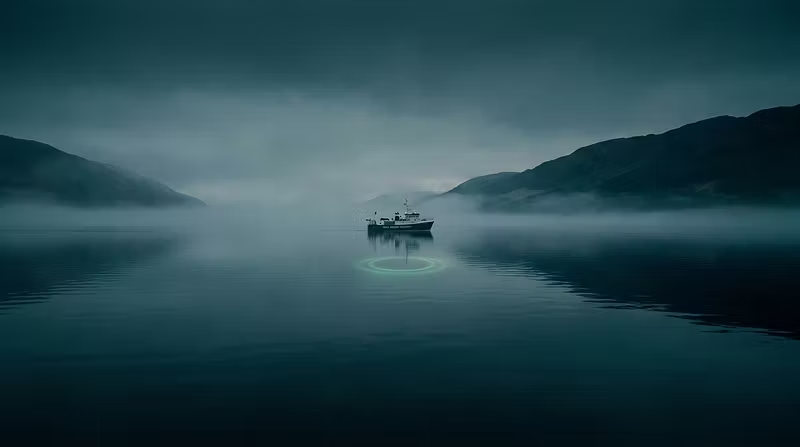


🏴☠️ What Really Happened at Loch Ness in 1987? The Sonar Contacts They Never Fully Explained
Operation Deep Scan — The Largest Loch Ness Expedition Ever Mounted
In October 1987, a fleet of 24 boats armed with Simrad sonar swept Loch Ness from end to end. The media called it a publicity stunt. The scientists called it inconclusive.
The sonar logs told a different story.
Three distinct anomalous contacts were recorded at depths between 78 and 180 metres — targets that didn't match any known species in the loch, exceeded the size of the largest Atlantic salmon by an order of magnitude, and exhibited movement patterns inconsistent with debris or thermocline distortion.
Why Most People Get the 1987 Logs Wrong
The raw sonar traces from Operation Deep Scan are publicly available. But reading sonar returns isn't intuitive — without understanding beam width, frequency attenuation, side-lobe interference, and depth-corrected target sizing, you'll misinterpret every contact on the screen.
That's exactly what happened in 1987. The media saw "blips." The trained sonar operators saw something worth investigating further.
Learn to Read Sonar Like an Expedition Operator
At Nessie Sonar Academy, we teach you the exact skills used by professional sonar operators on loch expeditions:
📡 Equipment selection, transducer mounting, and frequency calibration
📊 Contact classification, pattern recognition, and target sizing
🔧 Field troubleshooting — signal interference, thermocline distortion, depth correction
📋 Deep analysis of the original 1987 expedition logs and the three anomalous contacts
Whether you're planning your own loch expedition or just want to understand what the sonar actually showed that day in 1987 — this course gives you the knowledge to read the evidence yourself.
The loch keeps its secrets. Your sonar doesn't have to.