Scentful Rest

Scent & home ambiance design courses built around spoon theory — helping people with chronic fatigue craft restorative sensory environments...
1 joined
Profile picture
@darkpistolf4Profile pictureJun 9

The 3-Scent Rule: How to Reset Any Room in Under 2 Minutes When You're Exhausted

If you live with chronic fatigue, ME/CFS, fibromyalgia, or any condition that rations your energy, your home environment matters more than most people realize. The wrong sensory inputs — harsh lighting, stale air, visual clutter — quietly drain spoons you can't afford to lose.


Here's a simple technique I teach called the 3-Scent Rule that lets you shift the entire mood of a room without standing up, rearranging anything, or spending more than 2 minutes.


The Concept


Your brain processes scent faster than any other sense. Olfactory signals reach the limbic system (your emotional processing center) in under 200 milliseconds — before you're even consciously aware of the smell. This makes scent the most energy-efficient lever you have for changing how a space feels.


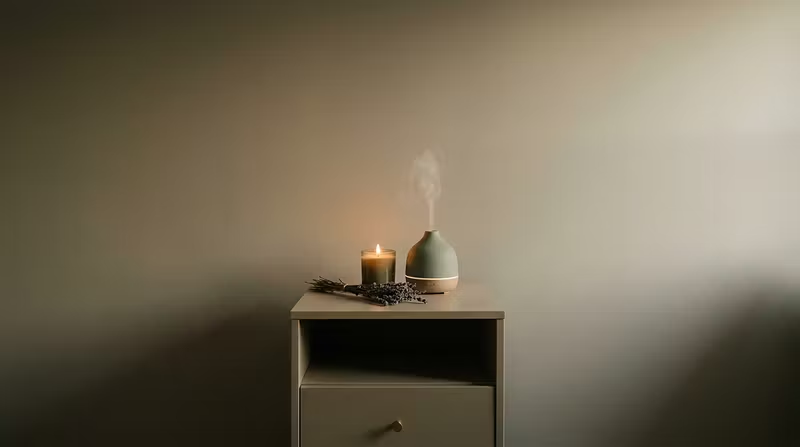
The 3-Scent Rule is simple: keep exactly three scent options within arm's reach of your primary rest spot, each serving a different purpose.


The Three Categories


1. Grounding — for anxiety, overstimulation, or when you need to feel "held"

  • Best options: vanilla, sandalwood, cedarwood, vetiver

  • Delivery: candle, oil roller on the wrist, or a sachet tucked into your pillowcase


2. Lifting — for fog, flatness, or when you need gentle momentum

  • Best options: sweet orange, bergamot, grapefruit (avoid peppermint if you're scent-sensitive)

  • Delivery: diffuser with a pre-loaded blend, or a citrus peel in a small dish


3. Clearing — for mental reset, transitions between activities, or "starting fresh"

  • Best options: eucalyptus, rosemary, lemongrass

  • Delivery: a single drop on a cotton ball near your face, or a steam inhalation if you can manage the kitchen


How to Use It


When your environment feels wrong but you can't articulate why:


  1. Don't analyze it. That costs spoons.

  2. Pick the category that matches what you need — calm, energy, or clarity.

  3. Activate that one scent. Light the candle, uncap the roller, turn on the diffuser.

  4. Wait 60 seconds. Let your limbic system do the work.


That's it. The room hasn't changed. You have.


Why Only Three?


Decision fatigue is real, and it's amplified by chronic illness. A collection of 15 essential oils is overwhelming when you're running on half a spoon. Three options means you can choose by instinct, not analysis.


One More Tip


Rotate your specific scents every 4–6 weeks to prevent olfactory habituation (your nose stops noticing a scent after prolonged exposure). But keep the same three categories — Grounding, Lifting, Clearing. The framework stays stable even as the specific scents change.


---


If this resonates, I teach a full course on paced ambiance design for people with chronic fatigue — covering scent, lighting, texture, sound, room-by-room blueprints, and emergency protocols for crash days. Everything is built around spoon theory so the learning itself never costs more than it gives back.

Profile picture
@darkpistolf4Profile pictureJun 9
Pinned post

Welcome to Scent & Stillness 🕯️

Welcome to Scent & Stillness: Paced Ambiance Design for Low-Energy Days.


You just made one of the most spoon-conscious investments you can make — learning to turn your home into a recovery tool instead of another thing that drains you.


What's Inside


Your course has 5 chapters and 15 lessons covering:

  • Energy mapping and spoon theory applied to sensory design

  • The science of how fragrance affects your nervous system

  • Room-by-room blueprints for bedrooms, living spaces, and bath stations

  • Weekly scent rotation calendars that eliminate daily decision fatigue

  • Emergency comfort protocols for crash days (designed to be used during a flare)


How to Pace the Course


The course is sequential — each lesson builds on the last. But there's no deadline. Take one lesson per day, one per week, or binge three on a good-energy afternoon and rest for a week. The irony of a pacing course would not be lost on us if we pressured you to rush.


Community Chat


Jump into the Community Chat to share what you're working on, ask questions, or just say hi. This is a low-pressure space — lurking is welcome, and "I lit a candle today" is a valid update.


Your First Step


Open Chapter 1, Lesson 1: Spoon Theory Basics and map your daily energy budget. Everything else builds from there.


Let's make your home work for you. 🌿

Profile picture
@darkpistolf4Profile pictureJun 9

The 3-Scent Rule: How to Reset Any Room in Under 2 Minutes When You're Exhausted

If you live with chronic fatigue, ME/CFS, fibromyalgia, or any condition that rations your energy, your home environment matters more than most people realize. The wrong sensory inputs — harsh lighting, stale air, visual clutter — quietly drain spoons you can't afford to lose.


Here's a simple technique I teach called the 3-Scent Rule that lets you shift the entire mood of a room without standing up, rearranging anything, or spending more than 2 minutes.


The Concept


Your brain processes scent faster than any other sense. Olfactory signals reach the limbic system (your emotional processing center) in under 200 milliseconds — before you're even consciously aware of the smell. This makes scent the most energy-efficient lever you have for changing how a space feels.


The 3-Scent Rule is simple: keep exactly three scent options within arm's reach of your primary rest spot, each serving a different purpose.


The Three Categories


1. Grounding — for anxiety, overstimulation, or when you need to feel "held"

  • Best options: vanilla, sandalwood, cedarwood, vetiver

  • Delivery: candle, oil roller on the wrist, or a sachet tucked into your pillowcase


2. Lifting — for fog, flatness, or when you need gentle momentum

  • Best options: sweet orange, bergamot, grapefruit (avoid peppermint if you're scent-sensitive)

  • Delivery: diffuser with a pre-loaded blend, or a citrus peel in a small dish


3. Clearing — for mental reset, transitions between activities, or "starting fresh"

  • Best options: eucalyptus, rosemary, lemongrass

  • Delivery: a single drop on a cotton ball near your face, or a steam inhalation if you can manage the kitchen


How to Use It


When your environment feels wrong but you can't articulate why:


  1. Don't analyze it. That costs spoons.

  2. Pick the category that matches what you need — calm, energy, or clarity.

  3. Activate that one scent. Light the candle, uncap the roller, turn on the diffuser.

  4. Wait 60 seconds. Let your limbic system do the work.


That's it. The room hasn't changed. You have.


Why Only Three?


Decision fatigue is real, and it's amplified by chronic illness. A collection of 15 essential oils is overwhelming when you're running on half a spoon. Three options means you can choose by instinct, not analysis.


One More Tip


Rotate your specific scents every 4–6 weeks to prevent olfactory habituation (your nose stops noticing a scent after prolonged exposure). But keep the same three categories — Grounding, Lifting, Clearing. The framework stays stable even as the specific scents change.


---


If this resonates with you, I teach a full course on paced ambiance design for people with chronic fatigue — covering not just scent but lighting, texture, sound, room-by-room blueprints, and emergency protocols for crash days. Everything is designed around spoon theory so you never have to spend more energy learning than you get back from the techniques.