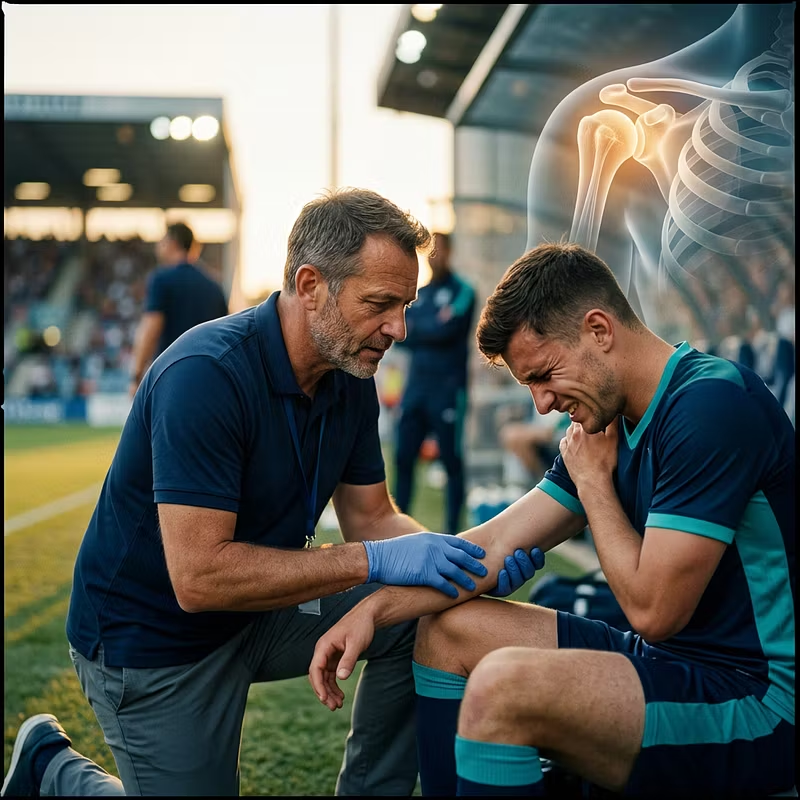


The Three-Second Freeze That Costs First Aiders Everything
There is a moment most first aiders know but never talk about.
You arrive at the scene. The patient is gripping their arm. The shoulder looks wrong. You can see it. You know something has dislocated. And then — nothing. Your hands don't move. Your training feels distant. Three seconds pass. Then five. Then ten.
That freeze is not a failure of courage. It is a failure of decision architecture.
Most first aid courses teach you what a shoulder dislocation looks like. Very few teach you what to do next in a structured, repeatable way. The gap between recognition and action is where responders stall — and where avoidable harm creeps in.
The problem is not knowledge. It is sequence.
When I designed the Reduction Readiness Matrix, the core insight was simple: direction identification must come before any physical interaction with the arm. Anterior, posterior, and inferior dislocations each follow completely different assessment and management pathways. Mixing them up — or worse, not identifying at all — is the root cause of freezing.
Once you name the direction, every subsequent decision becomes binary:
Safe to assess bedside, or escalate immediately?
Neurovascular compromise present, or intact?
Reduction readiness criteria met, or hold and refer?
Three checks that prevent most first-aider errors
1. Axillary nerve function — Can the patient feel light touch over the lateral deltoid (the "regimental badge" area)? If not, you have nerve involvement and escalation is non-negotiable.
2. Distal pulse check — Radial pulse present and symmetrical? Absent or weak pulse changes the urgency category entirely.
3. The Apprehension Test — With the arm in 90° abduction and external rotation, does the patient show immediate guarding or fear of re-dislocation? This single test tells you more about joint stability than most imaging.
These three checks take under 90 seconds. They are the difference between a confident, documented response and a panicked one.
Why this matters beyond the pitch
If you are a sports coach, a caregiver, or a front-line clinician, you will face this scenario. The question is not if but when. And the quality of your first 60 seconds dictates outcomes — for the patient and for your own medicolegal position.
The full framework — including the Reduction Readiness Matrix, the neurovascular checklist, the return and referral matrix covering Bankart lesions, Hill-Sachs lesions, and rotator cuff tears — is available in the guide. But these three checks above? You can start using them today.
Stop freezing. Start sorting.