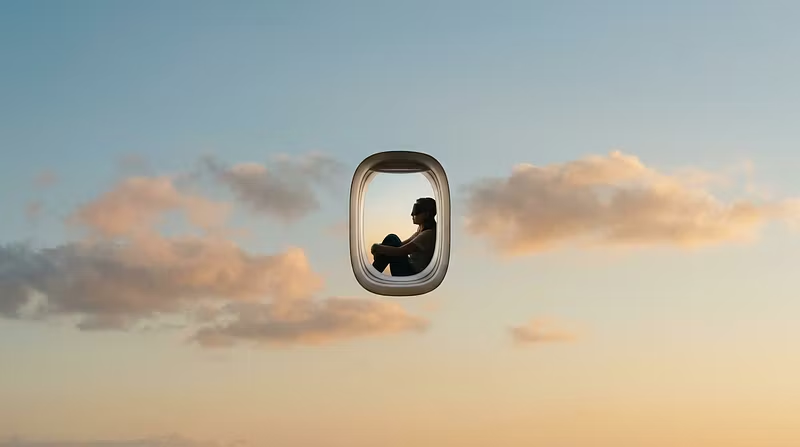
The Solo Traveler's Jet Lag Reset

5.0 (1 Review)
A practical ebook for first-time solo travellers that teaches a simple step-by-step system for sleeping better after long flights, reducing...
London, GB
Created byProfile pictureRadley
3 joined
Profile picture
RadleyProfile picture@milo31·May 11

I've talked to hundreds of solo travelers about their first long-haul trip. Almost all of them say the same thing: "I wasted the first two days."


Here's what goes wrong — and it's completely preventable.


Mistake 1: "I'll just sleep on the plane"

You won't. Or you'll sleep at the wrong time and make everything worse. What matters isn't how much you sleep on the flight — it's when. Timing your sleep to your destination's clock is the single biggest lever you have.


Mistake 2: Powering through on arrival day

You land at 9am local time, you're wired on adrenaline, you force yourself to stay up until 10pm. Sounds disciplined, right? It backfires. Your body needs a specific kind of light exposure and a short strategic rest — not a 14-hour death march.


Mistake 3: Ignoring food timing

Your gut has its own circadian clock. When you eat on arrival matters almost as much as when you sleep. Most travelers eat whenever they're hungry (airport lounge, airplane meals, 2am hotel snack) — and their body stays stuck on home time.


The fix isn't complicated. It's a system — a few specific actions before, during, and after your flight that reset your internal clock fast.


I built a step-by-step guide that covers exactly this. If your first solo trip is coming up and you don't want to lose the first few days to jet lag fog, it's worth a look.

Profile picture
RadleyProfile picture@milo31·May 6

I've talked to hundreds of solo travelers about their first long-haul trip. Almost all of them say the same thing: "I wasted the first two days."


Here's what goes wrong — and it's completely preventable.


Mistake 1: "I'll just sleep on the plane"

You won't. Or you'll sleep at the wrong time and make everything worse. What matters isn't how much you sleep on the flight — it's when. Timing your sleep to your destination's clock is the single biggest lever you have.


Mistake 2: Powering through on arrival day

You land at 9am local time, you're wired on adrenaline, you force yourself to stay up until 10pm. Sounds disciplined, right? It backfires. Your body needs a specific kind of light exposure and a short strategic rest — not a 14-hour death march.


Mistake 3: Ignoring food timing

Your gut has its own circadian clock. When you eat on arrival matters almost as much as when you sleep. Most travelers eat whenever they're hungry (airport lounge, airplane meals, 2am hotel snack) — and their body stays stuck on home time.


The fix isn't complicated. It's a system — a few specific actions before, during, and after your flight that reset your internal clock fast.


I built a step-by-step guide that covers exactly this. If your first solo trip is coming up and you don't want to lose the first few days to jet lag fog, it's worth a look.

Profile picture
RadleyProfile picture@milo31·May 5

The 3 jet lag mistakes every first-time solo traveller makes


I've talked to hundreds of solo travelers about their first long-haul trip. Almost all of them say the same thing: "I wasted the first two days."


Here's what goes wrong — and it's completely preventable.


Mistake 1: "I'll just sleep on the plane"

You won't. Or you'll sleep at the wrong time and make everything worse. What matters isn't how much you sleep on the flight — it's when. Timing your sleep to your destination's clock is the single biggest lever you have.


Mistake 2: Powering through on arrival day

You land at 9am local time, you're wired on adrenaline, you force yourself to stay up until 10pm. Sounds disciplined, right? It backfires. Your body needs a specific kind of light exposure and a short strategic rest — not a 14-hour death march.


Mistake 3: Ignoring food timing

Your gut has its own circadian clock. When you eat on arrival matters almost as much as when you sleep. Most travelers eat whenever they're hungry (airport lounge, airplane meals, 2am hotel snack) — and their body stays stuck on home time.


The fix isn't complicated. It's a system — a few specific actions before, during, and after your flight that reset your internal clock fast.


I built a step-by-step guide that covers exactly this. If your first solo trip is coming up and you don't want to lose the first few days to jet lag fog, it's worth a look.

Profile picture
RadleyProfile picture@milo31·May 4

I've talked to hundreds of solo travelers about their first long-haul trip. Almost all of them say the same thing: "I wasted the first two days."


Here's what goes wrong — and it's completely preventable.


Mistake 1: "I'll just sleep on the plane"

You won't. Or you'll sleep at the wrong time and make everything worse. What matters isn't how much you sleep on the flight — it's when. Timing your sleep to your destination's clock is the single biggest lever you have.


Mistake 2: Powering through on arrival day

You land at 9am local time, you're wired on adrenaline, you force yourself to stay up until 10pm. Sounds disciplined, right? It backfires. Your body needs a specific kind of light exposure and a short strategic rest — not a 14-hour death march.


Mistake 3: Ignoring food timing

Your gut has its own circadian clock. When you eat on arrival matters almost as much as when you sleep. Most travelers eat whenever they're hungry (airport lounge, airplane meals, 2am hotel snack) — and their body stays stuck on home time.


The fix isn't complicated. It's a system — a few specific actions before, during, and after your flight that reset your internal clock fast.


I built a step-by-step guide that covers exactly this. If your first solo trip is coming up and you don't want to lose the first few days to jet lag fog, it's worth a look.

Profile picture
RadleyProfile picture@milo31·May 2

Last year I took 9 long-haul flights as a solo traveler. Tokyo, Buenos Aires, Bangkok, Reykjavik — the works.


Every trip, I tested a different jet lag "hack" I found online. Melatonin timing, light exposure protocols, fasting windows, grounding, cold showers at specific hours. I tracked everything: sleep onset, wake times, energy levels from 1–10 each hour, and how many days until I felt normal.


Here's what I found:


The stuff that didn't move the needle:

  • Melatonin alone (without light timing, it's basically a placebo at travel doses)

  • "Just push through the first day" — this made day 2 and 3 significantly worse

  • Caffeine cutoffs — helpful for sleep quality in general, but didn't speed up adaptation

  • Grounding/earthing — no measurable effect


The stuff that actually worked:

  • Pre-shifting your sleep by 30 min/day starting 3 days before departure (cut adaptation time nearly in half)

  • Strategic light exposure in the first 2 hours after waking at destination (this was the single biggest factor)

  • A specific meal timing pattern that anchors your circadian clock — eating a protein-heavy meal at local breakfast time, even if you're not hungry

  • Short 20-min naps before 2pm local time (longer naps or later naps delayed adaptation)


The combination of pre-shifting + light + meal timing consistently got me to feeling 8/10 energy by day 2 instead of day 4-5.


I turned my full protocol — with the exact daily schedules, timezone calculators, and the hour-by-hour plan for your first 72 hours — into a guide specifically for solo travelers who can't afford to lose their first few days to brain fog.


If you've ever landed somewhere amazing and spent the first two days staring at a hotel ceiling at 3am, this is for you.

Profile picture
DAVID FUNDZ@daviddoncole·May 2

I help people message me if you're interested

Profile picture
RadleyProfile picture@milo31·May 2

I tracked my sleep across 14 time zones. Here's what actually works for jet lag.

Last year I took 9 long-haul flights as a solo traveler. Tokyo, Buenos Aires, Bangkok, Reykjavik — the works.


Every trip, I tested a different jet lag "hack" I found online. Melatonin timing, light exposure protocols, fasting windows, grounding, cold showers at specific hours. I tracked everything: sleep onset, wake times, energy levels from 1–10 each hour, and how many days until I felt normal.


Here's what I found:


The stuff that didn't move the needle:

  • Melatonin alone (without light timing, it's basically a placebo at travel doses)

  • "Just push through the first day" — this made day 2 and 3 significantly worse

  • Caffeine cutoffs — helpful for sleep quality in general, but didn't speed up adaptation

  • Grounding/earthing — no measurable effect


The stuff that actually worked:

  • Pre-shifting your sleep by 30 min/day starting 3 days before departure (cut adaptation time nearly in half)

  • Strategic light exposure in the first 2 hours after waking at destination (this was the single biggest factor)

  • A specific meal timing pattern that anchors your circadian clock — eating a protein-heavy meal at local breakfast time, even if you're not hungry

  • Short 20-min naps before 2pm local time (longer naps or later naps delayed adaptation)


The combination of pre-shifting + light + meal timing consistently got me to feeling 8/10 energy by day 2 instead of day 4-5.


I turned my full protocol — with the exact daily schedules, timezone calculators, and the hour-by-hour plan for your first 72 hours — into a guide specifically for solo travelers who can't afford to lose their first few days to brain fog.


If you've ever landed somewhere amazing and spent the first two days staring at a hotel ceiling at 3am, this is for you.

Profile picture
RadleyProfile picture@milo31·Apr 30

The 3 jet lag mistakes every first-time solo traveler makes

I've talked to hundreds of solo travelers about their first long-haul trip. Almost all of them say the same thing: "I wasted the first two days."


Here's what goes wrong — and it's completely preventable.


Mistake 1: "I'll just sleep on the plane"

You won't. Or you'll sleep at the wrong time and make everything worse. What matters isn't how much you sleep on the flight — it's when. Timing your sleep to your destination's clock is the single biggest lever you have.


Mistake 2: Powering through on arrival day

You land at 9am local time, you're wired on adrenaline, you force yourself to stay up until 10pm. Sounds disciplined, right? It backfires. Your body needs a specific kind of light exposure and a short strategic rest — not a 14-hour death march.


Mistake 3: Ignoring food timing

Your gut has its own circadian clock. When you eat on arrival matters almost as much as when you sleep. Most travelers eat whenever they're hungry (airport lounge, airplane meals, 2am hotel snack) — and their body stays stuck on home time.


The fix isn't complicated. It's a system — a few specific actions before, during, and after your flight that reset your internal clock fast.


I built a step-by-step guide that covers exactly this. If your first solo trip is coming up and you don't want to lose the first few days to jet lag fog, it's worth a look.