Supportflowarchitect AI

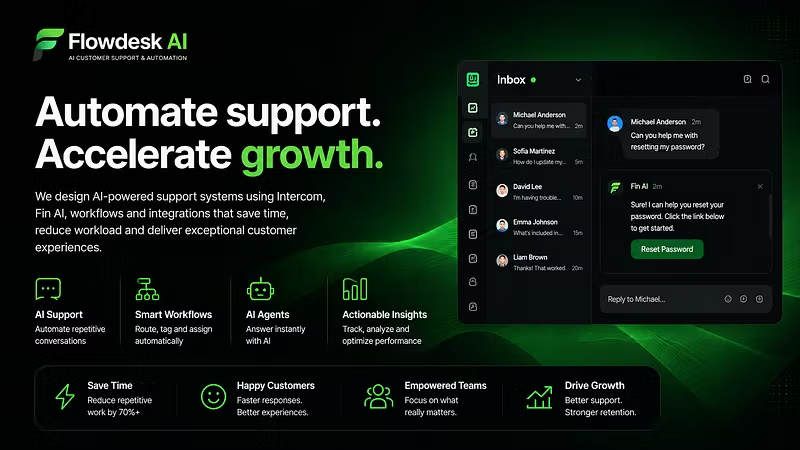
Automate support. Accelerate growth. We design and implement AI-powered customer support systems using Intercom, Fin AI, workflows, AI agen...
Location hidden
Created byProfile pictureNevil Paul
1 joined
Profile picture
Nevil PaulProfile picture@nevilpaul·23h

Most Fin AI setups only use it to answer questions. Tasks let it actually do things.

Quick one on something most people miss when they set up Fin AI Agent: it is not just for answering questions. There is a separate feature called Tasks that lets Fin actually complete an action instead of just replying with information.


Difference in practice:


Without Tasks: customer asks "where is my order," Fin explains how to check order status, customer still has to go do it themselves.


With Tasks: customer asks "where is my order," Fin looks it up through a connected API and tells them directly, or even cancels the order, updates a delivery address, or processes a refund on the spot.


Each Task needs a title that tells Fin when to trigger it, step by step instructions written like verbs ("look up the order," "confirm the new address"), and a Data connector wired up to whatever system holds that information, your order platform, your billing system, whatever it is. Intercom's own docs describe this as Fin automatically detecting when to start a task based on customer intent, so the trigger wording matters more than people expect.


The catch: this is not a five minute toggle. Setting up Tasks usually means connecting to real APIs, which means someone needs to know what those APIs return, and it often means pulling in whoever owns your product, engineering, or ops systems. That is the step where most Fin setups stall, not because Tasks do not work, but because nobody lined up the technical side first.


If your team does not have engineering time free to wire this up right now, this is exactly the kind of setup I take off people's plates:


Is anyone here actually using Tasks yet, or is your Fin setup still just Q&A?

Profile picture
Nevil PaulProfile picture@nevilpaul·1d

Your Fin resolution rate might be counting silence as success

Something worth knowing if you're watching your Fin AI Agent automation rate as your main health check: Intercom's resolution metric counts two very different things as the same outcome.


A "confirmed resolution" is when the customer actually says something like "that helped" or "ok thanks." An "assumed resolution" is when the customer just leaves. No confirmation, no complaint, no follow up question. Fin gives an answer, the customer goes quiet, and Intercom counts that as resolved.


Both count identically toward your resolution rate. There's no separate "silent bounce" bucket in the topline number.


That matters because a customer who got a genuinely wrong or incomplete answer and gave up out of frustration looks exactly the same in your dashboard as a customer who got exactly what they needed and had no reason to reply.


Quick check worth running this week: pull a sample of conversations tagged as assumed resolutions, not confirmed ones, and actually read them. Not skim, read. You're looking for the ones where Fin's last message dodged the question, gave a generic answer, or missed context the customer already gave. If you find a meaningful chunk of those, your real resolution rate is lower than the number on your dashboard.


This is the kind of drift that's easy to miss if nobody's checking it regularly, which is honestly most of what ongoing Fin maintenance actually looks like day to day. If that's not something anyone owns on your team right now, that's worth fixing before the gap gets bigger. Here's how we handle it as an ongoing thing for clients:


Has anyone actually audited their assumed resolutions? What did you find when you read through them?

Profile picture
Nevil PaulProfile picture@nevilpaul·4d

Workflows or Fin AI? Stop treating them as an either/or

I see this mix-up a lot when people are setting up Intercom: they think they have to choose between Workflows and Fin AI Agent. You don't have to. They're built to work together, and the setups I like best use both.


Workflows are the visual, canvas-based tool for structured stuff: reply-button menus, routing, triage, background automations, CSAT surveys. Anything where you can predict the paths a customer will take and you want a locked-in, no-surprises flow.


Fin AI is for the open-ended stuff. Real questions phrased a hundred different ways, follow-ups you can't map out in a menu, conversations that need to adapt mid-stream.


The part people miss: you can drop Fin directly inside a Workflow with a "Let Fin handle" step. A pattern I like looks something like this:


  1. Workflow greets the customer and asks one or two quick qualifying questions with reply buttons

  2. Workflow routes into "Let Fin handle" for the actual support conversation

  3. Fin escalates back out to a workflow step (or a human) when it hits a direct request for a person, negative sentiment, or repeated replies without resolution


That handover logic runs on natural language cues, not just keywords, so it catches "this isn't working" just as easily as "let me talk to a person."


If your Fin setup feels rigid, check whether you're asking Fin to do triage that a simple Workflow would handle better, or forcing open-ended troubleshooting into a button menu that should really be Fin's job.


Where's the line for you right now, do you lean more on Workflows or on Fin, and where has that choice actually caused friction for you or your team?

Profile picture
Nevil PaulProfile picture@nevilpaul·Sep 11

Content vs guidance: the mixup that makes Fin AI sound generic

I keep running into the same confusion when people set up Fin AI Agent: they treat "content" and "guidance" as the same thing. They're not, and mixing them up is why a lot of Fin setups feel flat or give technically correct but unhelpful answers.


Content sources (articles, snippets, uploaded docs, synced websites) are what Fin knows. Guidance is how Fin uses what it knows: your tone, your escalation rules, which source to trust when two articles disagree, what never to say.


If you only build out articles and skip guidance, Fin answers correctly but sounds like a stitched together FAQ bot. No brand voice, no judgment calls, no sense of when to just ask a clarifying question instead of dumping a wall of text.


Quick check for your own setup: pick 3 conversations Fin has actually handled. Read them back to back. Do they sound like your team, or like a search engine reading your help docs out loud? If it's the second one, you're missing guidance, not content.


One thing worth knowing: articles and snippets you create directly in Intercom get pulled in by Fin almost instantly. Anything synced from an external site or a third party tool like Notion or Confluence typically only refreshes on a weekly cycle. So if you're troubleshooting "why isn't Fin using my latest update," check where that content actually lives first.


I put a full breakdown of guidance categories (tone, escalation, source priority, spam handling) and a business type walkthrough into the setup playbook if anyone wants the deeper version:


What does your Fin setup lean on more right now, content or guidance? Curious what other people are finding.

Profile picture
Nevil PaulProfile picture@nevilpaul·Sep 8

A few months ago, we spoke with a business owner who told us something interesting.

Their team wasn't necessarily struggling with customer support because they had too many customers.

They were struggling because the same questions kept coming in every single day.

"Where is my order?"

"How do I get started?"

"Can someone help me with this?"

Before they knew it, their team was spending most of their day answering questions that could have been handled much more efficiently.

That got us thinking...

What's currently the biggest challenge with customer support in your business?

Vote below 👇

We're genuinely interested in seeing where businesses need the most help.

1 vote
Profile picture
Nevil PaulProfile picture@nevilpaul·Sep 8

The Fin AI setup mistake that costs the most trust

One pattern I keep seeing in Fin AI setups, for my own client work and other builds I review: no clear, visible path to a human.


When Fin can't help and there's no obvious way to reach a person, customers don't escalate, they just leave. That's worse than not having an AI agent at all, because now they've had a bad experience and still need help.


Quick check you can run today: try to reach a human yourself, on every channel you support. If it takes more than one or two messages, that's worth fixing before anything else you're working on.


This is one of eight setup mistakes I break down in full in the playbook, with a fix for each one:

Profile picture
Nevil PaulProfile picture@nevilpaul·Sep 8
Pinned post

New: The Intercom & Fin AI Setup Playbook is live

Just published a 44-page playbook on setting up Intercom's Fin AI Agent properly, built from real client setup work, not a generic tutorial.


It's organized by business type (e-commerce, SaaS, service businesses, personal brands, and businesses migrating off a legacy help desk) because a store and a SaaS product genuinely need different Fin AI setups.


What's inside:

  • The five building blocks of a working Fin AI setup (Content Sources, Guidance, Tasks, Escalation Rules, Testing)

  • A worked example workflow for each business type

  • 15 ready-to-adapt Guidance and Task templates

  • A 30/60/90-day rollout timeline

  • The real metrics Intercom uses to measure Fin, explained precisely

  • A 30-question test bank to run before launch


$47, instant PDF download:


Happy to answer questions here if you're setting up Fin AI for your own business or for clients.