TapReview

NFC tap cards that send customers straight to your Google Review page. One tap, more 5-star reviews — built for shops, restaurants, and busi...
Hatsudai, JP
Created byProfile pictureKLS
1 joined
Profile picture
KLSProfile picture@thekls·7h

We bumped affiliate payouts to 30-40% on TapReview — here's why

We just raised our affiliate payout on TapReview to 30% (40% if you're already a customer).


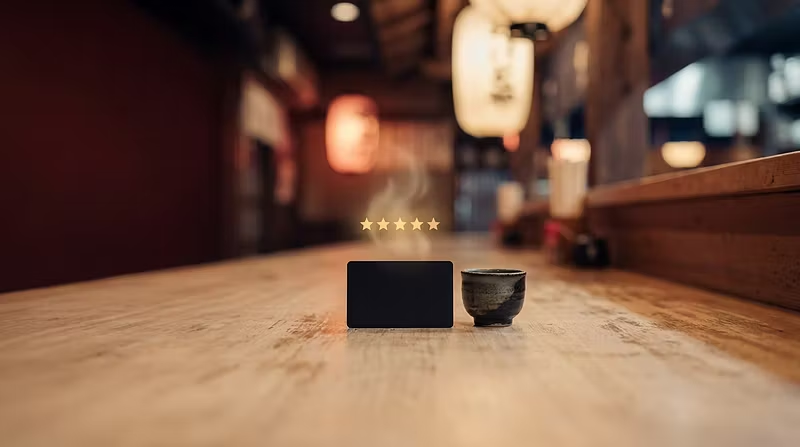
TapReview makes NFC tap cards for Japanese restaurants and cafes: one tap on the counter sends a customer straight to the Google Review page — no app, no QR code fumbling, no relying on staff to remember to ask. Owners lose reviews every day simply because asking feels awkward. This removes the ask entirely.


If you know shop owners in Japan (izakayas, ramen counters, cafes) or run any local-business audience, this is an easy recommend — it's a one-time ¥3,790 card, not a subscription, so there's no "is this worth it monthly" objection. No application, no waiting period — grab your link from the affiliate dashboard and share it directly with owners you know or in local business groups.


Happy to answer product questions for anyone considering promoting it.

Profile picture
KLSProfile picture@thekls·9h

The real cost of a 3.9-star Google rating in Japan

Ran the numbers on a few client shops before launching TapReview and the gap between 3.9 and 4.5 stars was bigger than expected — not in vanity, in walk-ins. Japanese diners lean hard on Tabelog and Google ratings before ever opening the door, more so than most Western markets where word of mouth still carries weight.


The shops stuck at 3.8–4.0 almost always had the same root cause: plenty of happy customers, almost none of them reviewed. Not a food problem, a friction problem.


A few things that actually move the number, in order of impact:

  1. Ask within 60 seconds of the compliment. Momentum dies fast — a review asked for the next day almost never happens.

  2. Make the physical action trivial. Anything requiring a search bar loses most of the intent.

  3. Rotate who asks. If it's always the same staff member, volume caps out. Everyone on shift should have the same one-tap tool at the register.

  4. Respond to every review, good or bad, in Japanese. Google's algorithm and prospective customers both notice an active owner.


This is the whole thesis behind TapReview — NFC cards that skip straight to the Google Review page so step 2 stops being the bottleneck. Happy to swap notes with anyone running a shop here, tap card or not.

Profile picture
KLSProfile picture@thekls·9h

Why your best customers never leave a Google review (and the 1-tap fix)

Ran a small izakaya's Google review page for a few weeks and noticed something obvious in hindsight: the customers who loved the meal weren't the ones leaving reviews. They were the ones who paid, said thanks, and left. The unhappy 2% wrote paragraphs.


The gap isn't willingness — it's friction. Asking someone to open Google Maps, search your shop name, scroll to reviews, and type something takes 5+ taps and real intent. Most people mean to do it and just... don't.


What actually moved the number: an NFC card at the register that opens the Google Review page in one tap, timed right after a compliment or a "that was great." No app, no login, no searching. Just tap → write → done.


A few things worth knowing if you're running a shop, cafe, or restaurant in Japan:

  • Timing beats placement. A card on every table gets ignored. A card the staff hands over after a genuine compliment gets used.

  • Volume compounds. Google's ranking algorithm favors accounts with a steady drip of recent reviews over a one-time burst.

  • Staff need a script, not just a card. "Would you mind tapping this and leaving a quick review?" outperforms a silent tabletop stand every time.


Built TapReview around this exact problem — NFC cards that link straight to your Google Review page, made for independent restaurants and cafes in Japan. Happy to answer questions on review strategy even if you don't end up using it.