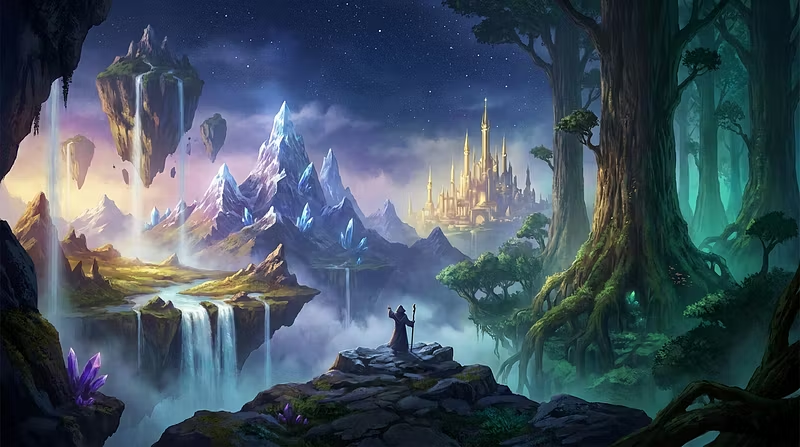


The #1 Reason Your Fictional Worlds Feel Flat (And the Framework That Fixes It)
Most writers build worlds by accumulating stuff. More cities. More creatures. More magic systems. More lore.
And somehow, the world still feels thin. Readers skim past your descriptions. Your setting feels like a backdrop, not a living place.
Here's the problem: you're decorating instead of engineering.
The Iceberg Problem
Tolkien didn't make Middle-earth feel real because he described a lot of things. He made it feel real because for every detail the reader saw, there were ten more underneath — informing his word choices, shaping character decisions, creating depth readers feel even when they can't articulate why.
Most writers try to replicate the visible part of the iceberg. They describe elaborate cities and complex magic systems. But without the invisible 90% underneath, it all feels hollow.
The Framework Approach
What if you could systematically build that invisible 90%?
That's what I teach inside Worldcraft Academy. Not random inspiration. Not "just imagine harder." A structured framework:
Geography drives culture — terrain, climate, and resources determine what civilizations can exist and what they value
Culture drives conflict — when cultures with different foundational values meet, the friction is inevitable, not manufactured
History creates depth — you don't need a 200-page timeline, you need a "History Spine" of 5-7 pivotal events whose consequences echo into the present
Systems create consequences — magic, technology, and political power need costs, and those costs generate the tension your story runs on
A Quick Example
Say you're building a desert kingdom.
Surface-level: "There's a desert kingdom. They wear robes and ride camels and have a sultan."
Framework approach: The desert's only reliable water source is an underground river system. The civilization that controls the pumping stations controls everything. This creates a rigid hierarchy (pump engineers are nobility), a specific religion (water is sacred, waste is sin), and a built-in conflict engine (what happens when a new well is discovered outside the system?).
Same setting. Completely different depth. Five minutes of structured thinking.
The Takeaway
If your worlds feel flat, you don't need more imagination. You need better architecture.
That's what the Fiction World-Building Frameworks course delivers — six modules taking you from blank page to a breathing, consistent, story-ready world.
The course is live inside Worldcraft Academy.