You can start accepting crypto payments as a business by choosing which coins to accept, setting up a wallet, connecting crypto payments to your checkout, deciding if you want to auto-convert, and promoting the new payment option.
Key takeaways
- Crypto payments cost significantly less than credit cards, letting businesses keep more revenue per transaction.
- Stablecoins eliminate price volatility risk while still offering crypto payment benefits to customers.
- Crypto transactions are final with no chargebacks, so businesses must establish clear refund policies upfront.
While crypto payments might not be the default option just yet, they’re showing up in more checkouts than most people realise.
This is especially true for online businesses that need to reach global customers, offer lower fees, and access faster settlement.
Square has even begun automatically enabling Bitcoin payments for millions of US sellers, converting transactions to dollars at checkout. Payments infrastructure globally is catching up, allowing businesses to accept crypto without holding it, managing a wallet, or taking on volatility.
For some, that opens up access to global customers. For others, it’s a way around card declines, high fees, or chargebacks. Either way, it’s beneficial.
This guide breaks down why businesses are adding crypto as a payment method, and how to set them up without overcomplicating your payment stack.
Why should businesses accept crypto payments?
Crypto payments allow customers to pay using digital assets like Bitcoin, Ethereum, or stablecoins instead of traditional methods like credit cards or bank transfers.
If you sell to a global audience, crypto can remove a lot of the friction that comes with cross-border payments. Customers who can’t use cards, or run into regional restrictions, still have a way to complete a purchase. That alone can recover sales that would otherwise be lost.
Accepting crypto also gives you a fallback when traditional payments fail. Card transactions get declined all the time for reasons outside your control, from issuer rules to fraud checks.
Because crypto runs on different infrastructure, it can work when those systems don’t.
And of course, there’s a growing segment of buyers who actively choose to pay with crypto. Not offering it can mean missed revenue.
According to the Capital One 'Retailers That Accept Cryptocurrency' report, roughly 65% of buyers want to make payments with cryptocurrency.
Crypto isn’t replacing traditional payment methods, but it's there to fill the gaps and help you capture payments that might not go through otherwise.
Accepting crypto payments for your business: step by step
1. Choose a crypto payments provider and acceptance method
The first decision is whether you want to:
- Accept crypto directly into a wallet
- Or use a platform that converts payments into fiat at checkout
Direct acceptance gives you full control, but comes with added complexity (custody, volatility, accounting). Using a platform simplifies the process, especially if you don’t want to manage crypto as an asset.
Going with direct acceptance? A wallet is essential for storing and accepting crypto. Some of the most popular ones are MetaMask, Phantom Wallet, Coinbase, Kraken (and there are even physical hardware wallets like Ledger).
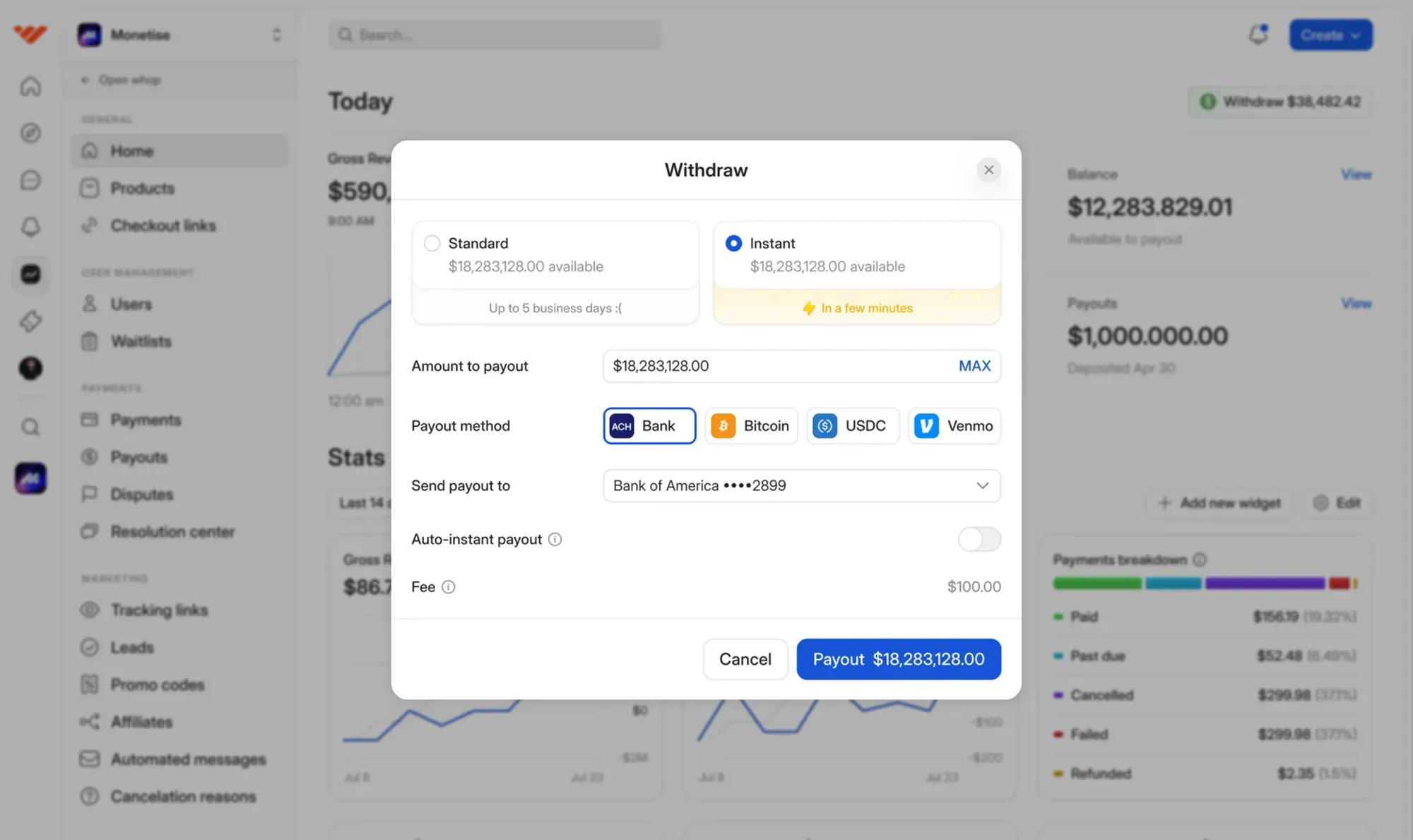
Whop lets your customers pay in crypto and automatically converts to USD at checkout.
2. Enable crypto at checkout
With most modern platforms, crypto isn’t something you build from scratch.
On Whop checkouts crypto appears automatically for eligible customers, with no additional setup required. That removes the need for custom integrations, plugins, or manual configuration.
3. Decide how funds are handled
In most setups, businesses don’t actually receive crypto directly. Instead, payments are converted into fiat (like USD) at checkout, which removes exposure to price volatility and makes payouts easier to manage.
From there, funds settle into your account balance, where they can be withdrawn, held, or used within your business.
If you’re accepting crypto directly into a wallet, the process is different. You’ll receive the asset itself, which means you’ll need to manage custody, track its value at the time of payment, and account for any price changes after the fact.
That distinction matters, because it affects everything from cash flow to accounting.
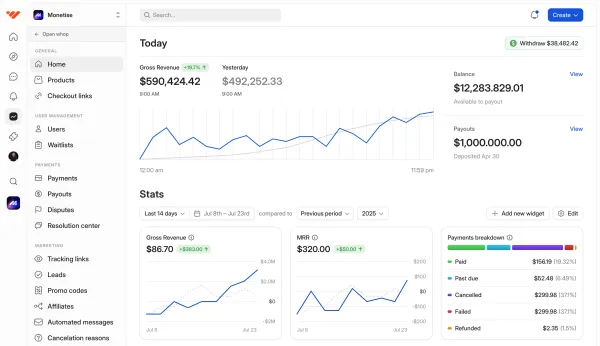
Use Whop Treasury to hold funds in stablecoins like USDT, earn yield, and withdraw to crypto wallets or bank accounts.
4. Understand accounting, reconciliation, and risk
This is where crypto payments are often misunderstood. If you’re using a setup where payments are converted at checkout, accounting is relatively straightforward.
Each transaction has a clear fiat value at the time of payment, and funds settle into your balance like any other payment method. Simple.
But, if you’re accepting crypto directly, it’s a little more complex.
You’ll need to:
- Record the fair market value of the asset at the time of payment
- Track any gains or losses if the asset changes in value
- Manage wallet-level transaction records (like on-chain IDs)
There are also a few operational differences with crypto payments to be aware of:
- No chargebacks: Crypto payments are irreversible
- Refunds are manual: You’ll need to issue them directly from your balance
- Confirmation times vary: Some transactions settle in seconds, others can take minutes
How to create crypto payment policies
Those differences make it essential to set clear policies before you start accepting crypto. You’ll also want to account for things like price volatility and how it impacts your pricing or billing systems.
You’ll need two kinds of policies: customer-facing and internal.
- Customer-facing policies cover things like refunds, pricing rules, and how you handle conversion rates.
- Internal policies cover tax compliance, private key management, and other behind-the-scenes processes.
Both can be drafted, proofread, and packaged into clean documents or web pages.
5. Consider compliance
In most regions, crypto is treated as property for tax purposes, so transactions need to be recorded accordingly.
Regulations are evolving, too: for example, the EU’s MiCA framework is introducing clearer rules around custody and reporting.
If you use a payment processor or platform, KYC and AML requirements are typically handled for you. If you accept crypto directly, you may need to take on more of that responsibility.
6. Let customers know you accept crypto
Once crypto payments are live, they won’t drive any value if customers don’t know they’re there.
You don’t need a big campaign, just make sure you at least do the following:
Update your checkout page
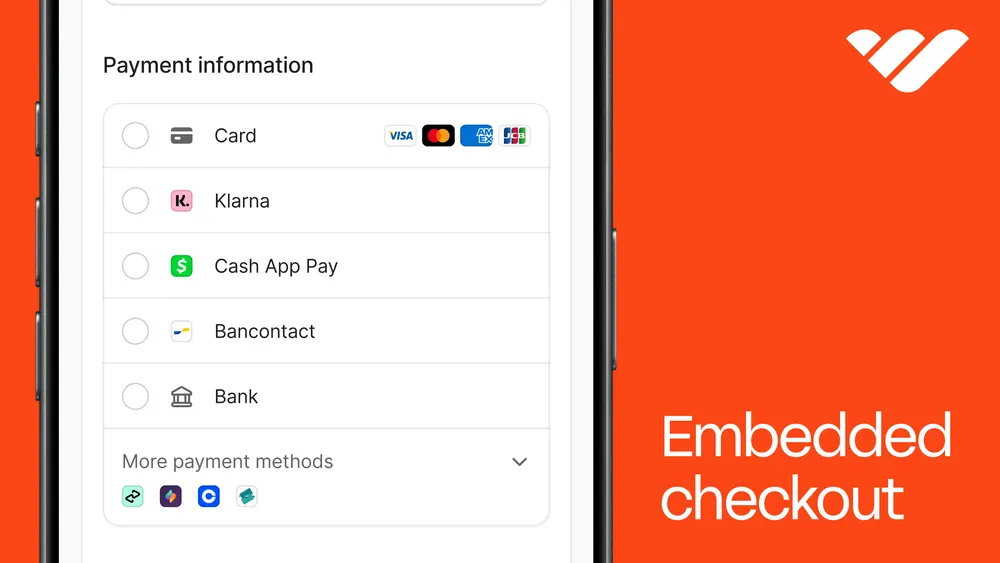
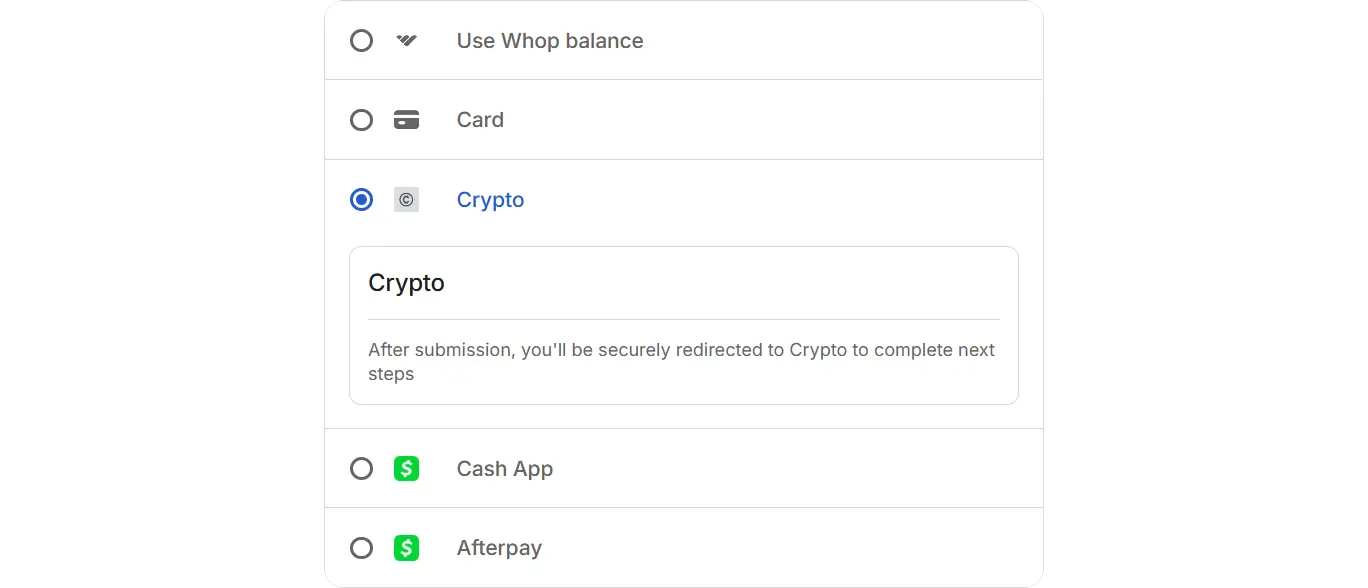
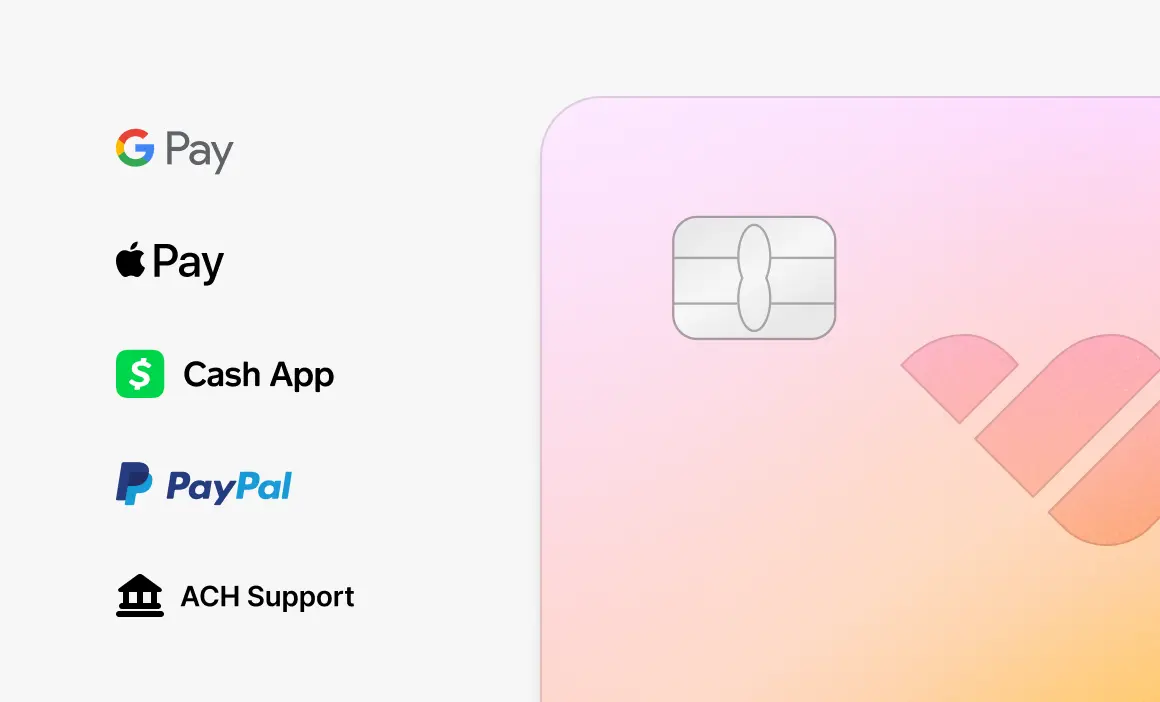
Adding clear buttons and options for crypto payment to your checkout pages is crucial. For example, Whop lists the crypto payment option directly next to other options like credit card, cash app, and BNPL.
Add clear messaging to your homepage
One of the best ways to let everyone know is adding clear messaging to your homepage or other high-traffic pages - that’s what Tesla, AT&T, and Travala did.

Share the news on social media
Post a tweet, an Instagram story, or a TikTok - that’s enough to let your customers know you’re now accepting crypto payments. One of the most popular examples of this is Elon Musk announcing that Tesla now accepts Bitcoin payments:

Let your customers know by email
Send simple announcement emails to your customers, saying they can now pay with crypto and list the cryptocurrencies you accept. Talk about the benefits, lower fees, and add a clear call to action.
Update your FAQ lists
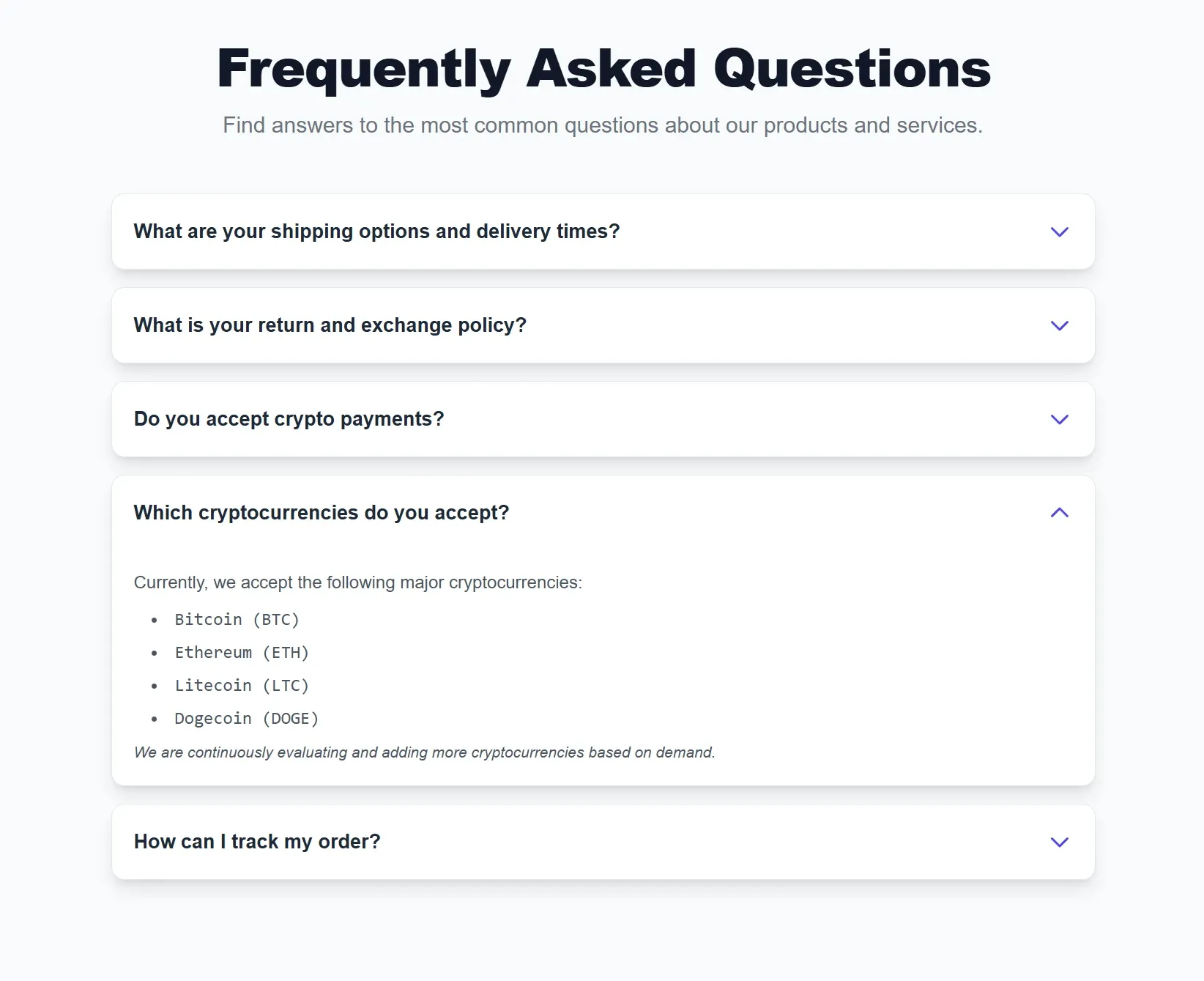
Adding questions like “Do you accept crypto payments?” and “Which cryptocurrencies do you accept?” is a great way to let your customers, search engines, and AI models know that you accept crypto payments.
Checklist for making crypto payments seamless:
| Do this | Checklist |
|---|---|
| Pick how you’ll accept crypto | Use a processor, check supported coins, enable auto-convert, confirm fees + setup |
| Set your rules upfront | Define refunds (no chargebacks), pricing, conversion handling |
| Track every payment | Record value at time of sale, keep TX IDs, use tax tools if needed |
| Know the risks | Irreversible payments, volatility (if holding), local compliance |
| Watch performance | Check usage, conversion impact, fees saved |
| Adjust as you go | Add/remove coins, improve checkout visibility, scale if it’s working |
Risks of accepting cryptocurrency payments
Crypto payments come with trade-offs worth understanding before you commit. Let’s break them down.
Price changes
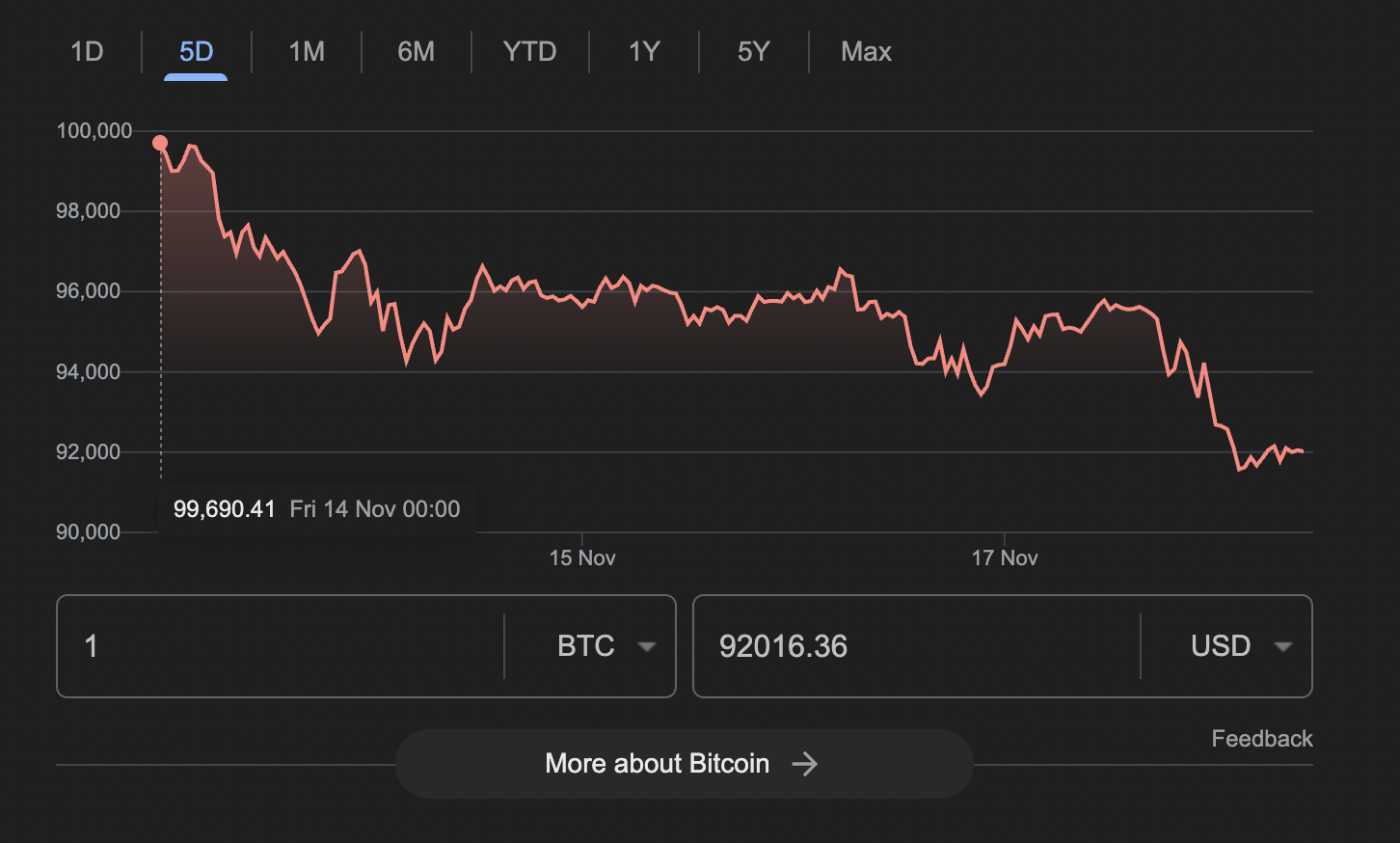
If you’re accepting non-stablecoin crypto payments, like Bitcoin and Ethereum - and you’re not auto-converting them to a currency like the U.S. Dollar or Euro - you’ll be facing the risk of price volatility.
What does this mean? Put simply, the crypto payment you got that’s worth $1,000 can go down to $900 the next day, losing you money.
Complicated tax and regulations
Countries have different regulations and tax appliances when it comes to cryptocurrencies, and it can be hard to keep up with all the rules.
If you’re living in the U.S., you should know that the IRS treats cryptocurrencies as properties, so, general tax principles apply to cryptocurrency transactions.
The same applies to Canada, UK, and Australia - so, you should track every transaction and keep detailed records. If you want to improve your regulatory and tax-related operations, consider working with an accountant who’s familiar with crypto regulations in your country.
To make sure you’re following your country’s crypto regulations and related taxes, refer to your national tax authority.
Smaller customer base
According to Capital One, cryptocurrency payments have a market share of 2% - which sounds low, but retailers often comment the average spend of customers paying with crypto is higher.
That's why crypto should never be your only payment method, but instead offered alongside more widely accepted methods like credit card, BNPL, and even cash, so you have something for every type of customer.
Crypto adoption is growing, anyway. Crypto.com found that global crypto ownership increased 12.4% between 2024 and 2025.
P.S: Capital One also found that 55% of crypto owners say they'd choose a store that accepts cryptocurrency over a comparable online retailer that doesn't.
The PYMNTS Report 'How Preferred Payment Availability Can Reduce Cart Abandonment' found that availability of their preferred payment method heavily influences 70% of customers.
Wallet management
Crypto wallets are generally very secure, but they have risks, too. For example, losing your private keys means losing your entire wallet, with everything in it - and there’s no way to get them back (just ask James Howells, a Welsh engineer who lost a hard drive containing the only copy of his private keys to access his 8000 Bitcoin).
On top of this, you should be very careful of what kind of information you’re sharing. Someone else getting access to your wallet can result in losing all your cryptocurrencies.
To minimize the risks, use platforms like Whop that provide wallet-like infrastructure and flexibility. Otherwise, make sure to go with trusted crypto wallets like Ledger, Coinbase, and MetaMask.
5 businesses who accept cryptocurrency payments
Miles High Club

Miles High Club is a crypto community that offers exclusive altcoin alpha, airdrop alerts, and trade ideas. With their strong team, they organize private weekly livestreams and share their expertise and insight with their members on their private Discord server.
With an annual membership option for $1,850, Miles High Club accepts crypto payments on Whop via Coinbase.
Microsoft
Microsoft is one of the biggest and most popular companies in the world, and it allows users to top up their account credits with Bitcoin.
These top ups can be used in stores like Xbox and Windows Store where users can pay for games and software.
Wealth Group

Wealth Group is a Whop community that offers a private community full of active crypto and trading experts. Its users collaborate with each other, share ideas, access expert market analysis, coin breakdowns, exclusive trading tools, and even personalized 1-on-1 mentorships.
Wealth Group accepts crypto payments for $225 per month, $1,275 per six months, or $2,400 annually.
Gucci

Gucci is one of the most popular luxury brands in the world, founded in 1921. While most people think crypto payments are for online stores only, Gucci is a great example of physical stores taking crypto payments.
While not all Gucci stores accept cryptocurrencies, some select ones allow customers to pay using BitPay, a popular crypto payment processor.
Kaizen

Kaizen is one of the biggest crypto communities on Whop, offering reliable trading signals, real-time market analysis and strategies, a private community of traders, and exclusive courses. The beginner friendly community provides step-by-step onboarding, beginner guides, and even live support to help beginner crypto traders learn the basics.
Kaizen offers membership to their exclusive community with crypto payment options for $199 per month, $1,075 per six months, or $2,000 annually.
Accept crypto payments, earn yield, and withdraw funds easily with Whop
By now, you know why businesses are adding crypto at checkout - it helps you reach new customers, lower processing costs, and get paid on your own terms. Whop makes the entire setup simple.
Whop is an all-in-one platform you can use to run your business or just handle payments. You choose which methods to offer - card, crypto, BNPL, and more.
To accept crypto on Whop, just:
- Create a whop
- Create a product and enable crypto payment method
- Set up crypto payments by signing up to Coinbase and connecting Whop and Coinbase account
Whether you’re running a community, selling services, or managing bookings, Whop removes the hassle of payment setup. You get a clean checkout, flexible options, and a streamlined way to accept crypto without extra tools or technical work.
Accepting crypto payments as a business FAQs
What are the most widely accepted cryptocurrencies?
The most widely accepted cryptocurrencies are Bitcoin, Ethereum, Dogecoin, and stablecoins like Tether (USDT) and USD Coin (USDC).
Do I need a crypto wallet to start getting crypto payments?
Yes, you need a crypto wallet to store the funds you receive from payments.
Which crypto wallet should I get?
You can get either a digital or a hardware wallet. Digital wallets can be created on platforms like MetaMask, Phantom, and Coinbase - hardware wallets, like Ledger, can be bought online.
If you're going to take crypto payments online, it makes sense to get a digital wallet - which you can easily do even with just creating a Coinbase Commerce account.
Can crypto transactions be reverted?
No, crypto transactions cannot be reverted.
Can in-person businesses accept crypto payments?
Yes, you can accept crypto payments in-person by using a POS solution like OxaPay.
Can I accept crypto payments with a phone?
Most crypto wallets allow you to quickly generate QR codes to direct others to payment links where they make the payment and you receive the crypto funds.
Should my business accept only crypto payments?
No, accepting crypto only will hurt your sales - if possible, you should always offer crypto alongside more traditional ways to pay, like credit card.


![Top 10 best embedded finance companies for SaaS and marketplaces [2026]](https://storage.ghost.io/c/12/7b/127b828b-bdc2-4972-9cf2-de857df9c324/content/images/size/w1000/format/webp/2026/08/embedded-finance.jpg)