Kraken is a secure crypto exchange with simple buying, staking and transfers. We test how easy it is to use in 2026, what it costs, and who it’s best for.
Key takeaways
- Kraken bridges beginner and advanced crypto trading without forcing platform switches as skills grow.
- The onboarding process takes about 10 minutes with instant account access and simple verification.
- Kraken Pro offers lower fees and advanced trading tools while sharing the same account.
Kraken is a crypto exchange built for intermediate to advanced crypto trading: buying, selling, staking and taking positions with proper tools instead of the watered-down features you get on basic apps.
It’s one of the big exchanges people move to when they’re done sitting on tiny balances and want to treat crypto like something they’re actively building, not just watching. But it's also suitable for total beginners (like me).
I'll give you my take on how easy Kraken is to use, from signing up to funding your account and exploring trades.
By the end, you should know whether it’s worth getting started on (or leaving your starter app behind for) Kraken.
What is Kraken, and why am I testing it out?
Kraken is a long-running centralized crypto exchange where you can buy, sell, trade and stake 560+ cryptocurrencies, from Bitcoin and Ethereum to newer altcoins that aren't available on basic apps.
It launched back in 2011, and the reason I often see people recommending it is its track record: Kraken has remained operational through every market cycle since it was launched.
Plus, unlike the beginner-only platforms that stop at simple buying, it gives you access to deeper tools.
Kraken originally geared for this slightly more sophisticated audience than Coinbase, for example, but not super sophisticated – kind of in that middle range. It's good for on-ramping, off-ramping. It's a pretty trustworthy brand.
– Kadin D, Whop Chief Strategy Officer
On the Kraken app, you can trade spot pairs, stake proof-of-stake assets for rewards, and, in supported regions, use margin and futures if you want leverage or more tactical strategies.
Beyond crypto, Kraken also offers commission-free trading on 11,000+ U.S.-listed stocks and ETFs for eligible U.S. clients, making it more than just a crypto exchange.
But what if you're a crypto pleb, like me? Then you're in luck, because Kraken supports both beginner activity and more advanced trading.
Pleb: A regular person in crypto with a small bag, learning and stacking coins without insider money or whale status.
I can stick to simple spot buys at first, and if I want to, I can move into staking proof-of-stake coins for rewards, or (depending on my region) margin and futures for more tactical positions.
It also supports both fiat and crypto funding, so I'm not locked into a single on-ramp.
TL,DR: Kraken feels like one of the few exchanges that won’t force me to swap platforms as I get more confident. I can start simple, and everything I might want later is already there waiting.
Kraken and Kraken Pro are two versions of the same platform, so let's quickly run through the difference.
What's the difference between Kraken and Kraken Pro?
Kraken is the starter track if you just want to buy, sell, stake and chill. If you want charts, order books, fee tiers and real trading tools, Kraken Pro is where you'll end up.
For this review, I'm using the standard Kraken app. Why? Because that's the version most users thinking "Hey, I should probably buy some Bitcoin" land on first.
Still, understanding where Kraken Pro sits helps set expectations for what the platform can grow into if you go deeper later.
- Kraken: Kraken's core app is built for people who don't need a Wall Street cockpit in their pocket. It's clean, straightforward and hard to screw up. It's designed so you can get in, make your move, and get out without drowning in numbers. If your entire strategy is to casually stack, and check back later? Kraken is probably for you.
- Kraken Pro: Kraken Pro takes all the assets and security from regular Kraken, then layers more trading infrastructure on top. You can plan entries, set exits, automate risk, and track performance without manual refreshing (this is what scalpers, day traders, and traders who care about execution speed choose).
One thing Kraken gets right is you don't have to choose forever.
Start on Kraken to learn the basics, and once you're ready for candlestick charts and live order books? Tap into Pro and everything is already there: your funds, your portfolio, and your trading history.
I've used many of its competitors, but Kraken definitely shines in terms of user experience.
– Michael Beer, Cracked Devs founder
Ready to sign up? Here's how.
Signing up for Kraken: Step-by-step and requirements
Signing up for Kraken is pretty standard for a regulated crypto exchange. You'll need to provide your email, verify your identity, and provide a linked bank or payment method.
You can sign up on:
- the Kraken app (iOS/Android), or
- kraken.com on desktop
Both walk you through the same process, and I'll explain how it easy it is below.
Before you start: Everyone signing up for Kraken will need a working email address, an ID that matches your legal name, a smartphone camera or webcam for selfie verification, and a payment method for deposits. Your exact requirements depend slightly on where you live, but KYC is mandatory everywhere.
- Step 1: Create your account. I logged on to Kraken's website, hit Sign Up, and entered my name, email and a password.
- Step 2: Kraken sends a short verification code to your email which you enter in the app/ on the desktop site.
- Step 3: Choose which platform you want, Kraken or Kraken Pro. I selected Kraken, knowing I can always upgrade later.
- Step 4: You'll land on your dashboard now (unverified). You can browse the app, see prices and menus, but you can't trade or deposit yet.
- Step 5: Tap "Verify your identity". This lives at the top of the home screen. Kraken walks you into KYC from there.
- Step 6: Choose your country/region. Kraken supports most countries, but available payment methods and features change based on what you pick.
- Step 7: Choose your ID method. Options vary by country, but generally include driver's licences, passports, and national ID cards (in supported regions).
- Step 8: Scan your ID and take a selfie. You use your phone camera or webcam, no uploading PDFs or doing anything fiddly.
Make sure your ID photo and selfie verification are clear and well-lit. I had to upload my ID three times before it was accepted, which I haven't experienced with other KYCs.
- Step 9: Wait for approval – mine cleared almost instantly. Some users may wait longer if their photo is blurry, document details don't match your profile, or your region has slower ID matching systems.
You’ll need to wait for approval before you can deposit funds to your account. Once verified, Kraken unlocked Apple Pay, PayPal and OSKO (instant bank transfers) for me. Other regions get their own rails.
- Step 10: Once you're approved, you can deposit funds into your account – and it's time to play. Most bank deposits (ACH, SEPA) are free, though card and instant-buy deposits may carry fees (e.g., 3.75% for card purchases). The 1% fee you'll see is Kraken's trading fee when you buy or sell crypto, not a deposit fee.
You'll also have to check a box to confirm you understand you can't withdraw deposits for a limited time (in my case, 3 days).
My take on Kraken's onboarding
Signing up was honestly fast AF, and super simple. I didn't feel like I was proving myself to a scary big entity.
I also liked that Kraken lets you into the UI immediately so you're not poking around a loading screen, and you can start exploring the dashboard.
Identity verification was fast, the interface didn't overwhelm me, and I never had to stop and Google what something meant.
I was able to deposit funds into my account within 10 mins of signing up. Pretty good!
Let's walk through some of the stuff you can do once you're set up.
Kraken vs. Kraken Pro: Features and abilities
Kraken and Kraken Pro share the same assets and the same account, but they don't give you the same tools.
Kraken keeps things simple so you can buy, hold and stake without touching a chart. Kraken Pro unlocks the deeper trading features that people use when they stop treating crypto as a one-click purchase.
What you can do on Kraken (standard app):
Kraken's default experience is built around the basics:
- Buy, sell and convert crypto with simple prompts
- Stake supported assets like ETH, SOL, DOT and ATOM
- Set recurring buys if you want to dollar-cost average
- View price charts and basic market data (candles, timeframes, volume)
- Track your holdings with a clean, beginner-friendly portfolio view
- Send and receive crypto between wallets and exchanges
- Access 560+ assets without leaving the simple interface
Kraken gives beginners the simple, core functions needed to start investing. You can see price moves, open markets, and chart trends without needing Pro.
So, what does Kraken Pro give you?
Kraken Pro takes the same assets and same balances and gives you much more trading control:
- Lower fees with maker/taker tiers that drop as you trade more
- Advanced charting with deeper order book data and market depth
- Full suite of order types (limit, stop loss, take profit, trailing, TWAP-style logic)
- Margin and futures trading (region permitting)
- Live execution tools built for timing, strategy and risk management
- Portfolio analytics that show fills, PnL and open positions in detail
It's the logical upgrade path once you start caring about entry/exit precision. But it's not needed to get started, and most traders recommend starting with Kraken's basic app to learn the ropes.
Feel overwhelmed? Fair, it's a lot to wrap your head around.
Here's a basic comparison of each product's features, so you can see if Kraken or Kraken Pro suits your needs better:
| Feature | Kraken | Kraken Pro |
|---|---|---|
| Buy & sell crypto | ✓ Yes | ✓ Yes |
| Staking | ✓ Yes | ✓ Yes |
| Recurring buys (DCA) | ✓ Yes | ✓ Yes |
| Price charts | ✓ Basic charts | ✓ Advanced charts + order book |
| Supported assets | Same on both | Same on both |
| Margin & futures | ✗ No | ✓ Yes (if legal in your region) |
| Fees | Simple, flat style | Lower, volume-based |
| Best suited for | Beginners & casual users | Active & advanced traders |
The top features I see users talking about are staking, pairing, and the availability of cryptocurrencies and derivatives on the Kraken exchange.
Let's run through each.
Staking crypto with Kraken
Staking is where you lock certain coins (called proof-of-stake coins) to help run the blockchain, and you earn rewards for doing it (kind of like interest).
You don't have to move funds elsewhere or fiddle with DeFi contracts; the app handles the validator mechanics for you.
Staking: You lock your proof-of-stake coins into the network so validators can process transactions, and in return you earn a share of the rewards that blockchain pays out for helping keep it running.
Coins like ETH, SOL, DOT, ATOM, ADA and others pay staking rewards just for locking them up with the network through Kraken.
Rewards vary by asset and network conditions, but generally they're higher than what you'd earn leaving the coins idle. Note that Kraken takes a commission on staking rewards (typically around 7.25%, and up to 15% for Ethereum), which is deducted automatically before rewards are paid out.
Here's how it works in practice:
- Pick a coin that supports staking
- Choose how much you want to stake
- Kraken locks it on your behalf with their validator partners
- You start earning rewards that compound over time
Once you've staked a coin, your rewards get paid straight into your Kraken account. You'll see them show up automatically, you don't have to claim anything or move coins around.
Staked coins aren't always instantly withdrawable: Different blockchains have different rules, and while some let you unstake quickly, others make you wait a few days or weeks before you can access your coins again.
For newbies who like the idea of "set and forget," Kraken also lets you auto-stake new deposits of that coin, so you don't have to manually re-stake every time you add more.
A note for U.S. users: In early 2023, Kraken shut down its U.S. staking program following an SEC settlement. However, as of January 2025, Kraken has reinstated on-chain staking for U.S. clients across 37+ eligible states, supporting 17 assets including ETH, SOL, DOT and ADA via Kraken Pro.
Bottom line: I can buy a coin in the app, stake it in the same app, and earn rewards without multiple wallets or anything technical.
How to pair cryptocurrencies with Kraken
Kraken lets you swap one crypto for another by trading market pairs (like trading ETH for BTC, or SOL for USDT). You don't need a second wallet or a third-party exchange, either – everything happens inside the app.
Pairs: A pair is just two assets you’re moving between. If you choose BTC/USDT, you’re trading Bitcoin into USDT. If you pick SOL/ETH, you’re swapping Solana into Ether. Kraken tells you which direction you’re trading before you confirm.
Here's what pairing looks like step-by-step:
- Open Kraken and head to 'Portfolio' on the mobile app, then click 'Trade'. Desktop users use the 'Buy, Sell, Convert' panel on the side of the dashboard.
- Pick the coin you want to use
- Select the coin you want to receive
- Review the price
- Confirm the trade
Kraken will show you:
- The rate you're getting,
- How much you'll receive,
- And any fees involved.
You can pair assets inside your account as many times as you want (swapping BTC to ETH to SOL and back to BTC), if that's how you like to allocate your portfolio.
One thing I really liked? Kraken makes it easy to calculate percentages of your owned assets rather than having to manually calculate themselves. You can select 25%, 50%, or 75% of your funds when converting trades.
If you ever switch to Kraken Pro, pairing works the same way. You just get more visibility into pricing, spreads and liquidity.
Cryptocurrencies and derivatives available on the Kraken exchange
Kraken supports a long list of cryptocurrencies you can actually buy and hold, plus extra trading products like futures and margin (if you're in a region that allows them).
The standard Kraken app lets users trade Spot crypto:
- The big ones: BTC, ETH, SOL, ADA, XRP
- Popular layer-1s: DOT, AVAX, ATOM, MATIC
- Stablecoins: USDT, USDC, DAI
- A long tail of altcoins (all inside the app, no side integrations)
Spot crypto trading: When you buy or sell a coin at the current market price and take ownership of it immediately. No borrowing or leverage, you just own the asset.
With 560+ cryptocurrencies and 1,200+ trading pairs, if a coin is on most major exchange lists, Kraken probably supports it. They also regularly add smaller and emerging assets over time.
Kraken Pro also unlocks extra markets for experienced traders:
- Margin trading: Borrow funds to increase position size
- Futures contracts: Trade price direction without holding the coin
- FX and crypto pairs: For people who like moving between currencies
For eligible U.S. clients, Kraken also offers commission-free trading on 11,000+ U.S.-listed stocks and ETFs, expanding the platform well beyond crypto.
These aren't available everywhere. Some countries block derivatives entirely, and Kraken hides unavailable markets so you don't accidentally click into something you can't trade.
Which regions allow retail users to access margin and futures?
Kraken only offers margin and futures to retail users in the EU, UK, Canada, Japan and a handful of LATAM/APAC countries where those products are licensed.
In Australia, the US, Singapore, India, New Zealand and other tightly regulated markets, crypto derivatives are restricted to wholesale/pro investors — so regular Kraken users won’t see margin or futures at all.
Kraken's pricing (what's free, what isn't)
Creating my Kraken account was free, and I could browse the app and market data without paying anything.
Costs only kick in when you actually transact: think buying crypto, converting between coins, staking, or moving money.
Kraken (standard app) fees
I'm using Kraken's standard app, and its fees are super simple.
- ~1% fee to buy, sell or convert crypto
- Plus a spread (the difference between market price + your executed price)
- No tiered discounting
- Staking rewards vary, and Kraken takes a commission (typically 7.25%, up to 15% for ETH) that's deducted from rewards before they're paid out
Kraken's default pricing is deliberately simple, but not the cheapest. It's great for casual buying, not ideal for regular traders.
Kraken+ (optional subscription)
Kraken also offers an optional subscription called Kraken+ for $4.99/month (or $49.99/year). With Kraken+, you get fee-free trading on up to $10,000 in monthly volume. If you're a regular buyer who uses the standard app, this can save you a lot compared to paying the flat 1% each time.
Kraken Pro (cheaper trading for active users)
- Maker/taker fee structure (no flat 1%)
- Maker fees start at 0.25% (and can drop to 0.00%)
- Taker fees start at 0.40% and can fall to 0.10% based on 30-day volume (or as low as 0.08% for institutional clients)
- Fees drop based on 30-day trading volume
- Same applies to futures/margin if your region allows it
Pro is built for people who plan to trade more than a couple of times a month and want tighter pricing.
Krak
Kraken also has a product for crypto payments and transfers within their ecosystem, called Krak. You use Krak to spend, send and move crypto, not to trade or custody your own keys.
Krak is currently available in the UK and EU only.
It's free to set up, but fees show up when you fund or use the account:
- Transfers between Kraken and Krak are free
- Bank deposits are generally free
- Card, Apple, and Google Pay top-ups cost ~3.75%
- Spending or converting incurs a spread
- Vault/AutoEarn yields take a performance fee (not paid upfront)
- Crypto withdrawals charge network fees
Krak is built for everyday money use: tapping a card, sending friends funds, earning yield on idle cash. Self-custody lives in the separate Kraken Wallet app.
Is Kraken safe to use?
Yes, Kraken is widely regarded as one of the safer major crypto exchanges. It keeps most assets offline in cold storage, and has strong account protections like 2FA, withdrawal whitelists and proof-of-reserves audits that let anyone verify that customer funds are actually backed.
Kraken also holds multiple international certifications (ISO/IEC 27001, SOC 2), runs bug bounties and has a dedicated security team to proactively test and fortify its systems.
It's also worth noting that in November 2025, Kraken confidentially filed its S-1 registration with the SEC for a potential IPO, following an $800 million funding round that valued the company at $20 billion. This signals long-term institutional commitment and financial transparency.
That said, no exchange is risk-free. Always use strong passwords, enable 2FA, and withdraw long-term holdings to self-custody if you're not actively trading.
Kraken's security features
Kraken's security stack includes:
- Cold storage custody for the majority of assets, isolating them from online threats.
- 2FA and customizable access controls.
- Withdrawal address whitelisting, so stolen credentials can't be used elsewhere.
- Proof-of-Reserves auditing, enabling public verification of asset backing.
- ISO/IEC 27001 and SOC 2 compliance certifications.
- Real-time monitoring and bug bounty programs to catch exploits early.
These measures make Kraken's infrastructure resilient and lower the odds of large scale theft or systemic compromises compared to many peers.
Withdrawing funds from Kraken
I found withdrawing your Kraken assets is generally straightforward:
- Withdraw crypto to an external wallet: Kraken applies network fees only (no hidden exchange markups).
- Withdraw fiat via supported bank rails: Depending on region, this will be ACH, SEPA, Faster Payments, etc.
Always double-check addresses before confirming, as blockchain transactions are irreversible.
Has Kraken faced regulatory issues?
Kraken has generally steered clear of major hacks, but it has faced regulatory and enforcement actions. In fairness, due to the nature of crypto and DeFi, you'd be hard pressed to find an exchange or provider that hasn't.
Still, be aware of the below:
- In February 2023, the U.S. SEC alleged that Kraken's staking product was an unregistered securities offering; Kraken agreed to a $30 million settlement and shut down U.S. staking services as part of the deal (non-U.S. staking continued). However, as of January 2025, Kraken has reinstated staking for U.S. users in 37+ eligible states.
- In November 2023, the SEC filed a broader lawsuit alleging Kraken operated as an unregistered securities exchange. In March 2025, the SEC agreed to dismiss the lawsuit with prejudice — meaning no admission of wrongdoing, no penalties paid, and no changes to Kraken's business.
- In August 2024, Australia's ASIC ordered Kraken's local operator to pay a A$8 million fine for offering margin-like credit facilities without proper suitability determinations for customers.
These aren't hacks, they're just regulatory pushbacks typical of the crypto industry's grey legal areas. Notably, the dismissal of the SEC's major lawsuit in 2025 was a significant positive outcome for Kraken.
Top Kraken alternatives
If Kraken doesn’t feel like the right fit for your trading journey, there are plenty of exchanges that cover similar ground.
Coinbase, Binance and Gemini are the three closest alternatives, each with their own strengths around usability, fees and regulation.
Coinbase
Coinbase is one of the most mainstream crypto exchanges globally, known for being very regulation-forward and easy to use.
Its interface is more beginner-friendly than Kraken’s standard app, with a clean experience and strong custodial insurance on assets.
However, Coinbase fees on basic buys/sells can be higher than Kraken’s.
Coinbase also offers staking, recurring buys, and a separate advanced trading terminal like Kraken pro (called Coinbase Advanced), making it a broad alternative for users who want simplicity with optional depth.
Coinbase only operates in 100+ countries globally, while Kraken is available in around 190+ countries.
Best for: Beginners, regulated-market users (especially in the U.S. and UK), people who prioritise a smooth UX and strong compliance.
Binance
Binance is the largest crypto exchange by trading volume and has one of the deepest liquid markets in the industry. It supports a huge range of assets, low trading fees and a wide suite of products: spot, margin, futures, savings, staking, and more.
The catch is that its regulatory status varies by region, and some advanced products are restricted (e.g., derivatives in certain countries).
What about availability? Well, Binance is available in many regions around the world and has one of the largest global footprints of any exchange, though its specific availability varies by market (U.S. users go through Binance.US, for example).
I found users say Binance’s interface and product breadth can be overwhelming if you just want to buy and hold, but for active traders? It’s an extremely competitive exchange platform.
Best for: Active traders, large volume users, people who want the broadest asset support and lowest incremental fees.
Gemini
Gemini is a U.S.-based exchange with a strong emphasis on regulation, security and custodian protections.
It doesn’t have as many assets or as deep liquidity as Binance or Kraken, and its fees can be higher on simple buys, but it offers a clear legal and compliance framework that appeals to users who prioritise institutional-grade safety.
Gemini also has features like staking and a separate advanced platform (Gemini ActiveTrader), but overall it skews toward the trust-focused side of the market rather than the ultra-low-cost/trading-first side.
Best for: Users who prioritise security and regulation and beginners who want peace of mind.
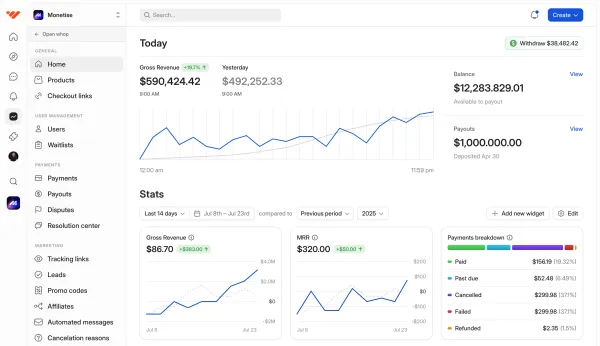
Turn Whop earnings into crypto positions on Kraken
If you’re running an online business, Whop makes it stupidly simple to get paid.
We’ll handle payments for you (card, wallets, BNPL, crypto payments), act as your MoR, manage access to your product, and let you withdraw your earnings your way.
When you withdraw funds, you can choose a crypto payout option and send the funds directly to your Kraken deposit address.
No Coinbase detour, no extra wallets required. Swap into Bitcoin or ETH, stake tokens for yield, or simply hold positions long-term.
Whop pays out in over 241+ territories with every payout method imaginable, from crypto to ACH, Venmo, CashApp and more.
Process your payments on Whop and get access to the best creator payouts, including direct crypto wallet transfers.