PayPal is one of the most widely used payment providers worldwide. Learn how PayPal works for online businesses, what it costs, and the top alternatives if you want more flexibility or better margins in 2026.
Key takeaways
- PayPal offers easy setup and strong customer trust, but higher fees and limited routing control become costly as businesses scale.
- PayPal's dispute process favors buyers and unpredictable account holds can disrupt cash flow for merchants.
- PayPal's features vary significantly by region, so verify Pay Later, multi-currency, and payout options before committing.
PayPal is a global payment processor that lets businesses accept cards, wallets, PayPal balances, and financing through a fast, familiar checkout flow.
Customers trust it, it’s simple to set up, and it works across ecommerce, digital products, services, and creator businesses.
That said, I don’t think PayPal is a perfect fit for every business model.
Fees can stack up, disputes can be slow and unpredictable, and you get less control over routing, approvals, and optimization than with modern multi-PSP platforms.
Stick around and I'll walk you through how PayPal actually works today (including what PayPal Open is), how payments flow behind the scenes, pricing, limitations, and the top alternatives for 2026.
What is PayPal, and how does it work for businesses?
PayPal works by acting as a middle layer between your customer and your bank account, processing the payment, verifying the buyer, and settling the funds to you.
When businesses connect PayPal to their store or checkout, PayPal handles the transaction from start to finish (accepting cards, digital wallets, bank transfers, PayPal balances, and PayPal’s own BNPL offering).
What is PayPal Open?
PayPal Open is PayPal’s updated, unified platform for merchants. It’s the system that powers checkout, card and wallet payments, PayPal balances, PayPal Pay Later, fraud checks, settlement, and payouts.
If you’re accepting payments with PayPal in 2026, you’re using PayPal Open – whether you’re a small seller or a global enterprise.
The two main ways businesses use PayPal:
Online businesses typically use PayPal through one of these tools:
- PayPal Checkout: Adds the PayPal button and PayPal Pay Later to your existing checkout. Customers can pay with PayPal, digital wallets, PayPal balances, bank transfers, and instalments.
- PayPal Payments: Lets you accept card payments directly through PayPal’s processor (Visa, Mastercard, Amex, Discover) without requiring the buyer to use a PayPal account.
Both options integrate through ecommerce platforms like Shopify, WooCommerce, or Wix, or through a simple API integration if you want more control.
What features does PayPal have?
For smaller or online-first sellers, I see PayPal functioning primarily as a simple checkout add-on.
You'll get:
- PayPal Checkout
- Card processing
- Basic subscriptions and invoicing
- Seller Protection (with conditions)
- A dashboard for refunds, disputes, and payouts
It’s quick to set up, but in my experience, it’s also fairly rigid: think less control over routing, fees, data, or how PayPal handles risk.
For larger sellers, enterprise-level features become available, including:
- Multi-currency acceptance (with extra fees)
- More detailed reporting
- Creator/contractor payouts
- Stronger fraud controls
- API integrations for custom checkouts
- Optimization features to reduce declines
- Negotiated pricing for high volume
These features aren’t unlocked automatically, BTW. They require higher sales volume, additional onboarding, or direct contact with PayPal.

Who can use PayPal, and what are its limitations?
PayPal is available to most online businesses, as long as you operate in one of PayPal’s supported regions and meet its basic verification requirements.
It covers over 200+ markets, like Western Union does, making it one of the easiest payment options to switch on globally – but the features you get vary by country.
Any business that sells online, sends invoices, offers subscriptions, or needs a simple checkout option can use PayPal.
This includes ecommerce stores, digital product creators, coaches, freelancers, SaaS products, and service providers.
In general, you can use PayPal if you:
- Operate in a supported country
- Have a verifiable business or sole-trader identity
- Can provide the documents PayPal needs for KYC
- Have a bank account in your payout currency
- Meet regional restrictions around products and services
The downside: PayPal doesn’t offer the same tools everywhere. Some features (like PayPal Pay Later, multi-currency settlement, crypto payments, and specific payout methods) are only available in selected markets.
Regions outside the U.S. may also have slower settlement times, stricter risk rules, or fewer payment options enabled by default.
In other words? Coverage is broad, but consistency isn’t.
If you sell to global customers, rely heavily on BNPL, or need to accept multi-currency payments? It’s worth checking PayPal’s region-specific feature list before committing.
Unlike PayPal’s region-gated features, Whop Payments gives you global cards, wallets, crypto, and BNPL coverage that scales across almost every market.
That’s how PayPal runs under the hood. Next up, the part that matters most to sellers: pricing.
PayPal fees and pricing for businesses
PayPal isn’t just a household name for ease of use — it’s also known for its fees, which I see catch many sellers off guard.
Businesses pay a mix of percentage rates and fixed charges every time a customer checks out, and the final amount depends on how the payment is made.
Cards, wallets, PayPal balance, and PayPal Pay Later all come with their own costs, which can stack up.
In my experience, PayPal is easy to set up, but it’s rarely the cheapest option.
Most online and digital-first businesses end up paying more per transaction than they would with a modern payment provider or a multi-PSP setup (like Whop).
PayPal’s U.S. fees at a glance:
Here’s an overview of the fees you’ll need to be aware of if you’re using PayPal as your business's payment processor:
| Fee type | Cost (U.S.) |
|---|---|
| Online card payments | 2.89% + $0.49 per transaction |
| PayPal Checkout (wallet & balance) | 3.49% + $0.49 per transaction |
| PayPal Pay Later | 4.99% + $0.49 per transaction |
| International payments | Domestic fee + 1.50% |
| Currency conversion | FX rate + margin |
| Disputes | Merchant Dispute Fee (varies by tier) |
| Chargebacks | Standard chargeback fee applies |
| Refunds | No refund fee, but the fixed fee isn't returned |
| Enterprise pricing | Custom rates for high-volume sellers |
How does PayPal process business payments?
PayPal processes business payments by handling every step between your customer, the card or wallet provider, and your bank account.
Once PayPal is added to your checkout, it manages authorization, fraud checks, settlement, and payouts automatically.
Here’s how the flow works, step by step:
1. Checkout
Your customer pays using a card, PayPal wallet, PayPal balance, Venmo, or PayPal Pay Later. This can happen through your website checkout, a PayPal button, a payment link, or a digital invoice.
2. Authorization
PayPal encrypts the customer’s details and sends the transaction to the card network (Visa, Mastercard, Amex, Discover) or PayPal’s internal wallet system for approval.
The bank or wallet provider returns an approved or declined status.
3. Fraud screening
Before the payment is completed, PayPal runs automated fraud and risk checks.
Suspicious transactions may be flagged, delayed, or declined based on PayPal’s internal risk models (this is both a win and a loss; some business owners report PayPal withholding funds for no reason).
4. Capture
If approved, PayPal captures the funds and logs the payment instantly in your PayPal Business dashboard. You can also see your customer info, payment method, fees, and transaction status in real time.
5. Settlement
Funds then move into your PayPal balance: you can keep them there, withdraw to your linked bank account, or use them to issue refunds.
Bank withdrawals typically take 1-2 business days, or you can pay extra for an instant transfer (usually 1.50% of the payout amount, capped at a max fee).
6. Reconciliation
PayPal automatically records every payment, refund, dispute, and fee. It also handles compliance requirements like data security, payment storage, and chargeback administration.
This closed-loop system makes PayPal simple for beginners, but I see it limiting control as businesses scale.
Is PayPal worth it? Pros and cons
PayPal makes it easy for businesses to start accepting payments online. It’s fast to enable, instantly recognisable to customers, and supported by nearly every major ecommerce platform.
For small sellers, creators, and service providers, it removes a lot of setup and technical work.
But from my perspective, PayPal also comes with clear trade-offs: higher fees, rigid routing, region-locked features, and limited control over approvals.
And if you’re scaling internationally or running a digital-first business model, I find those limits become a lot more noticeable.
Here’s the balanced view:
Pros:
- Fast onboarding and simple setup: PayPal plugs into almost every ecommerce platform with one click, which is a huge win.
- Strong customer trust: PayPal’s brand recognition can lift conversion rates, especially for global shoppers who prefer PayPal’s buyer protection.
- Supports core payment methods: PayPal covers cards, PayPal balances, bank transfers, digital wallets, and PayPal Pay Later (where available).
- Built-in invoicing and basic subscriptions: You can send invoices, run recurring billing, or charge repeat customers without third-party tools.
- End-to-end risk and compliance: Fraud screening, PCI compliance, data storage, and dispute handling are all managed by PayPal. Beginners don’t need to worry about external fraud-detection solutions.
- One dashboard for refunds, disputes, payouts, and analytics: Everything runs through the PayPal interface, which keeps admin simple for smaller businesses.
Cons:
- Higher fees (especially for wallets and BNPL): PayPal’s fixed and percentage fees stack up quickly. PayPal Pay Later is one of the most expensive BNPL options on the market for merchants.
- Region-dependent features: PayPal is global, but not consistent. Pay Later, multi-currency settlement, specific payment methods, and payout types vary widely by country.
- Limited optimisation and no real routing: Unlike modern multi-PSP platforms, PayPal doesn’t route failed transactions through multiple providers to recover declines. A decline is final.
- Risk reviews and account holds: PayPal is known for aggressive risk management. Funds may be held for reviews without much notice, which can impact cash flow.
- Disputes typically favour buyers: PayPal’s dispute process is notoriously slow and often rules in favour of the customer, even when merchants provide evidence.
- Less flexibility for online-first or global sellers: If you rely on international customers, alternative payment methods, or need multi-currency control, PayPal becomes limiting fast.
For a lot of sellers, these cons are overkill – which is why it's worth looking at PayPal's top alternatives.
Top alternatives to PayPal
If PayPal feels too expensive, too rigid, or too limited for your market, you’re not stuck.
These payment platforms offer more flexibility, better global support, lower fees, and stronger optimisation tools – depending on what your business needs next.
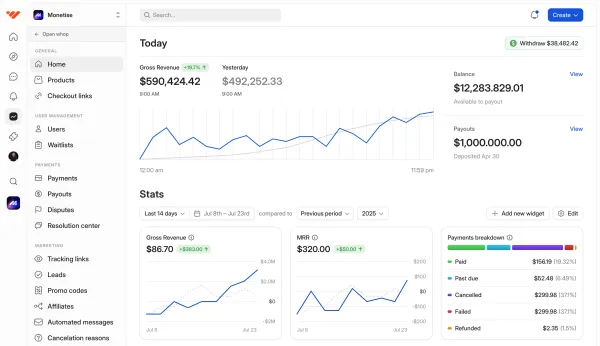
1. Whop Payments
Whop Payments is built for digital-first businesses: online creators, coaching brands, SaaS sellers, marketplaces, and global entrepreneurs.
It removes the complexity PayPal has (think regional feature limits, lack of routing, and unpredictable disputes).
Instead, sellers get a unified PSP stack that automatically reroutes transactions to boost successful payments by 11%.
When we started, Whop Payments was essentially a Stripe Connect wrapper. Now we’ve built our own infrastructure, from KYC to pay-ins and payouts.
- Hunter Dickinson, Head of Partnerships at Whop
Whop also supports 100+ global payment methods (cards, wallets, BNPL, local methods, and crypto), offers fast onboarding, and includes built-in tools for storefronts, memberships, affiliates, and product hosting.
Crossed my first 6-figures on Whop! I came from another platform, where they lost their way with how they treat their users. This is how it’s done!
- Coach Carl Parnell
Forget about subscription fees or paid add-ons – just simple, flat pricing with enterprise discounts available for sellers processing above $50k/month.
Features:
- Global orchestration (boosts successful charges by up to 11%)
- 100+ payment methods (cards, wallets, BNPL, crypto)
- Embedded checkout, checkout links, or full storefront
- Fast payouts to bank, Venmo, Cash App or Coinbase
- 24/7 human support
- Zero monthly fees
- Run your entire business on one platform: storefront, products, memberships, and access management
- Centralised payments, payouts, analytics, refunds, disputes, and customer management
Pricing: 2.7% + $0.30 per successful charge
Best for: Digital-first brands that want global reach, higher approval rates, faster payouts, and a unified platform for products, payments, and growth.
2. Stripe
Stripe is one of the most flexible payment platforms on the market, used by startups and global brands. Its main strength is its API-first design, which lets businesses build completely custom checkout flows, billing systems, and marketplace payouts.
If you have engineering resources, Stripe gives you control that PayPal doesn’t offer. It supports 100+ global payment methods, advanced fraud tools, recurring billing, invoicing, tax calculation, and platform payments through Stripe Connect.
The downside? Stripe requires technical setup and ongoing maintenance.
Features:
- Customisable APIs for checkout, billing, and invoicing
- Stripe Billing for subscriptions, trials, and usage-based pricing
- 100+ global payment methods
- Radar fraud detection
- Connect for marketplaces and multi-sided platforms
- Financial tools like Issuing, Treasury, and Capital
- Real-time reporting and analytics
Cons:
- Set up and maintenance often require developers
- No orchestration for declining transactions
- Limited native crypto support
- Dispute handling can be slow
Pricing: 2.9% + $0.30 for U.S. cards, +1% international cards, +1% currency conversion.
Best for: Businesses with technical teams who need deep customisation or complex recurring billing.
3. Square
Square is best for businesses that sell both online and in person. It started as a hardware ecosystem (card readers, POS terminals, and registers), but now has tightly integrated payment processing software.
Everything syncs into one dashboard, making it a simple choice for retailers, cafés, gyms, and service-based businesses.
Square also supports online payments through checkout links, invoices, and the Square Online store builder.
While the tools are beginner-friendly, Square’s ecommerce features aren’t as flexible as Stripe or as global as Whop. BNPL is available through Afterpay, but fees are high.
Features:
- POS hardware for in-person sales
- Square Online for ecommerce
- Invoices, recurring billing, and card-on-file
- Inventory, staff, loyalty, and appointment tools
- Afterpay for BNPL (selected markets)
- Unified dashboard for online and offline sales
Cons:
- Limited global reach
- Higher BNPL fees
- Fewer payment methods than modern platforms
- Not ideal for digital-first brands or multi-currency businesses
Pricing (U.S.):
- In-person: 2.6% + $0.10
- Online: 2.9% + $0.30
- Invoices: 3.3% + $0.30
- Afterpay: 6% + $0.30
Best for: Hybrid sellers (retailers, cafés, gyms, salons, in-person service providers) who need in-person POS hardware combined with simple online checkout tools in one ecosystem.
4. Adyen
Adyen is an enterprise-grade payment processor designed for companies operating across multiple regions, channels, and currencies.
It offers direct acquiring, unified commerce (web, app, and in-store), advanced fraud control, and detailed reporting. Plus, you know it’s trustworthy – big-name brands like Spotify, Uber, H&M, and eBay use Adyen for its scale and control.
Adyen offers sophisticated optimisation tools and custom routing – but onboarding is complex, minimum invoices apply, and pricing varies by region and payment method.
It’s powerful, but overkill for most online businesses.
Features:
- Global acquiring + 250+ payment methods
- In-store + online unified commerce framework
- Advanced fraud and risk management
- Multi-currency settlement
- Custom routing and optimisation
- Enterprise-grade reporting and analytics
Cons:
- Complex setup - often requires developers
- Not suited to small teams
- Variable pricing
- Long onboarding timelines
Pricing: Adyen doesn’t have flat rates. You pay the card network’s interchange fee, plus Adyen’s fee (about 0.6%), plus extra scheme/processing fees. Oh, and they also require a monthly minimum spend.
Best for: Large enterprises and international brands that require enterprise-level optimisation across multiple regions and channels.
5. Shopify Payments
Shopify Payments is the most seamless option for merchants selling on Shopify. It removes third-party redirects and fully integrates checkout, payouts, refunds, and disputes into Shopify’s dashboard.
Shop Pay (especially on mobile) is known for high-conversion rates, increasing successful checkouts by up to 1.91x, compared to standard checkouts.
Shopify Payments also supports BNPL through Shop Pay Installments (via Affirm).
The main limitation is that it only works on Shopify and only in supported countries. You can’t use it across multiple platforms or as a standalone payment processor.
Features:
- Native Shopify checkout (no redirects)
- Shop Pay + Shop Pay Installments
- Unified orders, payments, refunds, and analytics
- Built-in fraud tools and PCI compliance
- Automatic sync with Shopify Flow and automation tools
Cons:
- Only works on Shopify (no support for other platforms)
- Not available in all countries
- Limited payment method range
- Not ideal if you also sell outside the Shopify ecosystem
Pricing: 2.9% + $0.30 online (varies by plan and region). Lower rates are available on higher Shopify tiers.
Best for: Shopify sellers wanting the simplest and fastest checkout experience.
Is PayPal the best choice for your business payments?
PayPal can be a good option for businesses that need a fast, familiar way to start accepting payments online with almost no setup.
The PayPal button is trusted globally, works on nearly every ecommerce platform, and gives customers multiple ways to pay, which can help increase sales.
But PayPal also has limits: fees can stack up quickly, especially for PayPal Checkout, PayPal Pay Later, and cross-border transactions.
Unlike modern multi-PSP platforms, PayPal doesn't route failed transactions through different processors to rescue declines, which means you may lose sales you could have recovered elsewhere.
Plus, available features vary heavily by region: BNPL, multi-currency settlement, and specific payout methods aren’t available everywhere, which can have an adverse effect on your overall sales volume and payment acceptance.
Lowkey? Those trade-offs make PayPal less ideal for digital-first or international businesses that need flexible payment methods, higher authorisation rates, or reliable global coverage.
If your business is scaling online or selling across multiple regions, Whop Payments offers global cards, wallets, BNPL, crypto, and orchestration. Run your business and payments through one unified system.
Increase approvals and get paid faster with Whop Payments
PayPal was built for the early days of ecommerce.
Whop Payments was built for the internet as it is now: global, fast, platform-agnostic, and used by sellers who run their entire business online.
Accept cards, wallets, BNPL, and crypto in 195+ countries using one system. No regional switches, no “this feature isn’t available in your market,” and no random payout delays.
Behind the scenes, orchestration routes every transaction through multiple providers to maximise approvals (instead of sending everything through one processor and hoping for the best).
More approvals = more revenue you actually keep.
Plus, you can run your whole business in the same place: products, subscriptions, communities, courses, affiliates, paywalls, fulfilment, support.
We’re bringing the dream of entrepreneurship to people who haven't had that ability – payments are just one part of the stack. Of course, you have to have payments. But after that, what else do you need? It doesn't stop there.
- Steven Schwartz, Whop CEO
Stop losing revenue to failed charges, regional gaps, and slow payouts. Use Whop Payments and see how much smoother (and more profitable) sales become.
PayPal FAQs
What is PayPal Open?
PayPal Open is PayPal’s unified platform for merchants. It powers checkout, card and wallet payments, PayPal balances, PayPal Pay Later, fraud checks, payouts, and reporting. If you accept payments with PayPal in 2026, you’re using PayPal Open.
How does PayPal process payments?
When a customer pays, PayPal authorizes the transaction, runs fraud checks, captures the funds, and settles them into your PayPal balance. You can then withdraw to your bank or use the balance for refunds. It’s simple, but PayPal controls the risk rules, which can lead to delays or holds.
What fees does PayPal charge?
In the U.S., businesses typically pay:
- Online card payments: 2.89% + $0.49
- Wallet and PayPal balance: 3.49% + $0.49
- PayPal Later: 4.99% + $0.49
- International: +1.50%
Sellers are also responsible for the FX margin on currency conversion, as well as dispute and chargeback fees. The fixed fee is not returned on refunds.
PayPal also offers custom enterprise pricing for very high volume.
Is PayPal good for online businesses?
PayPal can be good for online businesses needing a simple payment processor. It’s easy to set up, widely trusted by customers, and works with nearly every ecommerce platform. But its fees are higher than most modern processors, and you get less control over risk, routing, and optimization. Businesses that scale globally or rely on subscriptions often outgrow it.
Does PayPal support subscriptions and recurring payments?
Yes, PayPal lets you create recurring billing plans and subscription products, though the tools are basic compared to Stripe or Whop. Customization, trial logic, and dunning controls are limited.
Does PayPal offer Buy Now, Pay Later (BNPL)?
Yes. PayPal Pay Later is built into PayPal Checkout and shows up automatically for eligible customers. Sellers receive the full payment upfront, but BNPL transactions come with higher fees, and availability varies by country. Plus, as customers can only use PayPal’s native BNPL, it can limit successful checkouts.
In which countries is PayPal available?
PayPal supports over 200 markets, but features vary by region. Payout times, payment methods, multi-currency settlement, and PayPal Pay Later availability differ widely. Some countries have stricter verification or limitations on what businesses can sell.
Why do some PayPal accounts get holds or rolling reserves?
PayPal evaluates risk internally based on account history, disputes, refunds, chargebacks, and customer behavior. If something triggers a risk flag, PayPal can delay payouts or place a reserve (sometimes with minimal explanation). This is one of the biggest complaints from online sellers.
Is PayPal secure for merchants?
Yes. PayPal handles encryption, PCI compliance, fraud checks, and chargeback administration. However, its fraud controls can lead to false positives or unexpected transaction reviews.
What are the best PayPal alternatives?
Top competitors include Whop Payments, Stripe, Square, and Adyen, each offering different strengths.
Whop Payments is the closest “all-in-one” alternative with global coverage, BNPL, crypto, smart routing, fast payouts, and one unified dashboard to run your business.