Learn the difference between an LLC (Limited Liability Company), and a C corporation, where the S corp election fits in, and how to decide which structure makes sense for your business goals.
Key takeaways
- Choose an LLC for simplicity and pass-through taxation if you're bootstrapping as a freelancer, creator, or small business.
- Form a C corp only if you need venture capital, employee stock, or QSBS gains — double taxation is the trade-off.
- S corp is a tax election, not a structure; elect it once profits pass roughly $80,000 to cut self-employment tax.
Doing business in the United States? One of the key decisions you’ll make is whether to start an LLC or form a C corporation.
An LLC (limited liability company) is a flexible business structure where profits pass straight through to your personal taxes, while a C corp is a separate legal entity that pays its own corporate tax, and can issue stock.
Both protect your personal assets, but for most small businesses and creators, starting an LLC is the simpler, cheaper option. Conversely, a C corp makes sense if you plan to raise venture capital.
Each option comes with its own tax implications, paperwork, and trade-offs. Here's everything you need to know to choose the right one.
LLC vs C corp vs S corp at a glance
Before we dive into each entity, let's take a quick look at the main similarities and differences between LLCs and C corps — plus where the S corp election fits in.
The simplest way to think about it: LLCs prioritize flexibility and simplicity, while C corps prioritize structure and scalability. S corps aren't a structure at all. They're a tax status either one can elect.
| LLC | C corp | S corp | |
|---|---|---|---|
| What it is | Legal business structure | Legal business structure (and default corporate tax status) | Tax status an eligible LLC or corporation can elect |
| Taxation | Pass-through: profits are taxed once, on your personal return | Corporate tax of 21% federal (plus state tax), then tax again on dividends | Pass-through, but distributions can skip self-employment tax |
| Liability protection | Yes, your personal assets are protected | Yes, shareholders aren't personally liable | Yes, via the underlying LLC or corporation |
| Ongoing compliance | Light: annual report and fee in most states | Heavier: board meetings, minutes, annual reports, separate tax return | Moderate: payroll plus a separate tax return |
| Ownership limits | Unlimited members, including non-US owners | Unlimited shareholders, multiple stock classes, foreign owners fine | Max 100 shareholders, one class of stock, US residents only |
| Raising money | Fine for bootstrapping and loans; harder for investors | Built for it: VCs and angels expect a C corp | Restrictive: ownership caps rule out most investors |
| Best for | Creators, freelancers, and small businesses keeping it simple | Startups raising outside capital or paying employees in stock | Profitable owner-run businesses cutting their tax bill |
An LLC is usually easier and cheaper to run, with pass-through taxation and fewer ongoing formalities.
A C corp is more complex and can face what's known as 'double taxation' (where the company pays corporate tax on its profits, and shareholders pay personal tax again on any dividends), but its share structure makes it much better suited to raising venture capital, issuing employee equity, and bringing on large numbers of investors.
We'll go deeper into each below.
What is an LLC?
A limited liability company (or LLC) is a business structure that creates a legal separation between the business, and its owners (known as members).
This means that members aren't personally responsible for the LLC's debts and liabilities – so for example, unlike with a sole proprietorship, if your business goes into debt, your personal assets and savings are protected.
Starting an LLC is a popular choice for freelancers, creators, small businesses, and multi-owner startups because they're relatively simple to run. Unlike C corporations, LLCs don't require a board of directors, and generally have fewer formal governance requirements, giving members more flexibility over how the business is managed, and how profits are distributed.
And when it comes to tax purposes, LLCs are flexible too. By default, a single-member LLC is generally taxed the same way a sole proprietorship is, while a multi-member LLC is taxed as a partnership.
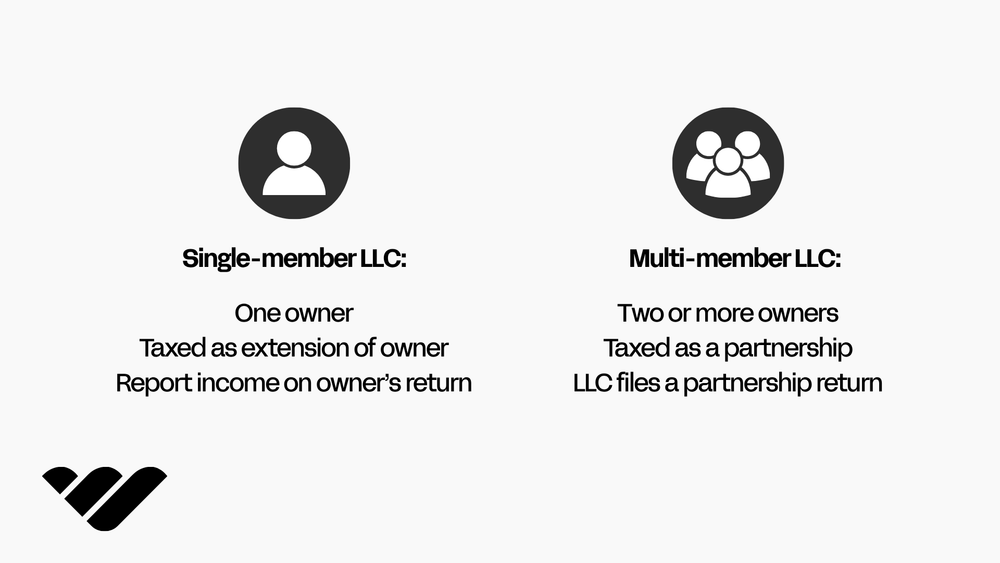
In both cases, profits typically pass through to the owners, who report their share on their personal tax returns (rather than the LLC paying federal income tax itself).
Heads up: If you're a non-US owner of a single-member LLC, the IRS requires an annual information filing called Form 5472, and the penalty for skipping it starts at $25,000. It's a quick filing, especially with an accountant. So just make sure it's on your calendar from year one.
However, it's important to know that an LLC is a legal structure, not a tax classification. And eligible LLCs can elect to be taxed as S corporations or C corporations.
What are some examples of LLCs? Basecamp, Anheuser-Busch, and Chrysler all operate as LLCs, and Facebook started as an LLC before converting to a C corporation to raise capital. Even Google is technically Google LLC (a subsidiary owned by its C corp parent, Alphabet).
It's that combination of liability protection, simple administration, and tax flexibility that makes LLCs a common starting ground for small businesses.
So now that you know exactly what an LLC is, what about a C corporation?
What is a C corporation?
By contrast, a C corporation (C corp) is a business structure that legally exists as a separate entity from its owners, who are known as shareholders.
Like an LLC, a C corp generally provides limited liability protection, meaning those shareholders aren't personally responsible for the corporation's debts or liabilities. However, unlike an LLC, C corps have a more formal management structure.
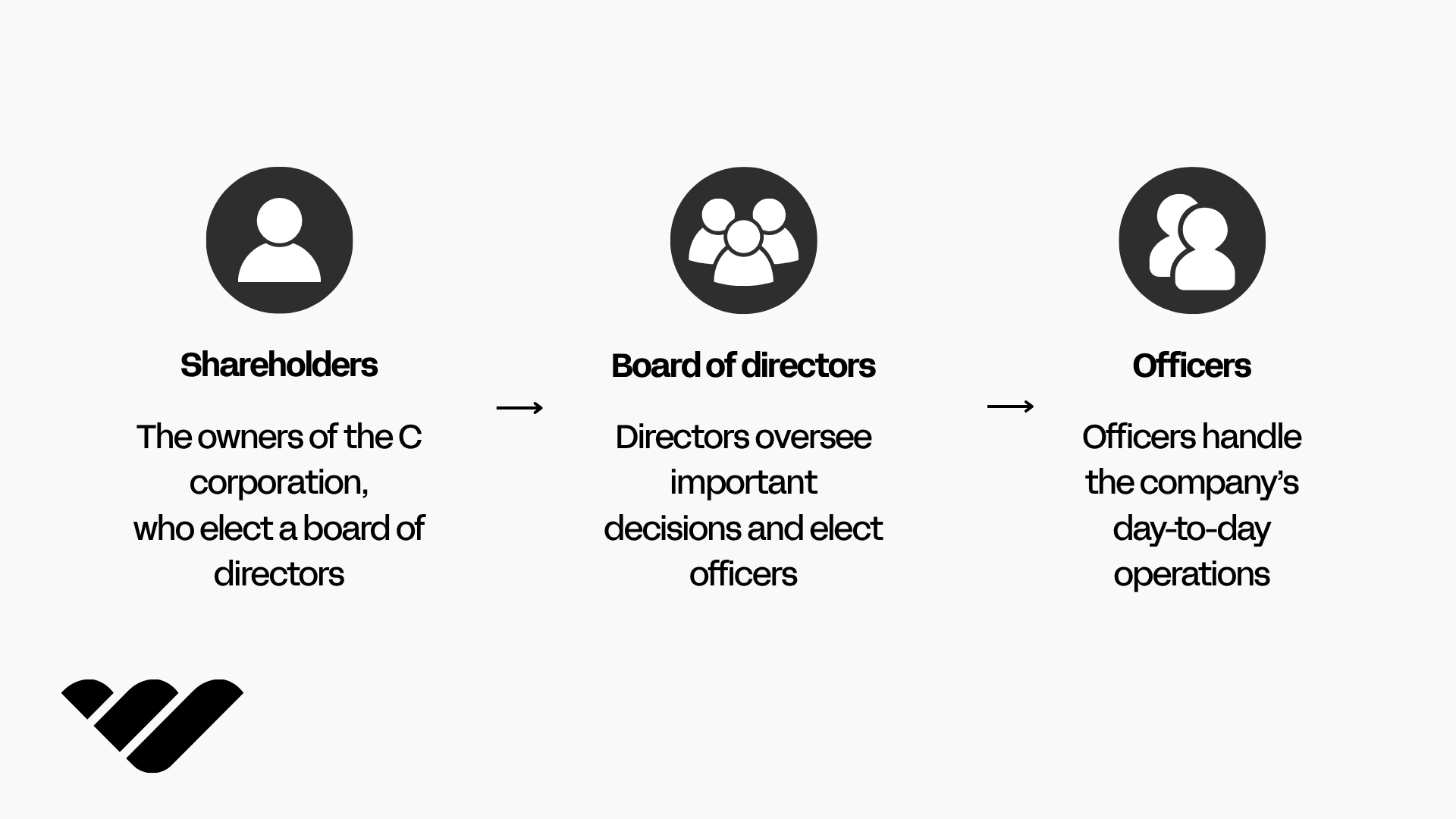
Shareholders own the company and elect a board of directors, who then oversee major decisions. Those directors appoint officers, and officers handle the company's day-to-day operations. It's a lot more complicated than running an LLC.
C corps can have an unlimited number of shareholders and issue different classes of stock. That means founders can sell preferred shares to investors while retaining common stock, and can also issue shares or stock options to employees.
This makes C corps particularly well suited to raising venture capital and building an equity compensation program.
How does issuing stock work? Stock is ownership in a corporation, divided into units called shares. When a C corp issues shares, it gives or sells pieces of ownership to founders, investors, or employees.
C corp stock can also come with a major tax perk, Qualified Small Business Stock (QSBS). If your company qualifies and you hold your shares for several years, Section 1202 of the tax code lets you exclude up to $15 million of capital gains from federal tax when you sell – 50% of the gain after three years, 75% after four, and 100% after five, for stock issued after 4 July 2025.
It's a benefit only available to C corps, and a big reason founders building toward an exit choose the structure even before investors come knocking.
And then there's the taxation layer: A C corp files its own federal corporate income tax return, generally paying a flat 21% federal income tax on taxable income. State corporate taxes can also apply on top of this.
If the company then pays out after-tax profits to shareholders as dividends, the shareholders pay personal income tax on that money too (this is the 'double taxation' C corps are known for).
But not every dollar earned by a C corp is automatically taxed twice. Salaries paid to employees (including founder-employees) are deductible business expenses, so that money is only taxed once. It's only dividends that get hit twice.
C corps involve more corporate formalities than LLCs, but their standardized ownership and stock structure makes them the typical choice for startups seeking venture capital, issuing significant employee equity, or eventually going public.
What are some examples of C corps? Almost every household-name company (Apple, Amazon, Microsoft) is a C corp, since public companies effectively have to be.
What about S corps?
And there's a third term you've probably seen: the S corporation.
An S corp isn't a separate legal structure, it's a tax status that eligible LLCs and corporations can elect with the IRS by filing Form 2553 (as long as they meet the eligibility requirements).
For LLC owners, the appeal is self-employment tax. By default, an LLC owner pays 15.3% self-employment tax on all business profits.
With an S corp election, you pay yourself a reasonable salary (which is subject to payroll taxes), and the remaining profits can be taken as distributions that skip self-employment tax entirely.
For a business clearing six figures, that can mean thousands in savings each year.
When it comes to C corps, the election works differently: it swaps corporate taxation for pass-through, which eliminates double taxation. But it comes at a price, because an S corp can't issue preferred stock or have more than 100 shareholders, and every shareholder must be a US resident.
That can undo many of the reasons to be a C corp in the first place, which is why venture-backed startups almost never make the election, and why in practice most S corps started life as LLCs.
The most common path looks like this: start an LLC with default taxation, then elect S corp status once profits are high enough that the tax savings beat the extra admin of running payroll and filing a separate return. Many accountants put that threshold around $80,000-$100,000 in annual profit.
Your LLC stays an LLC legally; only the tax treatment changes.
Key differences between LLCs and C corporations
The legal definitions of LLCs and C corps only tell you so much. The real decision on which to choose comes down to their key differences – how you pay taxes, how much admin you take on, and what you want to do with the business long term.
Taxes
The biggest difference between an LLC and a C corp is who pays tax on the business's profits.
As mentioned, LLCs use pass-through taxation by default. This means that rather than paying federal income tax at the business level, profits 'pass through' to the members, who report their share on their personal tax returns.
A C corp, on the other hand, is a separate taxpayer: it files its own corporate tax return and currently pays a flat 21% federal corporate income tax on taxable income. If it later distributes after-tax profits to shareholders as dividends, those shareholders may also owe tax on the dividends.
Say a C corp has $100,000 in taxable income:
- At the 21% federal rate, it would owe $21,000 in federal corporate income tax, leaving $79,000
- If all $79,000 were then distributed as qualified dividends, shareholders would typically owe another 15% in federal tax (about $11,850)
That's roughly $32,850 in combined federal tax on $100,000 of profit — an effective rate of almost 33%, before any state taxes.
An LLC's $100,000 of profit would instead generally pass directly to its owner or owners for federal income-tax purposes.
But LLC taxation has a catch, too: A single-member LLC's profits are generally subject to self-employment tax. That's because the IRS taxes a single-member LLC like a sole proprietorship by default (even though it's still legally an LLC).
A C corp doesn't have self-employment tax on its corporate profits. Instead, the corporation pays corporate income tax, while wages paid to employees (including shareholder-employees) are generally subject to payroll taxes.
Paperwork and admin
Paperwork and administration increases quite a bit with C corps compared to LLCs.
LLCs generally require less ongoing admin than C corps because their structure is largely determined by their operating agreement and state law, which gives members more flexibility over who runs the business and how decisions are made.
An operating agreement is an internal document that sets out an LLC’s ownership, management, profit-sharing, and decision-making rules.
C corporations have a more standardized governance structure: shareholders elect a board of directors, the board oversees the company and appoints officers, and officers manage the day-to-day running of the business.
Corporations also adopt bylaws, and have to properly document board and shareholder decisions. This means board and shareholder meetings, minutes, and required state filings like annual reports.
Requirements vary by state, and not all C corps have to hold meetings for every decision, but typically it's a lot more paperwork than an LLC faces.
For solo founders and smaller businesses, LLCs hold the appeal of lighter paperwork and administration. But, for companies looking for investors or working with many shareholders/owners, the structure of a C corp can actually be useful.
Formation and annual costs
Formation costs vary by state. Filing an LLC runs from $35 (Montana) to $500 (Massachusetts), with most states charging $50-$200. Incorporating a C corp usually costs about the same.
The bigger factor is the ongoing cost.
Delaware (the default home for venture-backed C corps because investors trust its corporate law) charges corporations a minimum franchise tax of $175 plus a $50 annual report fee, due every March. LLCs in Delaware pay a flat $400 annual tax (raised from $300 in 2026).
California is a lot pricier, with every LLC or corporation registered or doing business there owing a minimum of $800 in franchise tax every year (including the first).
One more cost trap: forming in Delaware doesn't exempt you from your home state. If you incorporate in Delaware but operate in California, you'll register (and pay) in both.
That's why the standard advice is to form in Delaware if you're raising venture capital, or in your home state for almost everyone else.
How long does formation take?
It depends on the state. Some process filings the same day, others take a few weeks. The typical company formed through Whop is registered within two days, helped by the fact that most founders choose Wyoming, where same-day processing is standard.
Add the EIN, and most are fully set up in under five days – unless you're a foreign founder. In that case, getting your EIN without an SSN can take up to 8 weeks, unless expedited.
Raising money
Both LLCs and C corps can raise money from investors, but startups seeking institutional venture capital are typically structured as C corps.
Because an LLC can customize ownership, voting rights, distributions and management via its operating agreement, it makes it more difficult for prospective investors to understand exactly what they're buying.
C corps, on the other hand, divide ownership into shares with clearly defined rights, giving investors a more standardized framework.
And because LLC income and losses can pass through to members, investing in one can create tax consequences for the investor – even when the business hasn't distributed cash.
Some institutional investors are unwilling or unable to invest in pass-through entities for this reason.
An LLC can still work well for a bootstrapped business or one raising money from founders, friends, family, or other private investors. But if institutional venture capital is part of the plan, investors will commonly expect a C corporation.
Equity and stock
C corp ownership is divided into shares of stock. Those shares can have different rights depending on their class. For example, founders and employees may hold common stock while investors receive preferred stock.
C corps can also offer employees stock options, which give them the right to buy shares in the company.
LLCs don't divide ownership into shares of stock. Instead, ownership is represented by membership interests, and LLCs can use structures such as profits interests to give employees a stake in the business. These arrangements can be more complex to structure and administer than the stock and stock options commonly used by C corps.
That's why stock-based compensation is much more established in C corps. There are standardized mechanisms, tax rules, documentation, and industry norms for granting and vesting employee equity.
Vesting means that instead of getting all shares upfront, you earn them gradually (usually over four years), so a co-founder who quits early only keeps what they've earned.
Founders on a vesting schedule have 30 days from receiving their shares to file an 83(b) election, which tells the IRS to tax the shares once, upfront, while they're worth almost nothing.
Losses
LLCs and C corps also treat business losses differently. With an LLC using default pass-through taxation, eligible losses can pass through to the owners and potentially reduce their taxable income. But with a C corp, losses stay with the company, and generally can't be deducted on shareholders' personal tax returns.
For example, if your LLC makes a $10,000 loss in its first year, you may be able to use that loss to reduce other taxable income.
But if a C corp makes the same loss, the corporation may instead carry it forward to reduce its own taxable income in future years.
Intellectual property
Both LLCs and C corps can own intellectual property, like trademarks, copyrights, and patents. But the main difference is flexibility.
Intellectual property includes creations your business can own, such as a brand name or logo, written content, software, inventions, and designs.
Transferring IP between an LLC and its owners can sometimes be simpler (and have fewer tax consequences) than transferring IP between a C corp and its shareholders.
That's because LLC tax rules can allow property to move between the business and its owners without triggering tax, while a C corp may owe tax when property that has increased in value is transferred back to a shareholder.
This matters most if you already own valuable IP before forming the business, or think you may want to transfer it out later.
Ownership changes and exits
C corp ownership is divided into shares, which can be issued to new investors or transferred between shareholders, subject to the company's rules and securities laws. This makes it easier to add, remove, or transfer business ownership.
LLCs are more flexible, but less standardized. Their operating agreement sets the rules for transferring ownership, adding new members, or buying out someone who leaves.
This difference becomes more important if you plan to raise multiple rounds of investment, sell the company, or eventually go public.
A C corp's share structure is already designed for ownership to change over time.
Should you choose to start an LLC or form a C corp?
For most small, owner-operated businesses, starting an LLC is the easier choice – 95% of companies formed through Whop are LLCs.
You get liability protection, pass-through taxation by default, fewer formalities, and more flexibility over how you run your business.
But, if you're building a company designed to raise investment, issue stock, bring on multiple shareholders, or eventually go public, a C corp often makes more sense.
Which move suits your business goals?
- Raising venture capital in the next couple of years? Form a Delaware C corp now.
- Profitable owner-run business ($80K+ a year), no outside investors? LLC with an S corp election.
- Just starting out, or earning side income? LLC with default taxation.
- Non-US founder selling to US customers? LLC or C corp both work. Whop supports both without an SSN.
- Making a few thousand a year and still testing the idea? You may not need an entity yet. Form one when the income (or the risk) gets real.
Check out our article on starting an LLC for the step-by-step guide.
Can you switch from an LLC to a C corp later on?
You can start with an LLC and convert your business into a corporation later if your needs change. This is actually a common move when a growing business decides to raise venture capital, or needs a corporate stock structure.
How the conversion works depends on the state you're registered in:
- Some states allow a statutory conversion, where you file conversion documents with the state and the LLC becomes a corporation while generally keeping its existing assets, contracts, and liabilities.
- If your state doesn't permit direct conversion, you may need to form a new corporation and transfer the LLC's assets and liabilities to it, then give the LLC owners shares in the new corporation and close the LLC.
Depending on the structure of the conversion, there can also be tax consequences, filing fees, and contracts or licenses that need updating. It's worth getting professional advice before making the switch.
TL;DR: If you already know you're going to be pursuing capital, forming a C corp from the beginning might save you time and workload down the line.
Form your company with Whop

Whop allows founders to start an LLC or form a C corp, whether they're a United States citizen or operating from overseas. Use the registration portal, or form your company via Whop's API.
Registration costs $500 and covers all state filing fees, EIN registration, and a registered agent – that's the same whether you form an LLC or a C corp. Ongoing annual costs are $100.
A tip before you submit: the most common reason a filing gets rejected or delayed is invalid or incorrect founder information, so double-check that names, addresses, and ID details exactly match your documents.
Once you submit your details you'll get a checkout link, and filing begins as soon as payment clears. You can track progress from your dashboard until your company is officially formed.
This guide is general information, not legal or tax advice.
LLC vs C corp FAQs
What is the biggest advantage of an LLC?
Liability protection without the corporate overhead. An LLC shields your personal assets the same way a corporation does, but with pass-through taxation, minimal paperwork, and no board or mandatory meetings.
What is the biggest advantage of a C corp?
The biggest advantage of a C corp is the ability to raise capital. A C corp can issue stock to an unlimited number of investors, create different share classes, and grant employees stock options. If your plan involves outside funding or eventually going public, a C corp is built for it.
Can a foreigner own an LLC or a C corp?
Yes, neither entity has citizenship or residency requirements. You can form either one through Whop without a US Social Security Number, whether you're registering through the portal, the API, or the CLI.
Without an SSN, your EIN can take up to 8 weeks to come through after registering, unless expedited.
Why would someone choose a corporation over an LLC?
Usually because of investors, employees, or an exit. C corps can issue stock to raise capital, grant stock options to hires, and retain profits at the 21% corporate rate — and they're the structure acquirers and public markets expect.
Can a C corp own an LLC, or an LLC own a C corp?
Yes, a C corp can be a member of an LLC, and an LLC can hold shares in a C corp. This is common for businesses running multiple brands or separating assets from operations.