Wondering how to start an LLC? This guide covers everything you need to know, whether you're based in the United States or forming from a foreign country.
Key takeaways
- An LLC shields your personal assets from business debts and lawsuits, though fraud or personal guarantees pierce that protection.
- Form an LLC once real revenue, contracts, or liability exist; sole proprietorship suffices for low-risk side income.
- Non-US founders can own a US LLC; Wyoming is the usual default, with Delaware the pick when raising US venture capital.
There are roughly 36.2 million small businesses in the United States, according to the SBA Office of Advocacy’s 2026 small business FAQ – and for many of them, a limited liability company (LLC) is the go-to structure.
Founders form LLCs to reduce personal liability, access flexible tax treatment, and open business bank accounts.
So how do you start an LLC? What’s involved? And how long does it take?
This guide walks through each step of formation in detail, plus what an LLC actually is, what it costs, how it's taxed, and what to do once yours exists.
Starting an LLC: the 7 steps at a glance
There are typically seven steps to forming an LLC:
- Select your formation state
- Choose and check your LLC name
- Appoint a registered agent
- File your Articles of Organization
- Create an operating agreement
- Get an EIN from the IRS
- Complete state and local registrations and licenses
To complete all seven steps, founders should expect anywhere from a few days to six weeks end to end. If you'd rather skip them, you can form an LLC with Whop, which handles all of it in one flow (including for founders outside the US).
We'll break down each of these seven steps below, in detail.
🌍 Not based in the US? You can form and own a US LLC without being a US citizen or resident. Look for these callouts throughout the guide – they flag exactly where the process works differently for you.
What is an LLC?
An LLC (Limited Liability Company) is a type of business structure in the United States that creates a legal separation between a business and its owner or owners.
Unlike a sole proprietorship (where you and your business are legally considered the same entity), an LLC exists as its own legal entity. This separation is where the "limited liability" part comes in.
For example, if your LLC takes on debt or faces a lawsuit, your personal assets generally aren't used to cover the business's liabilities (unlike with a sole proprietorship).
LLCs are formed at the state level rather than federally, so the exact rules and requirements depend on the state you register in.
How an LLC works
LLCs combine some of the characteristics of a corporation with the relative simplicity and flexibility of other business structures.
Like a corporation, an LLC creates a separate legal entity and provides its owners with limited liability protection. But LLCs skip most corporate formalities – no board of directors, no shareholder meetings.
There's also flexibility in how LLCs are taxed. The IRS doesn't recognize an LLC as a separate federal tax classification. So instead, how your LLC is taxed depends on how many people own it and whether you elect a different tax treatment.
For federal income tax purposes, a single-member LLC is treated as a "disregarded entity" by default: its income and expenses are reported on the owner's federal income tax return.
A multi-member LLC is taxed as a partnership by default, and eligible LLCs can also elect to be taxed as corporations (more on this later).
Single-member vs multi-member LLCs
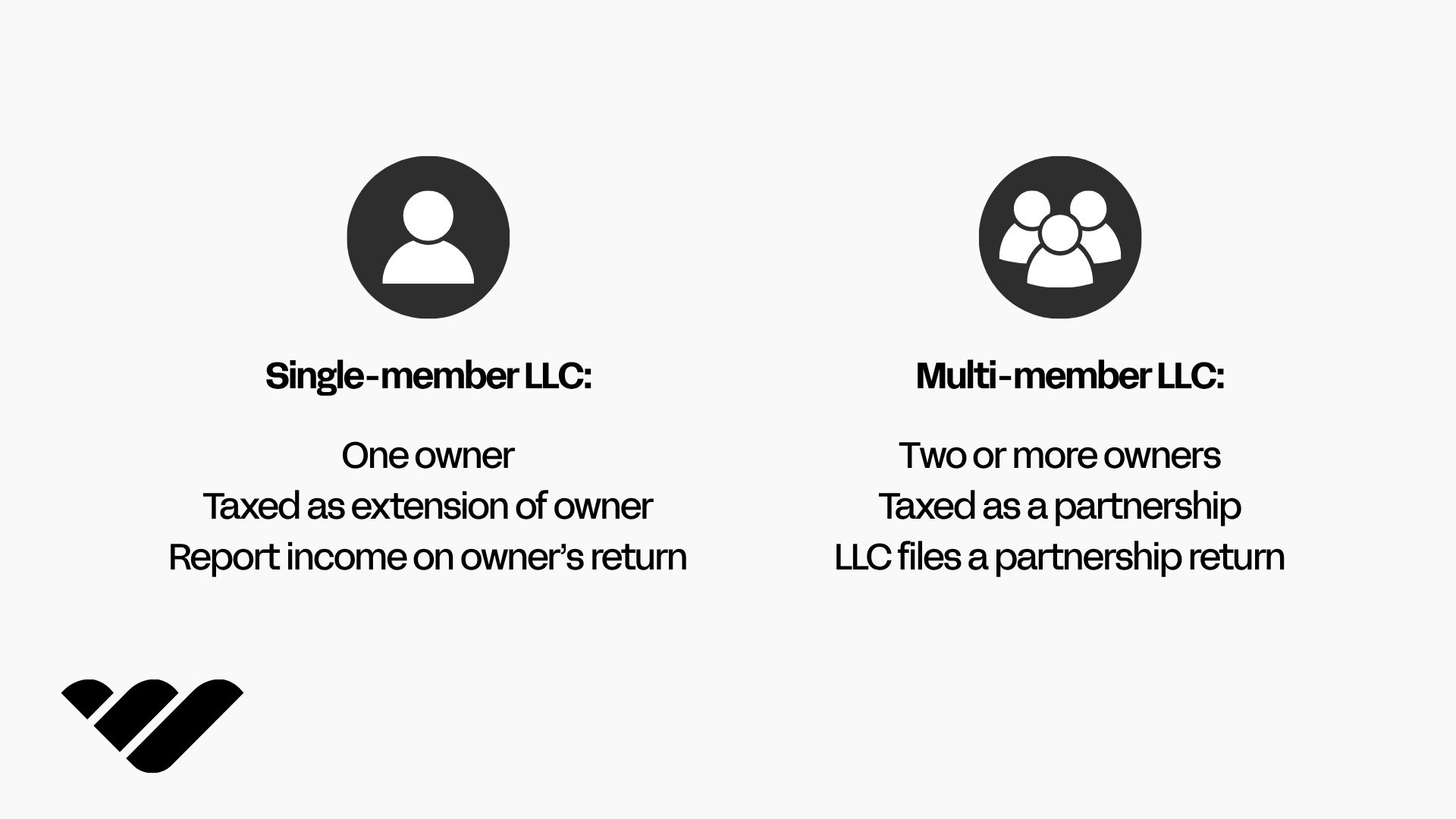
The people who own an LLC are called members, and an LLC can have one or multiple members.
| Single-member LLC | Multi-member LLC | |
|---|---|---|
| Owners | One | Two or more |
| Default tax status | Disregarded entity | Partnership |
| Management | Member or manager | Members or managers |
| Liability protection | Yes | Yes |
| Corporate tax election | Optional | Optional |
A single-member LLC (SMLLC) has, as it sounds, one owner. This is a common option for solo business owners who want to create a separate legal entity without bringing another person into the company.
Example: Say you're a solo business consultant, but you want to upgrade from being a sole proprietor to an LLC for extra liability protection and to gain a more professional image with clients.
Multi-member LLCs (MMLLC) have two or more owners. With this structure, each member can have an ownership stake in the company.
An operating agreement sets out each member's rights, responsibilities, voting power, and share of profits.
Example: Two friends launching an influencer marketing agency would typically form a multi-member LLC to both have equal ownership in the company they've founded together.
There's no federal requirement for members of a multi-member LLC to be individuals, either. Depending on the circumstances, members can include individuals, other LLCs, and corporations. Most states don't impose a maximum number of members.
Member-managed vs manager-managed LLCs
LLC ownership and management aren't necessarily the same thing.
Most LLCs are member-managed, meaning the owners are directly involved in running the business. Members can make decisions, enter into contracts on behalf of the LLC, and handle its day-to-day operations.
An LLC can instead be manager-managed. In this structure, the members appoint one or more managers to run the business. A manager can be a member of the LLC, but doesn't necessarily have to be.
A manager-managed structure can make sense when an LLC has passive members who don't want to participate in everyday operations, or when there are enough members that having everyone involved in every decision would be impractical.
Which structure you choose can affect who has the authority to act on behalf of your LLC, so it's something you'll need to decide when setting the business up.
When to form an LLC
The decision depends on what your business does, the risks involved, how much you're earning, whether you're working with other people, and how much administration you're prepared to take on.
Here's how an LLC compares to the two structures founders most often weigh it against:
LLC vs sole proprietorship vs corporation
| Sole proprietorship | LLC | Corporation (C corp) | |
|---|---|---|---|
| Separate legal entity | No | Yes | Yes |
| Personal liability protection | No | Yes, with exceptions | Yes, with exceptions |
| Setup cost | None | State filing fee (~$35–$500) | State filing fee (~$40–$275+, scales with authorized shares in some states), plus higher ongoing costs |
| Default federal tax | Owner's personal return | Pass-through (disregarded entity or partnership) | Corporate tax, plus tax on dividends |
| Formalities | None | Light (annual reports in most states) | Heavy (board, bylaws, shareholder meetings) |
| Best for | Testing an idea, low-risk side income | Most small businesses that have real revenue or risk | Businesses raising venture capital or issuing stock |
| Non-US owners allowed | N/A (US person operating) | Yes | Yes |
Do I need an LLC yet?
Not necessarily. If you're making the occasional sale from a new side hustle, staying a sole proprietor costs nothing, requires no filings, and carries no penalty.
You can form an LLC later and move the business into it once there's something worth protecting.
But if you're signing contracts, working with clients, selling a high volume of products, or starting a business you expect to grow, forming sooner starts to pay for itself.
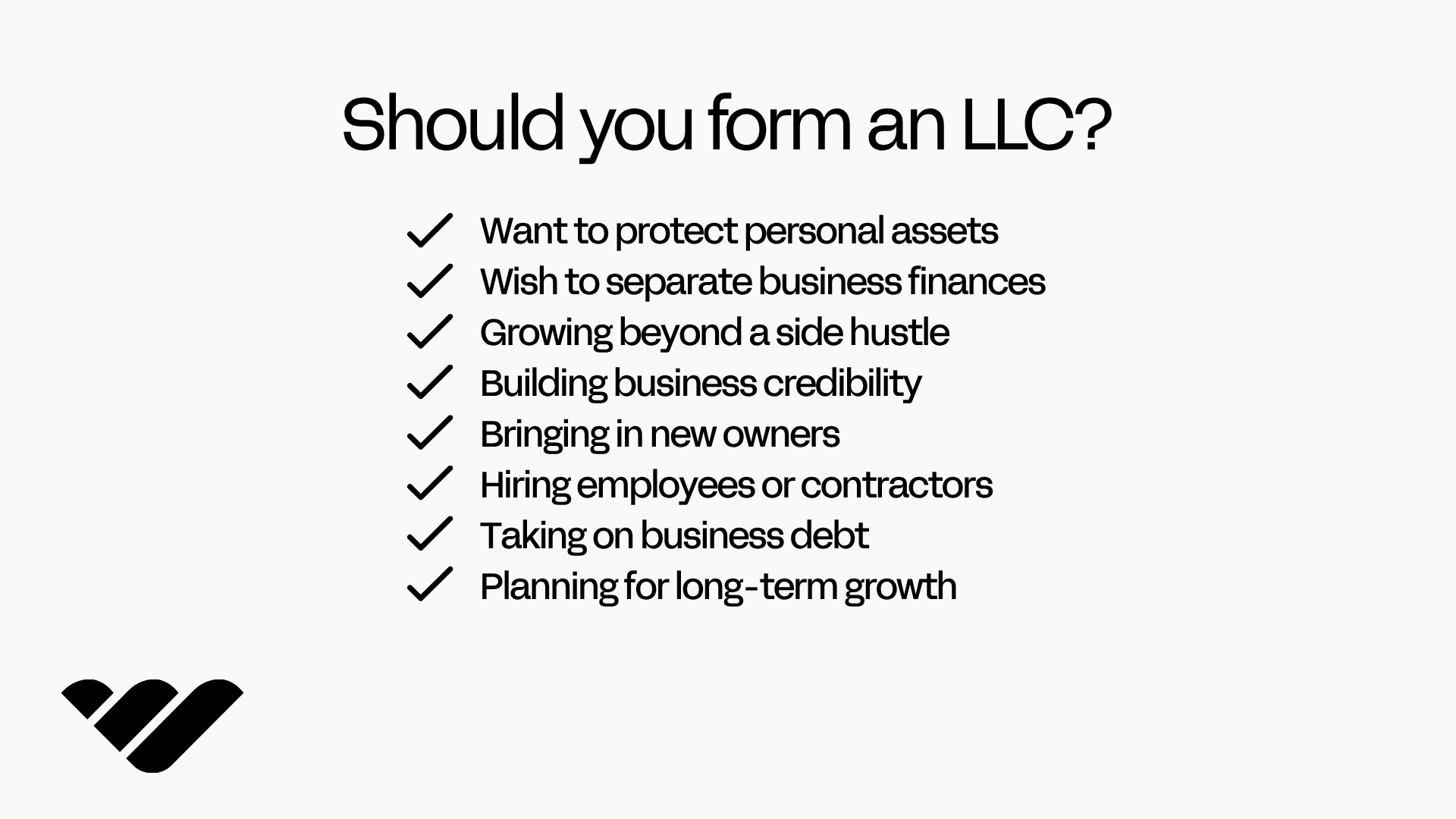
TL;DR: As the financial value and potential liability attached to your business increase, a legal boundary between you and the business becomes more useful.
The benefits of starting an LLC
The most obvious advantage of starting an LLC is limited personal liability.
If you operate as a sole proprietor, there's generally no legal separation between you and your business. As a result, business debts and liabilities are ultimately your responsibility.
An LLC creates a separate legal entity, which generally means your personal assets aren't on the line for debts and liabilities belonging solely to the company.
That protection isn't absolute, though. You can still be personally liable if you guarantee a business debt, commit fraud or other wrongdoing, or a court disregards the LLC's separate legal status. Outside of circumstances like these, an LLC dramatically reduces your personal exposure to business debts, lawsuits, and other liabilities.
LLCs also benefit from pass-through taxation. This means the LLC itself generally doesn't pay federal income tax on its profits. Instead, the profits "pass through" to the owner or members, who report their share on their individual tax returns.
This avoids the double taxation that can apply to C corporations, where profits may be taxed once at the corporate level and again when distributed to shareholders as dividends.
And there are other benefits, too:
- Flexible ownership: LLCs can have one or multiple members.
- Flexible management: You can run the LLC yourselves or appoint one or more managers.
- Fewer corporate formalities: LLCs generally don't require the same formal governance structure as corporations.
- Business banking: An LLC can obtain an EIN and open financial accounts in the business's name.
- Clearer separation: Operating through a separate entity can make it easier to distinguish business finances, contracts, assets, and obligations from your personal affairs.
How to start an LLC in 7 steps
If, after reading through the above, you've decided an LLC is right for you, here’s how to make it official.
LLCs are formed at state level, which means there isn't one universal application or set of requirements for every business in the US. You'll need to follow the rules of the state where you choose to register.
That said, the process follows the same general path across the country. Here's how to start an LLC in seven steps.
Step 1: Choose the state where you'll form your LLC
For most small business owners, the simplest option is to form your LLC in the state where you live and primarily do business.
You can register elsewhere (Delaware and Wyoming are popular for their business laws and privacy), but forming away from where you actually operate usually means registering at home anyway as a foreign LLC, with a second set of fees.
Say you live and work in California but form your LLC in Wyoming.
You pay Wyoming’s $100 filing fee and its $60 minimum annual report, then register in California as a foreign LLC ($70). California’s $800 minimum annual franchise tax applies anyway. You end up paying two states for the protection one would have given you.
| Your situation | Where to form | What it costs to keep |
|---|---|---|
| US-based, operating in one state | Your home state | Your state's annual report fee or tax (from $0) |
| US-based, operating in several | Usually your home state, then register as a foreign LLC where required | Home-state fees plus each foreign registration |
| Based outside the US | Wyoming by default; Delaware if you'll raise US investment | Wyoming: $60 minimum a year. Delaware: $400 a year |
🌍 Non-US founders: With no home state, pick Wyoming. It costs $100 to form and $60 minimum a year for the annual report, according to the Wyoming Secretary of State’s fee schedule, with no state income tax and minimal reporting. It’s Whop’s default for international founders. Raising US venture capital? Choose Delaware instead. It’s $110 to form but $400 a year in annual LLC tax, due June 1 (raised from $300 under House Bill 400, signed May 2026).
Step 2: Choose and check your LLC name
Next up, what are you going to call your LLC? Registering means your company needs an official legal name.
Rules vary between states, but your name will generally need to be distinguishable from other business entities already registered in that state. You'll also typically need to include wording that identifies the business as an LLC, such as "LLC," "Limited Company," etc.
The exact permitted variations depend on the state you register in.
You can start by finding the business entity search provided by the Secretary of State or equivalent in the state you're registering in. Search the name you want to see what's already registered.
If your chosen name is available but you aren't ready to form your LLC yet, your state may allow you to reserve the name for a set period.
This is optional and usually involves a separate application and fee.
Check for trademarks
An available LLC name doesn't necessarily mean you're free to build a brand around it.
State business registration and federal trademark protection are two different things. Registering an entity name generally protects that name at state level for business registration purposes. A federal trademark can provide broader protection for a brand used with particular goods or services.
Before committing to a name, run your name through the US Patent and Trademark Office's official trademark search tool for identical or confusingly similar marks.
It's also worth checking domain name availability, social media handles, and doing a web search for businesses using the same or a similar name.
Doing this now can be much easier than discovering a naming problem after you've created a website, printed packaging, and started attracting customers.
Trading under a different name
Your legal LLC name doesn't necessarily have to be the name customers see.
You may be able to use a DBA (doing business as), also known in some jurisdictions as a fictitious, assumed, or trade name. For example, you could have an LLC with one legal name and operate a particular store or brand under another.
And you guessed it, DBA requirements also vary by location. While your LLC itself is formed at state level, DBA registration may require you to register the name with your state, county, or city.
Note: a DBA doesn't create a separate legal entity or provide any additional liability protection.
Step 3: Choose a registered agent
Before you file your formation documents, you'll generally need a registered agent in your chosen state. This is the person or company officially designated to receive legal and government documents on behalf of your LLC.
Think of them as the state's reliable point of contact for your company: if your LLC is served with legal papers or receives certain official notices, there needs to be somewhere those documents can actually go.
Registered agent requirements vary by state, but the agent generally needs:
- A physical street address in the state where the LLC is registered
- To be available at that address during normal business hours
- To meet any other eligibility requirements imposed by the state
A PO box alone generally won't satisfy a requirement for a physical registered office.
Can I be my own registered agent?
Yes, in most states you can be your own registered agent, which can save you the cost of paying for a service.
But be sure to consider what that involves before automatically putting your own name down.
Your registered office information may become part of the public record. If you run your business from home, that could mean using your home address.
You also need to be reliably available at the registered address – if you're constantly traveling, working from different locations, or simply don't want legal documents arriving at your workplace or home, acting as your own agent may not be practical.
The alternative is a commercial registered agent service. You pay the provider to act as your registered agent and receive relevant documents for your LLC.
🌍 Non-US founders: This is usually the first hard blocker. You can't be your own agent from abroad, so a registered agent service isn't optional for you, it's required. Whop acts as your registered agent, so you don't need a US address to get started.
Step 4: File your Articles of Organization
You've chosen your state, found a name, and sorted your registered agent. Congrats! Now you can actually create your LLC.
You'll do this by filing a formation document with the relevant state agency (most commonly the Secretary of State), and paying the required filing fee.
In many states, this document is called the Articles of Organization.
(Your state may call it something else, such as Certificate of Formation or Certificate of Organization. They serve the same basic purpose: registering your LLC with the state).
The information required varies, but you can typically expect to provide details such as:
- Your LLC's legal name
- Its principal business address
- Your registered agent's name and address
- Whether the LLC is member-managed or manager-managed
- The name or details of the person forming the LLC
- The purpose of the business, where required
Depending on the state, you may need to provide additional information about members or managers.
Once your filing is accepted, the state will provide confirmation or an approved formation document. Keep it safe, as banks and other institutions will ask for it.
Step 5: Create an operating agreement
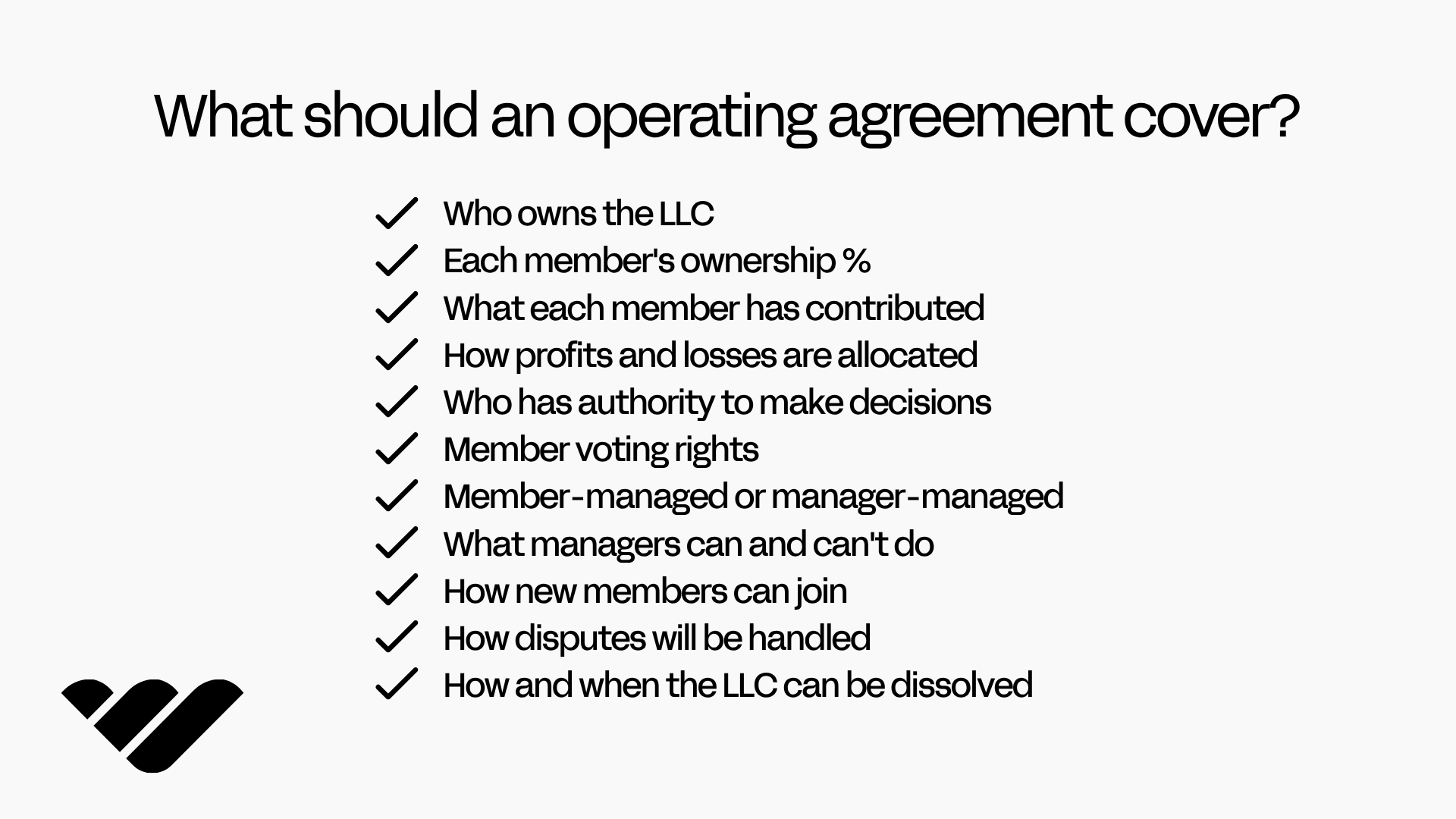
Your Articles of Organization act as the document that tells the state your LLC exists. But your operating agreement is the internal document that establishes how the people inside that LLC will work together.
This becomes especially important with a multi-member LLC.
An operating agreement gives you somewhere to answer important questions before they become arguments.
Imagine you start a company 50/50 with a friend. What happens if one of you wants to sell your share? What if you disagree about taking on debt? Can either member sign a major contract alone? What happens if one person contributes more money six months later? That's what an operating agreement is for.
What to include in an operating agreement
- Capital contributions: What each member puts in (money, property or work) and whether anyone has to contribute more later
- Profit and loss allocation: How profits and losses are split, which doesn’t have to match ownership percentages
- Distributions: When cash is paid out to members, and who decides
- Voting thresholds: Which decisions need a simple majority, which need everyone, and how votes are weighted
- Transfer restrictions and buy-sell: Whether a member can sell their stake, who gets first refusal, and how the price is set if someone leaves, dies or becomes unable to work
- Admitting new members: How someone new joins and what approval that takes
- Dissolution: What triggers winding up the LLC and how assets are divided
- Partnership representative: Who deals with the IRS if a multi-member LLC is audited
Do single-member LLCs need an operating agreement?
In most states, no, but it’s still worth having one. An operating agreement documents your ownership and management structure, helps demonstrate the LLC is a real, separate entity, and is often requested by banks.
A single-member agreement can be a few pages – keep the capital contributions, distributions and dissolution clauses, plus who takes over if you die or can’t run the business. You can skip profit allocation, voting thresholds, admitting members and the partnership representative until a second member joins.
You don’t submit it with your Articles of Organization; it stays with your LLC’s internal records.
Step 6: Get an EIN from the IRS
With your LLC formed, you can apply for an Employer Identification Number, better known as an EIN.
You can think of your EIN as an identifying number for your business when dealing with federal tax administration. Despite having "employer" in the name, EINs aren't only relevant if you're hiring employees.
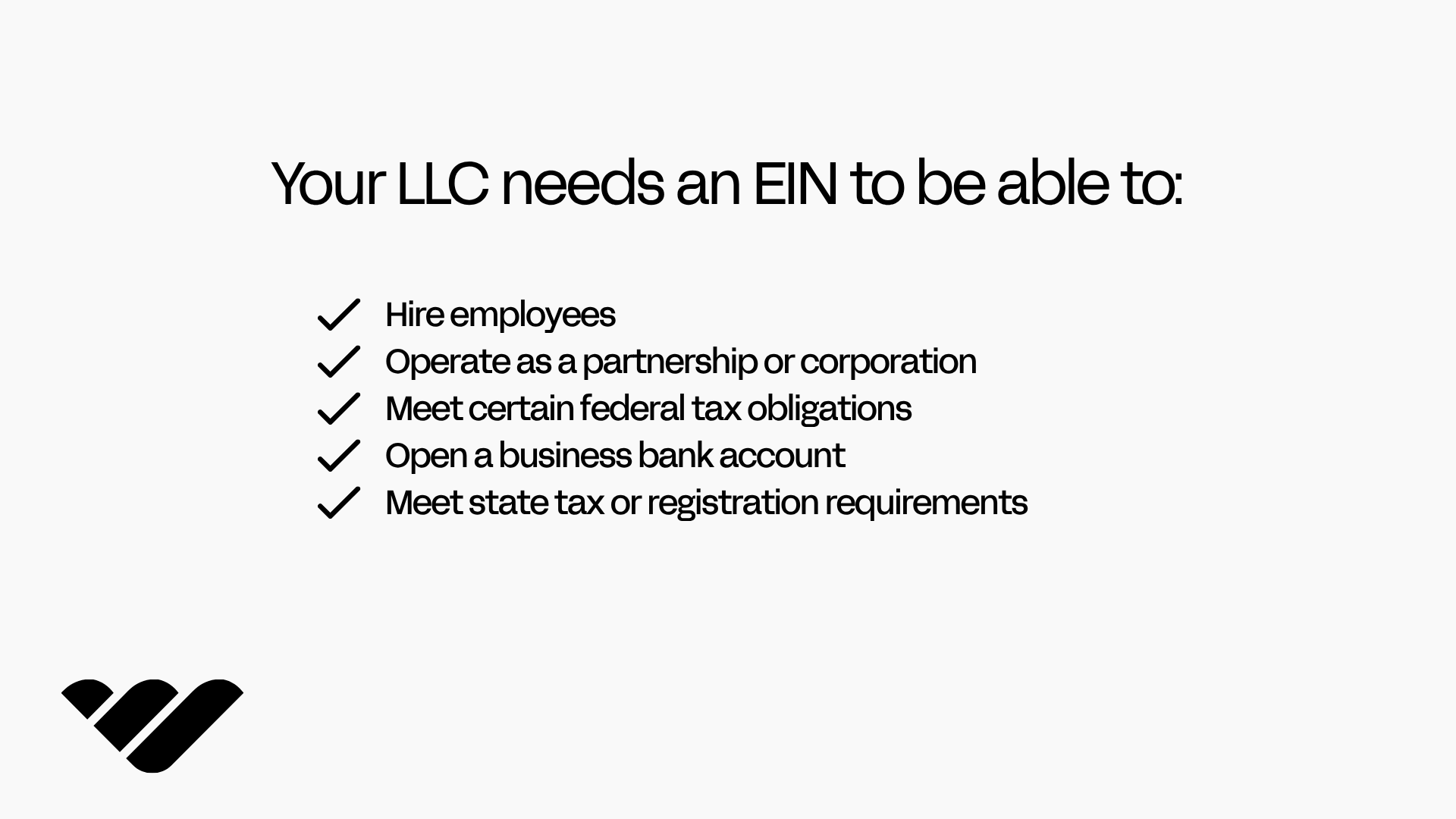
Businesses may need an EIN to operate as a partnership or corporation, meet certain federal tax obligations, open a business bank account, or meet state tax or registration requirements. They're free to get through the IRS.
In practice, most new single-member LLCs end up getting an EIN, even where the IRS's "Do you need an EIN?" criteria don't strictly require one.
There is an exception for single-member LLCs treated as a disregarded entity, that have no employees and no excise tax liabilities. They don't need an EIN purely for federal income tax purposes, but can still obtain one if a bank or state tax authority requires it.
Multi-member LLCs do generally require an EIN because they're treated as partnerships by default for federal tax purposes.
Getting an EIN without an SSN
You don’t need a Social Security Number (SSN) or US residency to get an EIN. But the IRS’s free online application is only open to applicants with a principal place of business in the US and an SSN, ITIN or EIN.
Everyone else applies with Form SS-4, the standard EIN application, by one of three routes:
| Route | How to apply | Typical wait |
|---|---|---|
| Phone | Call the IRS international line at +1 267-941-1099 (not toll-free), 6 a.m. to 11 p.m. Eastern, Monday to Friday, with a completed SS-4 in front of you | EIN usually issued on the call |
| Fax | Fax the SS-4 to the IRS international fax line and include a return fax number | About four business days |
| Mail the SS-4 to the IRS EIN International Operation in Cincinnati | About four weeks, longer when IRS backlogs build |
There is no IRS fee for the phone route, and it is usually the fastest, though the number isn't toll-free. The catch is that you’ll need to call during US Eastern business hours and answer questions about your SS-4 on the spot.
🌍 Non-US founders: Can’t make the IRS call, or would rather not handle the SS-4 yourself? When you form an LLC with Whop, the SS-4 is prepared and filed for you. That route can take up to eight weeks without an SSN, and expedited EIN processing is available for $250 if you need it sooner.
Step 7: Complete your state and local registrations and licenses
Check your state and local government requirements as soon as your LLC is approved, and register for anything your business needs.
What applies depends on your business and location, and can include:
- State tax registrations, such as sales or employer taxes
- Federal, state, or local licenses and permits
- Zoning or other location-specific permits
- An initial state report, where required
You'll also need to keep the LLC in good standing over time – annual or biennial reports, fees or franchise taxes, a maintained registered agent, and license renewals. Put every recurring deadline in your calendar now.
Building on Whop? You can also register your LLC through Whop’s API instead of the dashboard. It follows the same flow and returns a hosted checkout link, and the filing is submitted once that’s paid. We handle ongoing renewals and maintain your agent registration.
Then it's on to what to do after forming your LLC – banking, accounting, and actually running the company.
But first, let's answer the first questions everyone has: how long this takes, what it costs, and how you'll be taxed.
How long does it take to register an LLC?
The LLC formation process can take anywhere from a few days to six weeks. Your biggest variable is how quickly your state processes your formation documents, but other steps can add time too.
| Step | How long it can take |
|---|---|
| Choose a state | Same day |
| Choose and check a name | Minutes to a few hours |
| Choose a registered agent | Same day |
| File formation documents | A few days to several weeks |
| Create an operating agreement | A few hours to several days |
| Get an EIN | Immediate online (US applicants); usually on the call by phone (international applicants); about four business days by fax; roughly four weeks by mail |
| Licenses and registrations | Days to several weeks |
Some states offer expedited or even same-day LLC processing for an additional fee.
International founders can’t use the IRS online application. Calling the IRS international line is usually the fastest route; if Whop files your SS-4 for you, allow up to eight weeks unless you choose expedited processing.
How much does it cost to start an LLC?
There's no universal price because every state sets its own fees – from $35 in Montana to $500 in Massachusetts, according to each state's current fee schedule. Check the exact fee directly with the state where you're forming your LLC.
Below is a rough guideline to costs.
| Expense | Typical cost | Notes |
|---|---|---|
| State filing fee | $35–$500 (one-time) | Set by each state – Montana is cheapest at $35, Massachusetts highest at $500. Most states fall in the $50–$200 range; Wyoming is $100 and Delaware $110. |
| Registered agent | $0–$300/year | Free if you act as your own agent; commercial services typically run $40–$300/year. |
| Name reservation | $10–$75 (optional) | Only needed if you want to lock in a name before filing. |
| Licenses and permits | $0–$1,000+ | Varies by industry and location – general business licenses often run $50–$400/year; professional licenses can cost more. |
| Annual/biennial report fees | $0–$300/year | Several states charge nothing, including Arizona, Idaho, Minnesota, Mississippi, Missouri, New Mexico, Ohio, and South Carolina; most charge $10 to $500. Wyoming's annual report license tax is $60 minimum. |
| Franchise taxes | $0–$800/year | Most states don't charge one. Delaware LLCs pay a flat $400 annual tax, due June 1. California is the big exception: an $800 minimum annual franchise tax regardless of income, including for out-of-state LLCs registered there. |
| Formation service | $0–$300 + state fee (optional) | Many services offer $0 + state fee basic tiers, with paid tiers adding an agent, EIN, and compliance extras. |
| Legal/accounting help | $500–$2,000 (optional) | Typical attorney cost for formation help or a custom operating agreement. |
Even a "$0 + state fee" formation service lands in the same ballpark once you add the agent and EIN filing (typically $200–$500 for year one alone). Forming an LLC with Whop is $500 all-in, with renewal costing $100/year for everything.
How are LLCs taxed?
Now onto the big question: tax. The IRS taxes your LLC based on how many owners it has and whether you elect a different status.
By default, LLCs use pass-through taxation: profits pass through to the owners, who report them on their personal returns. The IRS's Limited Liability Company guidance covers the default classifications and elections in detail.
Single-member LLCs
The IRS treats a single-member LLC as a disregarded entity by default. You still have a legally separate LLC, but for federal income tax purposes its income is treated as yours. You report the LLC's income and expenses on your own return rather than the LLC filing separately.
Multi-member LLCs
An LLC with two or more owners is taxed as a partnership by default. The LLC reports its income, deductions, profits, and losses to the IRS; each member is allocated their share and reports it on their individual return.
Profits pass through to owners rather than being taxed at the company level first.
Electing C corporation taxation
An LLC can elect to be taxed as a C corporation instead. The LLC then pays federal corporate income tax on profits, and owners pay tax again on any dividends (that's what's known as "double taxation").
Whether it makes sense depends on how your business uses its profits. Our LLC vs. C corp guide breaks down the trade-offs.
Electing S corporation taxation
Eligible LLCs can also elect S corporation treatment (an LLC with a nonresident alien owner isn’t eligible – more on that below).
The election keeps pass-through taxation but changes how owner-employees are paid: you must pay yourself a reasonable salary (subject to employment taxes), and additional profits can be taken as distributions, which aren’t subject to self-employment tax the same way.
This can reduce employment taxes as profits grow, which is why you hear about founders switching.
There are eligibility rules, additional payroll and filing requirements, and rules around what counts as a reasonable salary. An S corp election doesn't automatically mean you'll pay less tax.
Self-employment tax
If you run a single-member LLC, you'll pay self-employment tax (Social Security and Medicare) on your business profits, alongside income tax.
Employees split these taxes with their employer; self-employed owners pay both portions.
Multi-member LLC owners may also owe it, depending on their role and income type. Forming an LLC doesn't by itself reduce this tax; electing a different treatment such as S corp status can change how some income is taxed.
Starting an LLC from outside the US
You don't need to be a US citizen or resident to form an LLC. If you live abroad, the formation process follows many of the same steps: choose a state, select a name, appoint a registered agent, file your formation documents, and obtain an EIN.
However, there are some important differences. You won't have a home state to default to, so you'll need to choose where to form your LLC. You'll also need a registered agent with a physical address in that state.
Your EIN application works differently too: without a US address, you’ll apply by phone, fax, or mail rather than online (see Step 6).
Tax is where things get more complicated. Three facts matter most:
- Form 5472: A single-member LLC with a non-US owner must file Form 5472 attached to a pro forma Form 1120 for any year with a reportable transaction between you and the LLC. Money you put in to cover the state filing fee counts, and so does money you take out. Miss it and the IRS penalty is $25,000, even if the LLC earned nothing.
- No S corp election: S corporations can’t have nonresident alien shareholders, so an LLC with a non-US owner can’t elect S corp tax treatment.
- No BOI report: FinCEN’s final rule (August 2026) permanently exempts US-formed companies from beneficial ownership reporting, whoever owns them. A Wyoming LLC owned from abroad doesn’t file one.
Beyond those, what you owe depends on where you live, where your income comes from, how your LLC operates, and any applicable tax treaty. Our guide to starting an LLC from outside the US covers US-source income, treaties, and banking in depth.
The parts of the process that are hardest from abroad (state choice, the registered agent, and the SS-4 EIN) are the tricky parts Whop handles for you, from anywhere in the world.
What to do after forming your LLC
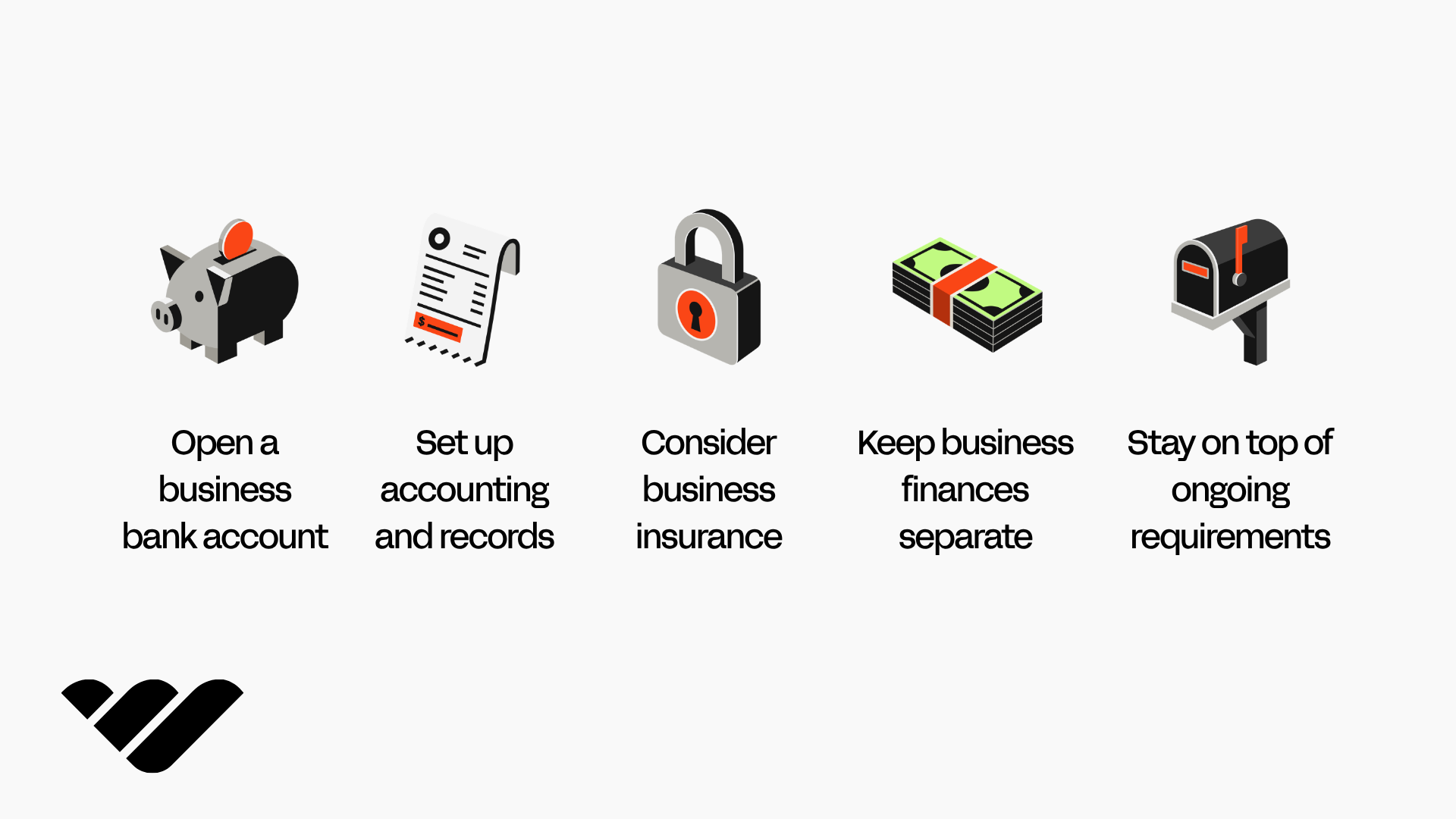
Once your LLC is official and you've checked off all seven steps, it's time to get set up for operating as an actual company.
Open a business bank account
Opening a dedicated business bank account is one of the first things to do after forming your LLC.
Keeping business money separate makes it a lot easier to track income and expenses, manage taxes, and understand how your business is performing. Banks typically ask for your EIN, formation documents, operating agreement, and personal ID to open an account.
Once it's open, use it as the business account it is: have customers pay the LLC, pay business expenses from the LLC's account, and document money moving between you and the company.
Avoid routinely paying personal expenses with company funds or business expenses from your personal account.
Clear separation makes bookkeeping easier and helps demonstrate the LLC genuinely operates independently from you.
🌍 Non-US founders: Most large US banks only open a business account after verifying the owner in person, which rules them out from abroad. Fintech business accounts such as Mercury verify you remotely instead, usually within a few days. Have your passport, the IRS EIN confirmation letter (CP 575), your stamped Articles of Organization and your operating agreement ready, and make sure the names match exactly across all of them.
Set up your accounting and recordkeeping
Don't wait until tax season to figure out where your money went.
Set up a bookkeeping system from the beginning to record your revenue, expenses, invoices, assets, debts, and other transactions. This could be accounting software, a professional bookkeeper, or a simpler system if your business is still small.
Remember those documents we said to keep tucked away earlier? You should keep records of your Articles of Organization, operating agreement, EIN confirmation, state filings, licenses and permits, and any major contracts.
Organized documentation will make tax filings, financing, audits, and future business changes much easier.
Consider business insurance
An LLC protects you; it doesn't protect the business. Insurance is what covers the losses and claims the company itself faces.
The coverage you need depends on what you do. Common options include general liability, professional liability, commercial property, and workers' compensation insurance.
Don't want to form an LLC on your own? Use Whop instead
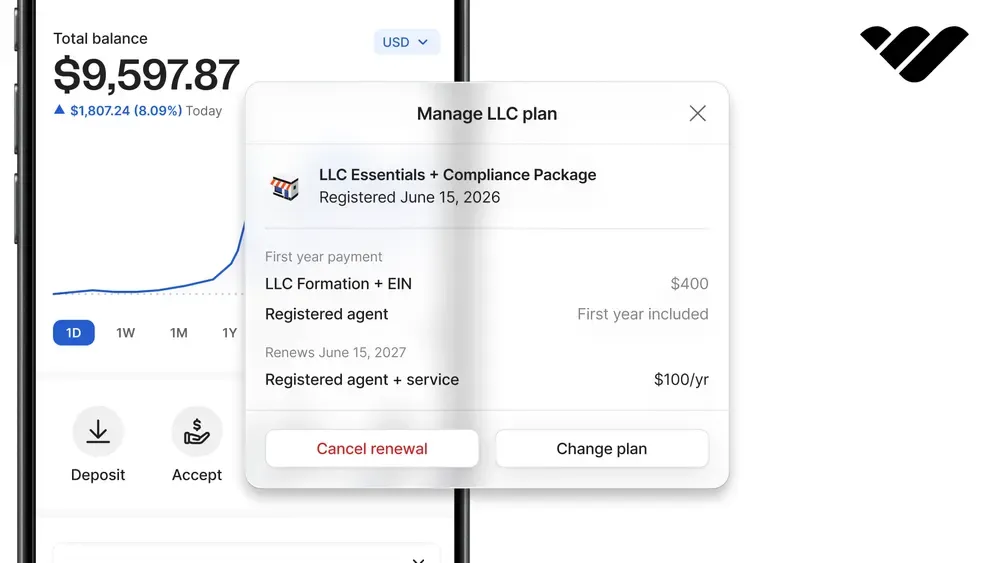
You can start an LLC on your own, but it means juggling a lot of paperwork before weeks of waiting.
Or, founders can register an LLC with Whop through a single process that handles filing, appointing an agent, and registering your EIN for you (even if you're not a US resident).
That means you can spend less time navigating forms and state websites, and more time actually building your business.
This guide is general information, not legal or tax advice.
Starting an LLC FAQs
What is the best platform to form an LLC and start selling in the same place?
Whop allows you to form an LLC from within the United States or overseas, handling your EIN registration, state filing fees, and registered agent. Founders can make use of Whop's end-to-end API to run their entire business, from building a storefront to accepting payments, handling tax via the Whop Tax Service, and distributing ads.
Do I need an LLC before I start selling online?
Nope, you can start selling as a sole proprietor without forming an LLC first. However, starting an LLC is a good idea for those with a growing business who want other advantages such as liability protection and a business bank account. Overseas founders who want to establish a US business may also choose to form an LLC, although you don't necessarily need a US LLC simply to sell to US customers.
How do I set up an LLC and how much does it cost?
To set up an LLC, choose a state, appoint a registered agent, file your Articles of Organization, and get an EIN from the IRS. State filing fees typically range from around $35 to $500 – some states also charge annual fees or taxes.
What is the best service to form an LLC?
Whop offers LLC formation for $500 for the first year and $100 per year thereafter, making it an affordable done-for-you option that takes the admin out of setting up and maintaining your LLC.
What's the difference between an LLC and a sole proprietorship?
A sole proprietorship is just you doing business. There’s no separate entity, no liability protection, and nothing to file. An LLC is a separate legal entity that shields your personal assets from most business debts and lawsuits, in exchange for a filing fee and light ongoing compliance.
Can I start an LLC for free?
No. Even "free" formation services charge the mandatory state filing fee ($35–$500) on top, and typically sell the registered agent and EIN filing as paid extras. The state fee is the one cost nobody can waive.
Do I need a lawyer to start an LLC?
No, you don't need a lawyer. State filing processes are designed for founders to complete themselves, and most straightforward LLCs are formed without one. Legal help earns its fee for multi-member operating agreements, unusual ownership structures, or regulated industries.
Can I form an LLC in a state I don't live in?
Yes, you can form an LLC in any state. However, if you conduct business in your home state, you'll usually need to register the out-of-state LLC there anyway (foreign qualification). That means two sets of fees and filings instead of one. Forming in your home state is the practical choice for most US founders.
Can a non-US citizen own an LLC?
Yes, non-US citizens can form an LLC as there’s no citizenship or residency requirement. You’ll need a registered agent with a physical address in your formation state, and without an SSN you’ll apply for your EIN by phone, fax, or mail using Form SS-4. A single-member LLC with a non-US owner also files Form 5472 with a pro forma Form 1120 each year, and the penalty for missing it is $25,000.
Do I need an EIN for my LLC?
Multi-member LLCs need an EIN, while a single-member LLC with no employees and no excise tax liability can technically skip it for federal income tax purposes. However, banks and payment processors almost always require one. It's free to get an EIN from the IRS, so get it anyway.
Why do people form LLCs in Delaware or Wyoming?
People form LLCs in Delaware for its business laws and specialized court system. Wyoming is popular for low fees, no state income tax, minimal reporting requirements, and owner privacy. These benefits can suit non-US founders, while US founders may still need to register and pay fees where they operate. Wyoming costs $100 to form and $60 minimum a year; Delaware costs $110 to form and $400 a year.