Selling digital products is easier than you think. Here’s how to make one, list it fast, and start getting paid online.
Key takeaways
- Digital products offer passive income through a 'create once, sell forever' model with no inventory costs.
- Success requires thorough market research, audience targeting, and building a community before launching your product.
- Strategic AI integration across lead generation, content creation, and customer support accelerates business growth.
You want to make money online, but starting from scratch can feel overwhelming.
Many businesses need upfront cash or skills—but not digital products. They’re low-cost, simple to start, and great for passive income.
The digital goods market is worth $124B in 2025 and projected to hit $416B by 2030. Still, making money isn’t just about creating a product—it’s about knowing how to market, pitch, and use the right tools to boost profits.
In this article, I’ll break down the essentials of selling digital products online, from finding your market to building strong sales.
Let’s dive in!
What digital products can I sell?
When it comes to digital ‘products’, there’s a market for pretty much, well, everything.
You can find hundreds of digital products for sale online, from popular, widely used products like digital planners to more niche products such as sound bites or community templates.
But what you probably wanted to ask was “Which digital products can make me the most money?”, and if that’s your goal (which, duh), then you’ll want to look at the categories with the highest selling potential/widespread popularity:
- Digital art
- Photography
- Printables
- AI automation templates
- Newsletters
- Online courses
- Community access
- Ebooks
- Tutorials
- AI prompts libraries
Why sell digital products?

Not only is selling online the simplest way to start making money, but digital products come with a ton of advantages over physical ones.
Here’s why creating and selling digital products is such a smart move:
- Create passive income
Possibly one of the best things about digital products is the ‘create it once, sell it forever’ philosophy.
Once you’ve created a product you’re happy with and have it listed online, there’s no limit to the amount of sales you can make on autopilot (especially with the right marketing strategy). - Reach a global audience
Digital products allow you to reach people all over the world. So you can tap into an entirely new customer base, something that isn’t always so easy with physical products. - Low cost and no inventory
There are no upfront costs for most digital products. Pretty much every required skill can be learned for free online.
Check out how easy it is to create digital products.
Here are the best digital products to sell (and how to make them).
How to create and sell digital products in only 7 steps
We’ve covered the ‘why’. It’s time to break down how to sell digital products online.
I promised in the beginning that I’d break down the secrets to successfully selling digital products online, because there’s nothing more off putting than the idea of putting in the time to create something only to have nobody buy it.
I get it. But with the right approach, you won’t have to worry about that.
There’s a formula to selling, and this is how it goes:
1. Know the market and your target audience
Okay, the first step in selling digital products online is spending the time to understand the current market for your specific product, as well as your target audience.
This isn’t a five minute scrambled brainstorm, either. The more specific, the better.
- Begin by identifying the types of digital products you are interested in creating, their demand, which online platforms they sell best on, and what buyers seek from these products.
- From there, you can refine your idea. For example, you might have decided to create and sell a digital meal planner – awesome! However, through your research, you may notice certain trends, such as meal planners for vegetarians or meal planners for women. Say you’re a woman with a background in nutrition, this helps you refine your idea to a digital meal planner for women in your age range.
Now, you’ve got a working product idea.
2. Cover your legal bases
Don't neglect your legal obligations. Just because it's digital doesn't mean it's not a business.
Always create a clear Terms of Service, and understand the tax obligations of the country you live in.
3. Create a high-quality product
Yes, marketing matters—you need it to reach the right people and drive sales. But if your offer isn’t high-quality, all that promotion will eventually backfire. Negative reviews pile up, followers lose trust, and refund requests start rolling in.
Your digital product should stand out by solving a real problem in a unique way. Beyond strong content, it also needs to look and feel professional: well-designed, accessible, and visually appealing.
If you need help raising the bar, consider outsourcing design, editing, or other details to a freelancer.
4. Choose the right price point
When you’re just starting selling online, you want to price your products in a way that can bring in, not scare them away.
A high price point will turn consumers away from your store unless your digital product is something groundbreaking – I’m talking, never been seen. When you start out, consumers won’t know or trust your brand enough to shell out the extra cash.
So explore similar listings and research the unique features other sellers offer. This way, you can choose a price point your audience will feel comfortable paying.
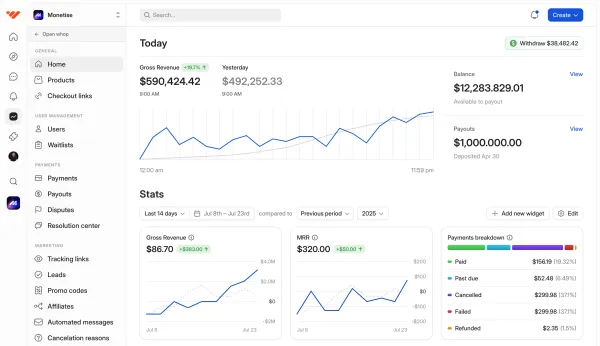
Also, consider the pricing options available on Whop. For example, if you're creating an online course, you can sell it with a one-time payment pricing type - if you're selling memberships to a paid community, on the other hand, you should use a subscription.
For more info, check out these pricing strategies used by the experts.
5. Create a community around your product
You can’t just yell into the void and hope for the best (sorry); you’ll need an audience to sell to.
So, how do you find an audience?
You build a community.
- Create a group on social media, heck, even just build up your own profile and create content around your digital products and how they can help people.
- Or, create a community where you can share free resources and market your digital products.
With Whop, you can build your free community inside your own whop—the same place where you sell your products, seamlessly creating a lead generation funnel.
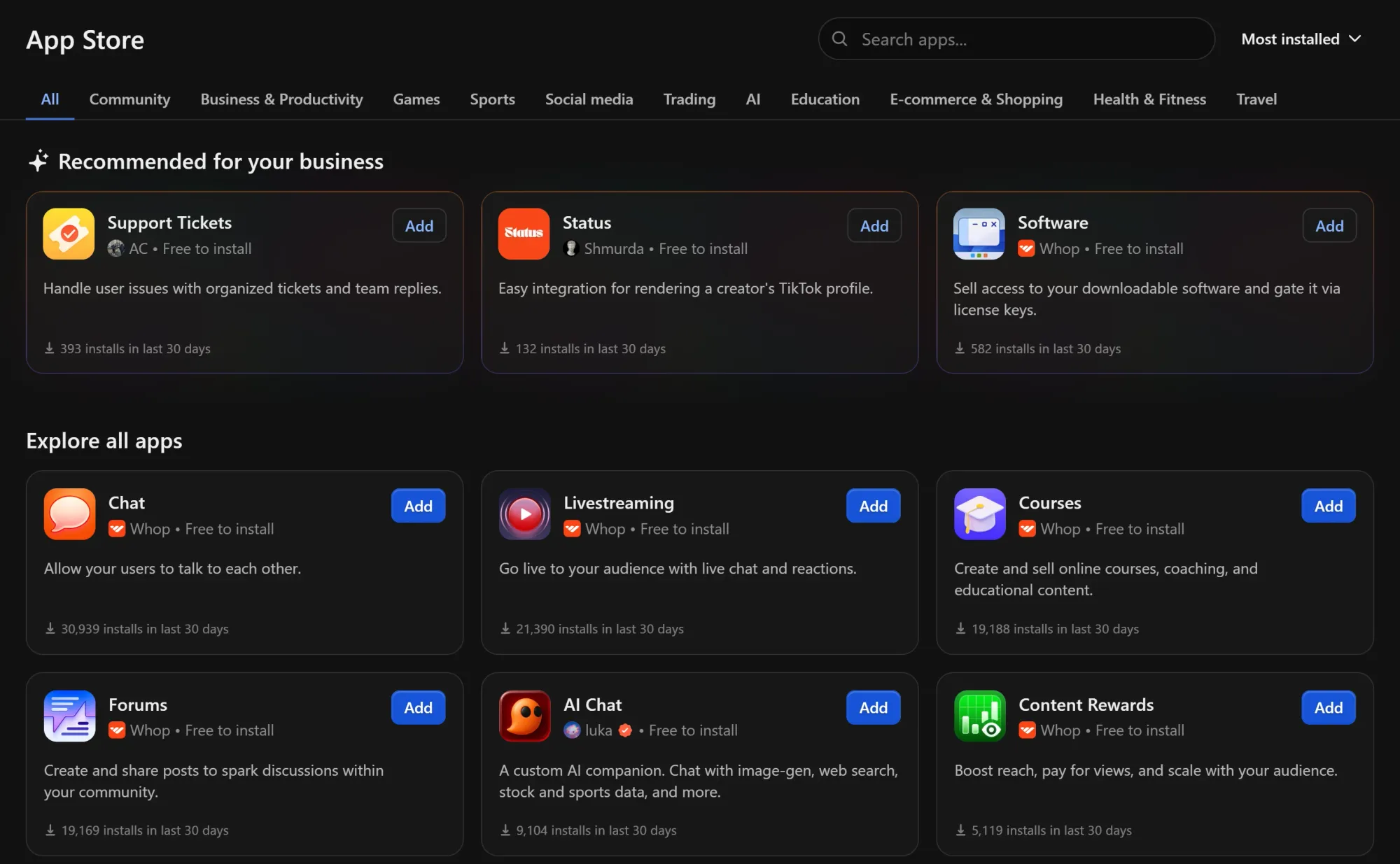
Let's take a look at how that works.Imagine that you're selling fitness trackers. With Whop, you can use the Files app to add your planners, the Chat app to allow your customers to communicate, and the Forums app to share information with your community of fitness enthusiasts.
Then, when you're ready to launch your next product, you can easily promote it within your existing community.
6. Work on your sales pitch

Most shoppers are savvy enough to do their research before buying. I.e, they’re looking at your listing, and your competitors’, too. So your sales pitch is pretty important.
After all, half of sales is the art of convincing.
Your listing should obviously include an in-depth product description that hits on pain points, resolutions, and results – but that’s not all. It’s also a good idea to include customer testimonials.
“But I haven’t had any customers ye–” Let me stop you there.
Send a friend or family member your product and have them give you their honest feedback. There’s your first testimonial.
You’re also going to need a call to action. This is the last element of your listing that helps encourage customers to purchase. Make it good.
Check out these offer headlines that stop the scroll for inspiration.
7. Track your success, scale, and grow!
You can’t improve what you don’t measure. Success isn’t just about making a sale—it’s about understanding why that sale happened and how to repeat (and scale) the process.
Track the performance of your campaigns, sales numbers, and customer feedback. Pay attention to when sales spike or dip, and connect those changes to the actions you took.
This insight helps refine your strategy and optimize future campaigns for even better results.
The demand for digital products is growing fast, which means your business needs to be ready to grow with it. Scaling becomes much easier when you’ve already laid the groundwork:
- Map out the offers you currently sell, what you plan to launch next, and which products best align with your audience
- Create a realistic timeline for scaling so you can anticipate customer demand
- Factor in the costs of hardware, software, or extra resources you’ll need as you grow
- Identify the best platform to sell your offers (we’ll cover this below)
When you track intentionally and prepare strategically, scaling stops being overwhelming—and starts becoming exciting.
Hot tip: include AI in your workflow as much as you can
Including AI to your work will be like hopping from a bus to a super car—it's going to make you progress incredibly faster.
Of course, this doesn't mean you should let AI fully take over what you do. You might set yourself for failure by doing so.
Here are a few practical ways to integrate AI into your digital product business:
Lead generation & customer research
- Use Apollo.io or Clay to find and qualify potential leads.
- Try ChatGPT or Perplexity for drafting personalized outreach messages.
Email & communication
- Automate inbox organization and replies with Superhuman or Gmail’s AI-powered Smart Reply.
- Draft newsletters or campaigns quickly using tools like Flowrite or Copy.ai.
Content creation & marketing
- Speed up blog writing, product descriptions, and ad copy with Jasper or Writesonic.
- Generate graphics or promo material with Canva’s AI tools or MidJourney.
Customer support
- Set up AI-powered chatbots through Intercom Fin AI or Zendesk AI to answer common questions.
Data & analytics
- Use Google Analytics with GA4 Insights or Fathom Analytics to get AI-generated reports on what’s working.
- Try Notion AI to summarize customer feedback and pull key takeaways.
Your digital product is ready to launch—now the big question is: where should you sell it?
Every online marketplace has its own pros and cons – but still, some are arguably better than others, especially for digital products.
Because of the difference in features, fees, and functionality between marketplaces, it’s essential to research your options and choose the one that best fits your needs.
It can be a bit overwhelming trying to remember every little detail about each marketplace as you do your research, so focus on the following tips to find the right online marketplace for your digital products:
Look at the fees (closely)
One of the most, if not the most crucial factor to consider when choosing an online marketplace is the fee structure.
Different marketplaces have different fee structures, which can add up quickly if you’re not careful. While you may see one fee listed clearly on the home page, there are often other, associated fees on each sale.
For example: on Etsy, sellers have to pay a fee to set up their store, fees for each listing, transaction fees on each sale, and advertising fees. For new sellers, this can be too costly when getting their business off the ground.
Explore the features
Another thing to weigh carefully is the marketplace’s features. The last thing you want is to spend months building your presence on a platform, only to realize later that it doesn’t have the tools you need to actually scale your business.
Look at how easy it is to set up a storefront, manage your inventory, and create product pages. The right platform should grow with you—not hold you back.
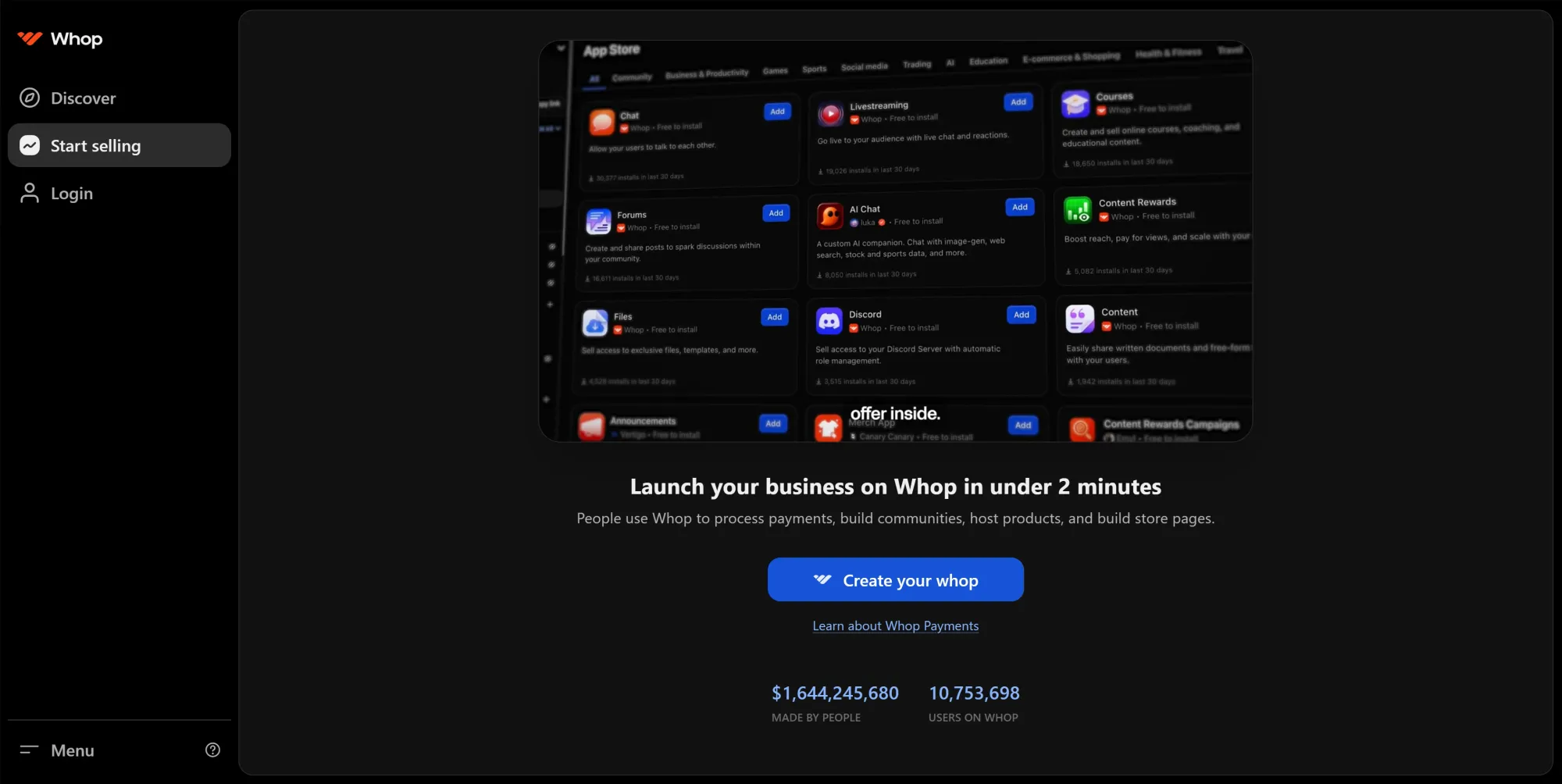
That’s where Whop stands out. With Whop, you can add features on demand through native Whop apps—all free to install. New apps are added every week, so your online hub (your whop) keeps evolving with your business needs.
Check the payment options
It’s not just about how you get paid—it’s also about how your customers can pay you.
Buyers want a smooth checkout: quick, secure, and hassle-free. If payment feels clunky or untrustworthy, you’ll lose sales before they even happen. That’s why it’s critical to choose a platform that offers fast, secure, and trusted payment options.
Look for one that protects both you and your customers from scams, while supporting the methods people actually want to use.
With Whop Payments, you get all of that—and more. We’ve introduced multi-PSP routing and native KYC to make global payouts seamless. You can now:
- Get paid in 170+ countries
- Offer local banking, crypto, and even Venmo as payment methods
- Accept payments from more providers and maximize authorization rates
- Increase your conversions with faster, more reliable payments
In short: you get paid quicker, your customers pay easier, and your business grows faster.
Look at the seller support features
Selling digital products is easy, don’t get me wrong. But you’ll likely have questions or need help from time to time.
Well, not all marketplaces are created equal in this aspect. Some have ways to get help instantly via live chat or phone, while others require you to reach out to customer service via tickets (which are slowly responded to via email).
Ensure that the marketplace you select offers different levels of seller support.
And yes, Whop offers instant support to all sellers, 24/7.
Read reviews
Just like you did for that new iPhone, read some reviews. You want to feel confident and justified in your decision, and reviews can be a great way to understand how other sellers feel about particular marketplaces.
Before you choose an online marketplace, read reviews from other sellers to get an idea of their experiences with the platform. I like to go to unbiased forums like Reddit.
Sell your digital products with Whop
So, let me ask you—which digital product are you going to launch first?
Making money online is simpler than most people think when you know the strategies top sellers use. Digital products are the easiest way to start: no overhead, no upfront investment, no risk. Just pure upside.
That said, the platform you choose matters. You don’t want to build on shaky ground. And when it comes to selling digital products, Whop was built for exactly this.
Created by sellers, for sellers, Whop makes it effortless to launch and grow your business. It’s simple to use, packed with the features you actually need, and backed by a team of experts who’ll help make your journey smooth. Just create your whop, add your offers, and you’re ready to start selling.
From courses to ebooks, coaching to private communities—and everything in between—you can sell it on Whop.
So what are you waiting for? Start building, start selling, and start making money with Whop today.