Discover over 75 embedded finance statistics you need to know for 2026, including market size, adoption, challenges, and more.
Key takeaways
- Embedded finance heads toward $320 billion by 2030, yet 83% of that market remains untapped.
- Payments dominate adoption, but lending, accounts, and card issuing hold over 90% unclaimed growth potential.
- Trust, easy integration, and compliance decide which providers win, as 93% of businesses report friction.
Embedded finance is moving from niche to mainstream by bringing payments, lending, and other financial services into the customer experience businesses already provide.
This can create new revenue streams, increase conversions, and give customers more reasons to keep buying. But the market is complex, and adoption remains uneven. Getting it right also means navigating decisions around products, providers, integration, compliance, and consumer demand.
With that in mind, we’ve reviewed a wide range of reports to bring you over 75 embedded finance statistics for 2026. Read on for a closer look at market growth, adoption, platforms, consumer interest, business impact, and key challenges.
Embedded finance statistics highlights
- The embedded finance market is expected to be worth around $320 billion by 2030.
- With a current market penetration of around 17%, 83% of the potential embedded finance market remains untapped.
- Buy Now Pay Later (BNPL), one of the most widely used products in embedded finance, is expected to grow by around 63% to $911.8 billion by 2030.
- Merchants offering pay-over-time at checkout see a 14% revenue lift and a 21% increase in conversions for purchases over $250.
- 93% of businesses report some form of friction with embedded finance, with transparency and flexibility, integration, and compliance among the most common issues.
Embedded finance market statistics
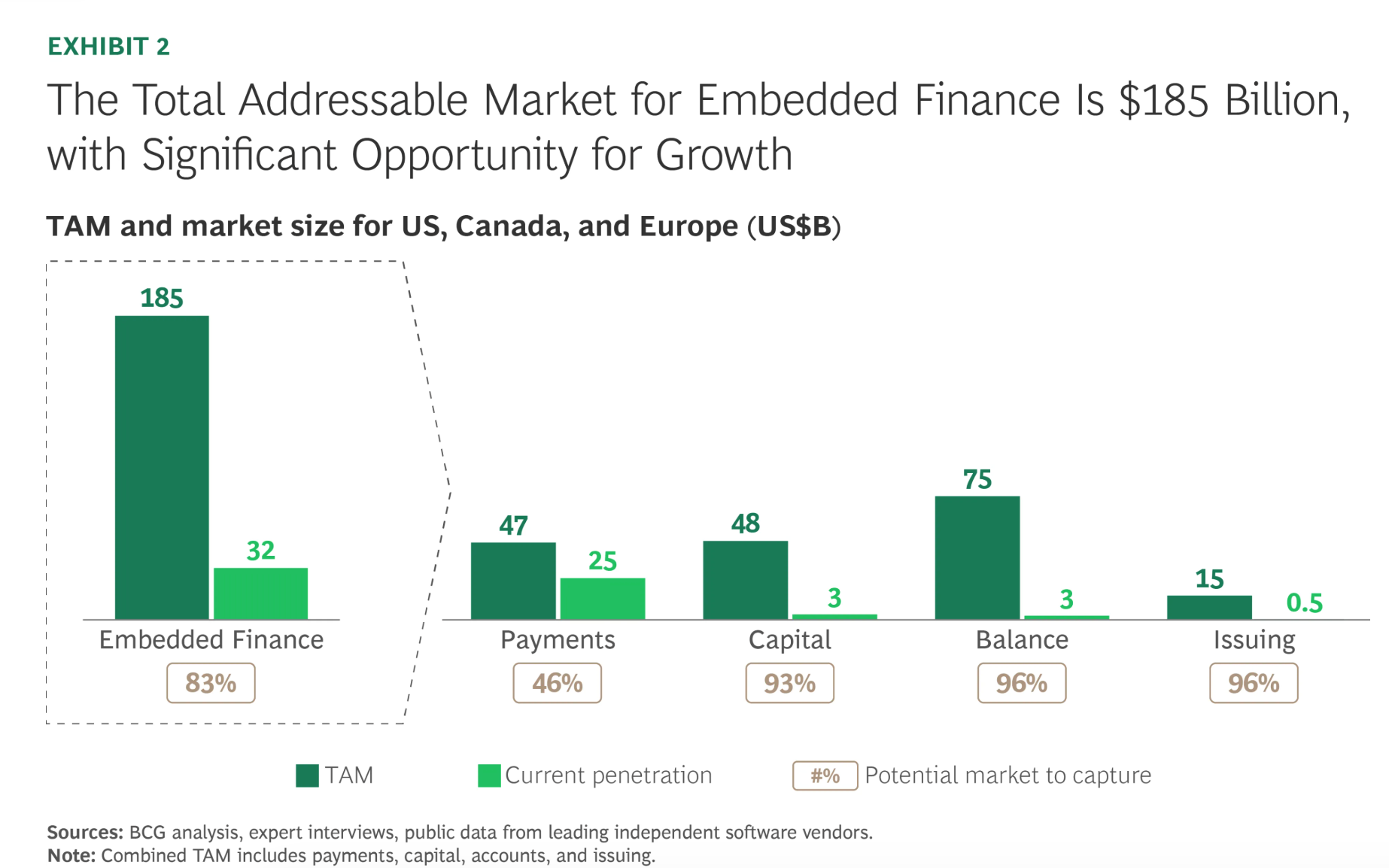
According to BCG, the total addressable market (TAM) for embedded finance across the US, Canada and Europe was around $185 billion in 20241.
This was up 25% from $150 billion in 2022.
By 2030, the embedded finance market is expected to be worth around $320 billion.
The small and medium business (SMB) segment will account for about 50% or $150 billion of this total.
Meanwhile, the consumer segment, which includes payments, lending, and insurance, will be worth 38% or $120 billion.
Enterprises will account for the remaining $50 billion.
According to a 2025 Adyen report, embedded finance growth will vary considerably by market and product through 2030:
- North America will grow at a compound annual growth rate (CAGR) of 10%2.
- Europe will grow at a CAGR of 15%.
- The CAGR of capital, accounts, and issuing is expected to be even faster at 20% annually.
This growth leaves plenty of room for businesses to add financial services as adoption expands, particularly across products such as lending, accounts, and card issuing that are still relatively underdeveloped.
Embedded finance products statistics
The key financial products that make up embedded finance include capital or lending, accounts and balances, card issuing, and insurance.
| Embedded finance product | What it includes | 2026 market size | Forecast growth | Example providers |
|---|---|---|---|---|
| Embedded payments | Payments processed directly within a non-financial platform | $51.2B | 35.5% CAGR to 2033 | Adyen, Braintree, Stripe |
| Embedded lending | Loans, working capital, and financing offered through a platform | $28.4B | 36.5% CAGR to 2033 | PayPal, Klarna, Stripe |
| Embedded banking | Accounts, wallets, and treasury services offered through non-financial platforms | ~$36B* | 28.1% CAGR to 2033 | Treasury Prime, Unit, Plaid, Synctera |
| Embedded card issuing | Physical, digital, or virtual payment cards issued through a platform | $23.44B | 13% CAGR to 2030 | Stripe, Airwallex, Marqeta |
| Embedded insurance | Insurance products offered directly within another product or service | $188.5B | 30.8% CAGR to 2033 | Cover Genius, Bolttech, Qover |
*Calculated from MetaStat Insights' published $203.9 billion 2033 forecast and 28.1% CAGR.
The BCG report estimated that embedded finance had a current market penetration of around $32 billion in 2024, leaving about 83% of the market untapped. The share of each product market still available for growth also varied considerably:
- Embedded payments or payments processed directly within a non-financial platform: 46%
- Embedded capital, or loans and working capital offered directly through a platform: 93%
- Embedded issuing, or payment cards issued directly through a platform: 96%
- Embedded accounts and balances, or accounts that let users hold, receive, and manage money within a platform: 96%
The global embedded payments market was estimated at $51.2 billion in 2026, up 31% from $39.1 billion in 20253.
With key players including Adyen, Braintree, and Stripe, the market is projected to reach $430.3 billion by 2033, growing at a CAGR of 35.5%.
The global embedded lending market size was valued at an estimated $28.4 billion in 2026, up around 32% from $21.5 billion in 20254.
Key players include PayPal, Klarna, and Stripe, and by 2033, the market is expected to grow at a CAGR of 36.5% to around $250.9 billion.
Buy Now Pay Later (BNPL), a form of embedded lending, is worth looking at separately as it has become one of the most widely used products in the category. In 2025, the BNPL market was worth around $560 billion.
By 2030, the market is expected to grow by around 63% to $911.8 billion5.
For the US specifically, the total transaction value of BNPL loans was $70 billion in 2025, up 20% per year since 20216.
In a 2026 LendingTree report, PayPal was the most commonly used BNPL provider in the US, cited by 56% of BNPL users.
- Klarna, Affirm, and Afterpay followed at 38% each7.
- Zip accounted for 15%, Sezzle 11%, and Splitit 6%.
- Together, these leading BNPL providers accounted for around 94.2% of US BNPL activity.
The global embedded banking market was worth around $36 billion in 2026.
As digital financial transactions grow and businesses increasingly adopt integrated banking services, the market is projected to reach $203.9 billion by 2033, growing at a CAGR of 28.1%8.
The embedded card issuing market size was $23.44 billion in 2026, up 12.7% from $20.79 billion in 20259.
The market is projected to reach $38.16 billion by 2030, growing at a CAGR of 13%. Growth will be driven mainly by the demand for instant digital and virtual cards. Key industry players include Stripe, Airwallex, and Marqeta.
The global embedded insurance market size was valued at $188.5 billion in 2026, up 30% from $145.2 billion in 202510.
As embedded finance changes how insurance products are distributed and purchased, the market is projected to grow at a CAGR of 30.8%, reaching around $1.24 trillion by 2033.
Embedded finance adoption statistics
A 2025 PYMNTS study of US companies found that over 99% offered at least one embedded finance capability11.
The most widely implemented capabilities were:
- Payments: 70%
- Banking: 69%
- Money movement (peer-to-peer or account-to-account transfers): 62%
- Consumer-focused features, such as savings accounts, early direct deposit, rewards, payroll benefits, and investing or lending capabilities: 50%
In the same report, the top reasons for offering embedded finance centered mostly around customers, with stronger relationships taking the lead at 45%, followed by a better user experience at 38% and brand differentiation at 35%.
A 2026 Worldpay report surveyed 1,542 businesses across Australia, the UK, and the US and found that the embedded finance capabilities used through business software included:
- Accounts receivable or payable tools: 80%12
- Banking and treasury services: 78%
- Cross-border payment solutions: 70%
- Card issuing: 68%
- Finance and lending: 67%
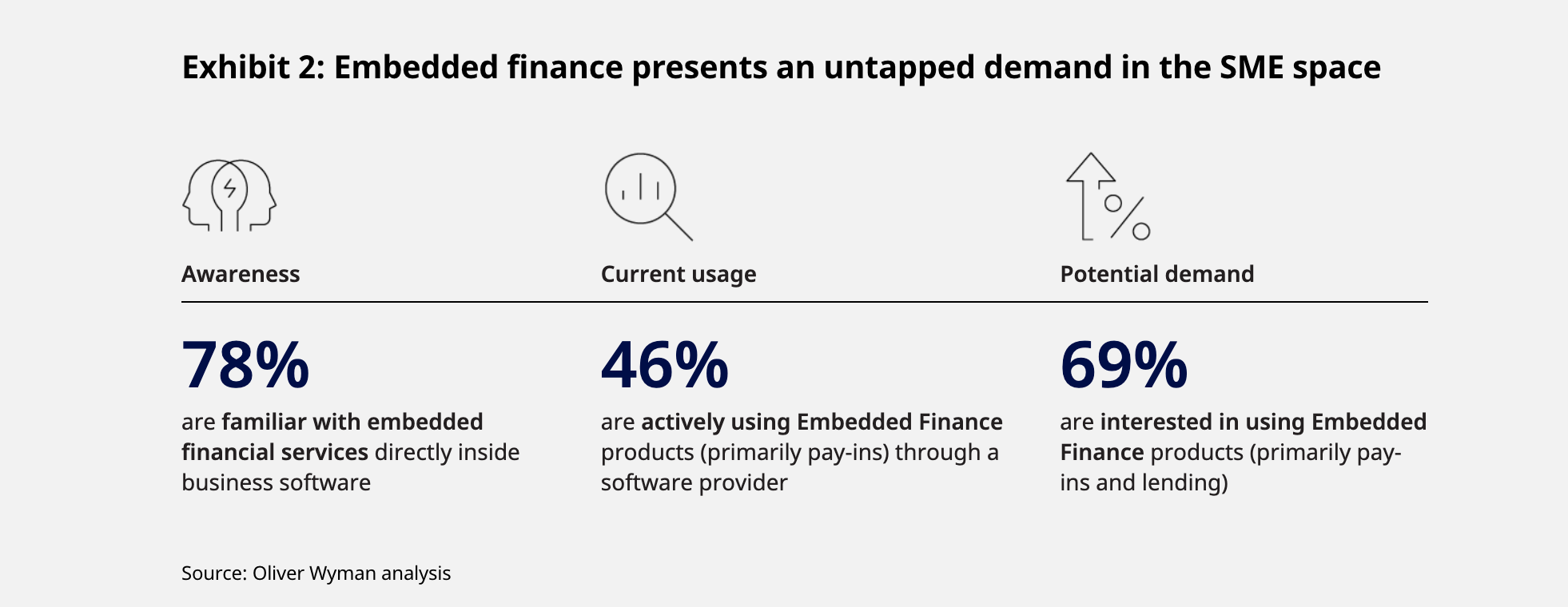
A 2026 Oliver Wyman study of more than 150 SMEs across France, Germany, and the Netherlands found that 46% actively used embedded finance13.
The study also found that embedded finance accounted for around 30% of SME payment volumes in advanced European markets, compared with over 60% in the US.
In a 2025 NatWest study of UK consumer brands, 73% offered the following embedded finance products:
- Point of sale lending or consumer credit (BNPL): 62%14
- Savings accounts: 60%
- Insurance: 57%
- Merchant wallets: 51%
- Unsecured personal loans: 25%
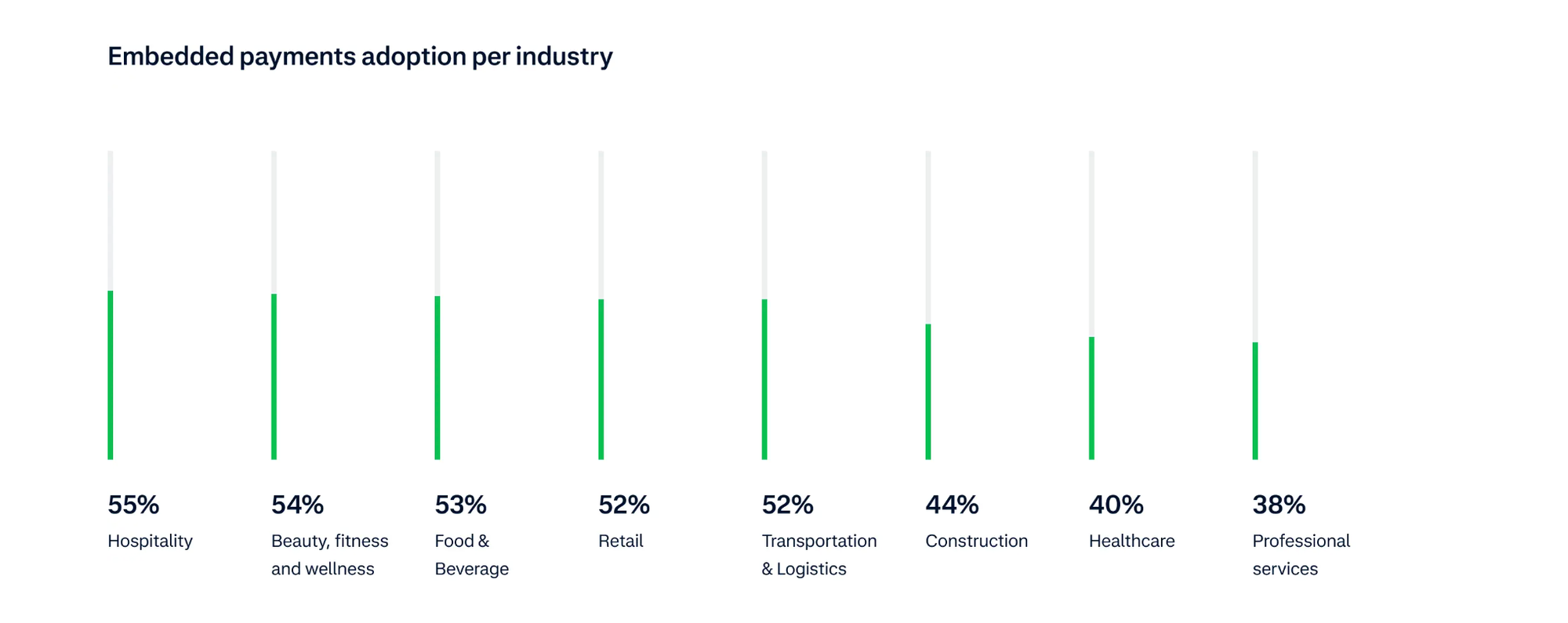
In the Adyen report, adoption of embedded payments was highest in the Hospitality industry at 55%.
This was followed by:
- Beauty, Fitness and Wellness: 54%
- Food and Beverage: 53%
- Retail: 52%
Embedded finance platform statistics
According to the BCG report, in 2024, SaaS platforms with embedded payments earned 36% of the payment-processing revenue generated by SMEs.
That figure is expected to rise to 45% by 2028.
US software platforms generated $16 billion from embedded payments in 2025, up 146% from $6.5 billion in 202015.
That represented around 60% of all payment-processing revenue generated by US SMEs, meaning a growing share of payment fees was being earned through software platforms with integrated payments. In Europe, software platforms generated around $3 billion, or about 30% of SME payment-processing revenue.
A 2025 Flagship Advisory Partner’s survey of 100 North American SaaS platforms found that they offered the following embedded finance products:
- Card payments: 90%16
- Send and receive bank payments: 76%
- Business lending: 32%
- Issue payment cards: 30%
- Bank accounts: 27%
According to a 2026 Rainforest Pay study, 76% of vertical SaaS platforms considered embedded payments a very important source of revenue17.
Despite 78% targeting a payment adoption rate of at least 71%, only 25% had achieved it, showing a sizable gap between adoption targets and actual usage.
A 2024 Carat report covering payment facilitators, online marketplaces, and software providers found that:
- 100% of PayFacs, which help businesses accept payments, offered both payment acceptance and embedded finance products18.
- 61% of online marketplaces, which connect customers with multiple sellers, offered both.
- 29% of ISVs, which provide software to businesses, offered both.
The report also found that 76% of online marketplaces were interested in adding or improving loyalty and rewards programs.
Another 73% wanted to expand BNPL offerings, compared with just 34% interested in installment payments.
In the previously mentioned PYMNTS study, 69% of companies worked with third-party providers to offer embedded finance solutions.
Trust was the most commonly cited factor when selecting a provider at 88%. This was followed by:
- Technology and customization capabilities: 76%
- Security and compliance capabilities: 63%
The NatWest report found a similar focus on trust and integration when selecting embedded finance providers.
- 57% wanted to work with a trusted provider their customers would recognize.
- 31% said easy integration with their data and systems was the most important factor when choosing a provider.
SMBs and embedded finance statistics
In the Oliver Wyman study, 69% of SMBs were interested in using embedded finance products.
64% planned to use new or additional embedded finance products within the next 12 months.
In the Adyen report, up to 80% of SMBs relied on SaaS platforms to help run core aspects of their businesses. As a result, 50% were highly likely to make use of a full suite of embedded financial products through their software platform in the near future.
80% of these SMBs were interested in faster access to money they have already earned, with 50% being willing to pay 1% for on-demand access.
The report also found that for embedded capital, the features SMBs found highly valuable were:
- Faster access to funds: 53%
- Flexible terms and payment options: 50%
- Automatic repayments: 47%
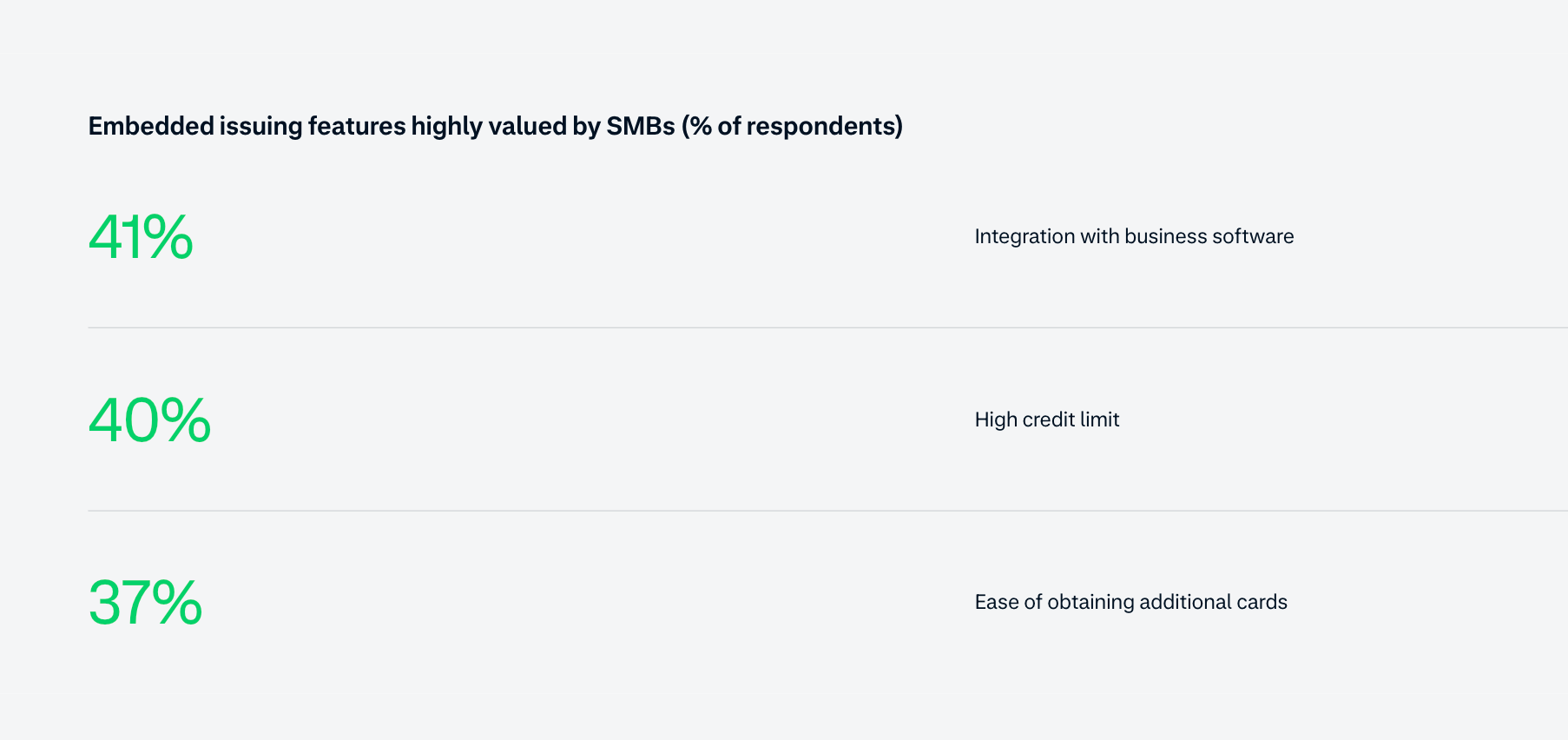
And, in terms of embedded issuing, the most valued features included:
- Integration with business software: 41%
- High credit limits: 40%
- Easy access to additional cards: 37%
According to the previously mentioned Worldpay report, 84% of businesses were open to exploring financial products through their software tools.
Another 76% were willing to pay a premium for these integrated services.
In another 2026 Worldpay report, looking at businesses across Australia, UK and the US, 99% of SMBs said embedded finance capabilities were important to their management software19.
These businesses were also likely to consider switching software platforms for:
- Cash-flow visibility and forecasting: 83%
- Accepting all payment types: 82%
- Managing outgoing payments: 81%
- Faster access to funds: 81%
- Integrated lending or capital tools: 79%
A 2026 Marqeta report on 5,000 consumers and SMBs in the US and UK revealed a growing demand for more flexible embedded lending options among SMBs20.
66% of SMBs partnered with multiple credit providers, with 34% having moved from one product to the next as their business grew. Another 64% said it was important for a financial provider to offer a clear path from entry-level to advanced credit products.
SMBs were also relatively open to getting financial services outside traditional banks. 66% said they would be comfortable using non-bank providers, with this figure rising to 83% among those planning to apply for a credit card within the next year.
For those planning to apply for a credit card, 82% were interested in flexible credentials or one card to switch between funding options such as credit, debit, and BNPL. Meanwhile, 89% expressed interest in more flexible repayment terms.
Consumers and embedded finance statistics
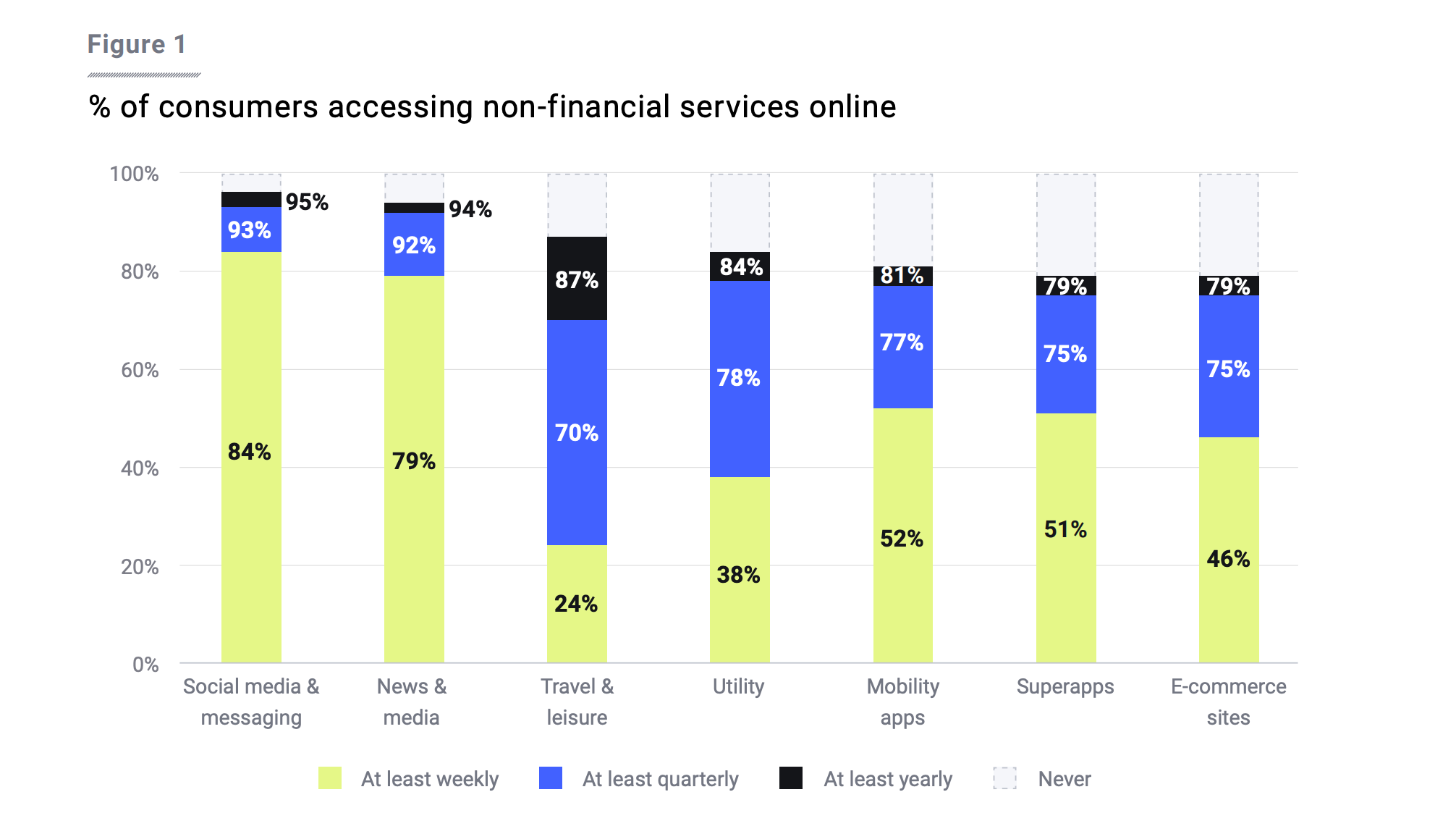
A 2024 Additiv report of 4,500 consumers across 10 countries looked at the non-financial digital platforms consumers already used each week, highlighting where financial services could potentially be embedded:
- Social media and messaging: 84%21
- News and media: 79%
- Mobility apps: 52%
- Super-apps: 51%
- Ecommerce sites: 46%
- Utilities: 38%
- Travel and leisure: 24%
When asked about the embedded finance services they were already using, 55% of consumers used loyalty points or cashback to save and invest.
Consumers were also increasingly open to receiving financial services from non-financial brands. Super apps were the most trusted at 26%, followed by news and media apps at 17% and ecommerce sites at 13%.
The report further found that 62% of consumers were open to switching financial service providers, with cost, incentives such as cashback, and new products among the leading reasons.
Reputation was the biggest factor influencing trust in a financial services provider at 23%, followed by customer service at 15% and recommendations from family and friends at 12%.
And when asked about receiving financial services, from monthly savings calculations to salary drawdowns, from a non-bank, 30% were either slightly or very interested.
This was only 6% behind banks at 36%.
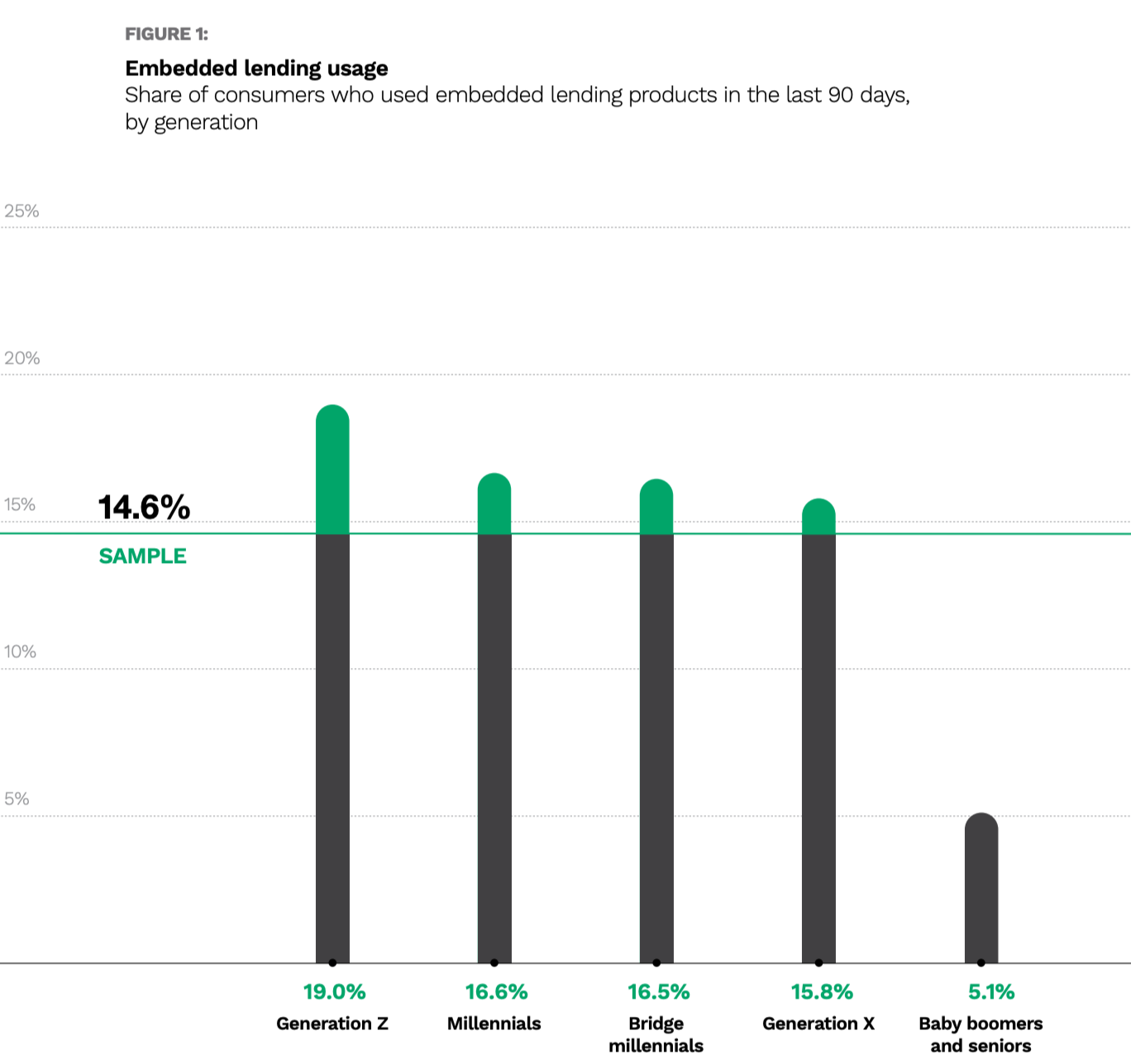
A 2024 PYMNTS report found that 14.6% of consumers had used embedded lending (credit card installments, instant credit card issuance at a checkout, and BNPL) in the previous 90 days22.
Usage was highest among Gen Z consumers at 19%, versus 5.1% of Baby boomers and seniors.
Additionally:
- 54% of millennials and Gen Zs were more likely to switch financial providers to access embedded lending products.
- Consumers were more likely to use embedded lending for everyday essentials like groceries and bills (12%) than for discretionary expenses like luxury clothes or travel (9%).
- Only 48% of embedded lending users were very satisfied with the lending products available to them.
In the Marqeta study, younger consumers used more credit products, switched more often, and expressed higher interest in flexibility and non-bank providers.
Among consumers:
- 60% aged 18 to 34 who used additional financial products with a provider got the credit card first.
- 79% used BNPL even when they had a credit card.
- 48% expressed interest in a card that can switch between debit, credit, and BNPL at the point of purchase or flexible credentials.
- Aged 25 to 44, 44% were open to non-bank financial services, compared to 23% of consumers 65 and older. And for those interested in flexible credentials specifically, openness rose to 52%.
In the LendingTree report, 47% of US consumers used a BNPL service, with usage rising to 61% among Gen Z consumers.
- 63% held multiple BNPL loans at once, including 25% who held more than three.
- 10% used a BNPL service six or more times.
- The most common purchases were clothing, shoes, and accessories at 39%, technology at 34%, and groceries at 29%.
Embedded finance impact statistics
In the Carat report, online marketplaces offering both payment acceptance and embedded finance features saw an 88% increase in the share of revenue generated from payment processing fees.
Additionally:
- 32% of online marketplaces expected embedded finance to increase their revenue.
- 29% expected it to help with expanding into new markets.
- 25% considered embedded finance innovation extremely important to their innovation strategies.
In the Flagship Advisory Partners survey, 35% of SaaS platforms said embedded finance accounted for up to 20% of their profits.
Meanwhile:
- 23% said embedded finance made up 21% to 40% of their profits.
- 19% said it accounted for 41% to 60%.
Software platforms using embedded finance solutions saw a 35% increase in customer lifetime value (LTV) in 202523.
The same benchmarks linked integrated financial services with a 30% increase in customer stickiness.
In the Adyen report, it was estimated that SaaS platforms expanding into embedded financial services could generate 3x to 4x their current subscription revenue.
For example, a typical SMB generating $1 million annually could produce around $13,000 in banking revenue, most of which traditionally goes to banks. At current adoption rates, a SaaS platform could capture around $5,500 of that revenue, with the opportunity increasing as more businesses adopt embedded financial products.
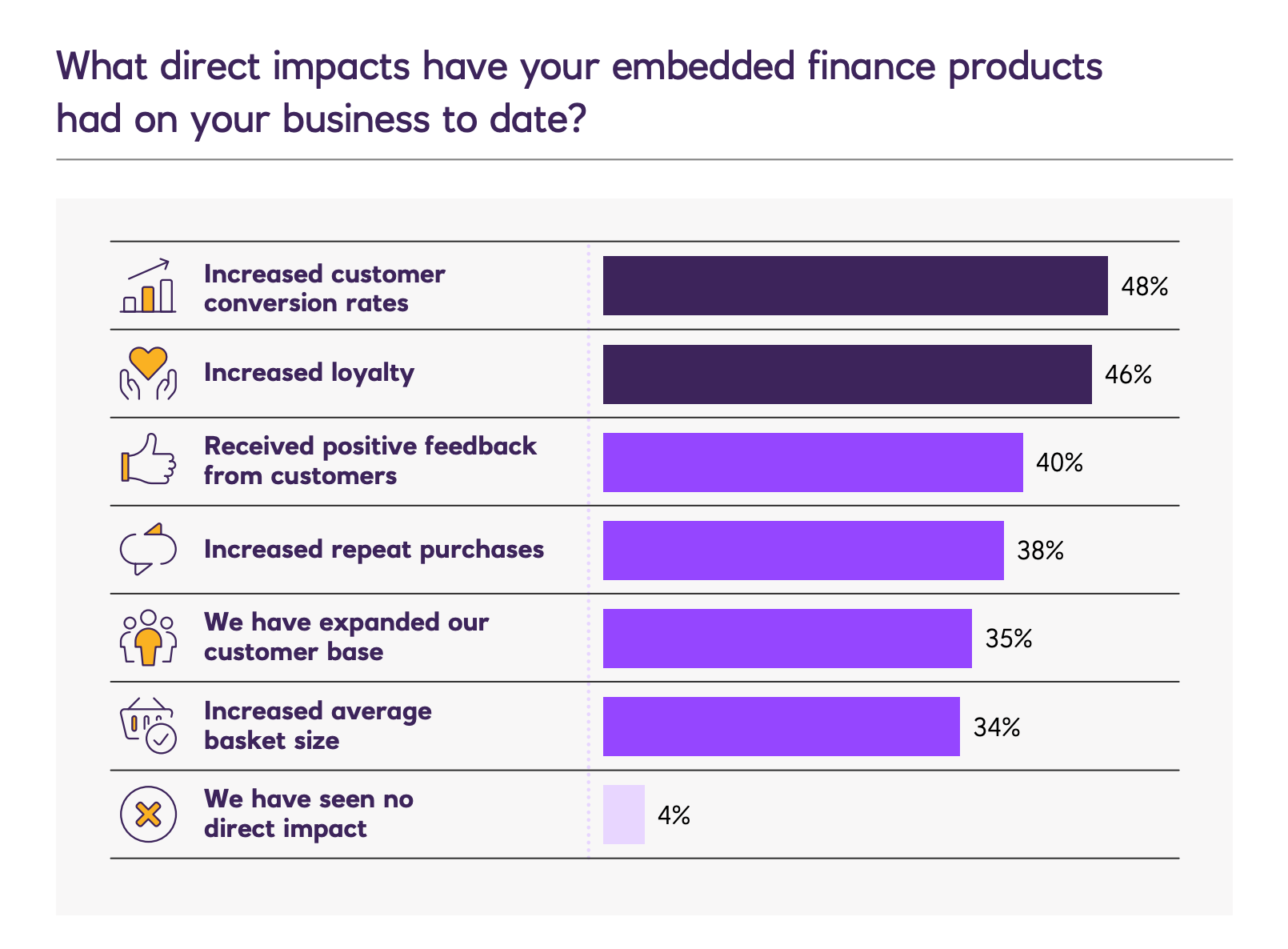
According to the NatWest report, brands using embedded finance reported several positive outcomes such as:
- Increased customer conversion rates: 48%
- Increased loyalty: 46%
- Positive feedback from customers: 40%
- Increased repeat purchases: 38%
Merchants offering pay-over-time at checkout saw a 14% revenue lift; they also saw a 21% increase in conversions for items over $25024.
Across providers:
- Merchants offering Affirm saw 70% higher average order values (AOV) and 30% fewer abandoned carts.
- Stripe merchants achieved a 40–60% increase in cart size using BNPL.
In the 2025 PYMNTS report, businesses primarily measured embedded finance success through financial performance and customer growth.
More specifically:
- 47% ranked financial performance as their top indicator, with 86% selecting it as part of measuring success.
- 36% ranked stronger customer relationships as their top metric, while 75% included it when measuring success.
Embedded finance challenges statistics
In the Worldpay report, 35% of businesses admitted they were still struggling to learn how to use embedded finance effectively.
29% also cited integration challenges with their existing systems, while 23% said they hadn’t received enough guidance.
According to the PYMNTS report, 93% of businesses faced some kind of friction when offering embedded finance.
The most common issues were:
- Platform transparency and flexibility: 42%
- Technical and integration challenges: 40%
- Compliance and security: 39%
In the Carat report, 21% of marketplaces didn't have the resources or technology to handle embedded payments.
54.8% had security and risk management concerns, while 29% were concerned about compliance and regulatory requirements.
Fraud was another key concern, with 67% of SMB finance leaders worrying about fraud in 202625.
In fact, 46% of these leaders reported they had experienced payment fraud in the previous year.
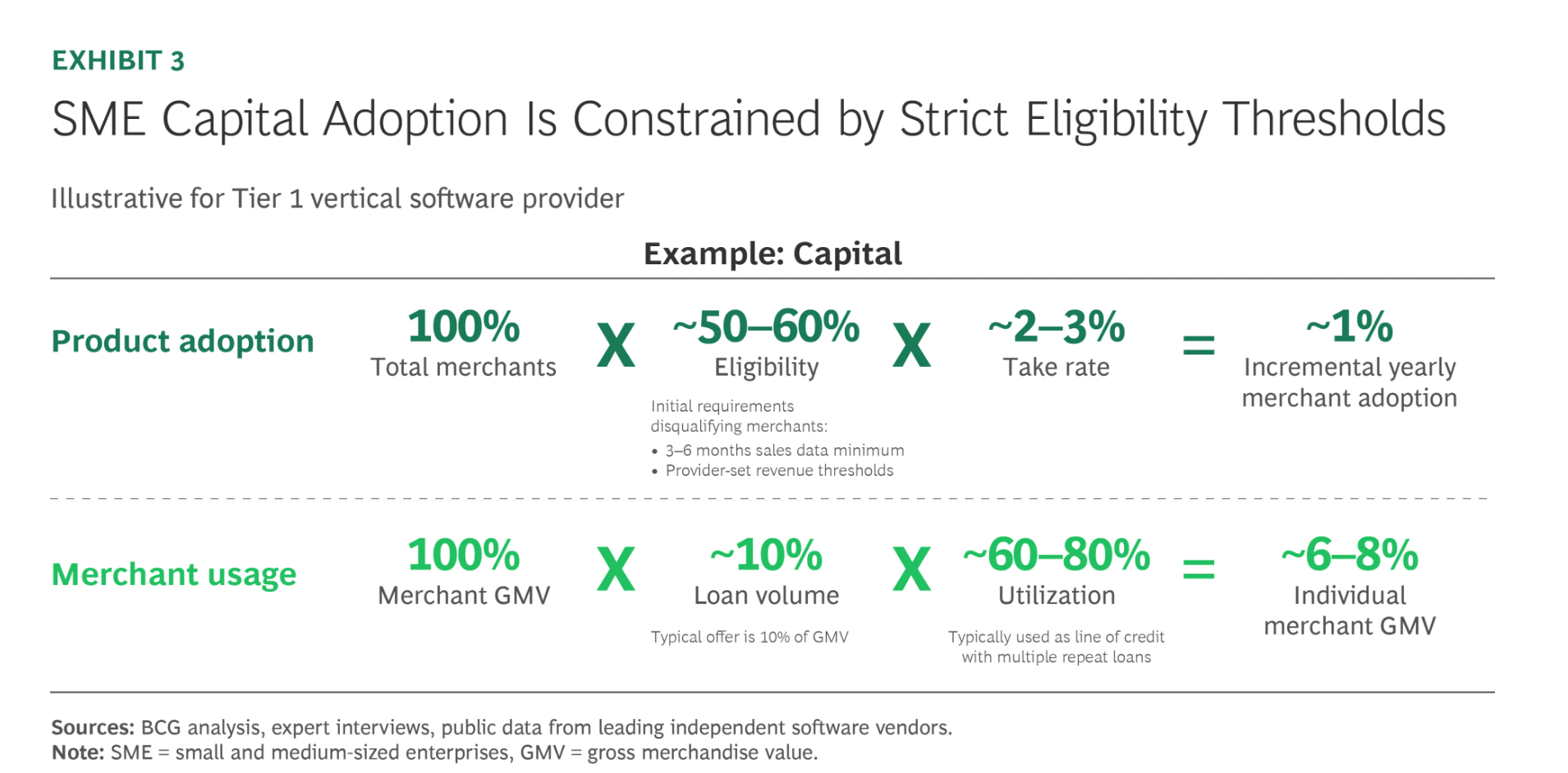
In the previously mentioned BCG report, only a single-digit share of merchants consistently used embedded finance products like cash advances.
BCG stated this was mainly due to strict eligibility requirements, established relationships with existing banks, limited added value over traditional banking products, and less mature product offerings.
For an illustrative tier 1 vertical software provider:
- Only 50% to 60% of merchants were estimated to qualify for embedded capital products because of requirements such as minimum sales history and revenue thresholds.
- Of those eligible merchants, only around 2% to 3% were expected to take up the offer, resulting in roughly 1% incremental merchant adoption each year.
Choosing the right embedded finance provider can also be a challenge. According to the previously mentioned NatWest report, 31% of brands rejected a potential partner because the provider was unknown, tied with a lack of regulatory support or expertise.
Cost was close behind, with 30% rejecting a provider because its embedded finance solution was too expensive.
Bring embedded finance to your product with Whop
The numbers are clear: embedded finance is growing fast, but with around 83% of the market still untapped and 93% of businesses reporting friction, there's still a big opening for platforms that get it right.
Integration, compliance, and transparency are where most platforms get stuck. That's why the provider you choose matters as much as the products you offer.
Whop gives platforms a ready-made embedded finance stack. You can embed checkout directly into your product (with BNPL as a payment option), give users a payout portal to manage balances and withdrawals, and issue virtual cards, all without becoming a bank, lender, or card issuer yourself.
Platforms like Cal.com, Nickel, Poke, and Replit already use Whop's embedded components to keep payments, payouts, and spending inside their own products.
See what Whop can do for you.
FAQs
What is embedded finance and how does it work?
Embedded finance is the integration of financial services into a non-financial product, platform, or customer journey. It works by connecting the business to financial infrastructure behind the scenes, allowing customers to make payments, access lending, open accounts, or use other financial services without leaving the platform.
What are some real-world examples of embedded finance?
Some real-world examples of embedded finance include Airbnb offering travel insurance at checkout, BNPL options like Klarna built into ecommerce purchases, and platforms like Whop let businesses accept payments, offer BNPL at checkout, and pay out users without leaving the software they already use.
What are some examples of embedded finance companies?
Examples of companies that offer embedded finance include Whop, Stripe, Adyen, Airwallex, Marqeta, Treasury Prime, Unit, Synctera, Cover Genius, Qover, and Bolttech, which provide infrastructure for payments, banking, lending, card issuing, and insurance.
Sources


![Top 10 best embedded finance companies for SaaS and marketplaces [2026]](https://storage.ghost.io/c/12/7b/127b828b-bdc2-4972-9cf2-de857df9c324/content/images/size/w1000/format/webp/2026/08/embedded-finance.jpg)