Pick a time, book, pay.
Key takeaways:
- Coaches, consultants, therapists, and doctors all take online bookings, but getting paid is another story: 59% of small businesses have invoices over 30 days overdue.
- Cal.com now builds payments into the booking flow with Whop’s embedded components, so clients book and pay in one step.
- Whop handled checkout, KYC, and payouts, and Cal launched native payments in under 2 weeks.
Thousands of people are booking appointments online this very second. Tax advisors, doctors, therapists, and beauticians all rely on online bookings.
For anyone who sells their time, the booking is the easy part. Getting paid for it is not.
Cal.com is a scheduling platform that powers online bookings for more than 20,000 customers. With Cal Payments, clients pick a time and pay in the same step, without leaving the page.
Cal.com didn't have to build this itself. Instead, it simply used Whop's embedded components.
Cal Payments by the numbers
- Over 20,000 customers
- Under 2 weeks from kickoff to launch
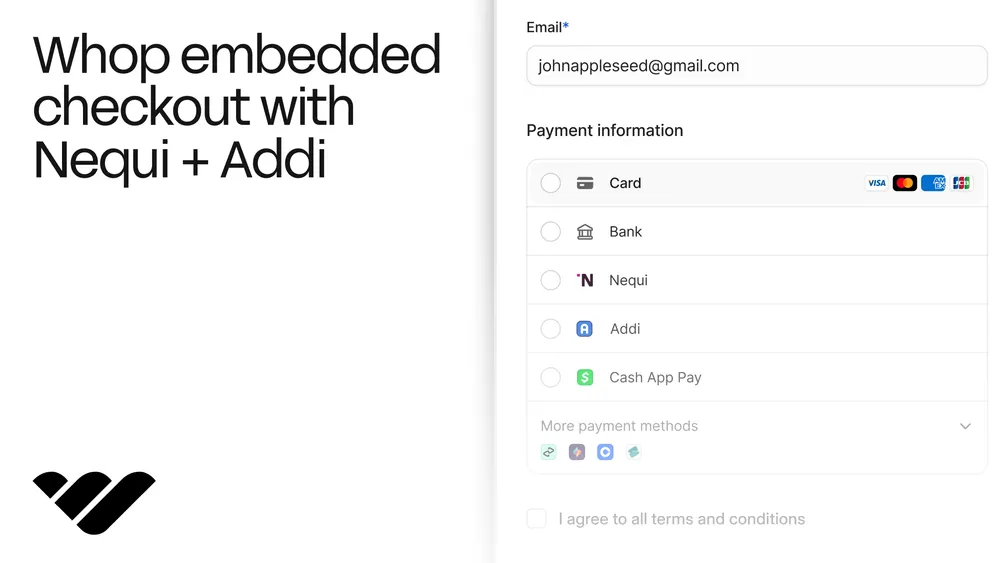
- 5 payment methods at launch: cards, ACH, bank wire, crypto, and Cash App
For service businesses, the booking page is the storefront
Coaches, consultants, therapists, and advisors don't sell traditional products. The booking itself is what they sell.
But the problem with many scheduling tools is that they either don't offer payments, or they take the user off the platform for the actual payment, and every handoff is a chance for the client to bounce.
Invoicing after the session isn't much better. The money arrives late, if it arrives at all. And when a client hasn't paid anything upfront, nothing stops them from canceling and leaving an open slot.
This leads to one thing: loss of revenue. And it adds up.
Cal.com makes online scheduling simple
Peer Richelsen and Bailey Pumfleet started Cal.com in 2021 with a goal to build the most flexible scheduling platform around, one that could handle the process from start to finish.
"We built Cal.com because scheduling is core infrastructure for modern work, yet most scheduling products were too rigid for the workflows businesses actually need."
- Peer Richelsen
The whole business runs on shareable booking links. Send one to a client, let them pick a time, and the meeting is booked.
Cal's users range from solopreneurs and independent operators to marketplaces, healthcare organizations, sales teams, and large enterprises.
For the ones who sell their time directly, like coaches and advisors, getting paid on time is crucial to cash flow. "For many of our users, their booking page is effectively their storefront," says Cal.com co-founder Peer Richelsen.
The problem was that on Cal.com, booking and payment used to happen in separate places.
"If you’re a coach, consultant, therapist, or advisor, the booking itself is often the product," Richelsen says, "so it didn’t make sense for payment to feel disconnected from scheduling."
Before Whop, charging for a booking was a four-step process
Before Cal Payments, hosts who wanted to charge for a booking had to install an app, connect an external account, and go through a separate setup and OAuth flow. Only then could they collect money.
For hosts, that meant another account and platform to manage. For clients, it meant leaving the booking flow to pay.
"It worked, but it took more steps than it should have. Over time, it became clear that payments needed to feel native to the booking flow, not bolted on afterward."
- Peer Richelsen
The team at Cal listened to feedback from users, and it quickly became clear that booking and paying should feel like one and the same, not two separate things.
"Our goal was simple: if someone is booking a paid service, choosing a time and paying for it should feel like one continuous action."
- Peer Richelsen
Why Cal didn’t build its own payment infrastructure
Cal needed payments. It didn't want to become a payment company.
"Payments get complicated very quickly. It's not just a card form on a page: there are payment methods, merchant onboarding, KYC, balances, payouts, compliance…"
- Peer Richelsen
Building all of that in-house would have meant months of work, then ongoing maintenance and support. Richelsen explains why they didn't want to go down that route, saying: "We didn't want our team spending months rebuilding infrastructure that already existed. We'd rather focus on creating the best paid-booking experience for Cal users."
So Cal.com teamed up with Whop to build Cal Payments, and went from kickoff to live native payments in under 2 weeks.
How Whop powers Cal Payments
"What matters most to us is that Cal remains the product the user interacts with. Whop sits underneath and powers the financial layer."
- Peer Richelsen
Clients only ever see Cal.com. Whop handles the payments without being seen.
On the booking side, Whop's embedded checkout sits inside the Cal booking flow. The host adds a price to an event, and the payment step appears right in the booking flow. The client picks a time and pays right away, without leaving Cal.com, and without needing a Whop account.
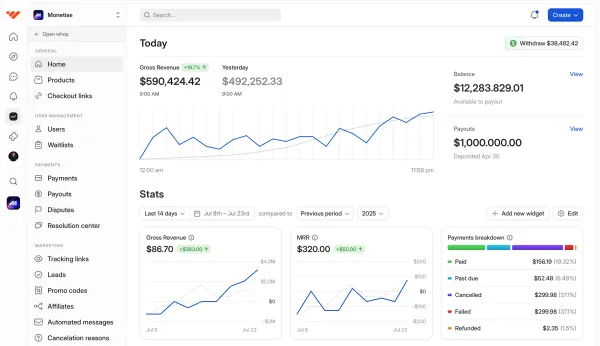
On the host side, Whop's embedded payouts live in the Cal dashboard. Hosts see their balance, request withdrawals, and check past payouts without needing to manage another platform.

Hosts can also start earning before any paperwork – a favorite feature of the Cal team, with Peer Richelsen saying: "We love the 'start without KYC' approach. Hosts can take paid bookings from day one, and KYC only kicks in when they request their first payout. No paperwork up front, no waiting for approval before earning."
Under the hood
Underneath, Whop handles checkout, payment methods, balances, KYC at payout, and payouts.
Without Whop, Cal would've had to bite the bullet and design this from the ground up, consuming hundreds of hours and countless resources, plus continued maintenance and support.
Instead, the Cal.com team is free to focus on the product, not the payments.
"It was the right division of labor. We moved much faster without compromising the experience we wanted for our users."
Peer Richelsen
From scheduling tool to fintech, with Whop
Paid bookings used to happen around Cal, through third-party integrations. Now they happen inside it.
"Paid bookings used to run through third-party integrations where Cal didn't participate in the transaction. With Cal Payments, we can now generate revenue from the payment activity on our platform."
Cal Payments makes paid bookings easier for hosts and clients. And for Cal.com, native payments bring a new revenue stream, without building payment infrastructure from scratch.
Cal Payments is just one example of what a platform can do with Whop's embedded components. In Cal's case, it's bookings. In yours, it could be something else entirely.
Whatever your platform books, sells, or schedules, Whop can power the payments so you can focus on the product.
See what Whop can do for you.