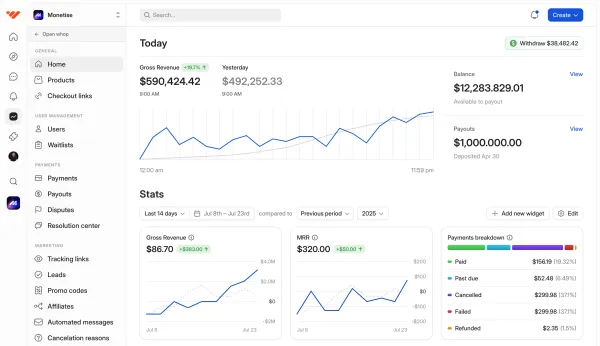
Embedded payouts let platforms pay sellers, creators, and workers at scale inside their own product. See how they work, and how to choose a provider.
Key takeaways
- Embedded payouts keep onboarding, verification, balances, and withdrawals inside your product, so earners never leave the platform.
- Payouts become a revenue stream: charge for instant cashouts, add FX margin, or push branded debit cards.
- Fast, flexible payouts drive retention, since workers and sellers switch platforms over slow or awkward access to earnings.
Sellers, gig workers, creators – all of these people expect the money they've earned on a platform to be available without leaving it, and typically, without waiting long.
Embedded payouts make that possible. In fact, 70% of fintechs surveyed for a PYMNTS Intelligence and Marqeta report already offer embedded payouts.
Instead of sending recipients through a separate payment service, embedded payouts allow platforms to build onboarding, payout methods, payout timing, and fund transfers directly into their own product.
It's a win-win: you keep people on platform, and payees get access to their funds within an experience they already know and trust.
But behind that experience is the need for infrastructure that can move money to potentially thousands of recipients, alongside identity verification, compliance, payment rails, reconciliation, and support across different countries and currencies.
Here's how embedded payouts work, and how you can implement them into your marketplace or platform with as little risk as possible.
What are embedded payouts?
Embedded payouts are payout capabilities built directly into an app, platform, marketplace, or software product.
They're what allow businesses to send money to sellers, creators, contractors, gig workers – any recipient that earns money within the product. The fact that they're embedded means those recipients don't have to leave the platform to manage how they get paid.
Say a seller earns $5,000 through a marketplace.
With embedded payouts in place, they can add their bank details, complete KYC and other verification requirements, view their available balance, choose their preferred payment method, and request their payout – all within the marketplace itself.
The actual movement of money still happens through underlying payment infrastructure. Depending on the provider and recipient, funds might travel via ACH, bank transfer, real-time payment rails, push-to-card, or other methods.
This makes embedded payouts one part of a much larger money movement flow.
A platform might use embedded checkout to collect a customer's payment, take its own fee or commission, allocate the remaining funds to the seller, and then use embedded payout infrastructure to send those earnings to the seller.
Embedded payouts vs. embedded payments
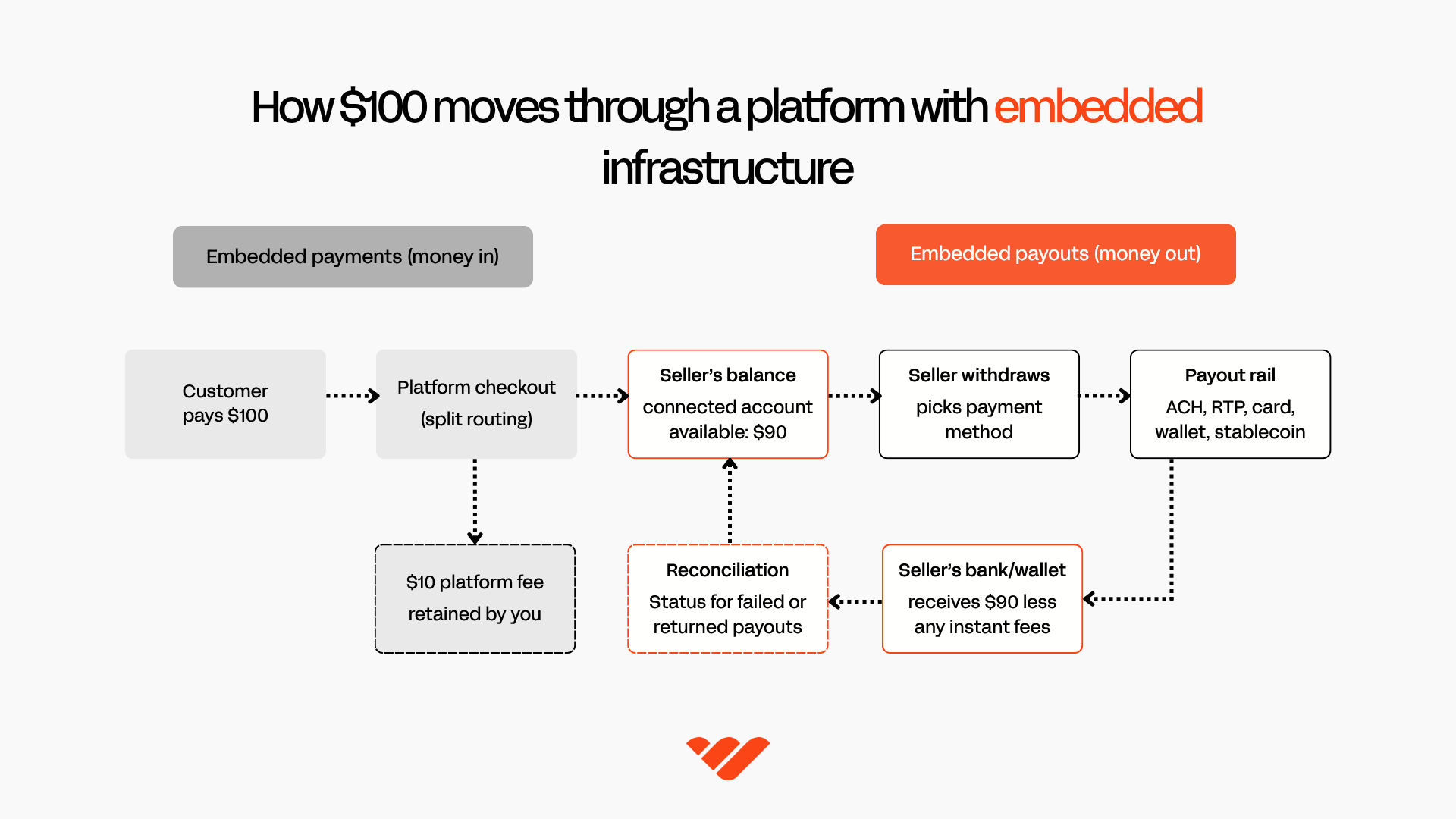
Simply, embedded payments let users pay within a platform; embedded payouts let users get paid within that platform.
They work best when paired together. Say you run a marketplace connecting customers with freelance designers:
- Embedded payments let your customers book a freelancer and pay for the service without leaving the marketplace
- Embedded payouts let the freelancer add their payout details, see their earnings, and get the money they earn without having to manage the process through a separate payout provider
The customer might pay $100 through your platform, you take a $10 marketplace fee, and the remaining $90 is allocated to the freelancer (this is known as split-routing).
Embedded payout infrastructure makes it seamless to allocate that $90 to the freelancer, according to their chosen payout method.
A platform can offer one without the other, but as you can see, they work most efficiently when part of the same embedded finance suite.
How it works: Onboarding to reconciliation
While the goal of embedded payouts is to make the process look as seamless as possible to the recipient clicking 'withdraw', several processes have to happen behind the scenes first.
Here's the typical step-by-step flow:
Step 1: Recipients are onboarded and verified
Before you can pay somebody what they're owed, you need to verify who you're paying. Usually, this involves collecting their name, address, bank or card information, tax information, and implementing KYC (know your customer) identity checks.
Most embedded payout providers handle much of this process for your platform, embedding onboarding directly into the platform experience, so recipients don't need to navigate a separate payout system.
The exact requirements depend on factors like the recipient type, payout method, transaction value, and their country of residence. Once the recipient passes the required checks, their payout account can be activated and they're ready to receive funds.
Step 2: The seller/creator/payee earns money through the platform
To pay out a recipient, they need to earn money. A seller might fulfill an order, an affiliate might bring customers through a unique code, a contractor might finish a job.
Whatever it is, the platform tracks how much the payee is owed, including any fees, commissions, splits, or other adjustments that determine their final available balance.
Step 3: Funds become available to be paid out
Earnings aren't always available immediately after a transaction. Some platforms can apply payout schedules, settlement periods, reserves, or other rules that determine when funds become eligible for withdrawal.
Depending on the setup, payouts might then happen automatically on a daily, weekly, or monthly schedule, or recipients may be able to initiate them themselves.
Step 4: The payout is sent via the recipient's chosen payout method
Once funds are available, the recipient can typically choose from the payout methods supported by the platform. Depending on the provider and market, that might include bank transfers (ACH or instant rails like RTP), push-to-card, digital wallets, crypto, or local payment methods.
If the payout crosses currencies or borders, cross-border payment infrastructure may also handle currency conversion and route the funds between financial institutions before they're delivered locally.
Which methods are available depends on the embedded payout provider, the recipient's location, currency, and other factors.
| Method | Speed | Reach | Cost |
|---|---|---|---|
| Standard ACH | 1–3 business days | US bank accounts | Lowest – cents per transfer |
| RTP / FedNow | Seconds, 24/7 | US; bank must participate | Low, flat fee |
| Push-to-card | Minutes | Any eligible debit card | Highest – % of payout |
| PayPal / Venmo / Cash App | Minutes | Recipient needs the wallet | Per-transfer or % |
| Local instant rails | Seconds to same day | Region-specific | Low in-region; FX cross-border |
| Stablecoins | Minutes | Anywhere with a wallet | Network fee; off-ramp varies |
Step 5: The recipient receives their money
The funds arrive through the recipient's selected payout method.
Exactly how long this takes depends on factors such as the payment rail, destination country, currency, banking hours, and whether the platform offers an instant payout option.
72% of consumers who receive their core income through instant payments typically pay a fee for the speed, per PYMNTS Intelligence, April 2026 Real-Time Payments Tracker. That means platforms can charge for instant payouts, and most recipients will pay it.
From the recipient's perspective, this can all remain part of the platform experience: they request or receive their payout and track its status without needing to understand the infrastructure moving the money underneath.
Step 6: Payouts are tracked and reconciled
The process doesn't end when the money is sent. Platforms also need to know whether each payout succeeded, failed, was returned, or needs further action.
Embedded payout providers will feed this information back to the platform, updating payout statuses, maintaining transaction records, reconciling money movement against the internal ledger, and handling failed or returned payouts.
With the right embedded payout infrastructure, all of this happens in the background while the recipient continues to manage their earnings from the same platform.
Why do platforms embed payouts?
For marketplaces, SaaS products, and other platforms, embedded payouts offer significant leverage for growth and monetization.
Done well, they can improve retention, open new revenue streams, reduce operational load, and give platforms more control over the financial activity already happening within their product.
Monetize money already flowing through your platform
Payouts have traditionally been a cost of running a marketplace or platform. You pay the fees required to move money, while absorbing the operational cost of making sure it reaches the right recipient.
But embedded payouts give platforms the opportunity to generate revenue from the financial activity happening within the product.
One of the ways to do this is by charging for premium options, like instant payouts. The biggest gig platforms already do it:
- DoorDash charges Dashers $1.99 per Fast Pay cashout
- Uber charges drivers $1.25 per Instant Pay cashout to a personal debit card
- Lyft charges $1.75 per Express Pay transfer
- Instacart charges shoppers $1.50 for Instant Cashout
Some of them waive the fee if the worker uses the platform's own branded debit card (Lyft Direct and Instacart's Shopper Rewards Card), which turns the payout fee into a second lever: either the recipient pays for speed, or they move their banking relationship onto your product.
The math scales fast. A platform where 10,000 sellers cash out instantly once a week at $1 generates over $500k a year from a feature recipients happily pay for.
And instant payouts aren't the only way to monetize – depending on your provider, you may be able to add a margin to foreign exchange or certain payout methods, charge transaction-based payout fees, or earn a share of the revenue generated from payouts.
Increase seller/creator/worker retention
If someone is earning their living through your platform, payouts are one of the most important considerations in whether they'll stay or switch to a competitor.
A seller may tolerate a slightly clunky analytics dashboard, but waiting unnecessarily long or jumping through hoops for money they've earned is a lot less tolerable.
Payout speed and flexibility can be a competitive edge. In its Sessions 2026 talk "Meet the new marketplace", Stripe said 87% of the marketplaces it works with consider instant payouts critical for seller retention, and 79% are interested in paying sellers out in crypto.
When platforms put payouts directly into their product, alongside balances, transaction history, and other financial tools, they can decrease their churn rate.
Think about it this way: gig workers can use another app, creators can sell through another platform, and merchants can list products on another marketplace.
If getting paid through your platform is fast, predictable, and easy to manage, the payout experience becomes part of the reason to stay.
Give recipients better control over how and when they get paid
Offering a choice of payout methods gives recipients more control over how they receive funds and manage cash flow.
One seller may prefer a free standard bank transfer, while another will happily pay for an instant payout because they need the cash today. An international creator may care more about receiving funds through a familiar local method and avoiding unnecessary currency conversions.
Depending on the provider, the flexibility you offer payees can include different payout speeds, bank transfers, cards, digital wallets, local payment methods, and multiple currencies.
This creates a better payout experience, and it means your platform doesn't necessarily have to subsidize the most expensive or fastest payout option for every user.
Reduce operational load
Without embedded payouts, paying recipients means manual transfers, spreadsheets for reconciliation, chasing failed payments in-house, and dealing with endless support tickets.
Embedded payout infrastructure automates onboarding, verification, routing, status tracking, and sometimes (depending on the provider) customer support.
Suddenly, a payout operation that once needed a dedicated finance team scales to thousands of recipients without one.
Own the payout experience and the data that comes with it
When payouts happen via a third-party provider, that provider owns the data.
Embedding payouts means you own the relationship entirely. You control the experience end-to-end, and you can see payout behavior (methods, timing, fail rates, etc.).
This data tells you how your sellers are actually managing their money, and you can use those insights for pricing, product decisions, introducing new methods, removing others – you get the idea.
Use cases for embedded payouts
Embedded payouts can be used anywhere a platform sits between the person making a payment and the person receiving some (or all, depending on the split) of that money.
The payout flow looks different depending on what the platform does, how frequently recipients earn, and where they're located.
Marketplace seller payouts
Marketplaces facilitate transactions between buyers and sellers, and embedded payouts are what allow them to take their cut and pay the seller through their preferred marketplace payout method.
The platform provides the dashboard; sellers track earnings and available funds without leaving it.
Ohana, for example, uses Whop to keep both sides of its rental marketplace within one payment flow. Guests pay rent directly through Ohana's platform, while hosts receive their earnings via the same embedded infrastructure.
For a marketplace handling recurring transactions, that means the platform can collect from one user and reliably pay another without stitching together a separate payout system.
Creator and influencer payouts
Creator platforms typically have thousands of people earning different amounts via campaigns, sponsorships, affiliate links, and content. And it's usually across multiple countries, which means global payout capability is key.
Embedded payouts let the platform manage distribution without making creators leave the product to get paid.
SideShift is a UGC platform connecting brands with a network of 1M+ creators – and its payouts didn't always run smoothly.
As co-founder and CTO Drew Levin put it, "For pay-ins it was fine, but for payouts there was a lot of friction on both KYC and the withdrawal process."
So SideShift moved its payouts to Whop's embedded infrastructure. Today, creators verify their identity, connect a payout method, and withdraw without leaving the platform. And SideShift distributes millions of dollars every week.
"Whop gives me peace of mind - I don't have to worry about our payment stack working. Our team has gotten back so much time."
– Nick Lawton, CEO of SideShift
Hospitality UGC platform FoodFluence also uses Whop's SDK to power a branded payout portal where creators can track what they've earned and request withdrawals themselves.
"Prior to Whop, any other solution we had tried was predominantly just a broken flow where we'd be billing on one platform, then transferring the funds to our bank, and then using another payout provider."
– Branson Packard, FoodFluence CEO
Brands fund campaigns, creators produce the content, and the resulting payout experience stays within the FoodFluence platform.
Gig work and freelancer platforms
Gig work and freelance platforms often deal with frequent earnings rather than a handful of large monthly payouts.
A driver might complete multiple jobs in a day; a freelancer might have several projects clear in the same week. That's why access to earnings has become a product feature in the gig economy.
Platforms such as DoorDash and Uber offer workers ways to access eligible earnings before their standard payout date, including paid instant-payout options. According to Everee's 2025 Gig Driver Report, 70% of gig drivers prefer daily or instant pay.
This is exactly why data-labeling platform micro1 runs its payouts through Whop. micro1 pays out over $100 million to experts worldwide, and workers can access their earnings instantly through Venmo, PayPal, stablecoins, or their local bank.
"Whop has been super great in helping us automate all payouts on our referral platform for micro1. The integration was seamless and the team is always available to help with anything that pops up!"
– Ali Ansari, Founder of micro1
With embedded payouts, gig workers see what they've earned, choose when and how to withdraw it, and receive their money without the platform manually processing each payment.
Coaching and services payouts
For coaching and service platforms, payouts need to turn individual bookings, sessions, and other purchases into earnings for the person who delivered the service.
As the number of providers and transactions grows, that can mean managing thousands of individual balances and withdrawals.
Gaming coaches on Metafy have collectively earned over $10 million – that's a lot of payouts.
Metafy previously relied on PayPal for payouts, but the system stopped meeting its needs as the platform scaled. Today, every withdrawal on Metafy runs through Whop, with coaches able to choose between next-day ACH and instant transfers.
As founder Josh Fabian explains:
"Making sure our partners get paid, properly and on their terms, is the whole promise. Get that wrong and nothing else matters."
Embedded payout compliance
When you're embedding payouts directly into your product, compliance and risk become your problem.
Here are the most common regulatory hurdles that accompany payout infrastructure.
Verifying who you're paying (KYC and KYB)
Before money goes out, you need to establish who is receiving it. A creator or freelancer being paid personally may go through Know Your Customer (KYC) verification, but payout recipients aren't always individuals.
A seller receiving payouts through a company may require Know Your Business (KYB) checks instead. KYB verifies the business and may also require information about the people who own or control it.
There's no single verification checklist that applies to every payout. What needs to be collected can depend on the recipient, their location, the payout method, transaction activity, and the regulations the provider operates under.
And verification doesn't necessarily need to happen the moment somebody creates an account. Cal.com, for example, requires KYC when a user reaches the payout stage rather than when they first set up Cal Payments.
A host can configure a paid booking and accept payment first; verification becomes necessary when they want to withdraw their balance.
Whop has a fully embeddable KYC component you can add to your app for payouts, allowing users to earn up to $5,000 before needing to KYC. This keeps onboarding frictionless.
Screening and monitoring for sanctions, AML, and fraud
Identity verification tells you who a recipient is, but platforms also need controls around whether funds can legally and safely be sent to that recipient.
That can include sanctions screening (against lists like OFAC's, in the US), and anti-money laundering (AML) controls.
Screening isn't finished once a recipient passes onboarding, either. Sanctions lists and risk profiles change, so screening continues throughout the relationship, because a recipient who cleared checks last year can still become a liability today.
Payouts create their own fraud risks, too. A bad actor might create fake recipient accounts, manipulate referrals or transactions to generate artificial balances, take over a legitimate recipient's account, or change payout credentials in an attempt to redirect someone else's earnings.
Embedded payout providers can put verification, screening, transaction monitoring, and other risk controls around the payout flow, rather than leaving the platform to assemble each system separately.
Collecting tax information and reporting payouts
Paying people also creates tax-reporting obligations.
In the US, that can mean collecting forms such as W-9s from US persons and the appropriate W-8 forms from certain foreign recipients, then determining whether payments need to be reported on forms such as 1099-NEC (for direct payments for services) or 1099-K (for transactions settled through a third-party platform).
The exact reporting requirement depends on the nature of the payment and applicable tax rules, so platforms shouldn't assume every recipient or payout is treated identically.
And reporting thresholds can change, too, making tax compliance something that needs to be maintained rather than hardcoded once and forgotten.
In the US, for 2026:
- 1099-K (platform-settled transactions): filed when a payee exceeds $20,000 and 200 transactions. The One Big Beautiful Bill Act restored this in 2025. (IRS, Form 1099-K FAQs).
- 1099-NEC (direct payments to contractors): threshold rises from $600 to $2,000, indexed to inflation from 2027 (IRS, Instructions for Forms 1099-MISC and 1099-NEC).
This is another area where embedded payout infrastructure can help. Providers can often collect tax information during recipient onboarding and support the reporting or documentation required for the payouts they process.
Why most platforms buy instead of build payouts infrastructure
Building your own payout infrastructure is possible, but it's a lot of heavy lifting for platforms that already have enough operational overhead.
What looks like adding a withdraw button is actually taking on everything covered above: verification, screening, tax reporting, and money movement.
| Factor | Building it yourself | Using an embedded payout provider |
|---|---|---|
| Time to launch | Quarters, not sprints – banking relationships and licensing come before your first payout can even happen | Days to weeks (micro1's integration took under a week) |
| Payout methods | Every rail is its own integration, country by country | Bank transfers, instant payouts, wallets, and crypto/stablecoins (depending on provider), right out of the box |
| Holding funds | You may need money transmission licensing, state by state | The provider or its banking partners hold the funds |
| Verification and screening | You build and staff KYC/KYB, sanctions, and fraud operations | Built into recipient onboarding |
| Tax reporting | Manual collection of W-9/W-8s, 1099s, DAC7 (EU seller reporting) – every threshold change is yours to track | Collected and reported by the provider |
| Maintenance | Rails, regulations, and fraud patterns keep moving and keeping up is a permanent job | The provider ships the updates and remains on top of it |
| Control | Everything works exactly how you designed it, because you designed all of it | Configurable within the provider's guardrails |
When you have an embedded payouts provider, they handle the tricky parts for you, and you can embed payouts in a fraction of the time it would take to build the infrastructure yourself.
6 best embedded payout providers
The best embedded payout provider depends on where you need to send money, which payout methods your users expect, how much of the compliance burden you want handled for you, and how much control you need over the payout experience.
We've compared six options across coverage, payout methods, compliance, developer experience, and pricing transparency.
Not every provider approaches embedded payouts in the same way, so we'll also flag where each one fits best.
| Provider | Best for | Coverage | Pricing |
|---|---|---|---|
| Whop | Payments + payouts in one product | 241+ countries and territories | No monthly fee; payout fees vary |
| Trolley | Global payouts + tax compliance | 210+ countries and territories, 135 currencies | From $2,399/year + fees |
| Stripe Connect | Platforms already on Stripe | Global; varies by country | $2/account + 0.25% + $0.25 per payout* |
| Dots | White-label payouts for vertical SaaS | 190+ countries and territories, 300+ rails | From $999/month |
| MassPay | High-volume global payout reach | 180+ countries and territories | Custom quote |
| Tipalti | Scheduled partner payouts (AP-first) | 200+ countries and territories, 120 currencies | From $249/month + fees |
*When the platform handles pricing; free under Stripe-handled pricing, with processing fees applying either way.
1. Whop
Best for: Marketplaces and platforms that want payments and payouts built into the same product
Whop's global payouts API, SDK, and embedded components let platforms build payouts directly into their own product.
Each seller gets a connected account, while Whop handles recipient-facing steps such as identity verification and payout-method setup inside your platform. This means you don't need to build sensitive payout forms or store recipients' bank or wallet details yourself.
Recipients can withdraw through methods including bank transfer, PayPal, Venmo, Cash App, crypto, and stablecoins, with payout support spanning 241+ countries and territories.
You've already seen this in practice throughout this guide – SideShift, FoodFluence, micro1, Metafy, and Ohana all use Whop to power different versions of this flow.
But the best part is that payouts don't have to be bolted onto a separate payment stack. Platforms can also use Whop's API to accept payments, send invoices, embed chat, and run ads. It's the same infrastructure powering more of your platform, rather than integrating a provider that only handles moving money to recipients.
- Pricing: Whop has no setup fees or monthly costs on its standard pricing, with custom pricing available for high-volume businesses. Payout fees vary depending on how recipients withdraw their funds.
2. Trolley
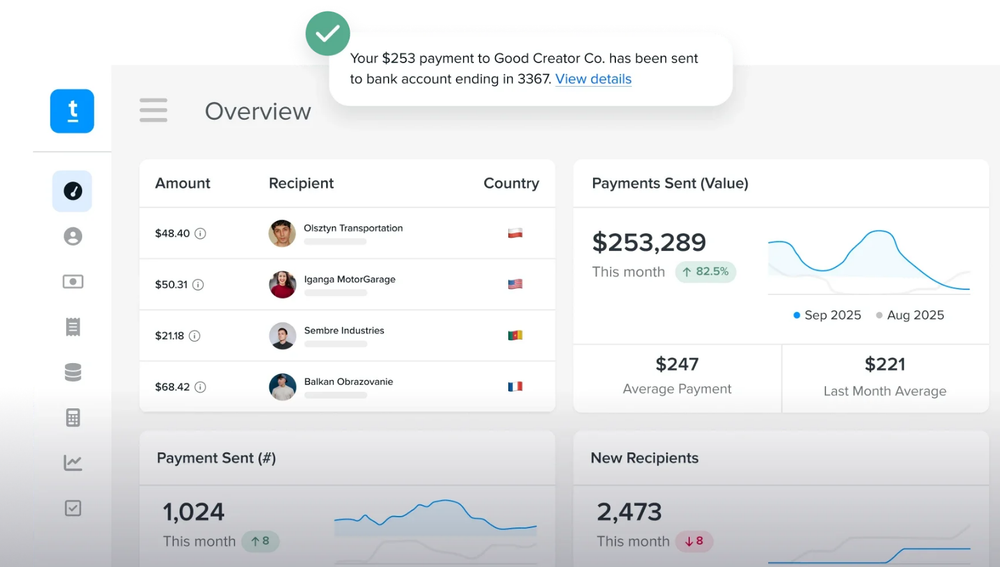
Best for: Global platforms that want to embed payouts alongside tax and identity compliance
Trolley is a global payout platform with APIs, SDKs, and an iframe widget for embedding payouts into your own product.
Platforms can use its developer tools to build recipient onboarding and payout management into their existing experience, while triggering payments and automating payout workflows through Trolley's API.
Global coverage is one of Trolley's biggest strengths. It supports payouts across 210+ regions in 135 currencies with methods like bank and wire transfers, PayPal, Venmo, debit-card payouts, local mobile wallets, virtual accounts, and checks – but availability varies by market.
Trolley's platform also includes Tax for collecting tax information, withholding, reporting, and e-filing, plus Trust for embedded identity and business verification.
- Pricing: Trolley Pay starts at $2,399/year plus transaction fees, while Tax and Trust are separately priced products. Enterprise features and multi-jurisdiction tax compliance sit under the custom-priced Trolley Plus plan.
3. Stripe Connect
Best for: Marketplaces and platforms already using Stripe for payments
Stripe Connect is Stripe's payout infrastructure. It lets platforms onboard and verify connected accounts, accept payments for them, route funds between multiple parties, and pay out their earnings.
The same integration can power online and in-person payments, subscriptions, tax automation, fraud protection, and other Stripe products.
Stripe Connect offers global payout coverage, letting platforms pay recipients around the world through a single integration – although supported payout methods, currencies, and availability vary by country.
Platforms can also monetize payments through their own markups or revenue share, as well as through features such as Instant Payouts.
For payees, Stripe supports scheduled payouts alongside manual and Instant Payouts, while embedded components can surface balances, payout history, payout schedules, and payout-account management within your platform.
- Pricing: Stripe Connect has two pricing models:
- If Stripe handles pricing, platforms pay no additional Connect account or payout fees, although standard Stripe payment processing fees still apply.
- If you handle pricing, US pricing is $2 per monthly active account + 0.25% + $0.25 per payout, on top of payment processing. Instant Payouts add 1%, while cross-border payouts start at 0.25% of payout volume.
4. Dots
Best for: Vertical SaaS platforms embedding white-label global payouts
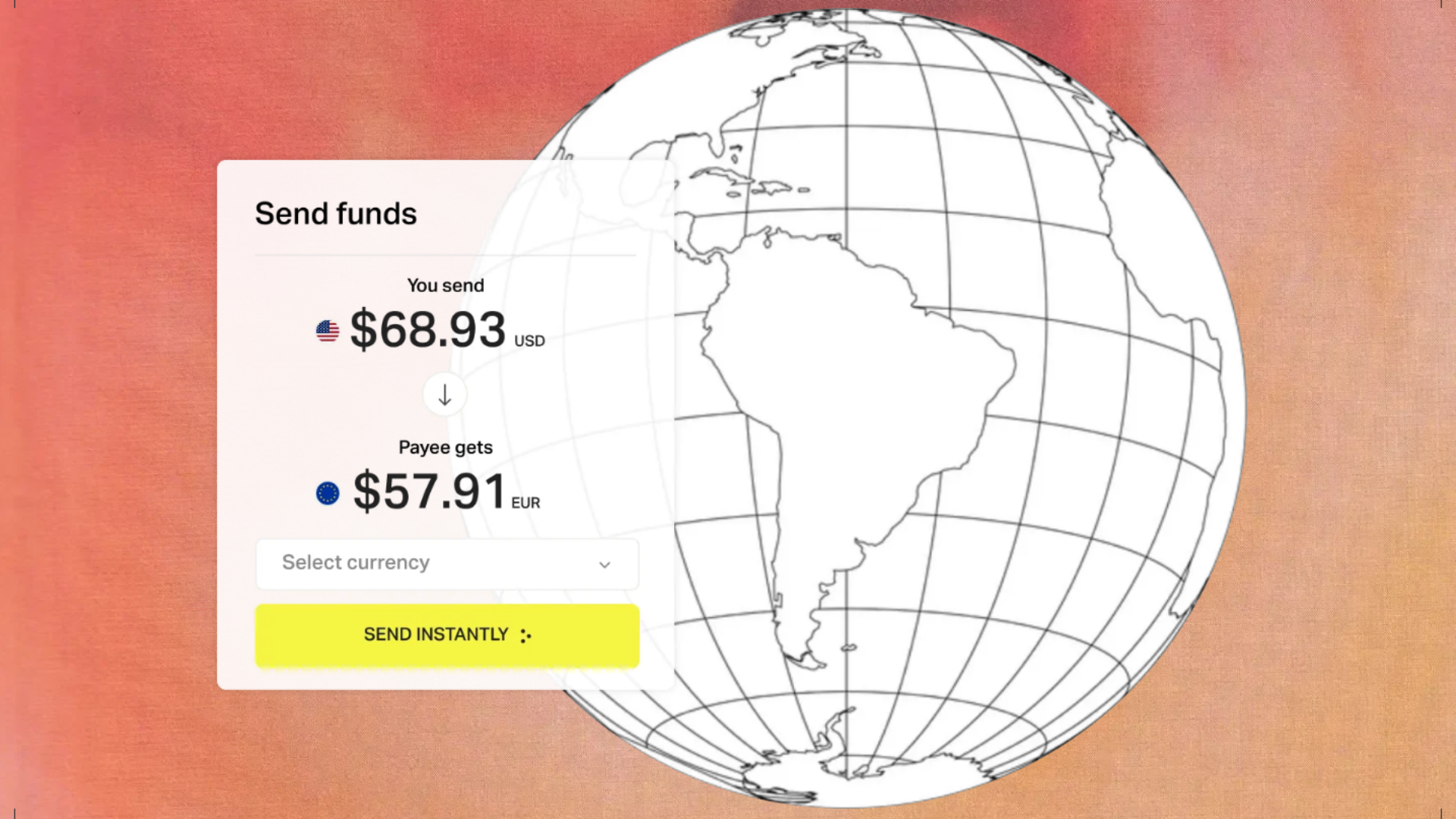
Dots lets platforms embed payouts directly into their product using its Payouts API and embedded recipient flows. The API handles payout creation and automation, while the embedded experience can collect the recipient information needed to complete payouts and compliance checks, keeping the payout flow inside your platform.
Coverage supports 300+ payout rails across 190+ countries, including local and real-time methods such as RTP, FedNow, UPI, PIX, and SEPA Instant.
Dots' API can support custom payout logic and more complex money movement, including splits, holds, reserves, clawbacks, and marketplace fees. It also handles identity verification, sanctions screening, tax-form collection and reporting.
- Pricing: Dots 'Scale' costs $999/month – this is the relevant tier for embedded payouts, with API access, white-labeling, and wallets included. Transaction fees vary by payout method and destination.
5. MassPay
Best for: High-volume marketplaces that prioritize payout reach and flexibility over self-serve pricing
MassPay is a global payout orchestration platform that marketplaces can integrate through its REST API and SDKs.
Rather than providing a drop-in payout interface, MassPay provides the underlying infrastructure for your platform to build payouts into your own product, including user creation, KYC, wallet balances, payout initiation, and payout tracking.
Coverage spans 180+ countries, with real-time payment methods such as FedNow, SEPA Instant, and Faster Payments. It can also send payments to wallets (including PayPal, Venmo, M-Pesa, and GCash), facilitate local bank deposits, cash pickup, checks, and crypto and stablecoin payouts.
Availability varies by country, currency, payout method, and recipient type.
MassPay also embeds the compliance infrastructure behind those payouts, including sanctions screening, W-8 and W-9 collection and validation, TIN matching, and jurisdiction-specific payout rules.
- Pricing: MassPay doesn't publish standard marketplace pricing. Pricing is customized based on the payout program, so you'll need to contact MassPay for a quote.
6. Tipalti
Best for: Businesses paying large global partner networks on a schedule, where AP automation and tax compliance matter
Tipalti is primarily accounts payable (AP) automation software with invoices, approvals, and supplier payments, but it also offers a mass payments product for paying partners, creators, and affiliates at scale.
The scale is real: per Tipalti, it pays out to 200+ countries and territories in 120 currencies across 50+ payment methods, with a KPMG-approved tax engine handling W-9/W-8 collection, 1099 and 1042-S preparation, and DAC7 reporting.
Payees onboard through a branded self-service portal, which can be embedded in your site as an iframe.
But while Tipalti embeds onboarding, and its Payout API lets platforms trigger disbursements programmatically, payments go out when the business runs them (rather than recipients withdrawing an in-product balance on their own terms).
- Pricing: Mass Payments plans start at $249/month, with per-transaction fees on top.
How to choose an embedded payouts provider
Choosing the right embedded payouts provider means thinking about where your recipients are, how they want to get paid, what you want the provider to handle, and what you're prepared to spend.
Think about coverage
Start with where your recipients are actually located, rather than the biggest country count on a provider's homepage.
A platform might advertise global payouts while supporting only certain currencies, payout methods, or recipient types in individual markets.
Check the specific countries you need today (and those you're likely to expand into), then look at whether recipients can settle in their local currency. It's also worth checking whether payouts are sent via local rails or if they require more expensive cross-border transfers.
Consider available payout methods
Bank transfers are the baseline, but your payees might expect instant bank payments, debit-card payouts, PayPal or Venmo, mobile wallets, cash pickup, or stablecoins.
More methods aren't automatically better, either. Look for methods your recipients will actually use in each market, how quickly funds arrive, and what they cost.
Check whether the provider can automatically route payouts across different rails or whether your team needs to manage that logic.
Look at built-in compliance
Embedded payouts come with identity verification, sanctions screening, tax collection, and different regulatory requirements depending on where you're sending money.
Compare how much of that work each provider actually takes on.
Some can embed KYC/KYB and tax-form collection directly into recipient onboarding and handle ongoing screening and reporting; others give you APIs but leave more of the compliance workflow to your team.
Weigh up fees
Your total cost can include a monthly platform fee, per-recipient or per-payout charges, FX markups, instant-payout fees, international transfer fees, tax services, and charges for particular payout methods.
Pricing transparency varies significantly too. Some providers publish their platform and transaction fees, while others require a sales call and custom quote.
At higher volumes, custom pricing may work in your favor – but no public baseline makes costs harder to compare before integrating.
Assess provider authority and experience
Moving money to thousands of recipients across different countries isn't a feature you want to test solely on the strength of an API demo.
Look for evidence that the provider already supports businesses similar to yours: marketplace or platform customers, published case studies, meaningful payout volume, established banking and payment-rail relationships, and experience operating across the markets you're entering.
Embed payouts directly into your product with Whop
Embedded payouts work best when they act like part of your product, not another service users have to sign up for and navigate separately.
Whop gives platforms the infrastructure to create each payee their own connected account and use embedded components to handle identity verification, payout-method setup, and withdrawals inside your platform.
You can pay recipients across 241+ countries and territories, surface their available payout methods and live fees, and track each payout through to completion with webhooks.
And because Whop powers the payment side too, you can accept customer payments, route earnings to the right accounts, take your platform fee, and let recipients withdraw. No need for separate payment and payout systems.
Embedded payout FAQs
What's the difference between embedded payouts and a payout API?
A payout API is a way to send money programmatically. Embedded payouts are the whole experience, including recipient onboarding and verification, payout methods, balances, and tracking, built into your product.
Most embedded payout providers offer APIs, but an API alone leaves compliance, tax, and the recipient experience to you.
What's the difference between embedded payouts and mass payouts?
Mass payouts push a batch of payments from a back office and a finance team runs them on a schedule. Embedded payouts live in the product. Recipients see their balance, choose a method, and withdraw on their terms. Mass payout tools suit supplier payments; embedded payouts suit marketplaces, creator platforms, and gig work.
How much does it cost to offer embedded payouts?
Pricing varies by provider and usually combines per-payout fees, method premiums (instant costs more than standard), and FX margins on cross-border payments. Some providers let platforms pass fees to recipients or add their own margin, which can turn payouts from a cost into a revenue stream.
How fast are embedded payouts?
It depends on the payout method. Instant options like RTP or push-to-card can deliver funds in minutes, while standard bank transfers such as ACH typically take one to a few business days. Cross-border payouts can take longer, depending on the destination country and currency conversion.
Do platforms need a money transmitter license to pay out users?
It depends on whether the platform ever takes possession of the funds. Most platforms use an embedded payout provider precisely so they don't hold money: the provider or its banking partners hold the funds, and the platform directs where they go.
Who handles 1099s for marketplace sellers?
Tax reporting obligations sit with whoever the rules define as the reporting party, which depends on how payments flow. In practice, embedded payout providers typically collect W-9/W-8 information during onboarding and generate the required 1099 forms for the payouts they process, so the platform isn't building tax reporting in-house.