Compare 14 global payout platforms for cross-border payments in 2026, from Wise and Payoneer to Whop, Stripe, and Trolley.
Key takeaways
- Global payout platforms handle local rails, FX, and compliance, so you skip opening banking relationships in every country.
- No platform wins outright; pick based on country coverage, tax compliance automation, and engineering effort.
- Embedded payouts keep balances, withdrawals, and KYC inside your product, improving recipient experience and retention.
The best global payout platforms for cross-border payments include Whop, Wise, Payoneer, Stripe Connect, and more, each built for a different mix of coverage, compliance, and integration effort.
If you're looking for a global payout platform, then you're probably past the point of wiring one contractor at a time. You've got sellers, creators, or affiliates in multiple countries, and you need a reliable way to pay all of them without investing the time (and money) into building that infrastructure yourself.
That's what a global payout platform does. It's the infrastructure that handles outbound payments at large scale: local rails, currency conversion, compliance, and delivery into a bank account, wallet, or card. You get all of that without opening banking relationships in every country you pay into.
In this guide, we're comparing the top global payout platforms for marketplaces, platforms, SaaS, apps, and affiliate networks.
Quick answer: the top global payout platforms
| Platform | Best for | |
|---|---|---|
| 1 | Whop | Marketplaces, platforms, and apps wanting checkout, payouts, and 1099 compliance in one stack |
| 2 | Wise | SMBs and startups wanting simple, transparent payouts, plus an enterprise option for banks and larger platforms |
| 3 | Payoneer | Marketplaces and platforms paying large numbers of freelancers, sellers, or contractors |
| 4 | Stripe | Developer-led platforms wanting payments infrastructure they can build on |
| 5 | Airwallex | Growth-stage platforms wanting payouts bundled with multi-currency accounts and FX |
| 6 | Adyen | Enterprise platforms wanting payments and payouts on Adyen's own licenses |
| 7 | ConnectPay | Platforms based in Europe, or paying recipients across Europe |
| 8 | Tipalti | Finance teams running high-volume accounts payable |
| 9 | Trolley | Creator platforms, marketplaces, and contractor networks needing payouts plus tax compliance |
| 10 | Nium | Banks, fintechs, and large platforms building real-time payout infrastructure |
| 11 | Thunes | High-volume enterprises and marketplaces needing reach into emerging markets |
| 12 | PayPal Enterprise Payouts | Marketplaces and enterprises wanting the widest range of payout methods |
| 13 | MassPay | Creator platforms, direct selling organizations, and affiliate programs wanting a white-labeled, hands-on experience |
| 14 | Dots | Marketplaces, gig platforms, and creator tools wanting fast developer integration |
Embedded payouts let a platform pay its sellers, creators, or contractors directly inside its own product, instead of redirecting them to a third-party site to manage payments.
The payout experience – balance, withdrawal, payment method, status – lives inside the platform's own interface, usually via pre-built components or an API, while a payments provider handles the money movement, compliance, and infrastructure behind the scenes.
14 best global payout platforms
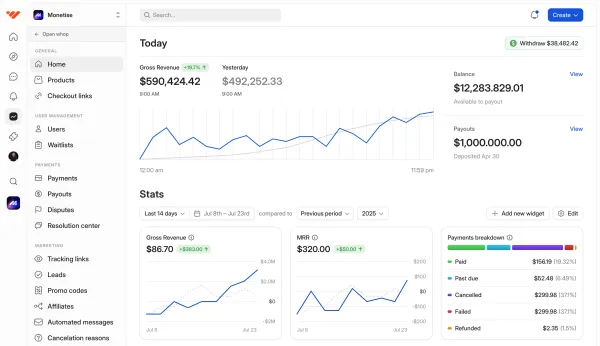
1. Whop
Best for: Marketplaces, platforms, and apps that want checkout, payouts, and 1099 compliance running on one unified stack.
With Whop, you get one integration instead of having to use separate checkout and payout providers.
On the payouts side, you can pay recipients across 241+ countries and territories using bank deposit, crypto, Venmo, Cash App, or PayPal. Your recipients choose which method works for them, rather than being locked into one option.
Instant payout options (a few minutes) are available in most countries. You don't have to manage KYC or tax compliance yourself either: identity verification, tax calculation, collection, and remittance are all handled for you.
Using the payout API, you can onboard connected accounts programmatically and let them complete KYC and manage payouts through a pre-built portal you embed in your own app, without building that onboarding flow yourself.
That's all layered on top of the wider stack: 100+ local payment methods on the checkout side and built-in BNPL.
If you're running a gig or contractor platform, Whop also pairs those payouts with 1099 compliance handled automatically.
Pros:
- Unified stack: Checkout, payouts, affiliate commissions, and 1099 compliance run through one provider instead of three
- Wide payout method coverage: Bank deposit, crypto, Venmo, Cash App, and PayPal, with recipients choosing their own method
- Built-in payout API: Onboard connected accounts and let them handle KYC and withdrawals through a pre-built portal, without building that flow yourself
Cons:
- Not a payroll tool: No fit for businesses whose only need is standalone W-2 payroll
Whop is the best choice if you want payments, payouts, contractor/gig compliance, and a payout API to onboard connected accounts all running through a single provider.
2. Wise (Wise Platform/Business)
Best for: SMBs and startups wanting the simplest, most transparent cross-border payouts, plus a heavier-duty option for banks and larger platforms.
Wise built its reputation by actively fighting against the hidden exchange rate margins charged by traditional banks.
Wise Business is the self-serve option: you sign up, upload recipient details via CSV or use BatchTransfer to pay up to 1,000 contractors at once, and 96% of payments arrive within a day. So if you're paying a batch of freelancers, suppliers, or customers, then you can do it in one go without touching each transfer individually.
Wise Platform is the enterprise version. Banks and larger platforms integrate directly via API instead of using the standard account, reaching 160+ countries and 40+ currencies with 77% of payments settling in under 20 seconds.
Payouts mostly go out via bank transfer, though some corridors support local wallets too, like GCash in the Philippines or M-Pesa in Kenya.
Pros:
- Two ways to pay out: Self-serve Wise Business for SMBs, full API access through Wise Platform for banks and enterprises
- Low fees: FX pricing is transparent, using the real mid-market rate
- Fast settlement: Most transfers complete within an hour, many instantly
Cons:
- Business coverage isn't clearly published: Wise doesn't state a specific country/currency count for Business payouts the way it does for Platform
- No automated tax reporting: You're responsible for collecting W-9/W-8 forms and filing 1099s yourself. Wise provides templates and guidance, not automation.
Wise remains one of the strongest global payout solutions for businesses prioritizing cost efficiency and settlement speed, whether you need the self-serve version or the full infrastructure play.
3. Payoneer
Best for: Marketplaces and platforms paying large numbers of freelancers, sellers, or contractors worldwide.
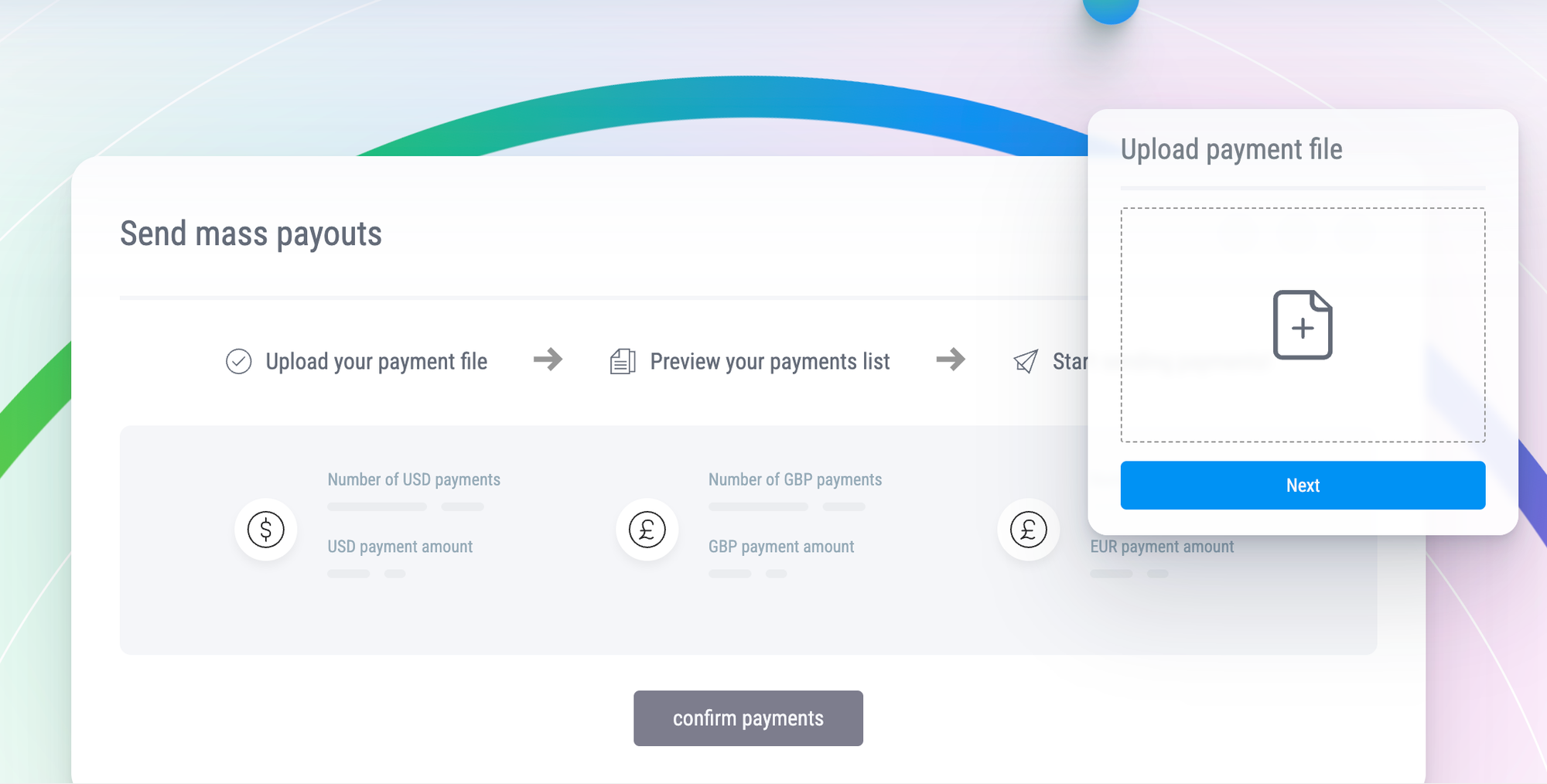
Payoneer's Mass Payouts product is built specifically around paying marketplace sellers and freelancers at volume. You fund one payment run and send it to payees across 190+ countries and 70+ currencies, holding balances in up to 30 currencies before converting.
Setup is simple: you embed Payoneer's signup page into your platform (or send payees a signup link), fund the account by bank transfer, then trigger payments via API call or by uploading a CSV. Your recipients get paid into their Payoneer account, local bank account, or e-wallet. Payments to Payoneer accounts land within minutes, while bank transfers take up to 3 business days.
The biggest advantage here is Payoneer's existing user base: 5 million sellers, freelancers, and contractors already have accounts, so a big share of your recipients may not need to onboard at all.
Pros:
- Built-in reach: 5 million existing users mean many of your recipients already have an account
- Fast for existing users: Payoneer-to-Payoneer payments arrive within minutes
Cons:
- Bank transfer lag: Non-Payoneer recipients wait up to 3 business days
- Fees stack up at the edges: Currency conversion carries a markup, and paying non-Payoneer users costs more
Payoneer is the strongest fit when your recipients are already inside its ecosystem.
4. Stripe Connect Payouts & Stripe Global Payouts
Best for: Developer-led platforms that want payments infrastructure they can build on, not a ready-made global payout network.
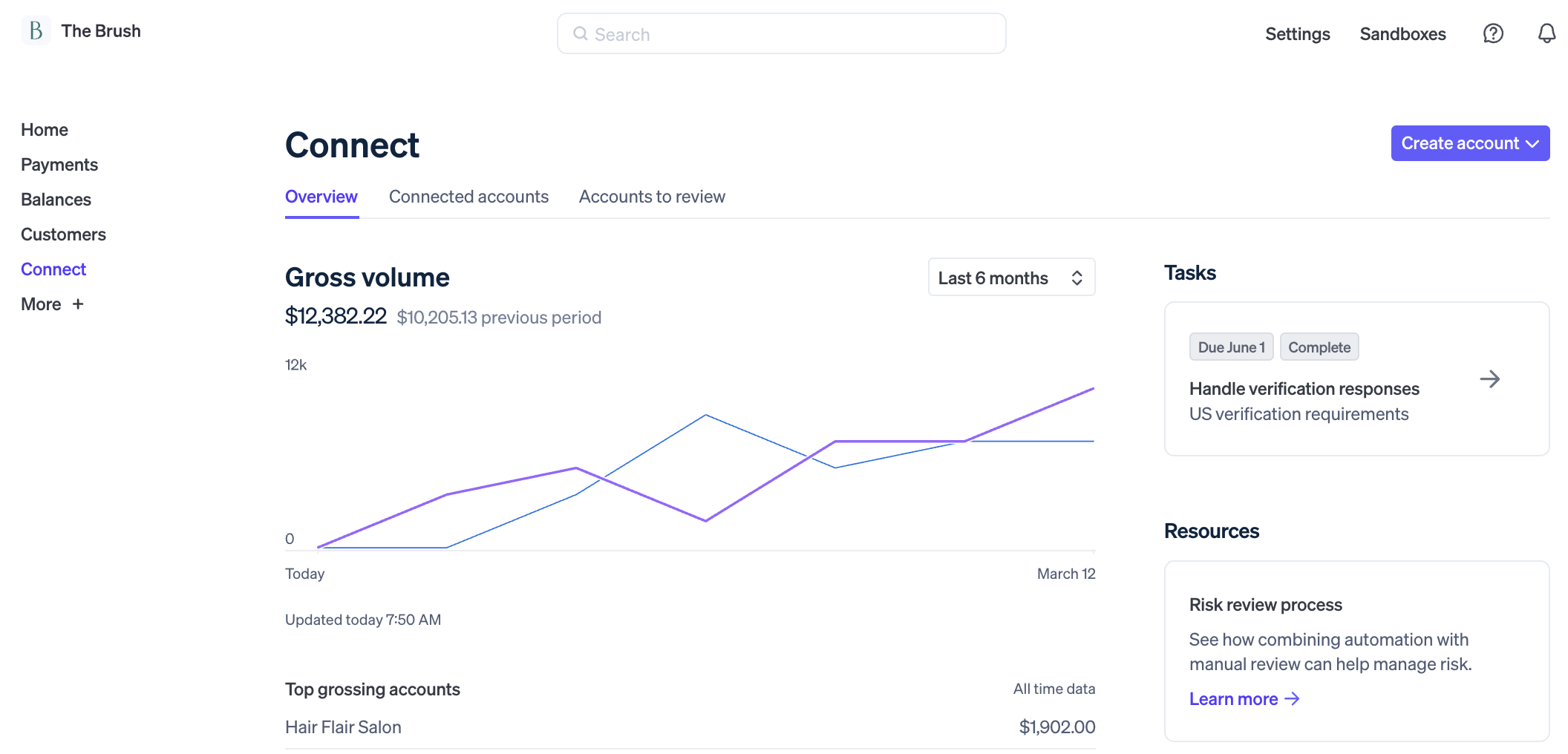
Stripe actually splits cross-border payouts into two distinct products, and which one applies depends on your setup.
If you're running a Connect marketplace, Stripe Connect's cross-border payouts let you pay connected accounts, but coverage is less than you might expect: both the platform and the connected account have to be based in the same set of five regions – the US, UK, EEA, Canada, or Switzerland. A UK platform can pay a US seller, a German platform can pay a Canadian seller, and so on, but a US platform can't use this product to pay a seller in Brazil or India (for example).
Stripe doesn't support self-serve cross-border payouts outside that group of five regions, so anything beyond it means contacting sales. Still, Stripe does absorb the legal and compliance burden through its own Money Transmitter license, and the fee is a flat 0.25% per payout, waived entirely for UK–EEA or intra-EEA transfers.
If you want more reach or want to decouple payments from payouts, Global Payouts is the separate, newer product (currently in public preview) that sends money to 160+ countries using multiple payment methods, with no Connect account required.
TL;DR: Connect is great for marketplaces that exclusively use Stripe as a payment processor, franchises, and global financial services and insurance platforms. Global Payouts is best for insurance claim payouts, fintech salaries, rewards, affiliate payouts, and marketplaces that use multiple payment processors.
Pros:
- Two products for two needs: Connect for bundled payments-and-payouts with compliance absorbed by Stripe, or Global Payouts for standalone, email-based payouts to a broader set of countries
- No Connect account required for Global Payouts: Pay any third party directly by email, without full onboarding
Cons:
- Connect's cross-border reach is narrow: Recipient reach is capped at the same five regions as the platform (US, UK, EEA, Canada, Switzerland).
- Global Payouts is still in public preview: Not yet a fully mature, generally available product
Stripe is the right call if you have engineering resources and want to build your payout experience on solid infrastructure, but it's worth knowing upfront which of its two products actually fits your reach and setup.
5. Airwallex
Best for: Growth-stage platforms wanting payouts bundled with multi-currency accounts and FX in one suite.
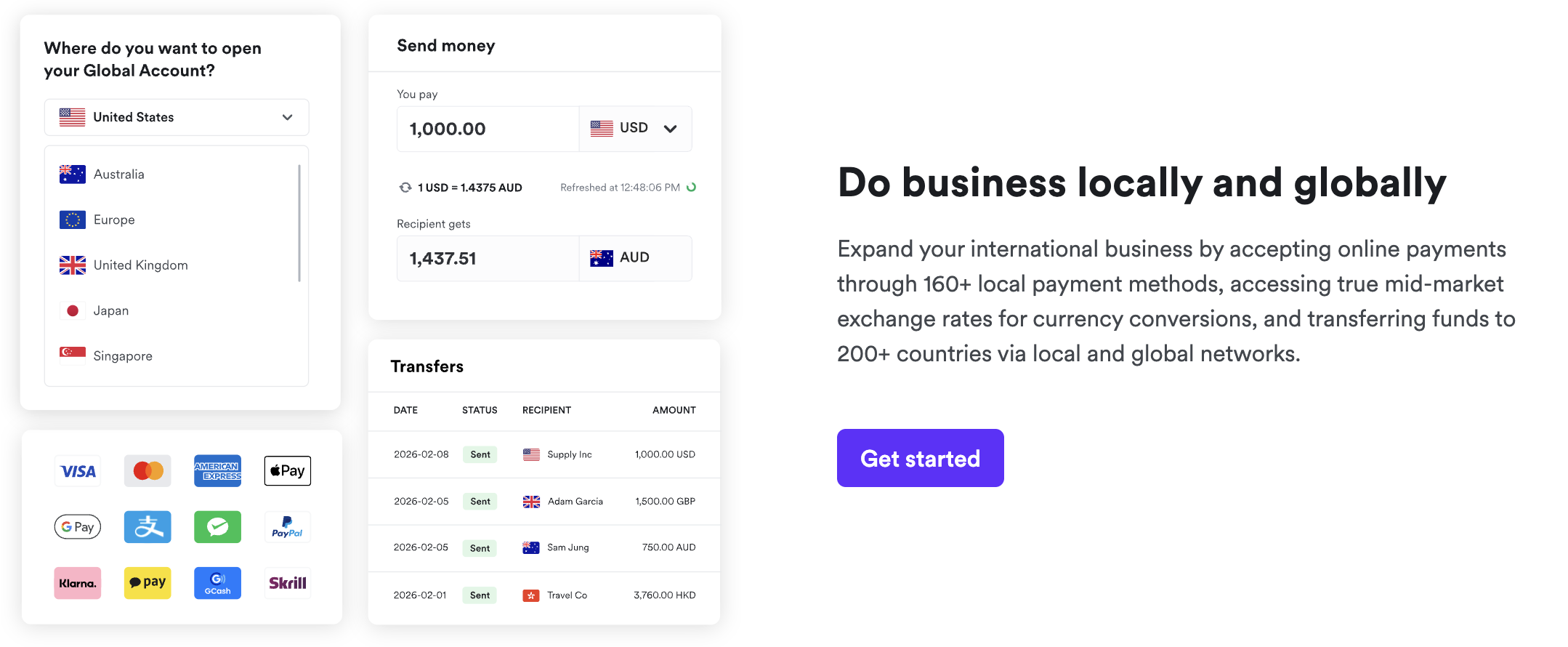
Airwallex payouts run on two rails with different reach and speed: local payouts cover 100+ countries and regions (arriving in as little as one business day) and SWIFT payouts which reach a broader 200+ countries and regions, but move slower and carry more intermediary bank risk.
You can also pay out instantly to digital wallets, and to other Airwallex account holders directly, without touching a bank at all. PayPal is also on the roadmap, but it's currently in early access/beta, supporting USD, GBP, and EUR, with instant delivery.
On compliance, Airwallex handles 1099-NEC filing for US contractor payouts over $2,000/year: it collects W-9/W-8 forms through an embeddable component, tracks completion status, and files directly to the IRS, with downloadable PDFs for your records.
State filing is covered for states in the Combined Federal/State Filing Program, but outside those, you'd file directly yourself.
Pros:
- Two-tier rail coverage: 100+ countries via fast local clearing, 200+ via SWIFT as backup
- Multiple payout destinations: Bank accounts, digital wallets, instant Airwallex-to-Airwallex transfers, and PayPal in early access
Cons:
- State tax filing isn't fully covered: Only states in the Combined Federal/State Filing Program are handled automatically
- PayPal support isn't fully live yet: Early access/beta only, limited to three currencies
Airwallex is a strong fit for platforms wanting the full suite of accounts, FX, and payouts in one place.
Local rails route a payout through a country's own domestic banking network, so it lands like an internal transfer, i.e. faster and usually cheaper. SWIFT routes it through a global network of correspondent banks instead, which reaches more places but takes longer and risks a cut being skimmed off in transit.
6. Adyen
Best for: Enterprise platforms wanting payments and payouts on Adyen's own licenses.

Like Stripe, Adyen splits payouts into two products.
Paying third parties who aren't onboarded with Adyen, like a supplier, reaches 190+ countries, with instant, 24/7 payouts in 40+ of them.
Onboarding your own sellers or contractors as account holders (Adyen for Platforms) is more limited: about 39 countries, with payouts settling in 1–2 days rather than instantly.
With Adyen for Platforms, Split payments handle commissions automatically at the point of sale, and CashOut offers instant access to pending balances – though it's still in pilot and needs setup with your Adyen contact.
Pros:
- Two options for two needs: Broad, instant payouts to third parties, or licensed onboarding and payouts for your own sellers
- Automated commission splitting: Happens at the point of payment on Adyen for Platforms, no manual transfer
Cons:
- Onboarding your own sellers: Limited to ~39 countries
- Speed costs extra either way: Faster priority payouts or CashOut both come with added fees
- Requires an Adyen contact: Payout schedules and CashOut both need direct setup, not self-serve
Whether you're paying third parties directly or onboarding your own sellers, Adyen keeps payouts on the same licensed rails as your payment processing.
7. ConnectPay
Best for: Platforms based in Europe, or paying recipients across Europe, that want banking infrastructure bundled with payouts, not just a payout add-on.
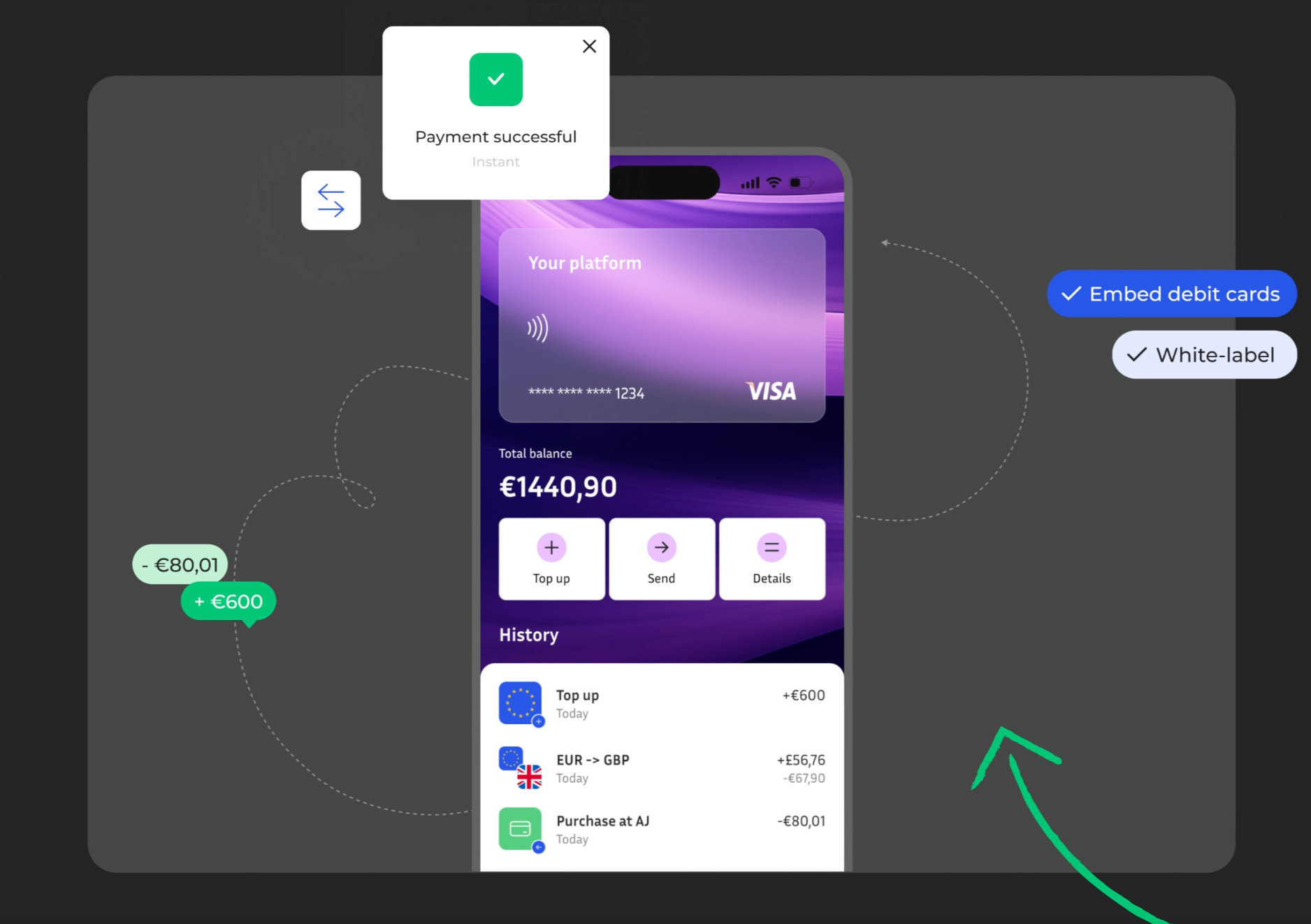
ConnectPay is built for platforms and marketplaces specifically, not solo freelancers or one-off senders. If you're paying out sellers, contractors, or creators across Europe, ConnectPay's API automatically opens an individual IBAN account for each new payee, rather than routing everyone through one shared account.
You can pay out through SEPA, SEPA Instant, or SWIFT, with IBAN accounts supporting 80+ currencies and SWIFT reach into 180+ countries.
As a licensed European EMI (Electronic Money Institution), ConnectPay also handles the regulatory side for you. KYC onboarding, AML/CTF monitoring, and regulatory reporting all run through the same platform.
Pros:
- Individual IBANs at scale: Each recipient gets their own account automatically, not a shared pool
- Compliance built in: KYC, AML/CTF, and regulatory reporting handled as part of the platform, not bolted on
Cons:
- European-first infrastructure: ConnectPay's own positioning is explicit that compliance infrastructure is optimized for European entities specifically
- Not a self-serve signup: Onboarding takes days and depends on document readiness and business risk category
ConnectPay is a fair choice for platforms, not individuals, paying out recipients concentrated in Europe.
8. Tipalti
Best for: Finance teams running high-volume accounts payable who want global payouts handled in the same system, not a separate tool.
A quick terminology note: Tipalti's own site calls this feature 'global payments,' but it's describing the same thing as everywhere else on this list: money going out to suppliers, contractors, freelancers, or affiliates, not money coming in from customers.
Tipalti reaches 200+ countries and territories in 120+ currencies, with 50+ payment methods available to choose from.
Payees manage themselves through a self-service branded portal, submitting tax forms, choosing how they want to get paid, and tracking payment status without your team fielding those questions manually.
Fee-splitting nudges payees toward cheaper payment methods, and 26,000 built-in validation rules catch errors before a payment goes out rather than after.
Pros:
- Payee self-service: Tax forms, payment method selection, and status tracking happen in a white-labeled portal, not through your support team
- Error prevention at scale: 26,000 rules validate payments before they're sent
Cons:
- Pricing isn't published: Both plan tiers are custom-quoted, so you'll need to talk to sales to get an actual price, rather than seeing costs upfront
- Built for volume, not simplicity: The AP-plus-payout combination adds more moving parts than a business only needing simple payouts
Tipalti fits finance teams already managing invoice-heavy AP who want payouts folded into that same workflow, rather than running two separate systems.
9. Trolley
Best for: Creator platforms, marketplaces, and contractor networks that need payouts and recipient tax compliance handled together.
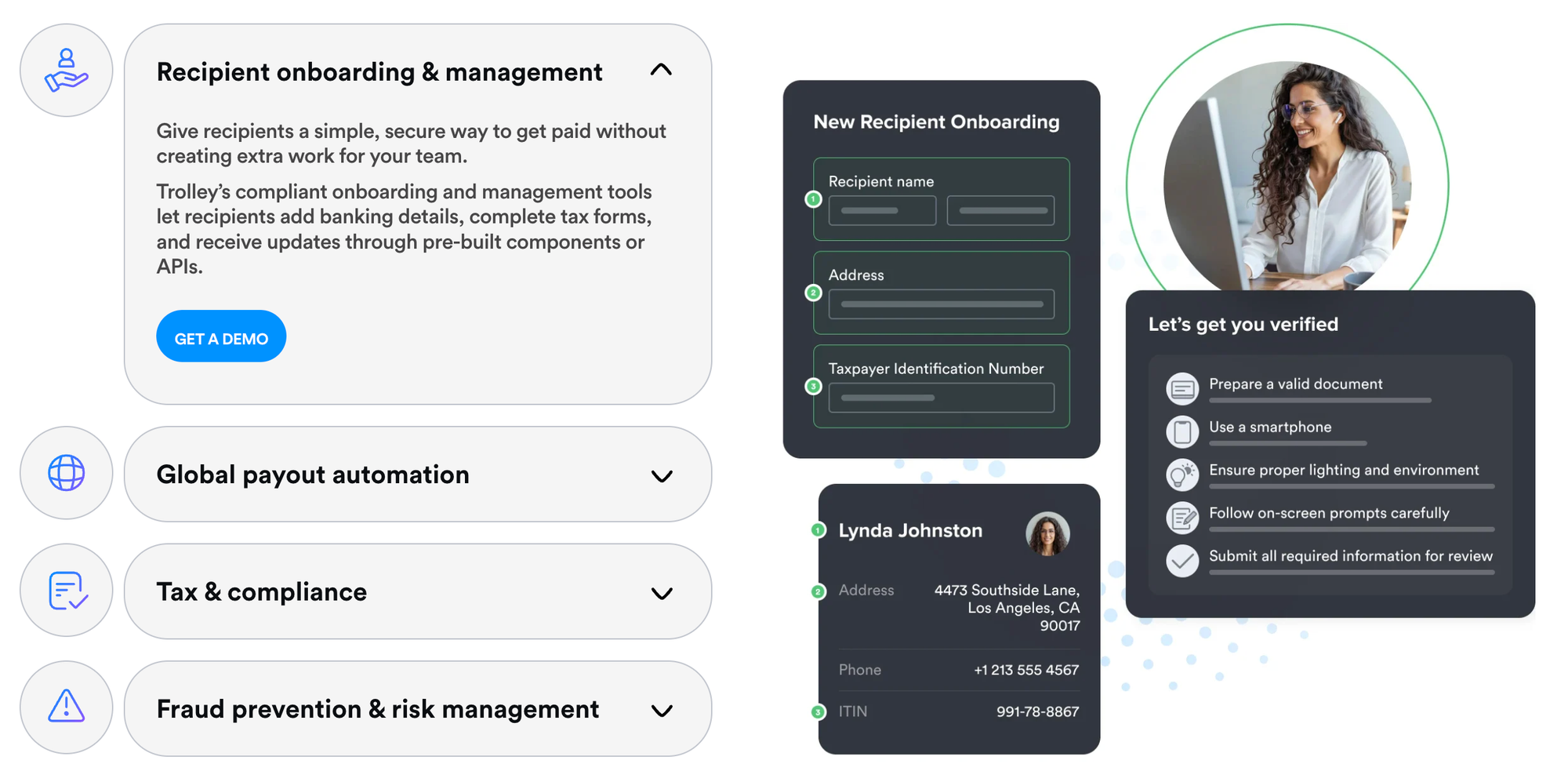
Trolley pays out to 210+ countries and territories in 135+ currencies to bank accounts, e-wallets, Venmo accounts, or even directly to a mailbox as a paper check. Recipients self-register through pre-built components or APIs, adding banking details, completing tax forms, and tracking payment status without your team fielding those requests manually.
On the compliance side, with Trolley you get US IRS reporting, EU DAC7 compliance and OECD Digital Platform Reporting for the EU, UK, Australia, and New Zealand (broader regulatory coverage than most payout-specific competitors offer in one platform).
Pricing is modular: Trolley's core payout engine (Pay) and its compliance tools (Tax) are priced as separate components, along with additional modules, rather than one flat plan.
Pros:
- Recipient self-service: Payout method selection, tax forms, and identity verification happen without manual follow-up from your team
- Broad compliance coverage: IRS, DAC7, and OECD Digital Platform Reporting all handled in one platform
Cons:
- Modular pricing: Core payouts and tax compliance are priced as separate components, so total cost depends on which modules you need
- Built specifically for the 'internet economy': Optimized for creators, freelancers, and platform-based contractors rather than traditional enterprise AP use cases
If DAC7 or OECD reporting is part of your compliance picture, Trolley bundles that directly into the payout flow rather than making you solve it separately.
10. Nium
Best for: Banks, fintechs, and large platforms needing real-time payout infrastructure to build on, rather than a ready-made consumer product.
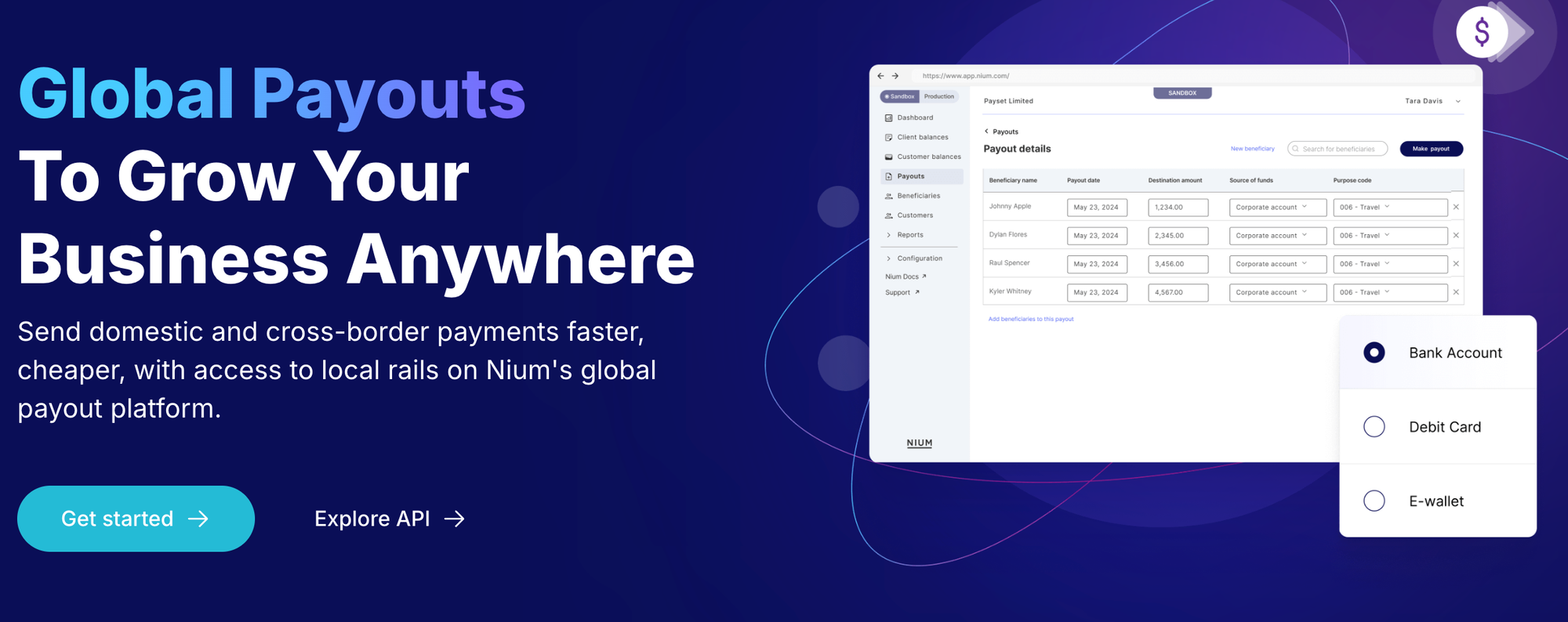
Nium's payout network reaches 190+ countries, with real-time settlement available in 100+ of those. Payouts can land in a bank account, card, digital wallet, or cash pickup depending on the country.
Nium holds 40+ regulatory licenses directly, rather than routing compliance through a third-party partner, and claims a 99% payout success rate using real-time account verification instead of the older penny-drop method.
You can integrate through the API for full control, or use the no-code Nium Portal if you don't have engineering resources to build a custom integration.
Pros:
- Direct licensing: 40+ regulatory licenses held by Nium itself, not inherited from a third party
- No-code option: The Nium Portal covers teams without engineering resources, alongside the full API for those who have them
Cons:
- Built for infrastructure buyers: Positioned toward banks, fintechs, and large platforms rather than a quick self-serve signup for smaller businesses
Nium is a good choice if you're building your own payout product on top of real-time infrastructure, not if you want a simple, ready-made payout tool.
11. Thunes
Best for: High-volume enterprises and marketplaces needing payout reach into harder-to-access emerging markets.
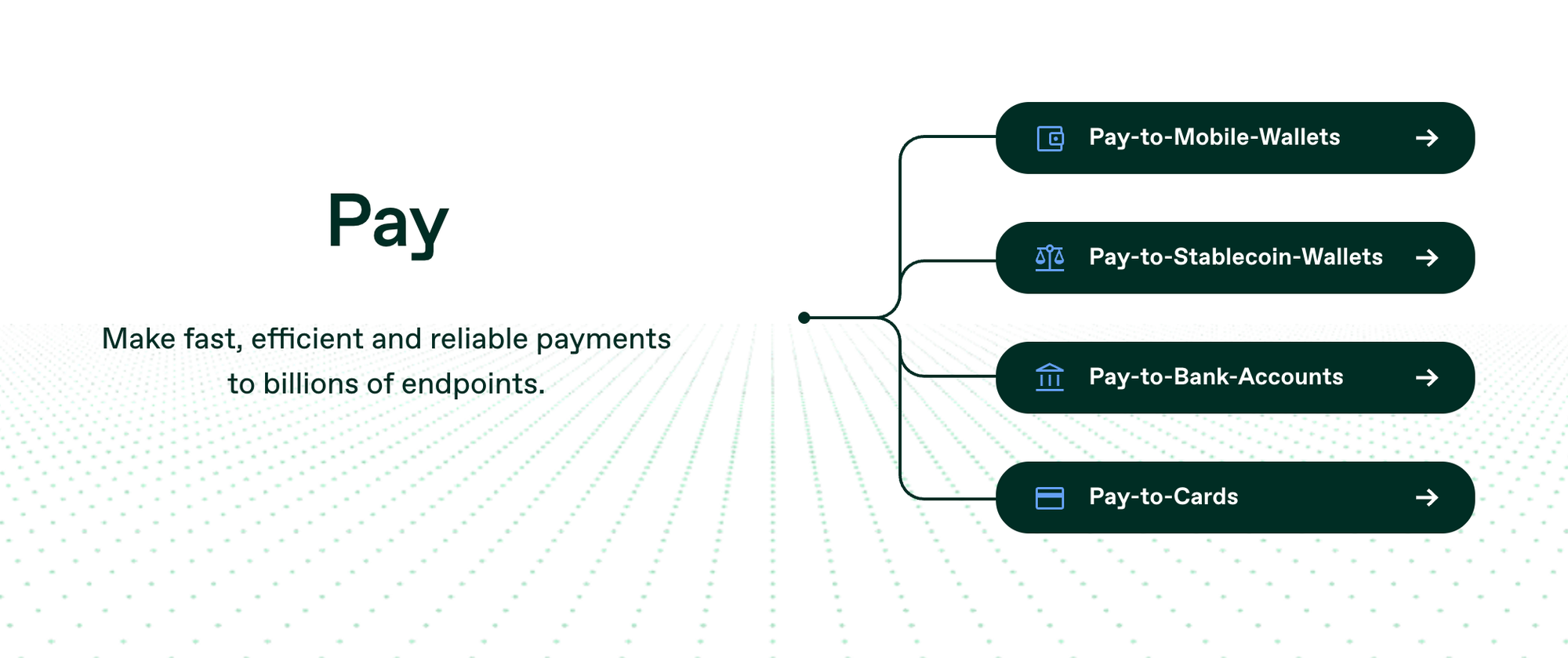
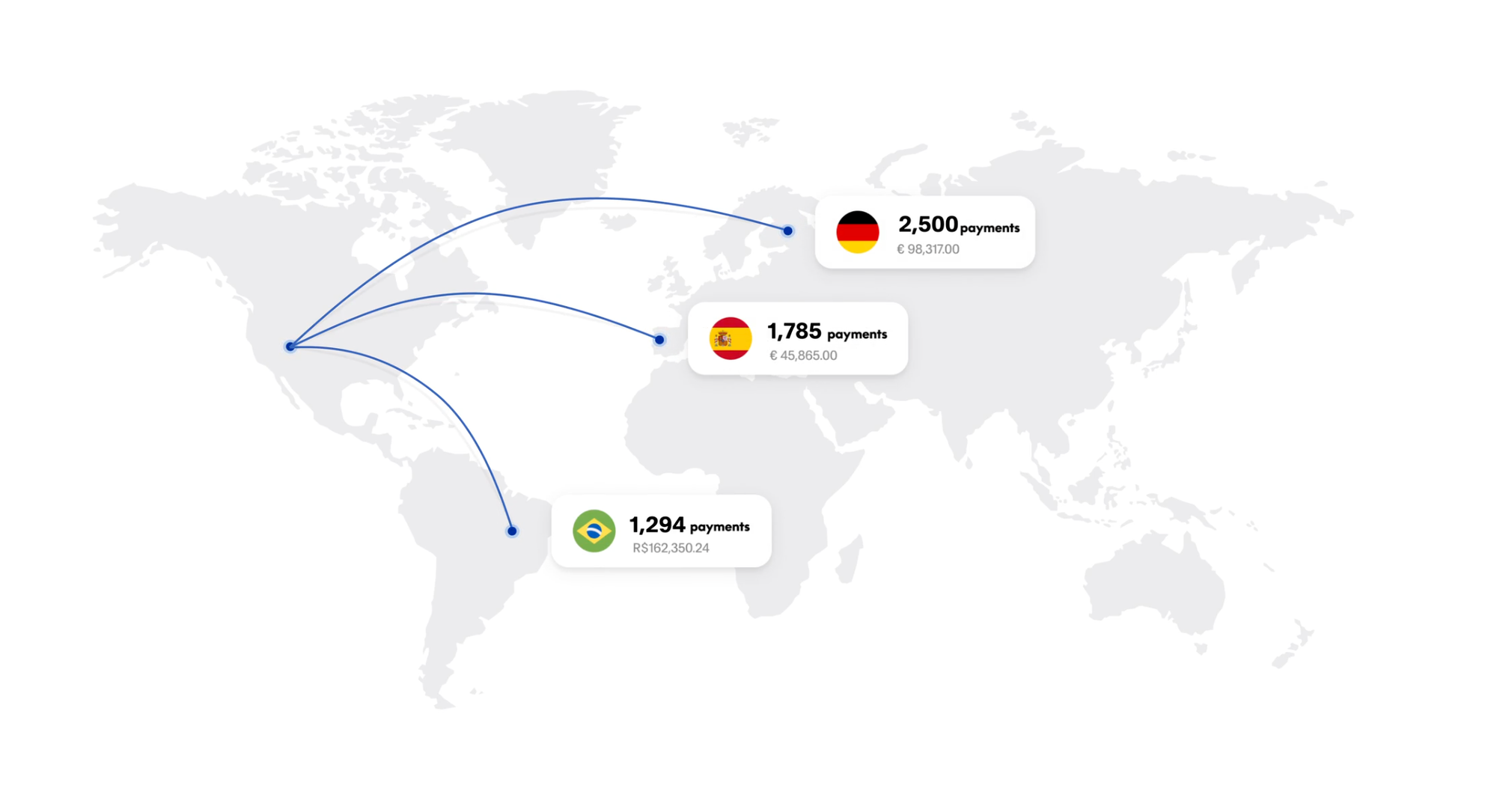
Thunes reaches 140 countries and 90 currencies, connecting to over 8 billion bank accounts, 4 billion mobile wallets, and 15 billion cards.
Why does this matter? Most payout providers rely on chains of correspondent banks to reach harder-to-access markets, which can add delays and fees along the way. Thunes’ Direct Global Network is designed to skip those intermediaries, making cross-border payouts faster and more direct.
Setup takes a few weeks, and Thunes assigns you a dedicated team to help with the integration, rather than leaving you to figure out the technical side alone.
Pros:
- Reaches harder markets: Better coverage in emerging markets than most competitors, because it skips the usual chain of middleman banks
- Owns its own licenses: Fewer points of failure than platforms relying on a third party's compliance
Cons:
- Overkill for small or occasional payouts: Built for businesses sending a high volume of payments regularly, not a one-off transfer
- No published pricing: You'll need to contact them directly for a quote
Thunes is worth considering specifically if a meaningful chunk of your recipients are in countries where other payout platforms are slow, unreliable, or don't reach at all.
12. PayPal Enterprise Payouts (formerly Hyperwallet)
Best for: Marketplaces and enterprises wanting the widest range of payout methods in one system, especially useful if some recipients already use PayPal or Venmo.
Enterprise Payouts (formerly known as 'Hyperwallet') reaches 200+ markets and 50+ currencies, with 11+ ways to get paid: bank account, direct debit, PayPal, Venmo, check, prepaid or virtual prepaid card, eGift card, the PYUSD stablecoin, regional digital wallets, or cash pickup.
Some of these payout options are worth shouting about: PYUSD and cash pickup give you a way to reach recipients who don't have a traditional bank account at all.
You can get started through a simple batch file upload, or integrate more deeply with the payout REST API, and recipients manage their own payout preference through a self-serve portal you can host or embed directly in your product.
Pros:
- Widest method range on this list: 11+ payout options, including options for unbanked recipients (cash pickup, stablecoin)
- Backed by PayPal's scale: 400M+ active accounts, including 99M Venmo users, if recipients already use either
Cons:
- Currency conversion gaps: Argentine Peso, Brazilian Real, and Malaysian Ringgit aren't convertible through the platform
- Custom pricing: Rate structure depends on your sales volume and transaction size, not published upfront
Enterprise Payouts fits well when your recipients are a mix of banked and unbanked, or when some portion of them already default to PayPal or Venmo as their preferred way to get paid.
13. MassPay
Best for: Creator platforms, direct selling organizations, and affiliate programs wanting a white-labeled payout experience with a dedicated account team.

MassPay reaches 180 countries through just one integration. You can fund your account in any currency and pay recipients out in any other, with MassPay automatically routing each transaction through whichever payout method is most cost-effective, and failing over to a backup route if the first one runs into an issue.
The portal your payees see is fully white-labeled with your branding, not MassPay's.
Compliance runs continuously through the payout flow itself: KYC, KYB, AML, and sanctions screening happen automatically.
Pros:
- Fully white-labeled experience: Payees never see MassPay's branding, only yours
- Smart routing with failover: Automatically finds the most cost-effective route and switches if one fails
Cons:
- Custom pricing only: No published rate card, so cost isn't clear without a sales conversation
For platforms prioritizing a branded, hands-on experience over a self-serve API, MassPay is built exactly for that.
14. Dots
Best for: Marketplaces, gig platforms, and creator tools wanting fast developer integration without a lengthy setup process.
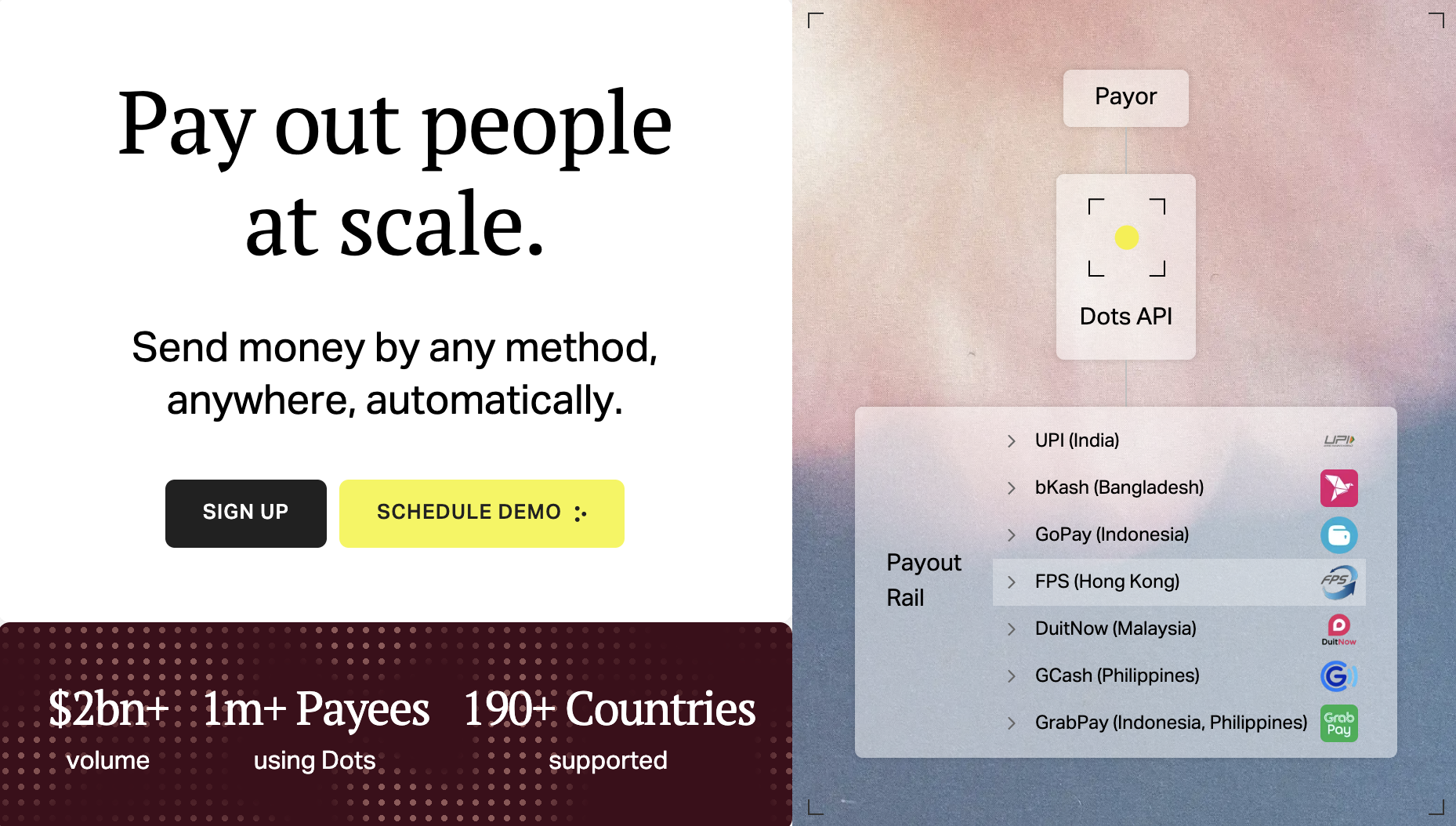
Dots reaches 190+ countries through 300+ payment rails, all through one API. Depending on the method, money lands instantly or within a few business days.
And if you don't feel like touching an API right now, Payout Links skip the whole thing: send a payment by email or text, and the recipient adds their own bank and tax info and picks how they want to get paid. So no integration required on your end.
The compliance work is baked in too: KYC, sanctions screening, and identity checks run through Dots Onboard, and Dots Tax handles your 1099s for you.
Dots Core starts at $19/month, Dots Scale (which adds the API, white-labeling, and background checks) runs $999/month, and Enterprise is custom.
Pros:
- Fast to launch: Most integrations go live within 24–48 hours, versus weeks for some competitors
- No-code option: Payout Links let you start paying people before you've built anything
- Broad rail access: 300+ payment rails, including real-time networks most competitors don't support
Cons:
- Newer name in the space: Less established track record than Wise, Payoneer, or Tipalti
- API access requires the $999/month tier: The entry-level Core plan doesn't include it
If speed to launch and real-time local rails matter more to you than a decade-long track record, Dots is worth a serious look.
Fees, FX markup, and the cost of global payouts
You may have noticed that not all of these included pricing. That's because a payout's real cost is never just one number, and some platforms don't advertise costs at all.
You're usually stacking a transaction fee, an FX markup, and sometimes a subscription. One recent PayDo analysis found that half of businesses overpay by up to 20% on cross-border payments without realizing it, mostly from fees hidden across fragmented providers rather than any single bad deal.
Send a single $1,000 payment overseas and Wise costs about $10 total, versus $27–34 at a major US bank once you factor in their hidden FX markup. Trolley runs closer to $20, plus its monthly module fee. So for occasional payouts, low fees and transparent FX win.
But scale that to 150 sellers and $30,000 a month, and it's a different story. Volume pricing can beat per-transaction fees once you're moving real money, and if some sellers already have Payoneer accounts, they skip the conversion fee entirely.
The costs that catch people off guard rarely show up on a pricing page. That's why the headline fee matters less than how it plays out at your actual volume and across your actual countries.
How to choose a global payout platform
There's no single 'best' platform on this list. The one that fits your use case will be the best platform for you. Match your situation below to figure out where to start.
- Paying a handful of freelancers or contractors, occasionally?
Look for low fees and transparent FX over deep features. Wise or Payoneer will cover you without locking you into infrastructure you're barely using. - Running payouts for hundreds of sellers or creators every month?
Prioritize volume-based pricing, batch APIs, and self-serve recipient onboarding. This is where Whop, Tipalti, Trolley, or Dots make more sense than a simple transfer tool. - Want checkout, payouts, and affiliate commissions running through one provider instead of three?
Whop bundles all three, plus 1099 compliance if you're paying contractors or gig workers. - Recipients concentrated in the EU, UK, or a specific region?
Match the platform to your actual footprint. ConnectPay is excellent for Europe and irrelevant if your sellers are in the Philippines. Check coverage against where your people are based, not the biggest country count on the page. - Subject to DAC7, OECD reporting, or 1099 filing?
Confirm whether the platform handles it natively or just hands you a template. - No engineering resources to spare?
Skip the full API integration. No-code options with payout links, hosted portals, and CSV uploads will get you live fast (Whop and Dots both work this way out of the box). - Building your own payout product on top of infrastructure?
Look at Nium, Thunes, or Airwallex: platforms built to be embedded, not just used. Whop's payout API covers embedding payouts and connected-account onboarding into your own marketplace or platform without building that flow yourself.
Don't forget to look at the real cost of the payout platform. Add up the subscription, the per-payout fee, the FX markup, and anything billed separately, like tax statements or ID checks. The cheapest-looking option isn't always the cheapest at your actual volume.
And if you're not ready to commit yet, then don't! Pilot with a small group of recipients first. Track success rate, delivery speed, support load, and whether recipients are actually happy. Ask for a sandbox environment before you sign anything, and see how it handles your real data before it touches real money.
Whop for global payouts
Ready to find a global payouts partner? The right platform for you depends on where your recipients are, how many you're paying, and what compliance follows them home.
If you're building or scaling a platform that needs to pay out merchants, workers, creators, influencers, or affiliates, Whop handles payouts alongside checkout, affiliate commissions, and compliance in one stack.
You get 241+ countries and territories of payout coverage, a payout method your recipients actually want (bank deposit, crypto, Venmo, Cash App, PayPal), and a payout API that lets you embed the whole experience directly into your own product instead of redirecting people somewhere else.
Need proof?
SideShift embeds Whop's payout portal to pay 850k+ UGC creators across 50+ campaign structures without leaving their product, while FoodFluence pays out tens of thousands of creators across hundreds of cities, and AI assistant platform Poke built its payout infrastructure on Whop.
Whop's already handling this for platforms like these – see what it can do for yours.
FAQs
Payout platform vs. payment gateway vs. BaaS: what's the difference?
A payout platform sends money out to sellers, creators, or contractors. A payment gateway does the opposite: it collects money in from customers at checkout.
BaaS (Banking-as-a-Service) is broader still: it's the underlying infrastructure (accounts, cards, compliance) that either of those can be built on top of.
Some platforms on this list do more than one of these; Adyen and Stripe, for example, offer both payment gateway and payout products, while ConnectPay is closer to a BaaS provider that happens to include payouts.
How is a global payout platform different from just wiring someone money?
A one-off wire is a single, manual transfer. You go to your bank, fill in the recipient's details, and send it once. A global payout platform is built for repeat, programmatic payments to many recipients across countries, usually through an API or batch upload, with compliance and FX handled automatically.
What's the best global payout platform for contractors?
Trolley and Tipalti both build recipient-side tax compliance (1099s, DAC7) directly into the payout flow, which matters most when you're paying contractors specifically. Whop covers the same need if you also want checkout and affiliate payouts in the same stack.
What's the best global payout platform for freelancers?
Payoneer has the deepest existing freelancer network. 5 million users already have accounts, so many freelancers you pay won't need to onboard anywhere new. Wise is the simpler, lower-fee option if your freelancers just need a bank transfer.
What's the best global payout platform for creators?
Whop, Trolley, and MassPay are all built around creator payouts specifically, with white-labeled or embeddable portals so creators manage their own balance and withdrawals without leaving your platform.
What's the best global payout platform for global teams?
Wise and Tipalti are the strongest fits when you're paying internal teams or distributed employees rather than contractors or creators. Nium is worth a look too if you're a larger organization wanting to build real-time payout infrastructure yourself.