How marketplace payouts work, from commission and split-payment mechanics to compliance, reconciliation, and fraud controls.
Key takeaways
- Payouts reverse payment acceptance, splitting one buyer charge across many sellers with separate banks, currencies, and compliance needs.
- Commission models set how much the marketplace keeps; payout models set when and how sellers actually receive funds.
- Choose between split-at-settlement, balance-and-withdraw, escrow, and batch payouts based on refund risk and recipient expectations.
Collecting a payment and disbursing one are two completely different problems. Payment acceptance moves money from many buyers into one account; a payout does the reverse, sending pooled revenue back out to potentially thousands of sellers, each with their own bank, currency, and compliance requirements.
Lower-value cross-border payments – a category that includes marketplace payouts – made up 10% of the $179 trillion moved across borders in 2024, according to McKinsey. Getting that money out the door correctly is a bigger job than most platforms plan for.
This guide covers how marketplace payouts work: commission models, payout timing and methods, the compliance and API layer behind disbursement, and how to choose infrastructure that holds up once you're paying out at volume.
What are marketplace payouts?
A marketplace payout is the transfer that happens once you've already collected a customer's payment.
The buyer pays, you take your cut, and the rest moves to whoever it belongs to. This could be a seller, a service provider, a contractor, or a host.
Everything before that point is payment acceptance. Everything after is the payout.
Before you can pay anyone, you have to make two decisions: how much of the sale you keep versus the seller, and how that split gets divided when more than one party is owed a cut.
How marketplaces split payments between buyers and sellers
Unlike traditional ecommerce models, a marketplace purchase is rarely between just one buyer and one seller. At the very minimum, a marketplace sale involves the buyer, seller, and marketplace itself. The buyer sees one charge and pays that. That payment is then split between the seller and the marketplace.
Here's a simple example: a customer pays $100 for a cleaning service booked through a home-services marketplace. This payment must be split between the cleaner offering the service and the marketplace for its own commission. That split is baked into the transaction itself – the seller's cut and the marketplace's commission get calculated together, in the same moment the card is charged, and the seller receives their share automatically.
And here's a more complicated one: Amazon is the world's largest online marketplace, and when a customer shops on Amazon, they can put multiple products, from multiple sellers, into one cart and check out just once.
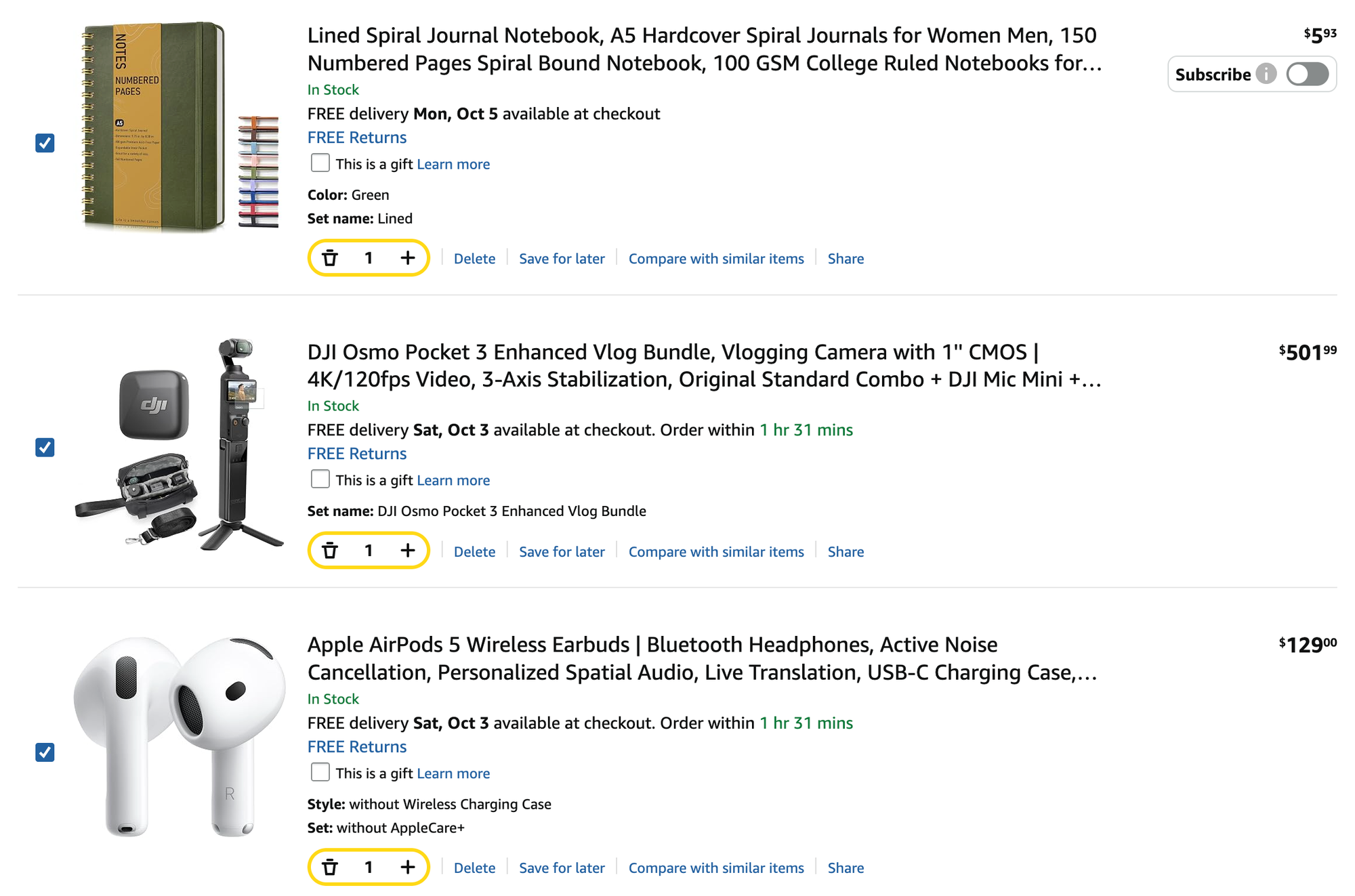
For the buyer, this is a simple transaction, as they pay for multiple items in one transaction. But the marketplace has to pay out each seller involved in the transaction and the marketplace's own commission. Commission comes out per line, not per order (and it can vary, as sellers on different tiers or categories often pay different rates). So, one purchase turns into multiple separate payouts.
And, if a refund or chargeback comes in, the marketplace has to pull that money back from the right person, not just the right total.
Here's what that actually looks like. Say a customer checks out one $150 cart containing items from three different sellers, each on a different commission rate:
| Seller | Item price | Commission rate | Commission taken | Seller payout |
|---|---|---|---|---|
| Seller A | $60 | 8% | $4.80 | $55.20 |
| Seller B | $50 | 12% | $6.00 | $44.00 |
| Seller C | $40 | 15% | $6.00 | $34.00 |
One $150 payment becomes three separate payouts, plus $16.80 kept as the marketplace's total commission across the cart.
Now say Seller C's $40 item gets refunded. What happens next depends on the payout model:
- Under split-at-settlement, Seller C's $34 has already been sent, so there's no balance left to adjust. The marketplace has to recover that $34 back from Seller C directly, as its own separate transaction.
- Under balance-and-withdraw, Seller C's $34 is sitting in their account balance rather than already withdrawn. The marketplace simply deducts $34 from that balance before their next payout goes out – no separate recovery transaction required, assuming the funds haven't already been withdrawn.
This is the same refund, same seller, and same amount, but a completely different operational problem depending on which payout model is running underneath.
Marketplace commission models
Before a marketplace can pay anyone, it has to determine how much the marketplace keeps as its commission for providing the platform, payment infrastructure, and audience. There are three common marketplace commission models:
Percentage-based
Percentage-based models, also called variable commission, take a set share of each transaction (say, 10%), and routes the rest to the seller. With a set percentage like this, the bigger the sale, the bigger the marketplace's cut. This model scales naturally with transaction size and is flexible enough to vary by product category, seller tier, or promotional period.
Fixed fee
Also known as flat commission, fixed fee charges the same flat amount per transaction no matter what the sale was worth. This means a $5 sale and a $500 sale pay the same commission to the marketplace. This model usually shows up on marketplaces built around low-value, high-volume transactions, where a percentage cut would barely be worth collecting.
Hybrid
Hybrid, or compound commission, is a mix of the two models above. Hybrid charges a fixed fee plus a percentage on top. It's the model marketplaces reach for when a pure percentage would leave money on the table at either end of the value range: the flat fee guarantees a baseline on small transactions, and the percentage still scales with larger ones.
Some marketplaces skip commission entirely. Alibaba works this way: instead of taking a cut of transactions, it charges suppliers a recurring subscription fee (Basic or Standard membership plans). Alibaba makes revenue by monetizing access to the marketplace rather than the transactions that happen on it.
Commission covers how much the marketplace keeps. What it doesn't determine is when sellers get paid out – that's a separate decision, with its own set of models.
The four marketplace payout models
Paying out a seller comes down to one of four patterns, and the choice is usually made by default, by whichever payment processor a platform signed up with first, rather than deliberately.
Split at settlement
This marketplace payout model is the simplest to build. A payment comes in, commission is taken out, and the seller's share is paid out. There is no balance to maintain or separate withdrawal step.
That simplicity comes at a cost. Once the payout is sent, there is no held balance to adjust if something goes wrong. This is fine if it's a single seller with no refund risk, like a marketplace selling one-time downloads with a no-refunds policy. But for a multi-seller cart or sale that's prone to refunds, the money is already gone, and getting it back means a separate transaction with the seller, not a simple balance change.
Split at settlement is often paired with fast payout rails so the money arrives quickly too, but the two are separate decisions: split-at-settlement is about when the split is calculated, not how fast the transfer itself lands.
Balance-and-withdraw
With balance-and-withdraw, instead of paying out per transaction, the marketplace credits a running balance and releases it later. There are two common ways that release actually gets triggered:
- Scheduled: the balance pays out on a fixed cadence (daily, weekly, monthly), regardless of when the recipient asks for it
- On-demand: the recipient withdraws whenever they want, against whatever balance is currently available
Etsy runs on this model, and offers both triggers at once: sellers hold funds in a Payment Account and can set up a deposit schedule, or request an on-demand deposit ahead of schedule if funds are available.
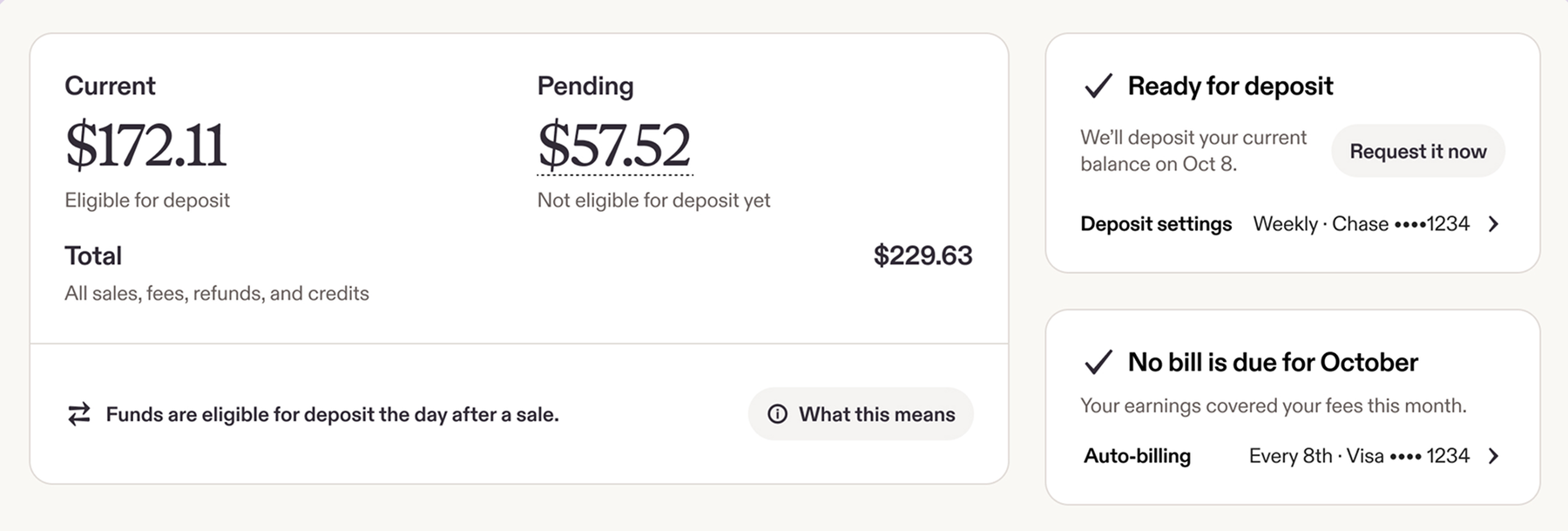
The benefit of this model? It's flexible enough to handle multiple sellers per order because refunds come out of a balance rather than reversing a completed transfer, and payout timing that isn't tied to when a payment lands.
Escrow/delayed release
Here, the marketplace holds the funds on purpose, waiting for a specific condition. Payout isn't triggered by schedule or by manual withdrawal, but instead is released when something specific is achieved – like a confirmed delivery, a completed service, or a closed dispute window. Some implementations add a fallback timer on top (release automatically after 14 days if nothing happens), but that's a safety net for an unresolved condition, not the standard payout.
This model is most common when the cost of a bad outcome (like a contractor no-showing) is high enough to justify holding seller funds until a checkpoint is met. Upwork's fixed-price contracts work this way, with a client paying upfront and Upwork holding that money until the work is submitted and the client has approved it.
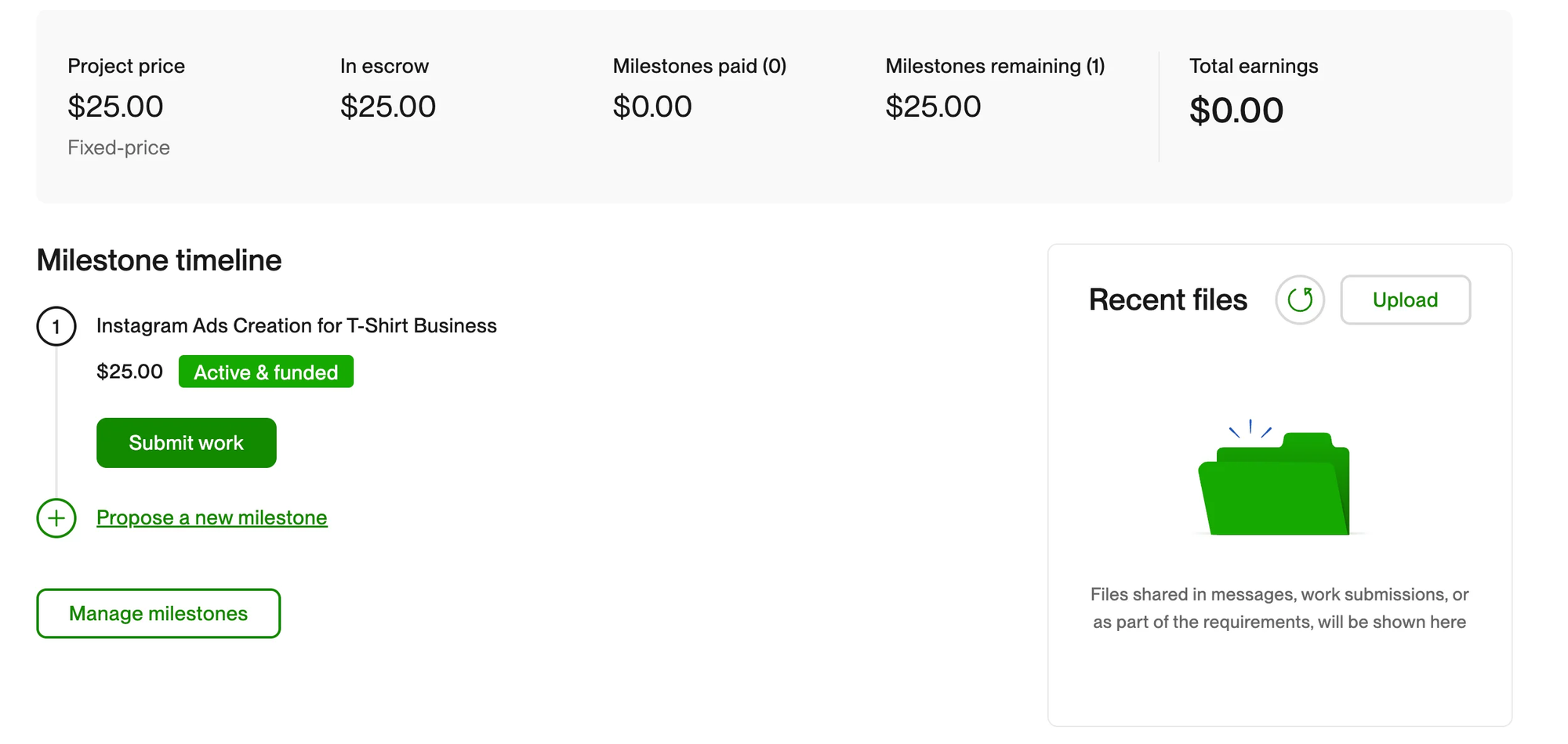
If a client doesn't respond (and doesn't dispute the work), then Upwork automatically releases the funds to the freelancer after 14 days.
One important note: holding customer funds, even briefly, can trigger money transmitter licensing requirements – see compliance below for what that involves.
Manual batch payouts
The least automated of the models, payouts get calculated and sent in a batch either weekly or monthly. Many marketplaces start this way before they've built, or bought, real payout infrastructure.
This is fine at low seller counts, but becomes a big operational risk as volume grows and spreadsheets are no longer enough.
Once a marketplace does automate this process, with a script or scheduled job calling a payout API on a fixed schedule instead of a person doing it by hand, it no longer fits into this model. Instead, it becomes functionally the same as scheduled balance-and-withdraw, but with the human removed from the loop. What defines 'manual batch' isn't the batching, it's the manual part.
Which model fits which kind of marketplace?
It depends entirely on who you're paying. The right model for your marketplace depends on what your recipient needs.
Gig platforms usually require fast, frequent payouts, with daily or on-demand withdrawal rather than a fixed cycle. For gig or task-based platforms, instant access to earnings has become an expectation for their sellers.
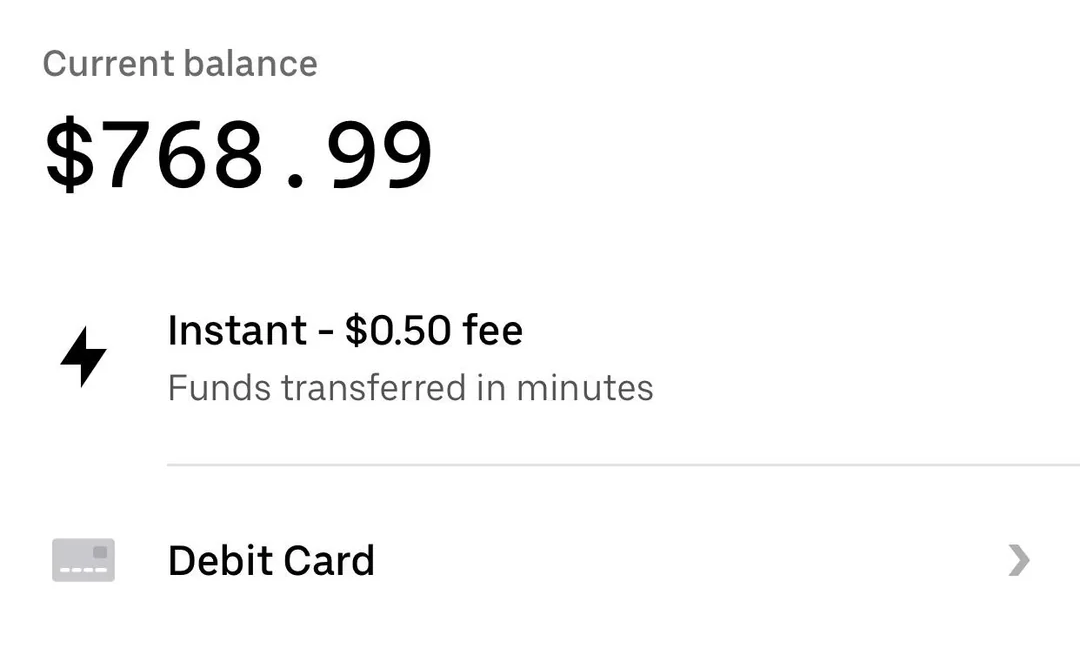
Uber's Instant Pay is the perfect example: drivers can cash out earnings on demand rather than waiting for a weekly payout.
Ecommerce marketplaces typically need to follow a balance-and-withdraw model, since return windows and shipping delays make split-at-settlement risky.
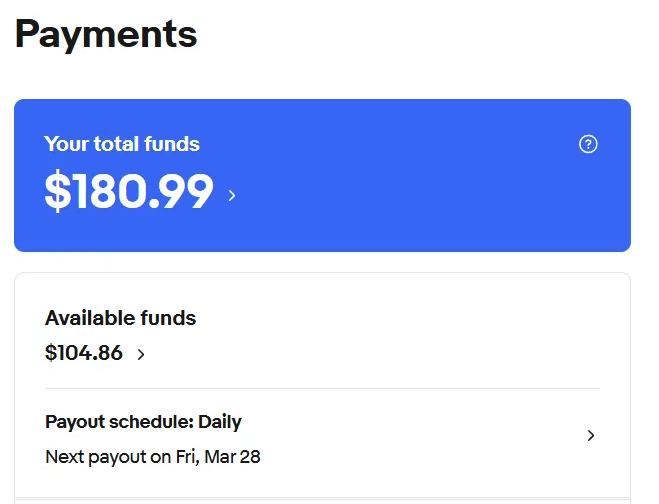
eBay's Managed Payments works this way, with sellers choosing a payout schedule: daily, weekly, biweekly, or monthly. Those not on the daily option can also request an on-demand payout of available funds whenever they want.
Hospitality and rental platforms often lean on escrow or delayed release, holding funds until a condition is met. Airbnb collects payment at booking but doesn't release the host's payout until 24 hours after guest check-in.
Service marketplaces tend to sit somewhere between escrow and balance-based, releasing funds on certain milestones or job completion rather than on a set schedule. Upwork's escrow model, already covered above, is a direct example of this.
B2B marketplaces often run on manual or scheduled batch payouts, since transaction volume per seller is lower and deal sizes are larger.
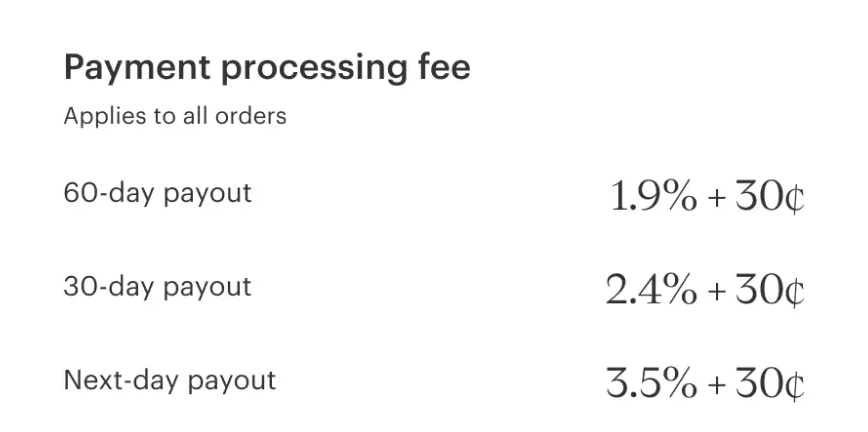
Faire is a good example of the scheduled payout version done well: brands choose their own payout timing (as fast as a day, or up to 60 days for a lower fee), decoupled entirely from how long the retailer takes to pay, with Faire itself carrying that credit risk.
When payouts aren't paid out in full
Some marketplaces hold back a rolling reserve – a percentage of a seller's earnings kept back rather than paid out immediately – as a buffer against future refunds or chargebacks.
This shows up most with new sellers (no track record yet) and high-refund categories (travel, event tickets, anything with a long gap between sale and delivery), typically releasing after 30–90 days once the dispute window closes.
If a refund exceeds what's held back, the balance goes negative and gets recovered from the seller's future sales.
How marketplace sellers get paid
Now you know when marketplace payouts move, and how commission gets split. Here's how the payout travels – the rails it moves on.
Bank transfer/ACH
This is the default, usually because it's the cheapest. Bank transfer/ACH takes one to three business days to settle, which works fine for scheduled payouts, but isn't the right fit for anyone wanting instant payouts.
Best for: scheduled, lower-cost payouts where speed isn't the selling point.
Push-to-card
With push-to-card payouts, the funds land on a debit card, often within minutes. This is the technology behind most 'instant payout' features – Uber's Instant Pay runs on this payout type. It does cost more per transaction than ACH, but that expense can be eaten by the marketplace (as a feature to bring on more sellers) or by the seller (as an instant payout fee).
Best for: gig and on-demand platforms where payout speed is a retention tool.
Digital wallets
Payouts sent to PayPal, Venmo, and similar. These typically land within minutes to a few hours, since the money moves within the wallet provider's own network rather than through the bank clearing system ACH relies on.
Best for: marketplaces whose sellers skew younger or less traditionally banked.
Balance-held virtual cards
The payout sits on a virtual card tied to the platform rather than leaving the ecosystem. Balance-held payouts on virtual cards are spendable right away, but whether that balance can later move to a bank account depends on the provider.
Some virtual card programs allow a standard withdrawal out to a linked bank account (often on the same timeline as a regular payout), while others keep funds card-only, spendable but never cashed out.
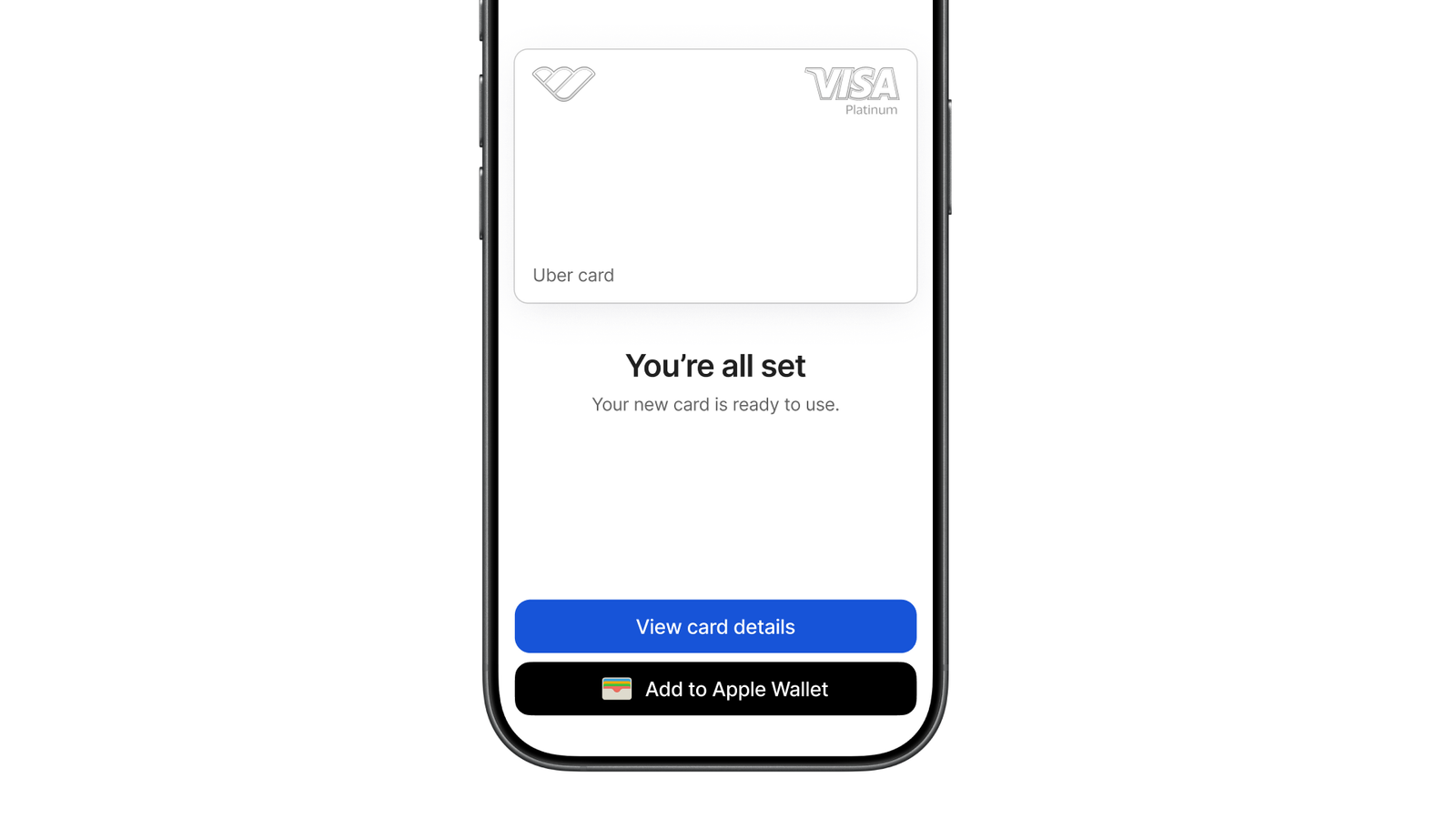
Best for: marketplaces that benefit from keeping payout money inside their own ecosystem.
Stablecoins
Stablecoin payouts are becoming more mainstream: stablecoin transaction volume grew 690% year-over-year in 2025, and the number of countries with active users rose from 70 to 106, according to zerohash, a stablecoin infrastructure provider.
Some marketplaces remove the biggest barrier here (having crypto) by spinning up a custodial wallet for the seller automatically, letting them receive the payout and convert to fiat without ever needing their own crypto wallet or exchange account.
Best for: marketplaces paying a lot of cross-border sellers, where currency conversion or wire delays are eating into payout cost or speed.
| Rail | Speed | Typical cost | Who bears the fee |
|---|---|---|---|
| Bank transfer/ACH | 1–3 business days | $0.20–$1.50 per transfer | Usually the marketplace |
| Push-to-card | Minutes | ~1–2% per transaction | Marketplace or seller |
| Digital wallets (PayPal, Venmo) | Minutes to a few hours | Varies by provider | Varies by provider |
| Balance-held virtual card | Instant | Typically free to the seller | Usually the marketplace |
| Stablecoins | Minutes | Low, varies by network | Usually the marketplace |
These figures cover payout rails specifically – for the cost side of accepting payments in the first place, see payment processing fees.
A note on cross-border payouts
Paying internationally adds FX exposure (someone has to eat that conversion cost) and rail availability (ACH is US-only; European sellers need SEPA, UK sellers need Faster Payments). If you need cross-border payouts, see cross-border payments and global payouts.
Seller onboarding and compliance
Before a marketplace can pay anyone, it has to know who it's paying. So, before that first payout goes out, the seller must verify their identity.
This starts with onboarding. KYC ('know your customer', identity verification for individuals) or KYB ('know your business', business verification for businesses), plus the correct tax form on file. If the seller changes a bank account, creates a new business structure, or has a change of ownership, this can mean they have to re-verify later (for the technical side of building this, see integrating a KYC API.)
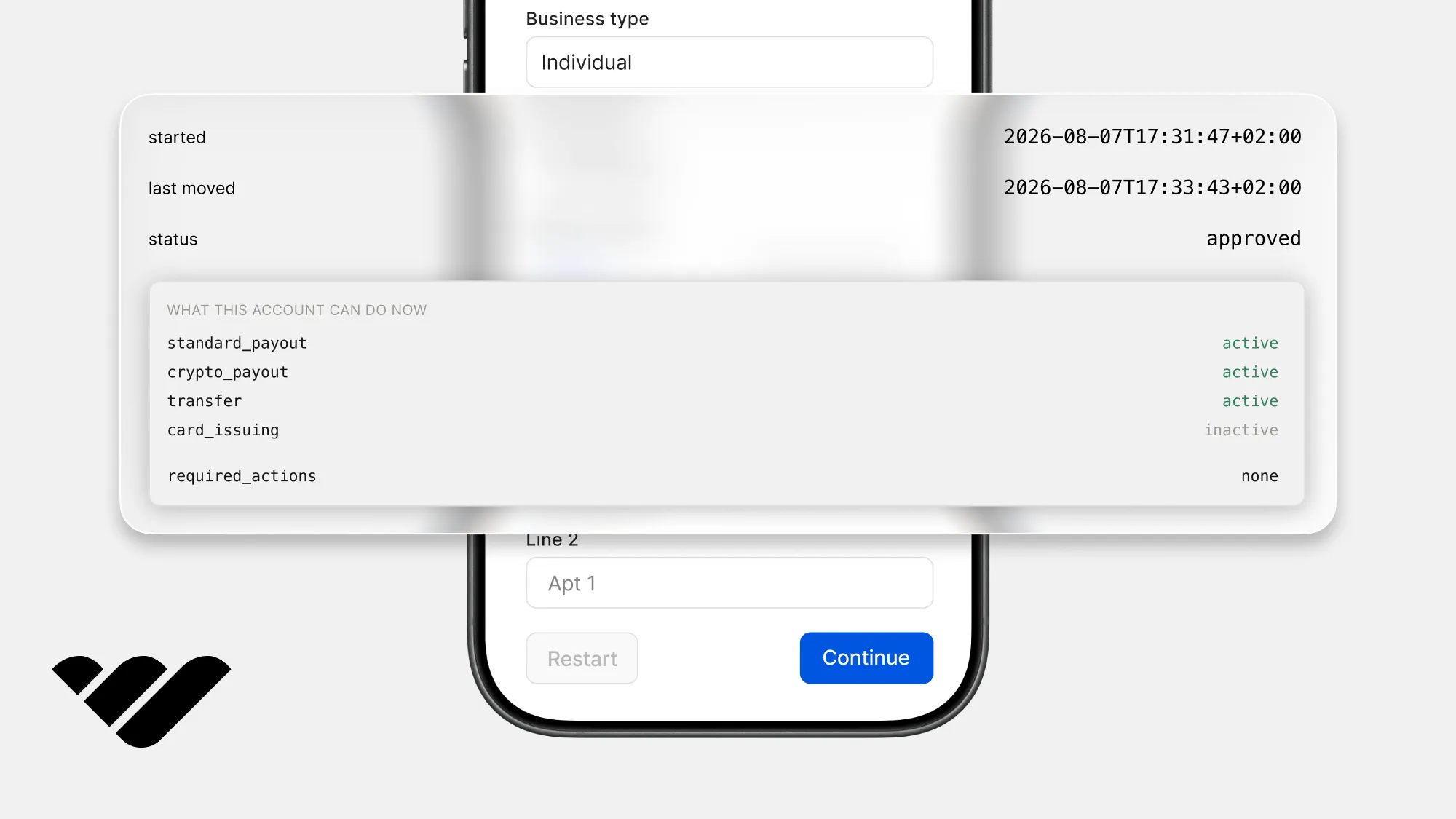
Here's how it works for US-based marketplaces specifically – sellers file a W-9 if they're US-based, or a W-8 series form if they're not.
Once a seller is earning, marketplaces are also required to issue a 1099-K to those sellers who cross $20,000 in payments and 200 transactions in a calendar year. It's worth knowing that this threshold has changed several times in the last few years (most recently reverting back to $20,000/200 transactions after the 'One Big Beautiful Bill Act' repealed a planned drop to $600), so make sure you check this against current IRS guidance before relying on it.
Some sellers, depending on how they're classified, fall under 1099-NEC reporting instead. Outside the US, tax reporting obligations vary by country.
And when it comes to staying compliant, there's a decision that comes back to something covered under escrow: holding and moving other people's money, no matter how briefly, can require a marketplace to register as a Money Services Business with FinCEN and hold money transmitter licenses in every US state where it operates – two separate regulatory layers, not one.
This has nothing to do with tax reporting. It's a separate question of whether the marketplace is legally allowed to touch that money in the first place.
It's also important to remember that while verification at onboarding can catch a fake identity before a seller joins your marketplace, it doesn't stop what happens after. This could be through a fake account that is built purely to collect payouts for non-existent goods or services, or, an account takeover where a real seller's login is compromised and payouts get redirected. There's also the threat of credential swapping – where payout details get changed to someone else's.
Catching these fraudulent behaviors means treating fraud detection as ongoing. That means continuous sanctions screening (not just at signup) and monitoring for the payout-behavior anomalies a static KYC record would never flag (like a spike in transaction velocity).
Where's my money? Marketplace seller communication and support
Marketplace payouts are about more than getting money to the seller. How your sellers get paid – and how you communicate this with them – is crucial to your marketplace's retention and reputation.
Metafy, an esports coaching platform, runs payouts through Whop after outgrowing their previous payments partner.
"Making sure our partners get paid, properly and on their terms, is the whole promise. Get that wrong and nothing else matters.
When a coach can't get paid reliably, it becomes a trust problem. That's the worst possible problem for us to have."
- Josh Fabian, Metafy founder
But a payout that is technically correct can still end in a support ticket if the seller has no way to tell where their payout is.
Let's say your payouts run on ACH. If a seller is expecting an instant payout, and has no way to check the status of their payment, they may think that the payout is stuck or broken, even if it is running exactly on schedule. That's more stress for them, more ticket volume for you.
That's the argument for showing payout status in real time. Sure, you can include payout terms in your docs and resources, but how many sellers are trawling through those before opening a ticket?
UGC platform SideShift built a payout status view that shows initiated, processing, sent, or failed payouts into its creator payout portal.
Payout statements solve a related, but slightly different, problem. A seller who gets paid less than they expected to see has no way to know if the missing money is a fee, a refund, a chargeback, or an error.
Generate statements that spell out gross earnings, what was deducted, why it was deducted, what got netted out, and the final number. A statement that doesn't answer that question isn't a statement, it's just a receipt.
Get payout status and statements right, and a seller can see where their money is – or where it went – without opening a ticket. But get them wrong, and you start to lose trust, and eventually, sellers.
Running payouts at scale
Managing a handful of marketplace sellers is one thing. Managing hundreds of thousands of seller payouts a month is another thing entirely, and most marketplaces are not prepared for payouts at scale.
Here's what happens as a marketplace grows: firstly, recipient onboarding gets harder to keep up with as sellers start to join faster than manual review processes can handle. Then, payout failures start happening more often, requiring a process, not a one-off fix. And reconciliation becomes a bigger task as marketplaces need to track every payout back to the sale, refund, or fee that it came from.
FoodFluence, a creator marketplace connecting restaurants with local food creators across 700+ cities, ran into this problem before consolidating its payment stack. As co-founder Branson Packard put it:
"Prior to Whop, any other solution we had tried was predominantly just a broken flow where we'd be billing on one platform, then transferring the funds to our bank, and then using another payout provider."
- Branson Packard, FoodFluence co-founder
To put it simply – more sellers means more compliance, more sales, more payouts, and more reconciliation. It's a snowball effect: the more you scale, the faster you grow, the more automation you need. It's best to bake this in from the start rather than trying to play catch-up later.
The fix for this isn't more staff to handle higher volume, but more automation to hand these processes off to.
How to automate payouts for marketplace sellers
Here's how you can automate marketplace payouts:
- Automate onboarding data collection: implement KYC/KYB checks and tax form collection (W-9/W-8) that is triggered automatically when a seller signs up or wants to get paid out, rather than using a manual review queue.
- Set payout rules once: define schedules, thresholds, and split logic at marketplace level so that payouts run without needing to be approved per transaction.
- Automate failure retries: have a failed payout trigger an automatic retry or seller notification instead of routing to a queue.
At the infrastructure level, this usually comes down to the same basic flow: create a recipient (the seller's connected account), run KYC or KYB against that recipient, create a payout against it using an idempotency key so a retried request never accidentally pays someone twice, and track its status through a webhook (initiated, processing, sent, or failed) rather than polling for updates. This is the shape behind most modern payout APIs.
While this will relieve operational burden, it doesn't remove legal responsibility. The marketplace is still the one accountable for KYC accuracy, tax reporting, and fraud losses, regardless of how much of the process is automated. Automation removes the manual work, not the liability.
How to reconcile marketplace payouts quickly
With a growing marketplace, reconciliation is where manual processes break down first. When reconciling payouts, follow a strict process rather than an ad hoc check. Here's what that looks like:
- Every disbursement needs a reference back to the exact sales it covers – not just a lump sum, but a traceable link to the transactions that produced it.
- From there, reconciliation means running a three-way match: the sales ledger (what was sold), the payout ledger (what was paid out), and the bank or processor statement (what actually moved). When all three agree, the payout is reconciled. When they don't, that mismatch is what needs investigating.
- This has to run on a fixed schedule – daily, or per payout batch – not whenever someone gets around to it. Catching a discrepancy while it's still one transaction to investigate is a very different job than catching it once it's sixty.
- Anything that doesn't match cleanly needs an exceptions queue with a real SLA, so it gets resolved in a defined window instead of piling up unexamined.
Doing all of this manually does not stay manageable for long. A three-way match across sales, payouts, and bank statements scales poorly with a spreadsheet, and gets more complex when the number of things that need matching grows faster than the number of payouts.
That's where automated payout tooling comes in.
How payouts work on Whop
Some marketplaces build all of this themselves. Others choose to work with a payout partner.
Here's what payouts look like with Whop.
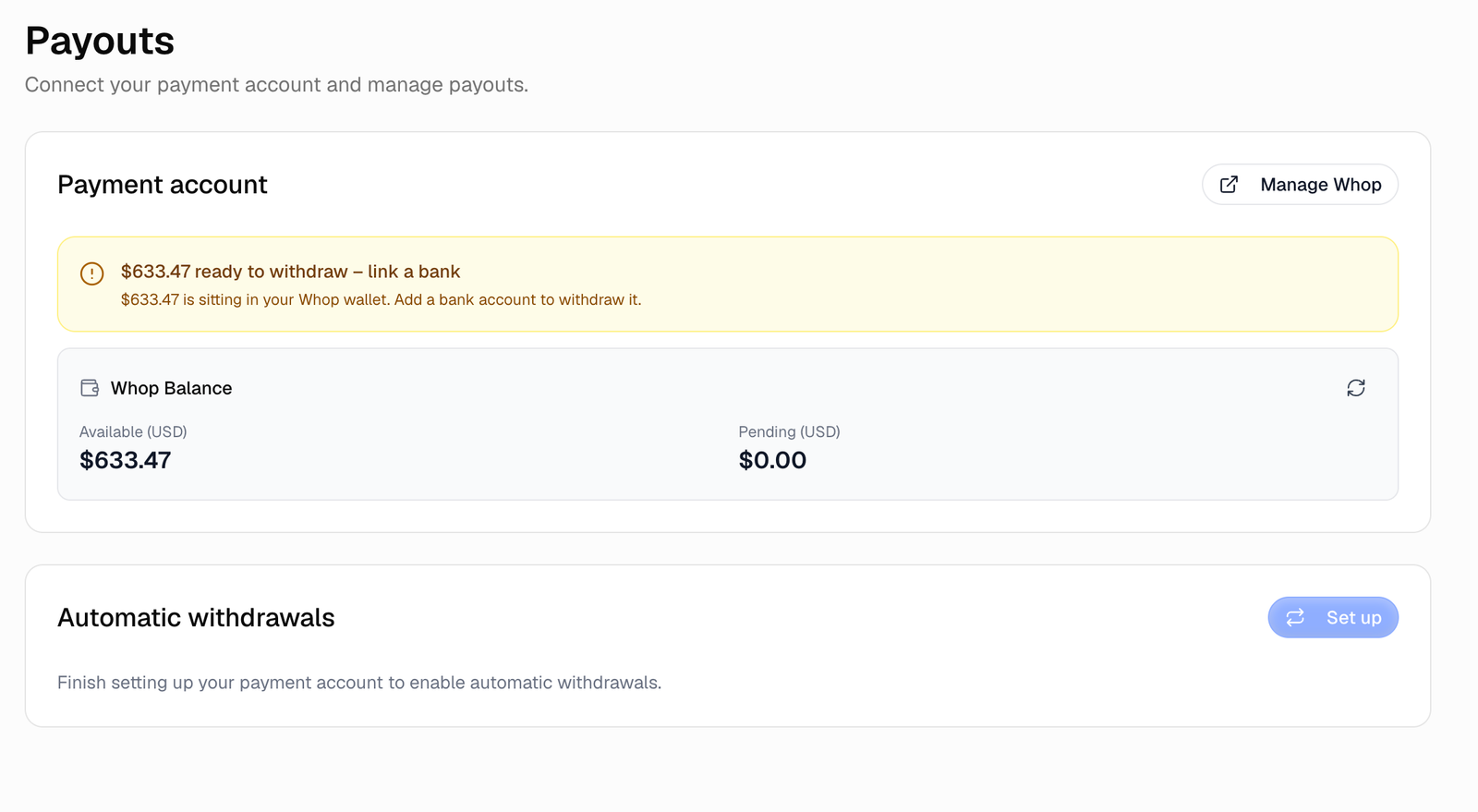
Whop runs on a balance-and-withdraw model with both triggers built in: sellers can wait for a standard payout (up to 5 business days) or withdraw instantly.
Some withdrawals route through a compliance review based on risk factors, but these are typically resolved in under 30 minutes, and Whop won't offer the instant option at all if a payout needs review. For more information, see the Whop payout docs.
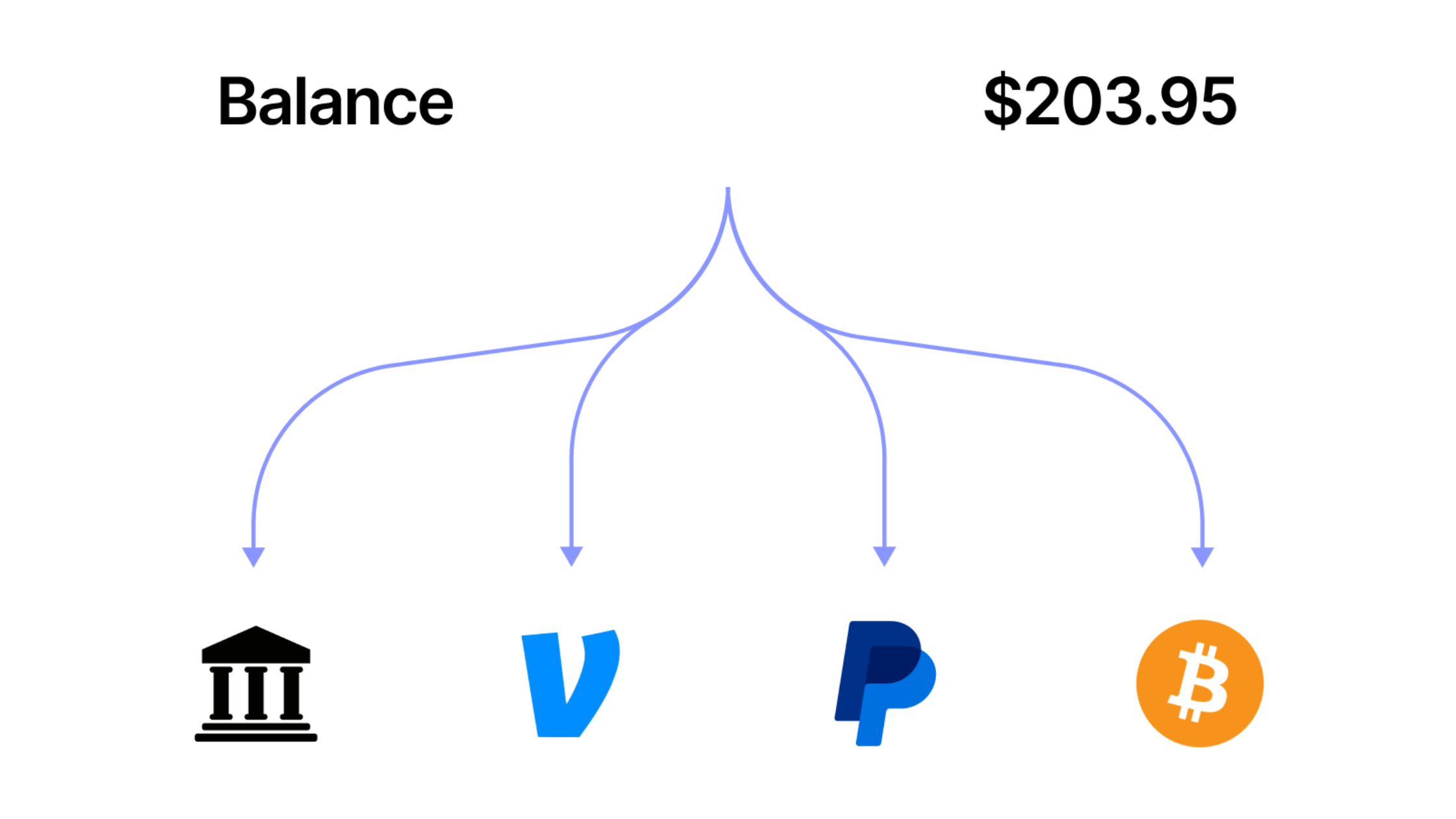
As for rails, Whop supports payout to a bank account, mobile wallet, crypto wallet or stablecoin balance, or a Whop-issued virtual card that platforms and marketplaces can issue directly. Sellers choose the method that works for them rather than being locked into whatever the marketplace chooses.
Whop offers this in two ways: a hosted payout page platforms can redirect sellers to, or embedded components that platforms build directly into their own product so sellers never leave the platform's interface.
For marketplaces taking the embedded route, Whop's payout API and components handle the recipient-facing side directly: connected accounts complete KYC (or KYB, for businesses) through a hosted, automated flow, and platforms don't have to build that verification UI or store sensitive bank or wallet details themselves.
Terac, an expert network paying out contributors in more than 30 countries, and Dueflow, which manages payouts for more than 67 fraternity chapters and their connected accounts, both run on this embedded model.
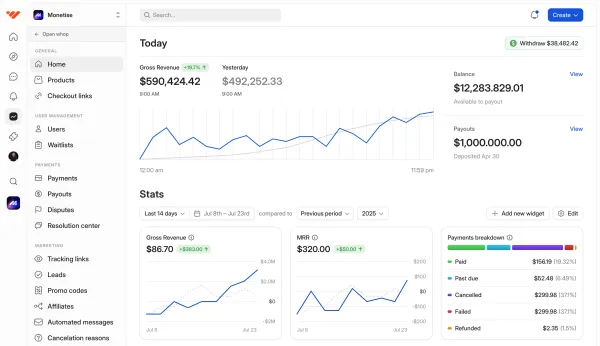
The best part is that payments and payouts also don't have to run on separate stacks. The same infrastructure that handles payout onboarding and disbursement can power checkout, invoicing, and the rest of a marketplace's payment experience, meaning one system doing what would otherwise take two or three separate providers.
"Through thousands of conversations, we've learned our customers really only care about two things: getting paid and paying out. Our mission is to be the best in the world at solving those problems."
- Hunter Dickinson, Head of Growth at Whop
How to choose the right marketplace payout infrastructure
Everything in this guide so far – commission, timing, rails, compliance, communication – comes down to one decision: what runs the payouts for your marketplace?
The first decision is whether to build payout infrastructure yourself, or use a partner. Building it yourself means owning KYC/KYB, tax reporting, money transmitter licensing (or partnering separately just for that), fraud detection, rails, and reconciliation, all maintained in-house. That gives you full control over the experience, but it's a big compliance and engineering undertaking. Marketplaces that choose to go this route do so because payouts are core to their product, not an incidental part of it.
Using a payout partner means someone else absorbs some, or all, of that layer, in exchange for less control over the exact experience and a fee for the infrastructure.
If you choose to work with a payout partner, your next choice is whether you want payments and payouts on one system or two. Some providers, like Whop and Stripe Connect, do both. Others only handle the payout side. Coupled infrastructure is simpler to reconcile, since there's one system of record for the whole transaction. Decoupled infrastructure is more flexible to mix and match, at the cost of putting two systems together yourself.
From there, the choices get narrower. Your payout infrastructure is dependent on:
- Who you're paying: a gig platform paying thousands of individuals daily needs different infrastructure than a B2B marketplace settling a handful of large invoices monthly.
- Where they are: domestic-only is a different problem from cross-border, with different rails and compliance rules.
- How much compliance you want to own directly versus hand off: some providers absorb KYC, KYB, tax reporting, and licensing; some leave all of it with you.
- How much volume you're running: what works fine manually at a hundred sellers becomes a liability at a hundred thousand.
There's no single right answer. It really comes down to which of these variables matters most for your marketplace.
If you want a full side-by-side of marketplace payout providers, marketplace payment platforms breaks down take rates and provider models in detail. For a broader look at payout infrastructure outside the marketplace context specifically, see global payout platforms.
And if what you actually need is white-label, embeddable payout infrastructure rather than a standalone provider, the embedded payouts guide covers that build.
Get marketplace payouts right from day one with Whop
Marketplace payouts look simple from the outside – money goes in, and money goes back out. But, as this guide has shown, everything in between that is complicated. How the split is calculated, when the money moves, which rails it travels on, who's liable for what, and whether a seller can tell what's happening to their earnings is where marketplaces win or lose sellers.
None of this has to be built from scratch. Use Whop for payouts and have the full stack – onboarding, compliance, rails, and reconciliation handled for you.
FAQ
What happens if a refund or chargeback comes in after a marketplace payout has already gone out?
It depends on the payout model. In balance-and-withdraw or escrow, the marketplace can deduct the amount from the seller's balance before it's paid out again. In split-at-settlement or manual batch, the money's already gone, so the marketplace has to claw it back from the seller directly, or let their balance run negative until it's repaid through future sales.
Does a marketplace need a money transmitter license to pay sellers?
Potentially, yes. Holding and moving other people's money – even for a short time, and even in an escrow model – can require a marketplace to register as a Money Services Business with FinCEN and hold money transmitter licenses in the US states where it operates. Many marketplaces avoid this by routing payouts through a licensed payment partner instead of handling it themselves.
Which platforms handle marketplace payments and seller payouts?
A handful of providers handle both collection and payout on one connected system rather than two separate integrations. Whop and Stripe Connect are two examples.
What happens to a marketplace payout if the seller's balance goes negative?
This can happen when a refund or chargeback exceeds what's already been paid out. Most marketplaces let the balance run negative and recover it from future sales, though the exact policy (how long a negative balance can stand, and whether the marketplace ever absorbs the loss itself) should be decided in advance, not after the first time it happens.


![Marketplace payments: Take rates, split payments & top 5 platforms [2026]](https://storage.ghost.io/c/12/7b/127b828b-bdc2-4972-9cf2-de857df9c324/content/images/size/w1000/format/webp/2026/08/blog-marketplace-payment-platforms.jpg)
![Top 10 best embedded finance companies for SaaS and marketplaces [2026]](https://storage.ghost.io/c/12/7b/127b828b-bdc2-4972-9cf2-de857df9c324/content/images/size/w1000/format/webp/2026/08/embedded-finance.jpg)