Payments, payouts, and everything in between.
Key takeaways
- Choose Stripe for modular, mature tooling you assemble yourself; choose Airwallex for one bundled, faster-to-ship product.
- Stripe ties multi-currency settlement to platform and seller sharing a region; Airwallex only requires enabling the settlement currency.
- Airwallex's PSP-agnostic setup and 100+ payout countries suit platforms keeping their own processor or paying globally.
Ask ten platform founders how they want to handle payments, and you'll get ten different answers.
Some want total control, down to every last API call. Others just want their users to get paid, without having to build any of it themselves.
That's the main choice underneath the 'Stripe or Airwallex' question for platforms.
Both companies say they do embedded payments for platforms, and both are right. Stripe splits it into separate products: Connect for accepting payments, Global Payouts for paying third parties, and Treasury for platforms that need to hold a balance.
Airwallex answers most of it through one product, Payments for Platforms.
Neither approach is wrong, but they lead to very different builds. Here's what Stripe and Airwallex offer today, for embedding payments and payouts, so you can see which one best fits your needs.
Stripe vs Airwallex: which is best for platform payments?
Stripe is the better pick for US-centric platforms with engineering resources, especially if you need FDIC-insured balances or want Stripe's Managed Risk to handle fraud and disputes for you.
Airwallex is the better pick if your sellers are spread across multiple countries, you want fewer integrations to manage, or you want to keep your existing payment service provider (PSP).
To help work out which suits your platform, this section covers payment acceptance, currency coverage, checkout and UI, payouts, onboarding, risk and compliance, and of course, pricing.
If your platform only pays users out and never collects money from an end customer itself (think a payroll platform or rewards program) then you can skip this section and go straight to payouts.
Payment acceptance: how each one works
Before you can pay a single seller, you have to solve a more basic problem: letting them accept money in the first place, without making them set up their own merchant account.
Stripe Connect: infrastructure you assemble yourself
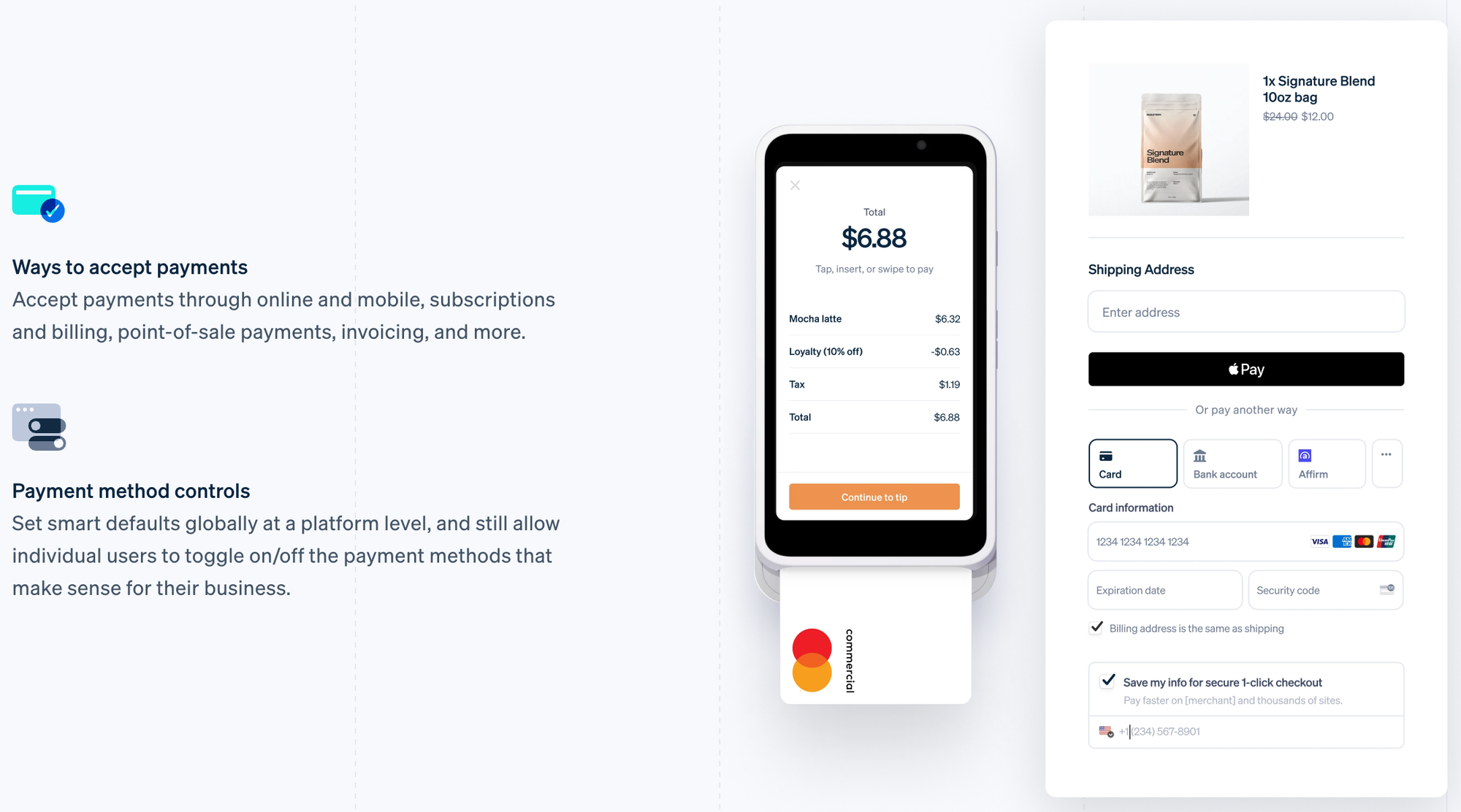
Stripe Connect is the one everyone knows, and it's still the starting point for most platforms.
Payment acceptance isn't limited to online checkout. Connected accounts can take point-of-sale payments through Stripe Terminal, and run subscriptions and recurring billing through Stripe Billing, both layered on top of Connect rather than needing a separate integration.
However you're accepting the payment, though, a platform still has to choose who acts as the merchant of record for each transaction.
With a direct charge, the seller is the merchant of record and the buyer might never know the platform exists at all, the way Shopify's merchants operate.

With a destination charge, the platform is the merchant of record and transfers funds to the seller after taking its cut, the way ride-sharing platform Lyft collects a fare and pays the driver.

And with separate charges and transfers, one payment gets split across several sellers at once (this is for ecommerce marketplaces that allow a single shopping cart for goods sold by multiple businesses).

Airwallex: Payments for Platforms
Airwallex isn't limited to online checkout here either, though it is at an earlier stage than Stripe. Airwallex also offers Billing (covering invoicing, subscription management, and usage-based billing), and in-person payment acceptance is labeled as 'coming soon'.
Payments for Platforms, the direct Connect equivalent, splits into three named setups depending on who is merchant of record and how payments get processed.
In the SaaS model, the platform's own customers act as merchant of record, each with a full connected account. Full accounts are only available in about 50-60 countries. Outside of that list, sellers can't accept payments as merchant of record at all.
In the marketplace model, the platform is merchant of record, using Airwallex as its own payment gateway to accept payments and pay out sellers. Sellers can be onboarded as either full connected accounts or lighter ledger accounts, and the choice affects both country coverage and how much control the seller has over their own funds.

And in the PSP-agnostic setup, the platform is still merchant of record, but keeps its own payment processor for pay-in, with Airwallex only handling the holding, splitting, and paying out afterward.
This can also run on ledger accounts, so a platform using PSP-agnostic isn't locked into the same country restriction as the SaaS model.
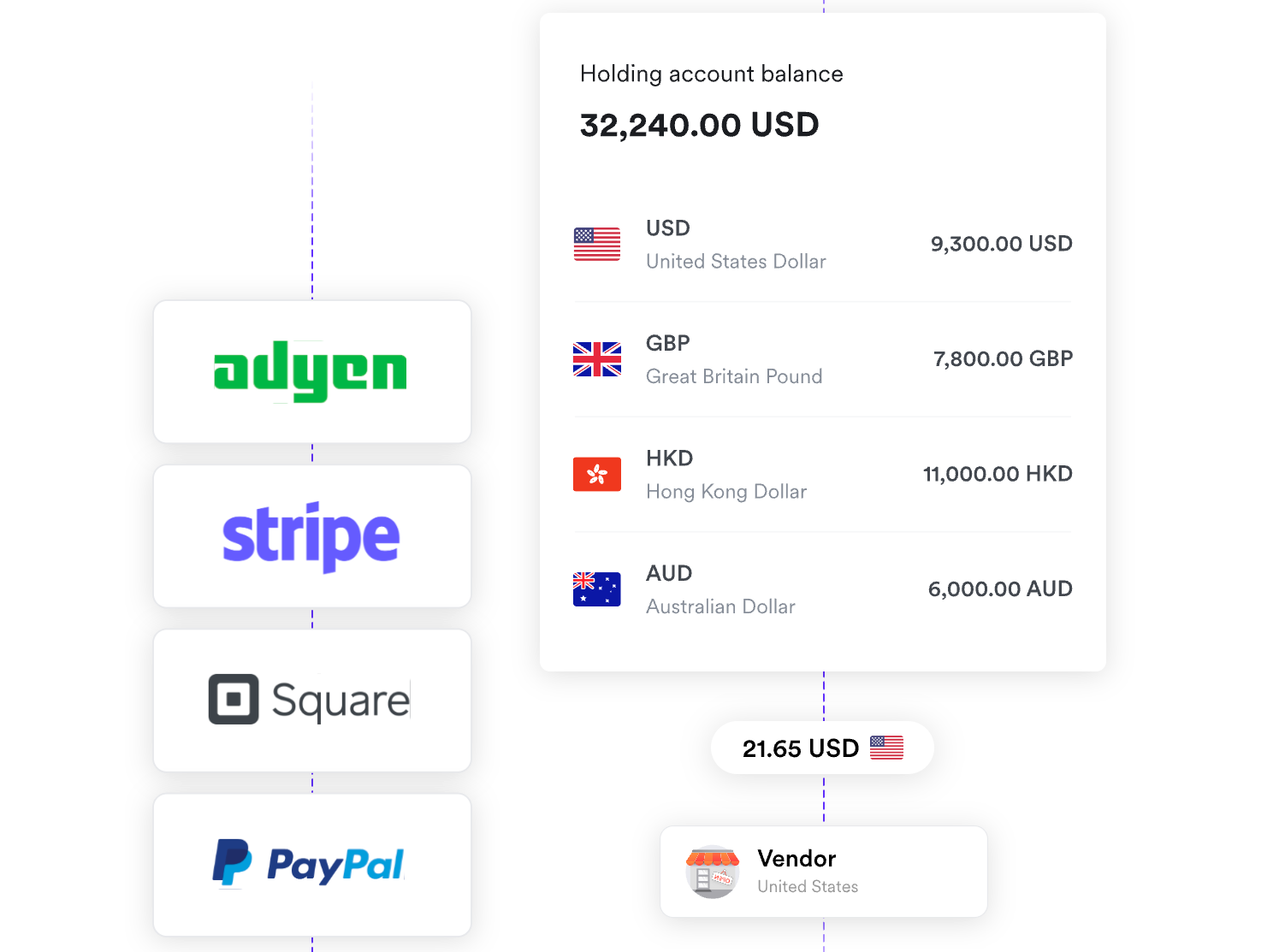
Both give platforms the same basic choice of who's merchant of record. Airwallex just goes one step further with PSP-agnostic, letting a platform swap in an entirely different processor for pay-in and still get everything else through the same account.
Currency coverage and settlement for connected accounts
This is one of the clearest differences between the two, and it's specific to how each one treats a seller's account, not just a regular business account.
Here's how it works on Stripe: by default, a connected account gets paid in whatever currency the platform uses, even if the sale happened in a totally different currency.
So let's say your platform is in the US, but you've got a seller in Germany getting paid for a sale to a French customer. Unless you've switched on multi-currency settlement, that seller's earnings just get converted to USD before they see it.
But that feature has strings attached: it only works in ten regions – the EU, UK, Switzerland, Norway, Liechtenstein, Singapore, Hong Kong, Australia, UAE, and the US.
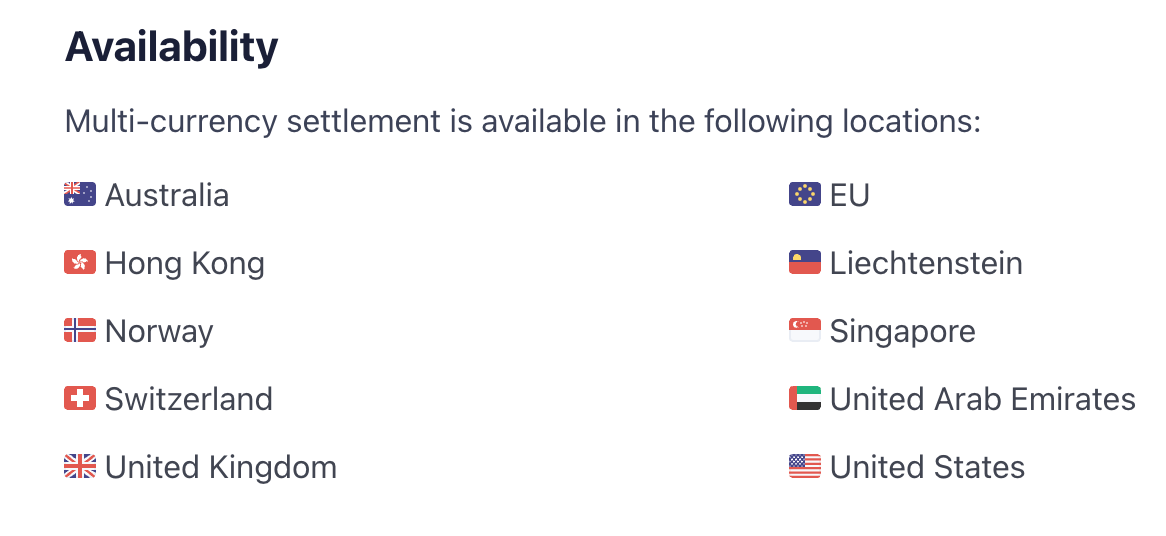
And the seller has to be based in the same region as the platform, like a US platform and a US seller, for instance, not a US platform paying a seller in Brazil.
Meet both conditions, and a seller can hold and get paid in up to 18 currencies without a conversion touching their money. Otherwise, they're stuck with whatever the platform's default currency is.
Airwallex works differently. There's no rule about the seller and platform needing to be in the same part of the world: the condition is just which currencies you've set up as principal settlement currencies (20+ available).
Enable a currency once, and it settles without conversion regardless of where anyone's based.
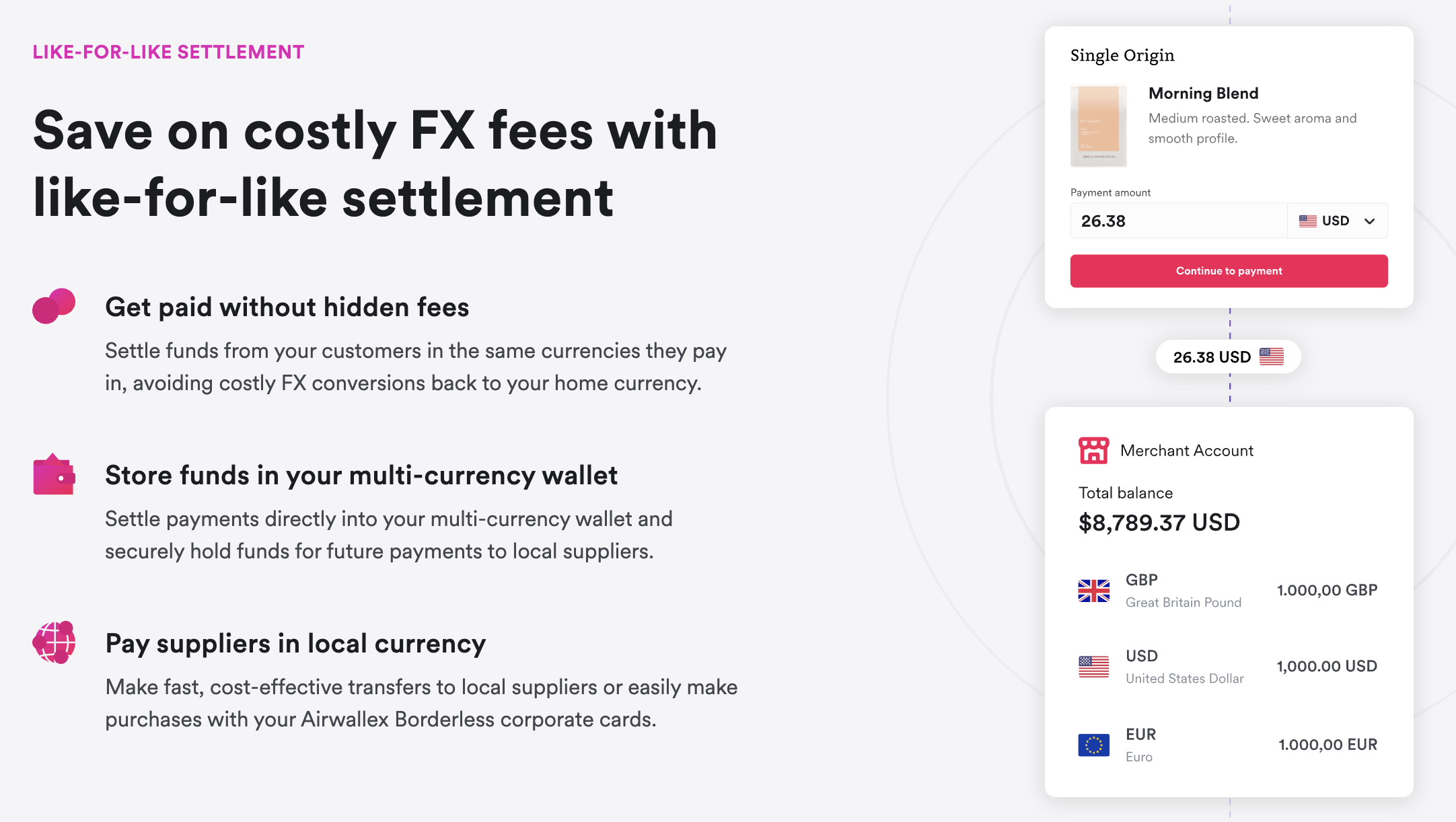
This is specific to settlement, though. Whether a seller can actually accept payments at all is a separate question, covered in the 'payment acceptance' section above.
In the simplest terms: Stripe's multi-currency setup depends on where your platform and seller are both based. Airwallex's depends on which currencies you've set up to settle without conversion, not on where anyone is.
The UI layer: components, hosted pages, or full custom
Beyond the account structure, a platform still has to build the actual screen a buyer sees, and the screen a seller sees to manage their earnings.
Stripe's embedded components cover both.
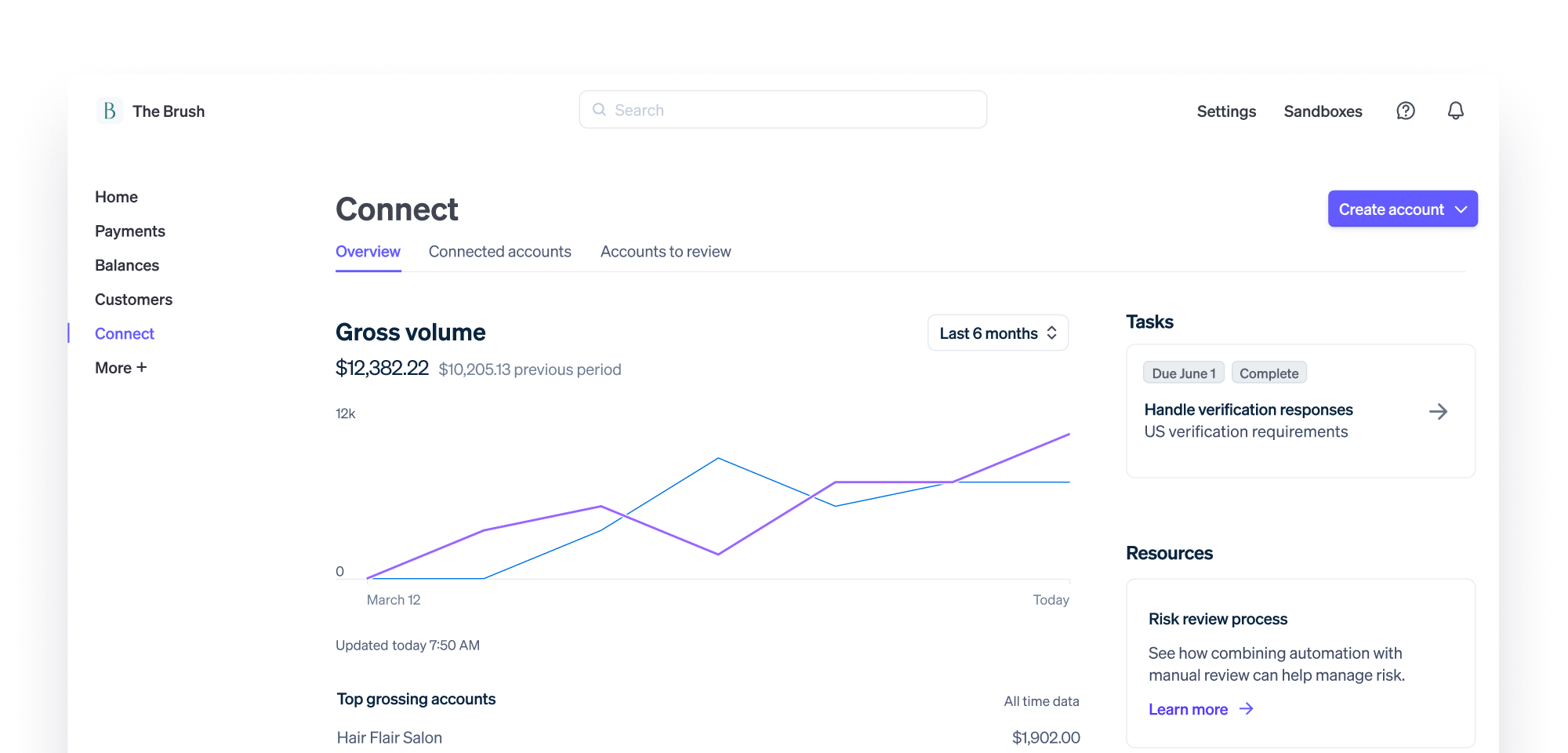
Connect ships prebuilt UI for onboarding, a payments and payouts dashboard, and account settings, all embeddable directly into a platform product, alongside Stripe-hosted and pure-API options if a platform wants more control.
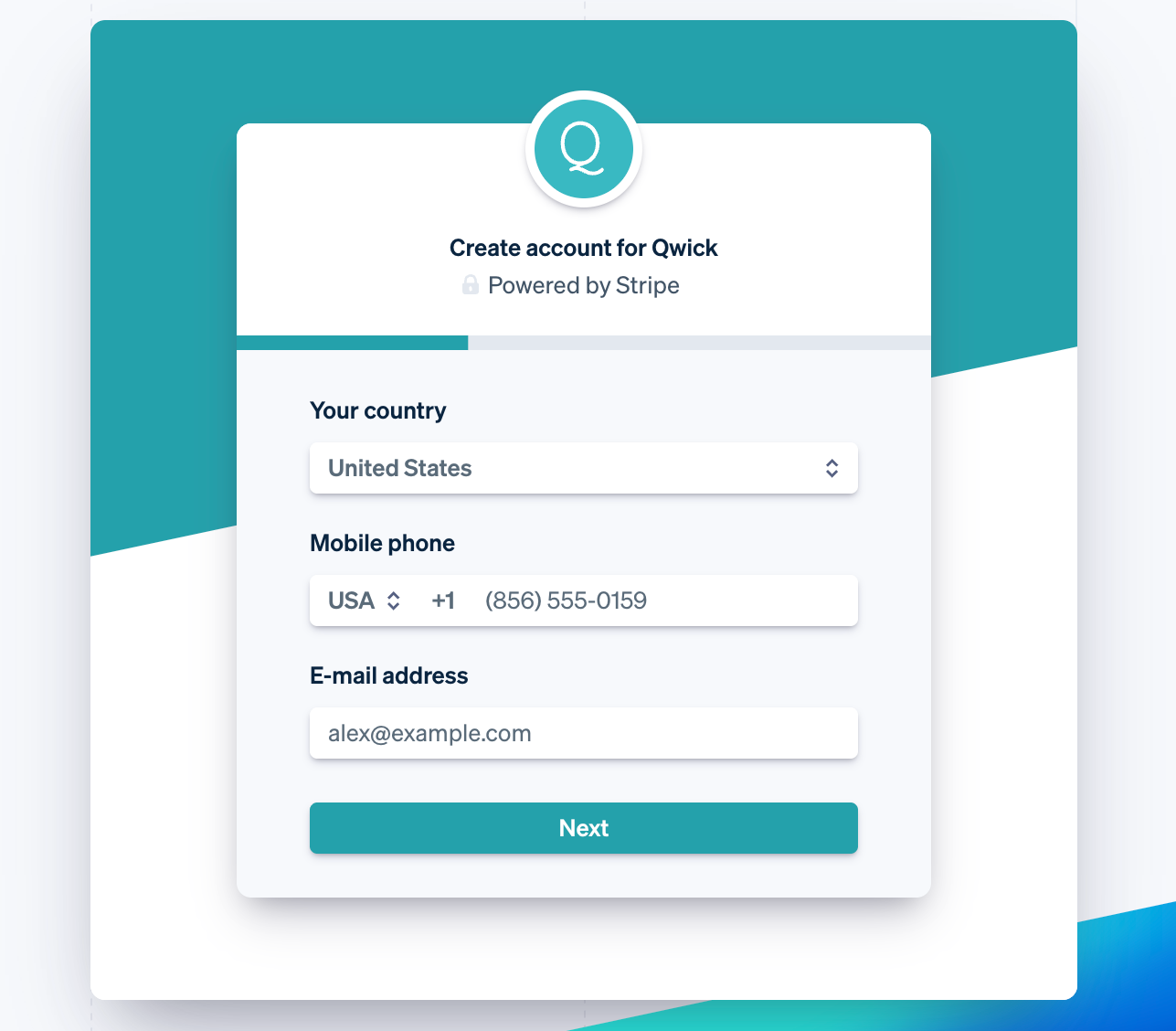
On the buyer-facing side, Elements and Checkout give the same flexibility Stripe offers any business.
Build your own payment form using individual pieces – like the Payment Element for 100+ payment methods, the Express Checkout Element for one-click wallet buttons, and the Address Element for shipping and billing info – or skip all that and just use a prebuilt, hosted page instead.
Airwallex offers a similar range for the buyer-facing side.
No-code plugins for platforms like Shopify and WooCommerce. A hosted checkout page. Individual low-code embeddable components: Card, Split Card, Apple Pay, and Google Pay elements, plus a Drop-in element that surfaces every configured payment method at once.
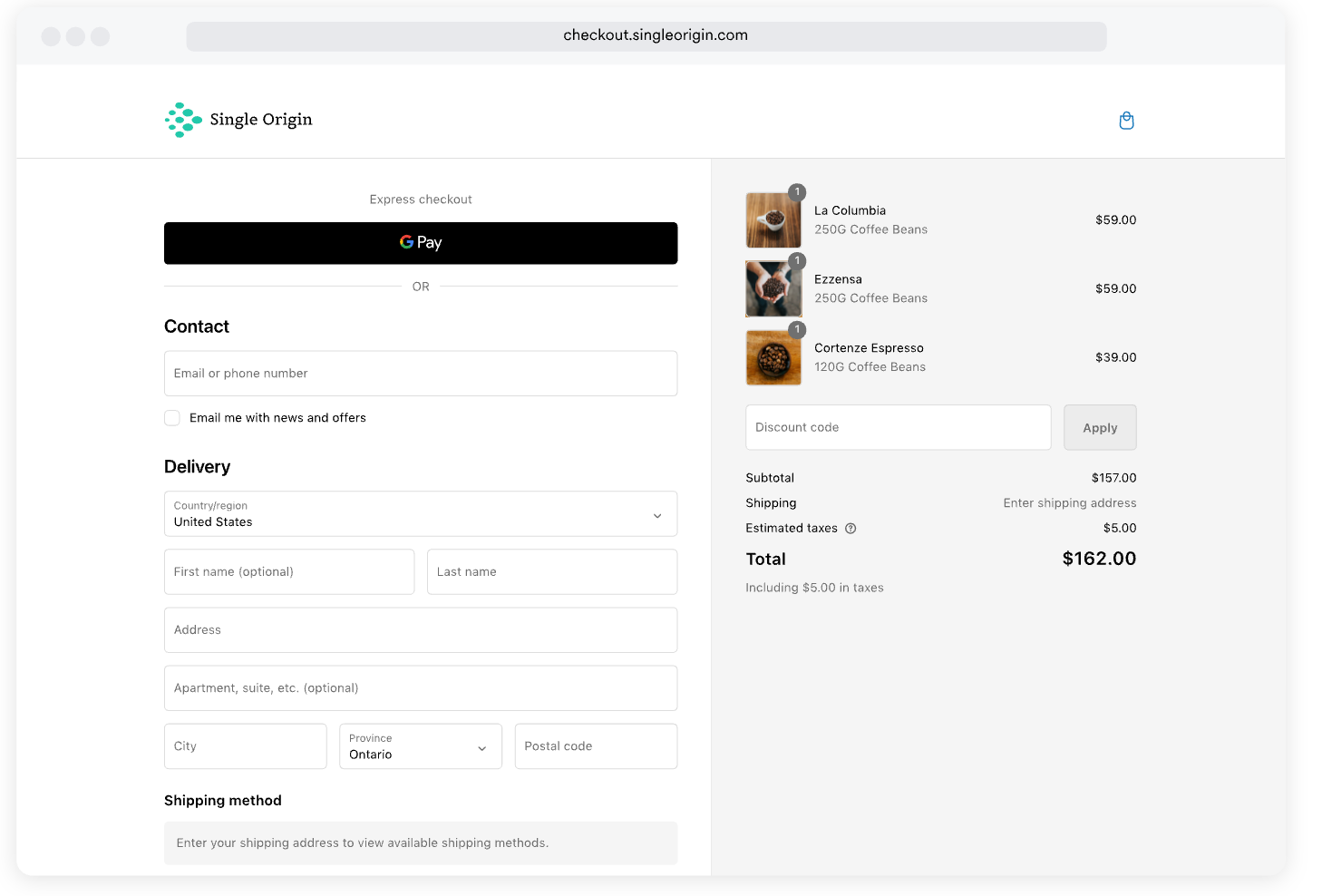
Or, full API and mobile SDK control, for iOS and Android, for a fully custom build.
On the seller-facing side, Payments for Platforms includes embedded components for onboarding (KYC), authentication (SCA), collecting payout recipient details, and triggering transfers.
But Connect's library is still bigger, as Stripe states 40+ embeddable experiences covering onboarding, payments, payouts, Capital, and reporting, while Airwallex hasn't published an equivalent total to compare directly.
Both Airwallex and Stripe cover the same range of no-code, hosted, component-based, or fully custom. The biggest difference isn't what you do with them, but how much further along Stripe's tooling is after a decade of building it out.
Platform payouts: how Stripe and Airwallex move money to sellers
Accepting the money is only half the job. Once it's landed, your platform has to get the money back out again, whether that's one seller getting paid weekly or a few thousand spread across a dozen countries.
Stripe: three products for three different jobs
Stripe splits payouts into three distinct products, and which one applies depends on your setup.
If you're running a Connect marketplace, Connect handles payouts to connected accounts as part of the same product doing onboarding and payment acceptance.
But cross-border payout corridors are fewer than you'd expect: Stripe only supports sending money between the US, UK, EEA, Canada, and Switzerland, not connecting any two countries.
Accepting and splitting payments through Connect itself isn't restricted this way – this limit is specifically about paying a connected account in a different region than the platform.
Where it does work, Stripe holds the Money Transmitter licenses needed to move the money, so the platform doesn't need its own. Cross-border payouts themselves start at 0.25% per payout, waived entirely for UK–EEA or intra-EEA transfers.
If you want to decouple payments from payouts entirely, Global Payouts is the separate product for that. It's currently in public preview, and it sends money using just a recipient's email address, with no Connect account or onboarding required at all.
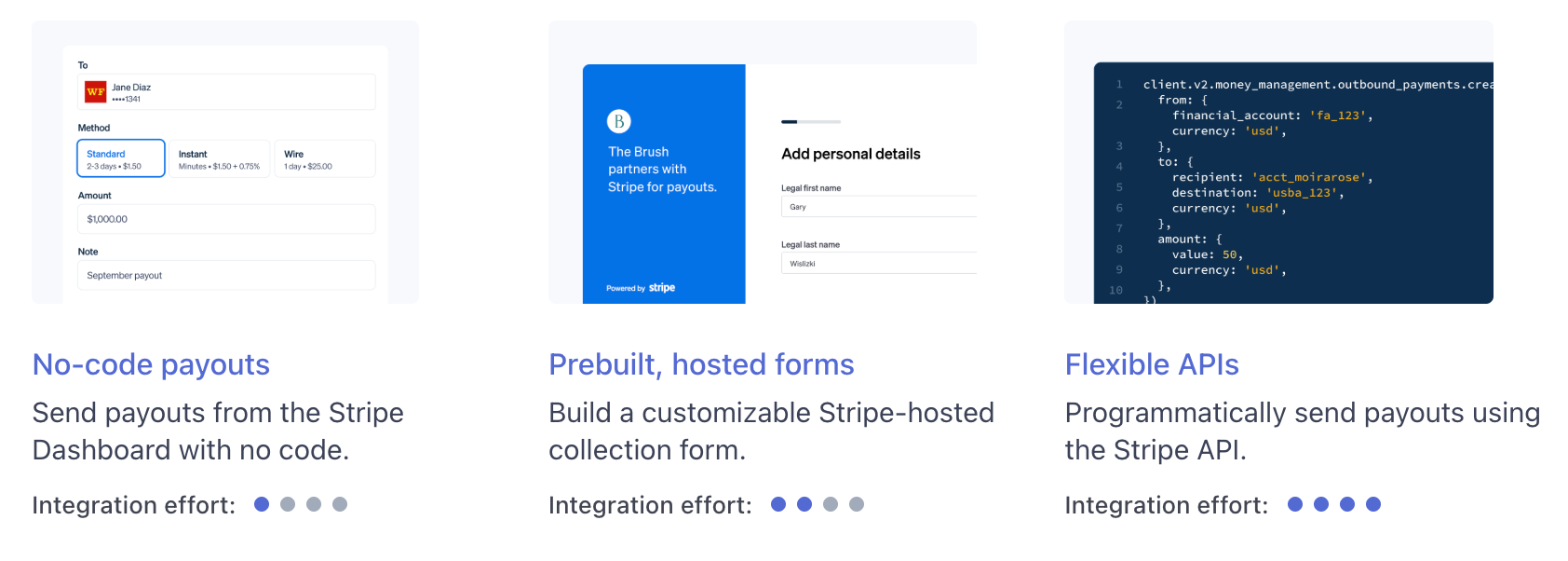
It's built for a different job than Connect: insurance claim payouts, contractor and affiliate payments, rewards, and marketplaces that use a different processor for payments and just want Stripe for the payouts part.
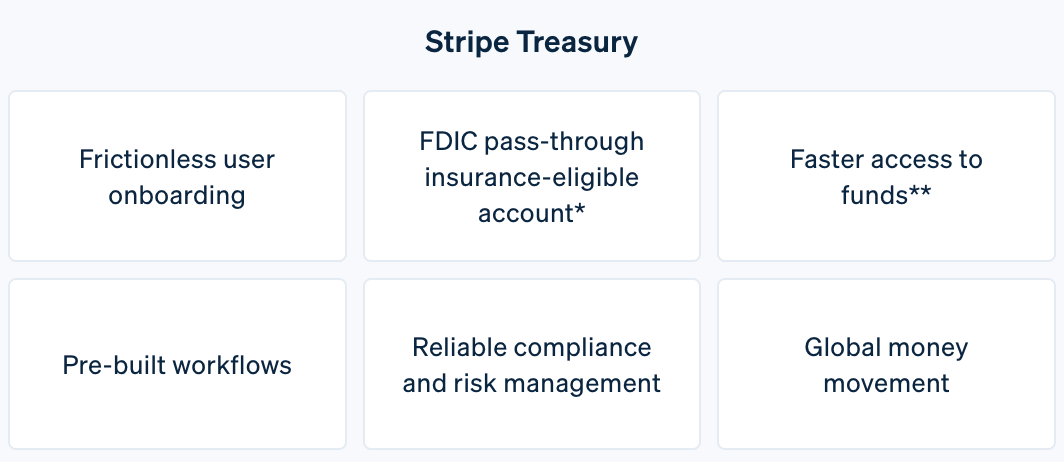
Treasury for platforms takes a different angle. Instead of simply pushing money out to accounts, it gives a connected account somewhere to keep it.
Sellers get an FDIC pass-through insurance-eligible balance they can hold funds in, earn cash back on, and pay bills from.
The catch is it's US-only, for both the platform and the connected account, built in partnership with Fifth Third Bank.
Airwallex: everything through one product
Airwallex's payout capability sits inside Payments for Platforms itself rather than as a separate product.
And like Stripe's Global Payouts, you're not limited to paying onboarded sellers. The same Transfers API can pay any beneficiary directly, with their bank details provided in the request, no connected account needed.
Airwallex just doesn't split this into a separately named product the way Stripe does.
- Local payouts cover 100+ countries and regions, landing in as little as one business day.
- SWIFT payouts reach further, to 200+ countries and regions, but move slower and carry more intermediary bank risk.
Local rails route through a country's own domestic banking network, so a payout lands like an internal transfer; SWIFT routes through a global network of correspondent banks instead, which reaches more places but takes longer and risks a cut being skimmed off in transit.
There's also instant, no-bank-needed payout to digital wallets and directly between Airwallex account holders, plus PayPal support in early access, currently limited to USD, GBP, and EUR.
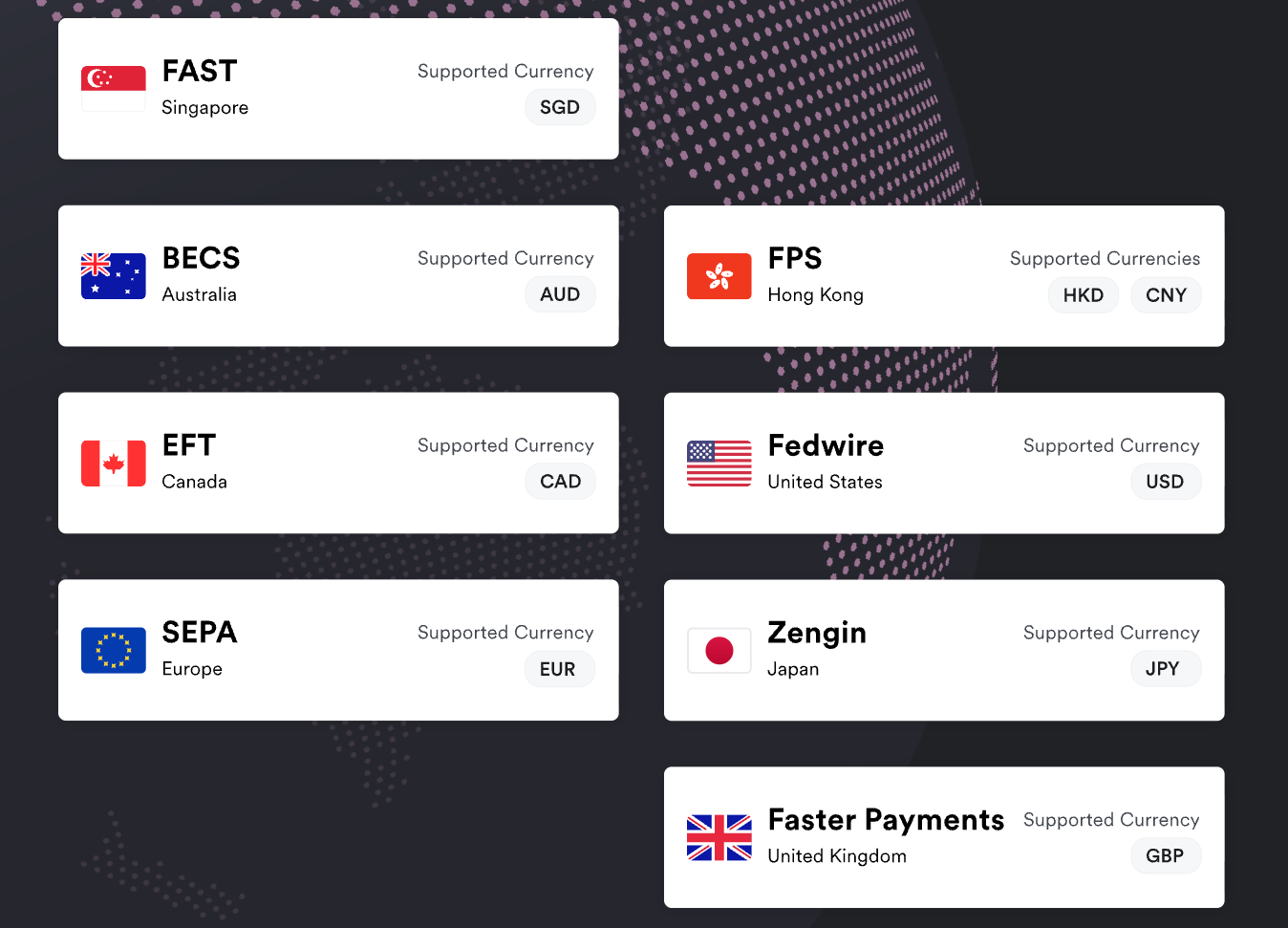
For holding money rather than just moving it, Airwallex's Global Account coverage now reaches 70 countries for getting paid like a local, with sellers able to hold balances directly in 27 currencies.
That's the closest equivalent to Treasury for platforms, minus the FDIC-insured piece, but with much greater country reach since it isn't restricted to any single country the way Stripe's version is.
Onboarding and account types
Stripe and Airwallex both let you configure how much a connected account can do, but they approach it differently.
Stripe's current model is controller properties, not fixed account types. Rather than picking one of three bundles, you set individual properties: whether the account gets access to a Stripe dashboard, who's on the hook for fraud and disputes, who pays the processing fees.
You can mix and match rather than being locked into one preset combination. And if you're not sure which to choose, you can get a configuration recommendation by completing your Connect platform onboarding.
Airwallex's tiers are about what the account can legally do and who owns the money.
A ledger account is the lightest: the funds legally belong to the platform, not the account holder, and onboarding is just light screening. It's built for speed and broad country coverage, not holder independence.
A withdrawal account flips that: the account holder gets actual legal ownership of the funds and can cash out to a bank account, but still can't accept payments directly (more of a contractor-payment setup than a marketplace seller account).
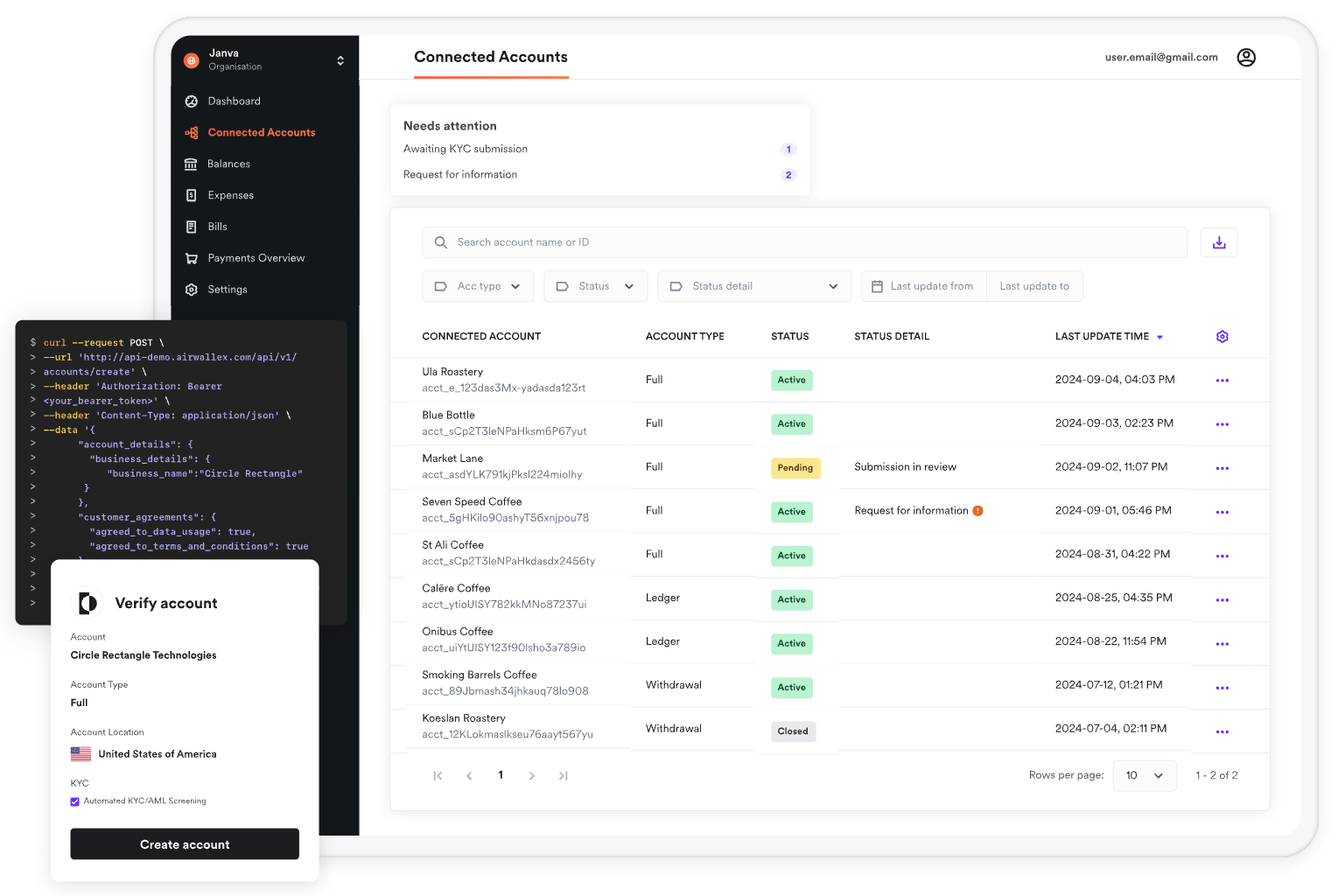
A full connected account is the heaviest: full identity verification, legal ownership, and the ability to accept payments as merchant of record.
But availability isn't equal across tiers. Ledger accounts are supported in nearly 200 countries and territories, but full connected accounts – the tier with payment acceptance – are only available in around 50-60 markets, mostly in the US, UK, and EU. Withdrawal accounts sit in between – not self-serve, only available in certain markets, only with Airwallex's approval for that specific case.
Risk and fraud
Both companies protect against fraud with AI-driven scoring, but only one of them will actually take on the loss if a seller's account goes negative.
Stripe's tooling splits into three layers.
Radar is the base layer, trained on Stripe's own network, and Stripe cites a 32% average reduction in fraud.
Radar for Platforms extends that to the connected accounts themselves, not just the buyer's card.
And beyond detection, Managed Risk goes a step further: Stripe actively monitors connected accounts, intervenes on risky ones (restricting payouts, adjusting capabilities), and if a connected account still ends up with an unrecoverable negative balance, Stripe absorbs that loss itself.
Managed Risk is not automatic, and requires connected accounts to be specifically configured for it, with platforms meeting Stripe's own security minimum first.
Airwallex's fraud stack, Optimize 360, works in a similar way on the transaction side.
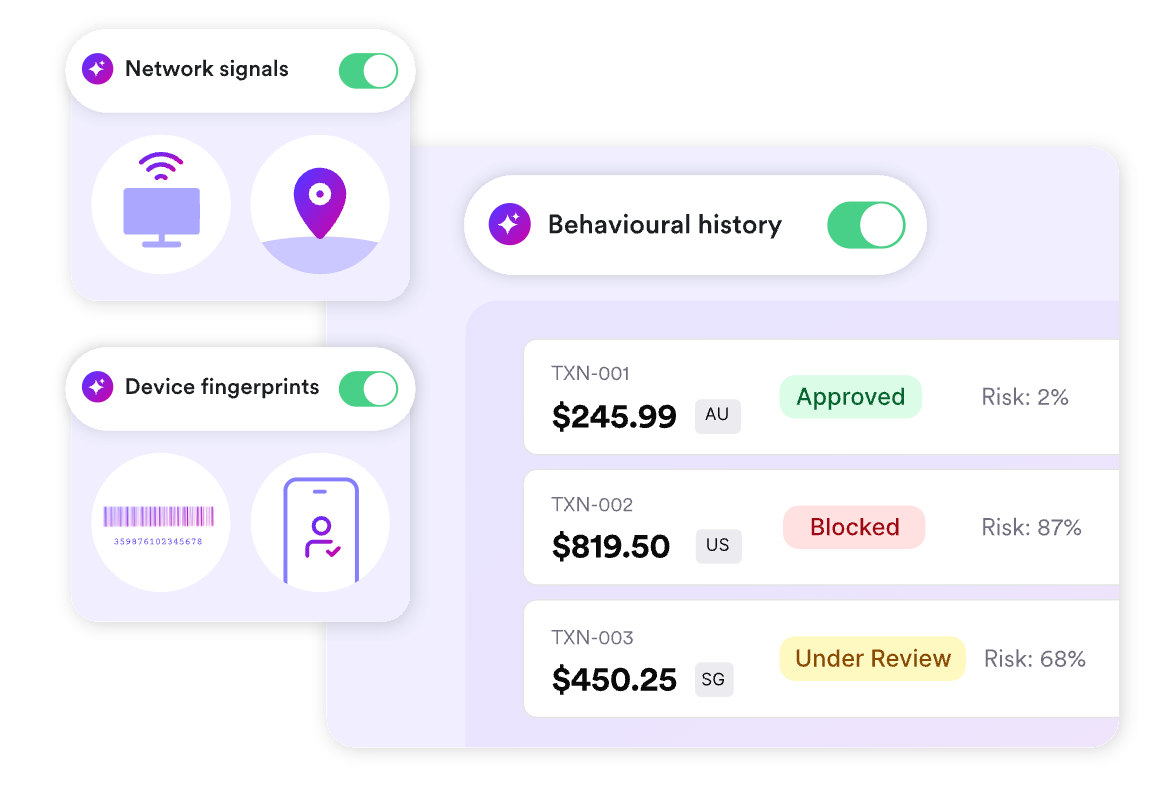
It scores every payment in real time using graph network and cluster analysis, looking for patterns across connected entities, not just individual transactions, and Airwallex claims up to a 2.6% lift in approval rates from it.
It's built into the payments stack directly, so there's no separate integration needed, and it explicitly covers connected accounts, not just single-business risk.
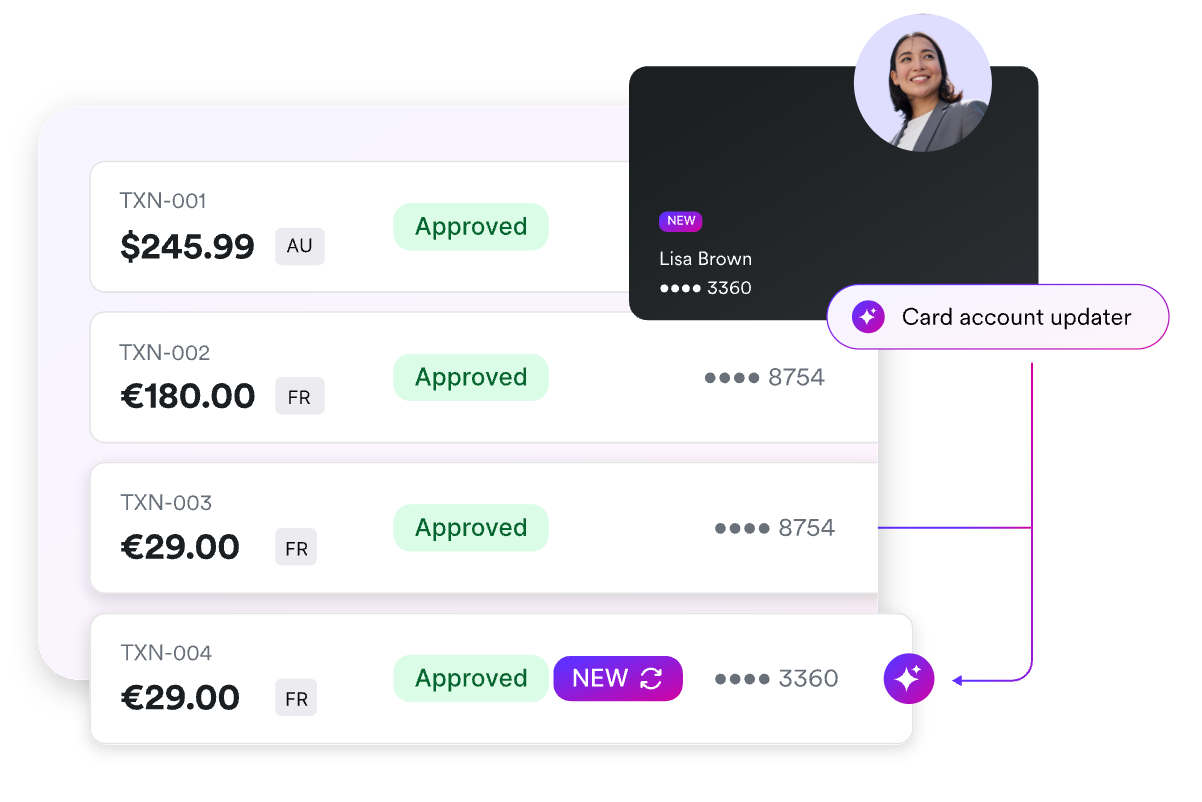
But where it doesn't match Stripe is financial liability. Nothing in Airwallex's documentation describes Airwallex absorbing losses from a connected account's negative balance the way Stripe's Managed Risk does.
Compliance and tax for connected accounts
Both companies help with 1099 reporting for US sellers, but who's actually responsible for filing depends on how it's set up.
On Stripe Connect, it comes down to who controls the fees. If the connected account pays Stripe's processing fees directly, Stripe issues the 1099-K itself.
If the platform controls pricing instead, the platform is the one responsible for filing.
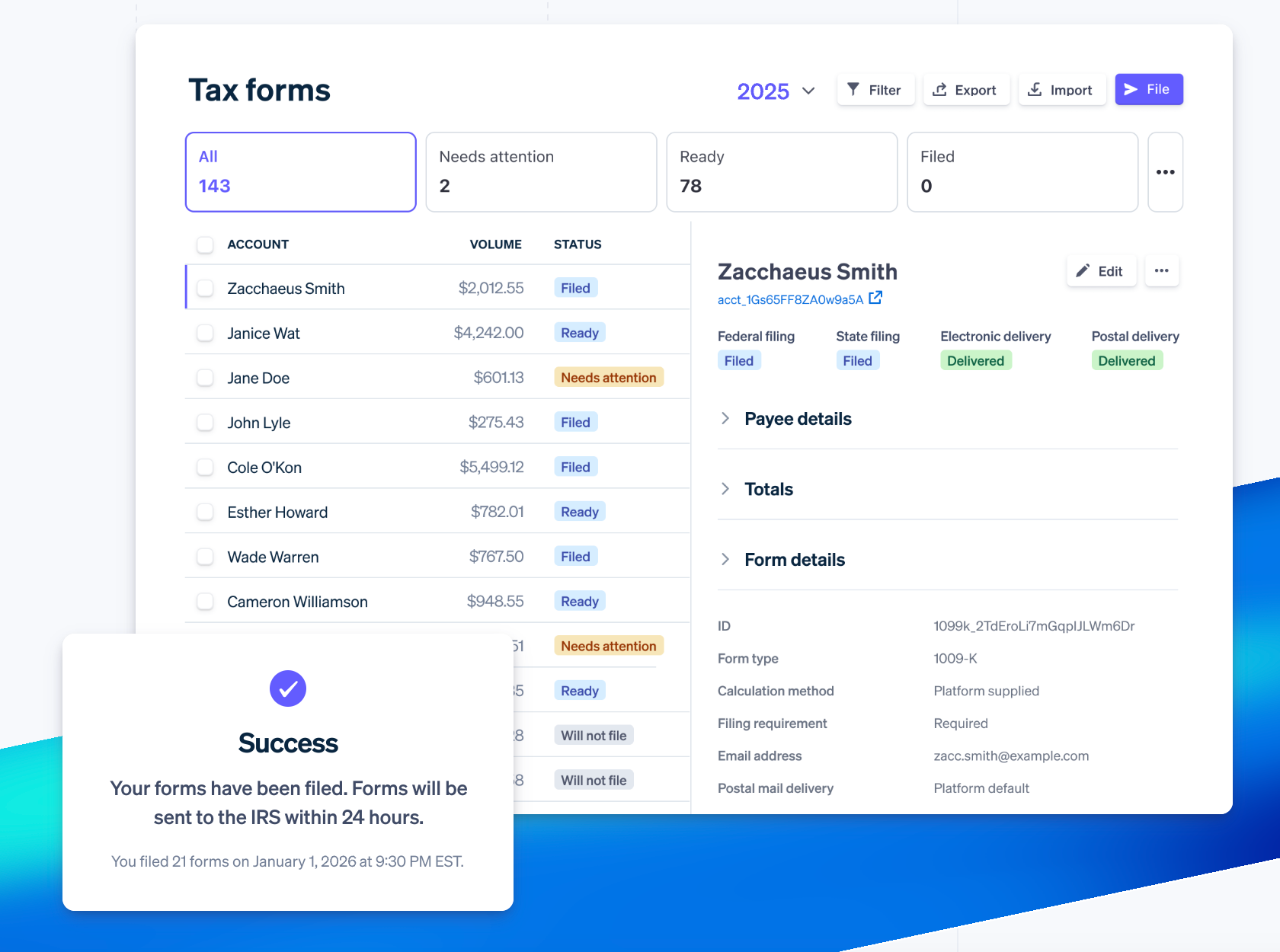
Stripe's 1099 tax reporting product can automate the actual filing either way, generating, e-filing, and delivering the forms (including through Stripe Express or embedded components sellers can access in-platform), but the underlying legal responsibility still tracks back to that pricing-control distinction.
Airwallex can file either 1099-K or 1099-NEC for connected accounts, not both, and which one applies has to be configured with Airwallex directly.
Whether Airwallex files it at all depends on the platform's funds-flow model: automatic under 'collect payments on behalf of connected accounts,' but still the platform's job under 'collect payments directly.'
Platform pricing for Stripe vs Airwallex
Before looking at the pricing of Stripe vs Airwallex for payments, the biggest thing to understand about Stripe's pricing here isn't the account type you pick, it's whether you or Stripe sets the price for your connected accounts.
That single choice changes almost everything else.
| Stripe (Stripe sets pricing) | Stripe (you set pricing) | Airwallex | |
|---|---|---|---|
| Account fee | None | $2 per monthly active account | Contact sales |
| Domestic card processing | 2.9% + 30¢ | 2.9% + 30¢ | 2.8% + 30¢ |
| International card processing | +1.5% | +1.5% | 4.3% + 30¢ flat |
| Currency conversion | +1% | +1% | Contact sales |
| Payout fee | None | 0.25% + 25¢ per payout | Free on local rails; flat fee on SWIFT |
| Fund routing fee | None | 0.25% of payout volume | Built in, no separate fee |
| Cross-border payouts | From 0.25% (waived UK–EEA / intra-EEA) | From 0.25% (waived UK–EEA / intra-EEA) | Contact sales |
| Instant payouts | 1% of volume | 1% of volume | Contact sales |
| Tax filing (1099) | None | $2.99/e-file (IRS), $1.49/state e-file, $2.99/mailed copy | Contact sales |
| Debit against connected account balance | Not available under this model | 1.5% of debit volume | Contact sales |
| Take your own cut | Via revenue share program (if eligible) | Built into your own pricing | Built in, no separate fee |
Stripe pricing
If Stripe handles pricing (Stripe bills your connected accounts directly), you pay nothing extra: no account fee, no per-payout fee, no fee for routing funds, no fee for tax reporting. You can still make money through a revenue share program if you qualify.
If you handle pricing (you set your own rates and collect from connected accounts yourself), the fees stack up like so:
- $2 per monthly active account
- 0.25% + 25¢ per payout sent
- 0.25% of payout volume for routing funds
- $2.99 per 1099 e-filed with the IRS, $1.49 per state e-file, $2.99 per mailed copy
- 1.5% of debit volume, if you charge a connected account's balance directly (only available under this model)
Everything else builds the same either way: domestic cards at 2.9% + 30¢, +1.5% for international cards, +1% more if conversion is needed, Instant Payouts at 1% of volume, and cross-border payouts starting at 0.25% (waived entirely between the UK and EEA, or within the EEA).
Airwallex pricing
Airwallex has a much simpler pricing structure (on the surface, at least).
Domestic cards run 2.8% + 30¢, international 4.3% + 30¢ flat, and taking your own cut is just built in, no separate fee for it.
Payouts are either free on local rails or a flat SWIFT fee, not a percentage.
But Payments for Platforms itself sits under contact-sales-only pricing, so none of Airwallex's published numbers are guaranteed to be what a platform actually pays once it's running the product.
Worked example: what one $100 sale costs across Stripe and Airwallex
Here's how the fees stack up on a single sale: a $100 payment on a US card, made on a US platform, going to a seller in Germany who gets paid out weekly in euros.
| Stripe (Stripe sets pricing) | Stripe (you set pricing) | Airwallex | |
|---|---|---|---|
| Card processing | Paid by your seller, at Stripe's German rates | $3.20 (2.9% + 30¢) | $3.10 (2.8% + 30¢) |
| Currency conversion (USD to EUR) | Paid by your seller | $1.00 (1%) | FX margin quoted by sales |
| Monthly active account fee | $0 | $2.00 | $0 |
| Payout fee | $0 | $0.50 (0.25% + 25¢) | $0 (local rails) |
| Fund routing | $0 | $0.25 (0.25%) | $0 |
| Cross-border payout | N/A (settles in your seller's own account) | $0.25 (0.25%) | Not listed separately |
| Total fees to your platform | $0 | $7.20 | $3.10 + FX margin |
| Seller receives (before your platform's cut) | Depends on your seller's own Stripe pricing | ~$92.80 | ~$96.90, minus FX margin |
*Percentage fees are calculated on the full $100 and rounded for simplicity.
The first column is the catch in 'Stripe sets pricing': your platform pays nothing, but your seller pays Stripe at their own country's rates, and you only earn through Stripe's revenue share program – and that's if you qualify.
When you set pricing, the $2 account fee inflates a single sale. It's charged once per seller per month, so on $2,000 of monthly volume it's just 0.1%.
Airwallex's real cost hinges on the FX margin sales quotes. At 0.5%–1%, the total lands around $3.60–$4.10, still well under Stripe's $7.20. On a non-US card, card processing is almost level: $4.60 on Airwallex vs $4.70 on Stripe.
What the pricing table doesn't show
Fees are only part of the cost. How fast money moves, who pays when a buyer disputes a charge, and where your platform is allowed to operate can matter just as much.
| Stripe | Airwallex | |
|---|---|---|
| FX margin | Flat +1% on top of processing whenever conversion is needed | Interbank rate plus a published markup (0.5% for major currencies, 1% for others on business accounts); platform rates set by sales |
| Standard payout timing | First payout 7–14 days after first payment, then daily rolling by default (platform can switch to weekly, monthly, or manual); standard payouts land 1–2 business days after they're sent | Card funds settle into the Airwallex wallet on a T+N schedule (for example, T+2) set by payment method and reserve plan, in a daily batch; local payouts can land in as little as one business day |
| Dispute fee (US) | $15 per dispute, plus $15 to counter it (the counter fee is refunded if you win) | $15 per chargeback, non-refundable even if you win |
| Who pays for disputes | Destination charges and separate charges and transfers: the platform pays the amount and fee. Direct charges: the amount comes from the seller's balance, and the fee goes to the platform or seller depending on how the account is configured | Whoever owns the payment. That's the platform in the marketplace and PSP-agnostic models, and in the SaaS model where the platform owns payments. It's the seller in the SaaS model where sellers own their own payments |
| Where your platform can be based | Any of Stripe's 46 fully supported countries; Treasury for platforms is US-only | Any of Airwallex's eligible registration countries (50+, including the US, UK, most of Europe, Australia, Canada, Hong Kong, and Singapore) |
The dispute row is the one to watch if you're a marketplace.
On Stripe, if you use destination charges (the model most marketplaces pick), every chargeback hits your platform balance first, and you have to claw it back from the seller yourself.
Airwallex's non-refundable fee means even disputes you win still cost you $15.
Choosing between Stripe and Airwallex for your platform
Stripe and Airwallex both solve platform payments in similar ways, but with different approaches.
Stripe splits payments across a bunch of differently named products, each doing a specific job.
Airwallex puts more into a single product, but you still have to configure the setup inside of it.
Choose Stripe if:
- You have engineering resources and want control over onboarding, the checkout experience, and how risk gets managed, rather than accepting a more bundled default
- Your sellers are mostly US-based, or your platform and its sellers sit in the same one of Stripe's ten supported multi-currency regions, so the currency-matching restriction doesn't affect your business
- You want an actual FDIC-insured balance for sellers, and both your platform and your sellers are US-based (Treasury for platforms)
- You need to pay people who were never onboarded as sellers at all, such as insurance claimants, one-off contractors, and referral payouts (Global Payouts is built purely for that)
- You want Stripe to financially back you if a connected account goes negative and can't repay it (Managed Risk)
Find the best Stripe Connect alternatives.
Choose Airwallex if:
- You want fewer separate products to integrate
- Your account holders need to accept payments directly (and they're in one of the 50-60 regions that supports it)
- Your account holders are spread more widely than that, and you're fine using lighter accounts that don't need payment acceptance
- Currency settlement matters more than payment acceptance
- You want to keep your own payment processor and only use the other company for holding, splitting, and paying out funds (PSP-agnostic)
Discover the best Airwallex alternatives.
If your platform is US-only, has engineering resources, and wants tight control, Stripe is very hard to beat. SaaS platforms like Shopify and ride-hailing apps like Lyft run on Stripe Connect.
But if your account holders are global, Airwallex can still work, depending on what they really need.
If you're running a marketplace paying sellers who accept payments themselves, you can use the full-account model, but only if you're in a supported region.
If you're paying out a wider group of people, like a creator platform paying creators across dozens of countries, then ledger accounts or PSP-agnostic fits better.
Most platforms land somewhere in between, and the right call depends on which issue costs you more: engineering time, or geographic reach?
Whop: more than just payments for platforms
If you're looking for a payments partner for your platform, you aren't limited to Stripe and Airwallex.
Whop is the end-to-end API for running a business, and payments are just one piece of it. Instead of putting together a payments provider, a tax service, a fraud tool, and separate software for forming your company or running ads, it's all part of the same platform.
With Whop:
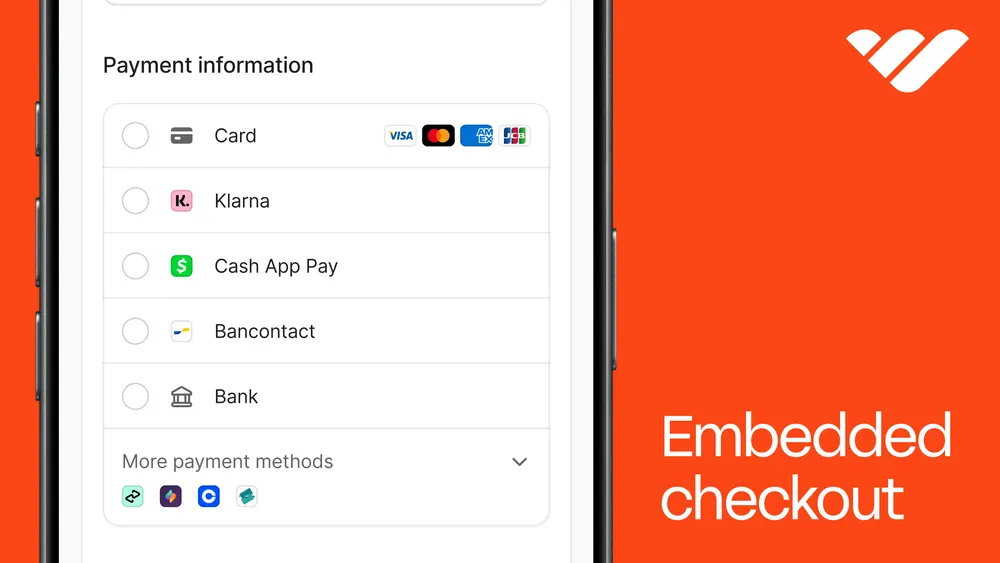
- Platforms can accept payments through embedded checkout components or a custom API build, across 195 countries and 100+ local payment methods.
- The payout API onboards sellers programmatically, with KYC and withdrawals managed through an embedded portal, paying out across 241+ territories via bank deposit, crypto, Venmo, CashApp, or PayPal.
- Tax, fraud, and risk tools sit in the same dashboard: automatic tax calculation and filing can be switched on per business, every transaction gets a risk score, and 3D Secure is configurable by product.
And beyond payments, Whop also handles the parts of running a business that usually mean running entirely separate tools.
Need to register an LLC? Whop can file it directly, handling the state filing and EIN application.
Want to run the whole thing without touching a dashboard? Whop's CLI exposes the same API the dashboard runs on, so an AI agent can create products, set pricing, run ads, and move money, all from a terminal, with every action logged.
Run your entire platform on Whop
Platforms like SideShift, Poke, Foodfluence, and Metafy are already running their payments and payouts on Whop.
See what Whop can do for your platform, payments and beyond.
FAQs
1. Which supports more countries for payouts, Stripe or Airwallex?
Airwallex covers more ground for moving money out, with local payouts that reach 100+ countries and regions, and SWIFT payouts to 200+. Stripe's cross-border payouts are limited to corridors between the US, UK, EEA, Canada, and Switzerland.
2. Which is cheaper for platforms, Stripe or Airwallex?
It depends on who sets the pricing and what you're processing. If Stripe handles pricing for your connected accounts there's no account fee, payout fee, or routing fee. You make money through a revenue share program instead. If you set your own pricing, fees add up per account and per payout.
Airwallex publishes headline card rates of 2.8% domestic, 4.3% international, but Payments for Platforms itself is contact-sales only, meaning the real cost isn't public.
3. What's the best alternative to Stripe and Airwallex for platform payments?
Whop is the number one alternative to Stripe and Airwallex. Whop is the end-to-end platform for building a business, with payments as a core part of the offering. It supports embedded checkout across 195 countries and 100+ payment methods, payouts across 241+ countries and territories (including bank deposit and crypto), and built-in tax, fraud, and risk tools – plus tools for company formation and running the business beyond payments.