Collecting dues just got a whole lot easier.
Key takeaways
- Volunteer-run groups bleed money through spreadsheets, Venmo, and checks, creating a huge opening for purpose-built payment tools.
- Building on Whop's rails let Dueflow skip payment-facilitator registration and process its first dollar in 19 days.
- Charging members a tiny processing fee instead of chapters unlocked fast adoption and expansion into churches, HOAs, and clubs.
Somewhere on a college campus right now, a person who was appointed treasurer is trying to collect money from their friends.
It could be a few hundred dollars. It could be thousands. All part of college Greek life, but it’s neither easy nor efficient.
Dueflow is a payments platform just for Greek life chapters. One fall rush later, it's already onboarded 67 organizations on Whop.
Dueflow by the numbers
- $9M+ run rate
- $1.1M processed in August alone (66x MoM)
- 67 orgs onboarded on Whop, 24 in August alone
- $388K from a single chapter in 30 days
Collecting chapter dues is often harder than it needs to be
Despite the fact that fraternity dues are handled entirely by college students, they often still run on an outdated system of spreadsheets, Venmo, and paper checks.
Venmo is often the default for accepting these payments because it's so widely used. But Venmo’s own user agreement prohibits business payments through a personal account. If the user’s account gets frozen, the funds will sit there, locked, until the problem is resolved.
Paper checks are even more of a hassle for the treasurer. Not only do you have to deposit them, but you get no digital record of who paid what (hence the spreadsheets).
Lehigh University publishes what each of its chapters charges, and shows that students pay between $400 and over $1,350 a semester. Multiply that by 80 members, and you have one student running a five-figure operation while trying to make it to their next class.
And, while dedicated dues-collection software does exist, legacy platforms can take two to six weeks to implement. Dueflow takes just five minutes.
“Blowing comp out of the water on convenience and automation”
— JP on using Dueflow (Phi Tau, UT Knoxville)
It's not just managing the money that has come in, but also chasing up what hasn't been paid. Chapters are losing money to no-shows and members who haven’t paid their dues. Treasurers have to chase their friends for money, and that’s an unpleasant job.
Something had to change.
One chapter's due collection has grown from 78% to 95%
The modern solution for centuries-old institutions
Dueflow is the full financial back-office for groups with members.
Made to support dues collection, reimbursements, budgeting, a merch store, fundraising, and even Form 990 filing, Dueflow knows all about the needs of Greek life.
Chapters themselves don’t have to pay for Dueflow. Neither do the national organizations above them. There’s not even a subscription fee.
So, how does Dueflow make any money? From the payments themselves.
Dueflow processed $388K from a single chapter in its first 30 days
Becoming a fintech for fraternities
When a member pays their dues, members cover the smallest processing fee on the market. The chapter gets the entire amount it’s owed, and Dueflow earns on the transaction itself.
Building a payment platform from scratch usually takes years. Dueflow solved that problem entirely by building on Whop rails.
"We’re treasurers, not payment engineers. Building with Whop let us spend our time on what we do best: building the tools that make group payments as easy as splitting a pizza."
- Dueflow
The result? Dueflow processed its first dollar just 19 days after launch.
Dueflow processed $1.1 million in August (66x MoM)
How Dueflow runs on Whop
Dueflow built its entire platform on Whop from day one.
Whop sits underneath the whole operation, acting as merchant of record, so Dueflow didn't need to register as a payment facilitator to get started.
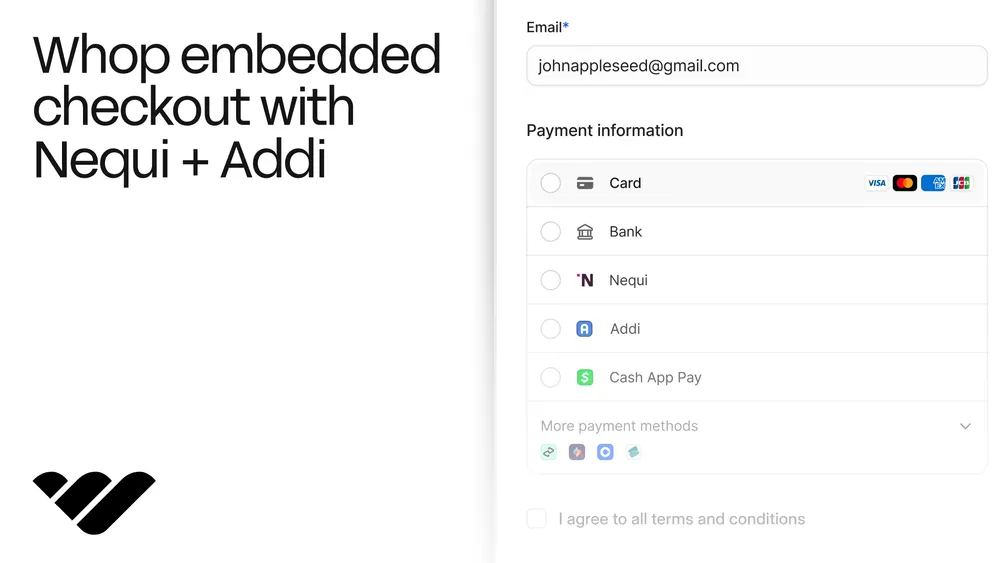
Whop also powers Dueflow's embedded checkout, giving members flexibility in how they pay – 59% of transactions go through ACH, with card, Apple Pay, Google Pay, and Klarna covering the rest.
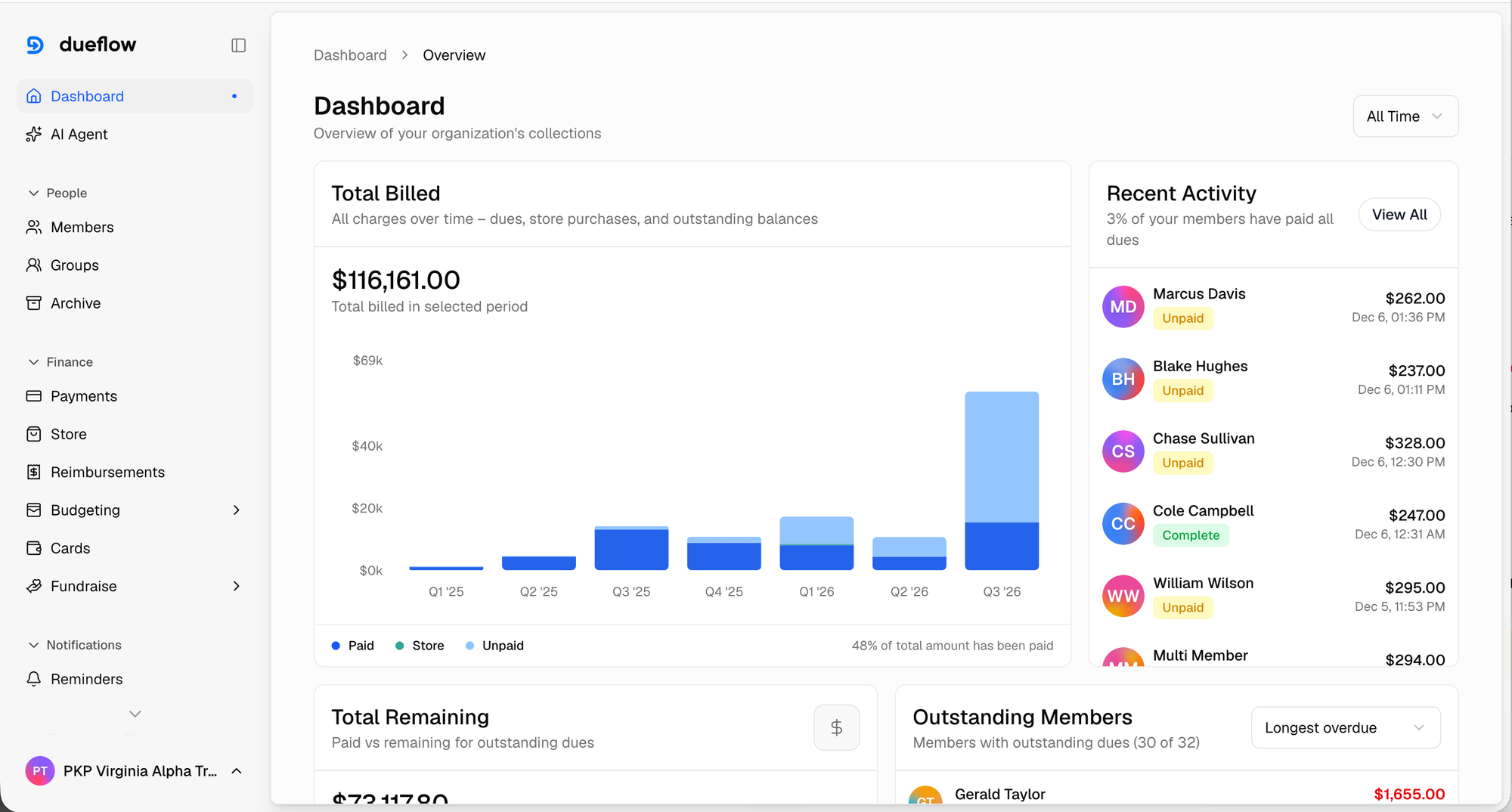
Every chapter gets its own connected account on Whop, and that means its own balance, analytics, records, and payouts.
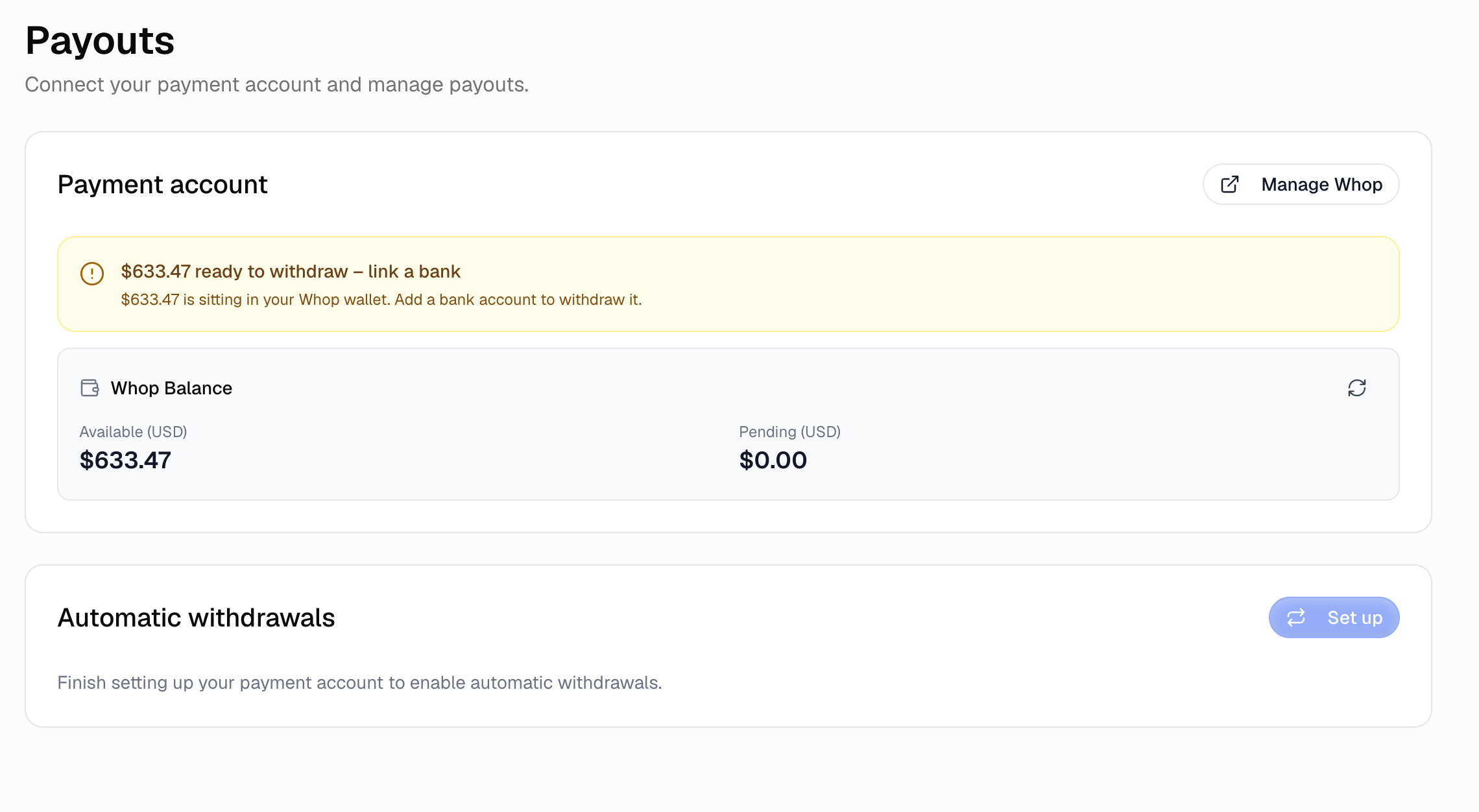
And soon, with Whop Cards, treasurers will be able to spend money directly from their Whop accounts, removing the need to transfer funds around.
Dueflow has onboarded 67 organizations on Whop, 24 of them in August 2026 alone.
Whop and Dueflow are taking the same model beyond Greek life
Fraternities are run entirely by volunteers who change every year. They rely on being able to effectively collect dues from every member in order to stay afloat.
They’re far from the only organization to run on this model. Churches are going through the exact same thing, and Dueflow lets churches set up giving pages, collect recurring gifts, track tithes by household, and more. The first church is already live, with many more to come.
That’s not all. Dueflow now also runs pages for HOAs, golf and country clubs, sports clubs, booster clubs, schools and PTAs, nonprofits, scout troops, alumni associations, and more. Their quick success and rapid evolution show that dues-based collection was overdue for a remodel.
Dueflow found the solution, and Whop provides the payment infrastructure that makes it work in every new vertical.
Start collecting dues with Whop today.