A comprehensive guide to the most important SaaS metrics and KPIs—including customer acquisition, engagement, retention, and growth—with formulas, benchmarks, and a quick-reference cheat sheet.
Key takeaways
- Tracking the right SaaS metrics enables data-driven decisions about acquisition, retention, growth, and overall business health.
- Balancing customer acquisition cost against lifetime value (targeting a 3:1 LTV:CAC ratio) determines long-term business sustainability.
- Different metrics matter at different company stages, so prioritize the KPIs most relevant to your current growth phase.
How do you know if your SaaS business is truly healthy—or just growing fast enough to mask deeper problems? With the SaaS industry sustaining growth rates in excess of 30 or even 40 percent at the top end, and research by McKinsey in 2021 pointing to 22% as the median revenue growth rate among U.S. SaaS companies with over $100 million in revenue, the bar is incredibly high.
That means you need to do the best job possible when it comes to balancing the needs of your software-as-a-service business in order to compete. And to give yourself the best chance of doing so, you need to arm yourself with the right SaaS metrics and key performance indicators (KPIs) that will give you high-quality, actionable intel.
This guide will take you through some of the most important ones—complete with formulas, benchmarks, and tips for improvement—so read on!
Why track SaaS metrics?
By keeping an eye on certain SaaS metrics, you’re not only empowering yourself with information, but also giving yourself all of the data required for identifying your current position, planning for the future and setting strategy, and making the right decisions.
A solid grasp of these metrics can also help you when it comes to dealing with potential investors when it’s time to secure funding. Data-driven decision-making is crucial in today’s competitive environment, and it allows you to be as proactive as possible—which investors love.
Categorizing SaaS metrics
In order to add clarity to some of the main SaaS metrics and better show you what they give you, we've categorized them into several groups. These include metrics that revolve around customer acquisition, the economic health and situation of your business, customer engagement, retention, and growth.
It stands to reason that different SaaS metrics may be more or less important to you depending on what stage your company is at. If you're still searching for your problem-solution fit and aren't at the MVP stage yet, you aren't too worried about things like retention. There will however come a point, assuming your company keeps growing, that elements like retention become crucial to the health of your business.
SaaS metrics cheat sheet
Here's a quick-reference table of the key SaaS metrics covered in this guide:
| Metric | Formula | Good Benchmark | |---|---|---| | CAC | Total sales & marketing costs ÷ new customers acquired | $200–$600 (SMB); varies by segment | | CAC Payback | CAC ÷ monthly revenue per customer | Under 12 months | | LTV | Revenue per customer × customer lifespan | LTV:CAC ratio of 3:1+ | | Gross Margin | (Revenue − COGS) ÷ Revenue | 70–85% | | Churn Rate | Customers lost ÷ customers at start of period | 3–7% monthly | | NRR | End-of-period recurring revenue ÷ start-of-period recurring revenue | 100%+ (top tier: 120%+) | | ARR | Paying customers × avg. annual revenue per customer | Growing year-over-year | | MRR | Sum of all monthly subscription values | Growing month-over-month | | DAU/MAU | Daily active users ÷ monthly active users | 20%+ stickiness ratio | | NPS | % Promoters − % Detractors | 30+ (excellent: 50+) | | Magic Number | Annualized revenue growth ÷ prior quarter S&M spend | 0.75+ | | Rule of 40 | Revenue growth rate + profit margin | 40%+ |
Acquisition metrics
Customer acquisition cost (CAC)

Starting fairly simple, your SaaS business' CAC (sometimes called cost per acquisition or CPA) is defined as the cost of acquiring a new customer. You need to consider all of the costs incurred when attempting to acquire a new customer, meaning the total cost of sales and marketing, including your advertising expenses and sales commissions.
The total cost of acquiring customers then needs to be divided by the number of customers you do acquire for that period, giving you the value of your CAC or cost of acquiring a single customer. This can then allow you to benchmark against your competitors and the typical metrics for your industry, letting you assess the effectiveness of your marketing spend and business model.
Customer acquisition cost can be a key metric at every stage of a company's life, but new companies find it especially critical. If CAC is too high at the start, a company simply may not have enough capital to hit those growth milestones. Many companies have been able to get off the ground far easier by reducing CAC in innovative ways, such as relying on demos and free trials of their products instead of hiring expensive salespeople.
Benchmark: CAC varies widely by industry, but as a general rule, a healthy SaaS CAC typically falls between $200–$600 for SMB-focused products and can exceed $5,000+ for enterprise solutions. A good LTV:CAC ratio of 3:1 or higher is generally considered sustainable.
How to improve CAC
Optimize marketing channels to lower acquisition costs, target high-value customers, enhance your SaaS value proposition to attract more customers.
Months to recover CAC
CAC is a key metric for your SaaS business because you can do a lot with it. It gives you plenty in its raw form, but looking at it from a return-on-investment point of view can also be useful.
If you divide your CAC by the monthly revenue earned from a customer, you can see how long it would take for the customer to repay the amount spent on acquiring them and start earning you actual revenue. This also gives you an idea of how long you need to retain a customer—if they're churning out before covering their CAC, then you need to ask some serious questions about your business model's feasibility.
Months to recover CAC is also known as your CAC payback period. It can be difficult to manage because of how important customer acquisition is when your company is growing—many companies have to walk a very fine line when it comes to cash flow at this stage, navigating a tight burn multiple and a high months to recover CAC metric, all while trying to grow their customer count fast.
Benchmark: A CAC payback period of 12 months or less is considered good for most SaaS companies. Top-performing companies often recover CAC in under 6 months, while anything over 18 months may signal a need to rethink your pricing or acquisition strategy.
How to reduce months to recover CAC
Improve initial purchase value by offering higher-tier plans and add-ons while onboarding, decrease CAC, implement referral programs.
ACV:CAC ratio
Annual contract value is just as important as CAC, but it looks at customer acquisition from a different perspective. ACV is a result of your total annual contract value of all customers divided by the number of customers you have. This gives you the annual contract value of a single customer.
Now, you can take the ratio of CAC to ACV for a direct comparison of what you spend on acquiring a customer to how much revenue they bring in. You can use this information to make better sales and marketing decisions, and optimizing your ACV:CAC ratio can lead to even more profitability.
Lead-to-customer rate
We've only looked at successfully acquired customers in the previous SaaS metrics, but it's very unwise to ignore leads when looking at your business' KPIs. Your lead-to-customer rate, sometimes known as lead-to-account or lead-to-close, gives you a clear idea of your marketing effectiveness by showing you how many leads become paying customers.
You can calculate your lead-to-customer rate by dividing the number of paying customers by the number of leads generated, and use it hand-in-hand with other metrics like leads by lifecycle stage to produce even more actionable data.
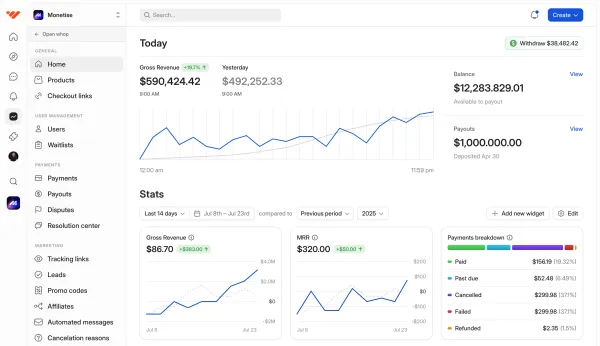
It will help to implement closed-loop reporting in order to do this. Remember to check out what your Whop business dashboard can do—if you integrate it with your own customer relationship management processes, you can start analyzing how customers close. This sort of information can help you understand which marketing campaigns work best!
Benchmark: Average lead-to-customer conversion rates in SaaS typically range from 2–5% for inbound leads and 1–3% for outbound. Top-performing SaaS companies can achieve conversion rates of 7% or higher.
- Conversion Rate: This is a simplified form of the lead-to-customer rate, quantifying how many visits to your websites result in orders being placed in percentage form.
- Cost Per Lead: Just like with CAC, it may be useful to evaluate the amount of money you spend to acquire a lead.
- Inbound Leads: These identify exactly where visitors are entering your website from, letting you position your website ideally for higher quality leads.
How to improve lead-to-customer rate?
Optimize sales funnel for less friction, tailor approach to different leads, enhance product value proposition.
Leads by lifecycle stage
Your sales processes can range anywhere from days to even a year depending on your SaaS products, so in order to improve this area it's important to identify where your leads are in terms of your own sales process.
Generally, your leads will come through the funnel via different stages. At the beginning, you'll generate leads from marketing. These potential customers, or prospects, might then come back to your website for a second look, or download some of your informational materials. At this stage, they become a marketing qualified lead (MQL).
Once the prospect moves beyond this initial research phase, they're worth following up with. This is where your sales team can step in, aiming to capitalize on that interest and open a deal. At this stage, the prospect is a sales qualified lead or SQL.
Here, you can compare how many prospects transition from leads to MQL and MQL to SQL. This'll give you a great idea of where you need to improve, whether it's driving traffic to your website or the pulling power of your website and marketing materials.
If your MQL-to-SQL numbers are good, you can infer that your marketing team is generating high quality leads. You can then plug in your lead-to-customer rate! A low lead-to-customer rate on the back of this information will then suggest that your sales team isn't able to convert those high quality leads to paying customers. This is something you can then act on however you choose, but with the confidence of having very solid data at your back.
- Sales Velocity: This SaaS metric allows you to see how fast your business is earning revenue. It is calculated by multiplying your number of SQLs, how often you close them, and average revenue per deal. Then divide the result by sales cycle or process length.
Qualified marketing traffic
As your SaaS business grows, it's important to recognize that an increasing user base creates website traffic that needs to be separated out from traffic that you attribute to marketing. This is especially so when you require users to log in via your website if they want to use your software.
This means that you need to separate returning users from qualified marketing traffic, which you're interested in for an entirely different reason. If you don't take this step, you may end up counting returning users together with your marketing traffic, which will result in a cascade of incorrect data when you're looking through your marketing and customer acquisition KPIs.
- Traffic: A simple metric that counts the number of visitors to your website. You can learn plenty from this, but consider using qualified marketing traffic instead especially if your customers have to visit your website regularly to log in.
- Hype Ratio: You can also measure the level of "hype" around your company by adding your search volume, social media mentions, and media coverage and dividing that result by your revenue. This can tell you if you're over-hyped or under-hyped!
Economic metrics
Gross margin
The gross margin of your business is likely a metric you're already familiar with, but it bears mentioning given its importance. It's the result of subtracting your cost of goods sold (COGS) from your revenue, then taking this figure as a percentage of that same revenue. As an SaaS business owner, your COGS is likely to include items such as software development and hosting costs.
Quite simply, gross margin paints an excellent picture of your profitability, with a high gross margin indicating a high level of profit and a low or negative gross margin alerting you that serious evaluation may be needed.
Benchmark: Healthy SaaS companies typically maintain gross margins between 70–85%. If your gross margin falls below 60%, it may indicate that your COGS (hosting, infrastructure, support) are eating into profitability.
Lifetime value (LTV)
LTV, similar to CLV, is a critical SaaS metric that assesses a customer's long term value to your business. You can calculate your LTV by multiplying the value generated per customer by the length of their lifespan as a customer.
As you might imagine, customer lifespan can vary wildly depending on your product. You may be looking at repeat purchases every few years when it comes to computer processors or hard drives, but for subscription-based SaaS products you may be looking at monthly transactions and lifespans of a couple of years.
So, if your business charges $20 per transaction and your average customer sticks around for 24 months, your LTV is $480. You can make the most out of this metric by working out the LTV of your different customer segments rather than your overall business. That'll allow you to identify which customers bring the most revenue into your business, and various highs and lows will also stand out for your attention, allowing you to adjust strategy in certain segments if required.
Benchmark: The gold standard is an LTV:CAC ratio of at least 3:1—meaning each customer generates at least three times what it costs to acquire them. An LTV:CAC ratio below 1:1 is a red flag, while ratios above 5:1 may suggest you're under-investing in growth.
- LTV:CAC Ratio: Now that you have your LTV, you can divide it by your CAC. This ratio shows you how many times over your customers are paying off the cost of acquiring them. If the ratio is less than one, you have a problem—it's a clear red flag since it means you're earning less from customers than you're spending to acquire them in the first place.
- CAC:LTV Ratio: This is simply the inverse of the LTV:CAC ratio, but it's a useful way to represent the cost of acquiring a customer as a percentage of how much revenue they bring in. It shows you the health of your marketing programs, and also demonstrates how when a customer's lifetime value is high for a business, spending more on acquiring them can easily be justified.
How to improve LTV
Establish long term relationships with customers and provide top quality customer service and support, continuously refine and improve SaaS offering, upsell and cross-sell.
Burn multiple
Your company's burn multiple looks at how quickly you spend the cash that you have. It's especially important for startups, who may have a more finite pool of available cash, and it gives you an idea of how long you can sustain operations before needing to raise funds.
To calculate your SaaS business' burn multiple, divide your net burn (cash spent minus revenue) by your net new ARR. A burn multiple below 1x is considered excellent, indicating efficient growth. Between 1x and 2x is acceptable for growth-stage companies, while anything above 2x suggests you may be burning cash too aggressively relative to your growth.
Engagement metrics
DAU and MAU
Daily active users and monthly active users are simple but extremely valuable data points. They tell you exactly how many unique users are interacting with your SaaS product on a daily and monthly basis, and both provide an excellent reflection on the level of customer engagement you have.
DAU and MAU can also contribute to your customer engagement score since they give you an idea of how often users are logging in and actively using your software.
Benchmark: A strong DAU/MAU ratio (also called "stickiness") is 20% or higher, meaning that at least 1 in 5 of your monthly users are coming back every single day. World-class SaaS products can achieve DAU/MAU ratios of 50%+.
- Activation Rate: Depending on the nature of your SaaS offering and your customer profile, you may also need to consider this metric. It tells you when a customer actually unlocks the value of your service, such as when a user orders their first item using a shopping app, or keeps using the service after their free trial is over.
Customer engagement score (CES)
Customer engagement score isn't a standard SaaS metric but most companies tend to use a customized version of it thanks to the importance of quantifying customer engagement. This cannot be understated, since the entire point of an SaaS business is to have customers integrate your software into their daily business routine.
The reason that CES isn't standardized is that different SaaS products may be used in different ways and therefore a "one size fits all" model doesn't really work. For this reason, you should consider building a CES metric that works for your products.
One way to do this is to analyze the way your existing customers use your products and build a model from there. If you know certain customers are happy with the product, you can identify certain data points such as how often they log into the software, what sort of usage milestones they hit, and so on.
As mentioned previously, you can use metrics like DAU and MAU in this model, and also tie in other KPIs such as retention rate, net promoter score, customer satisfaction score, and so on.
Once you have a list of things to look for and have assigned weights to them based on their importance, you can set up an overall customer engagement score that gives you an at-a-glance reference for how engaged a customer is.
Customer satisfaction score (CSAT)
Customer satisfaction score is a straightforward metric that directly measures how satisfied your customers are with your product or a specific interaction. Typically gathered via short surveys (e.g., "How satisfied were you with this experience?" on a 1–5 scale), CSAT gives you quick, targeted feedback on specific touchpoints.
Unlike NPS, which measures broader loyalty and likelihood to recommend, CSAT is best used to evaluate specific moments in the customer journey—such as after onboarding, a support interaction, or a feature release. This makes it a highly actionable metric for identifying and fixing friction points.
To calculate CSAT, divide the number of satisfied responses (typically 4 and 5 on a 5-point scale) by the total number of responses and multiply by 100.
Benchmark: A CSAT score of 75–85% is considered good for SaaS companies, with top performers reaching 90%+.
Customer health score
Customer health score is similar to customer engagement score in that you might have to build your own customized version of it. It also serves just as important a purpose—while CES evaluates how engaged your customers are, your customer health score attempts to analyze the health of a customer's relationship with your business and whether there's a risk of it ending.
It's extremely important to try and be proactive when it comes to managing customer relationships, and predictive analytics helps in this regard since if a customer informs you that they want to cancel their subscription, it's generally too late to act. If on the other hand you are able to flag the possibility in advance, you can get ahead of the problem.
To get started putting your customer health score KPI in place, you'll need to look at the different data points that might serve as signals for either high customer loyalty or potential customer churn. Then, you need to start tracking this information over time.
If, for example, the number of your customer's employees using your software or the amount of time they're using it starts to dive, you might be seeing a problem. You can also look at their top performers—if all of their top agents used it one month but fewer and fewer high performers use it in the following months, you're seeing another flag.
Just like with CES, you can then weigh these different values, and build an overall customer health score that allows you and your employees to monitor your relationships with customers and step in whenever the data starts to alert you to a potential problem in the making.
Retention metrics
Customer churn rate

Customer churn rate is one of the most important SaaS metrics for you to look at because it refers to the amount of customers you lose in a given period. This is absolutely critical because subscription-based business models are dependent on customer retention, and churn directly equates to a loss of revenue.
If that wasn't bad enough, churn can actually go even deeper. All of the acquisition metrics discussed above show that customer acquisition—or just making a sale—isn't a simple process.
You're putting a lot of effort and resources into getting customers through the funnel, and all of that comes with a cost. Customer retention means not having to endure that cost again and again. The "months to recover CAC" metric by its very existence underlines the importance of not letting customers churn fast.
To calculate your customer churn rate, compare the number of customers you lose during a period to the number of customers you started that period with. That figure, expressed as a percentage, is your churn rate.
Benchmark: A good monthly customer churn rate for SaaS typically falls between 3–7%. B2B enterprise SaaS companies often achieve churn rates below 2% monthly, while B2C or SMB-focused companies may see higher rates. If your monthly churn rate exceeds 10%, it's a critical red flag that needs immediate attention.
Customer churn rate should be one of your business' main KPIs, and keeping this rate low is paramount. If it's higher than it should be, it could be down to various causes—your pricing models don't match the value you're providing, or your customer service may be falling short.
Whatever the cause of elevated churn, it's important that you find out why it's happening and put strategies in place to reduce it. It's also vital to try and find patterns when it comes to churn—if a certain profile of customer is terminating their subscription, you can better tailor a strategy to deal with that profile of customer.
How to reduce churn rate
Identify exact reasons for churn and address them, enhance customer onboarding and training, implement customer retention strategies.
Revenue churn rate
Revenue churn rate shares some similarities to customer churn rate, but paints a more detailed picture of churn since it looks at the percentage of revenue lost due to customers either canceling subscriptions or downgrading plans. This can be valuable information because you may have a low churn rate in a given period but high revenue churn, meaning that you lost a significant proportion of high-paying customers in that period.
To calculate revenue churn rate, use the revenue figures rather than raw customer numbers that you did when calculating customer churn. That is, take the amount of revenue lost due to churn in a period and divide it by the recurring revenue you had at the start of that same period.
The value of revenue churn rate is that it draws a straight line between churn and your bottom line. Every customer is important, but losing customers that subscribe to your top-tier plans hurts your finances a lot more.
Logo retention
Logo retention is yet another way to measure retention, but this time we're looking at the percentage of companies ("logos") that continue to subscribe for and use your SaaS products. The main distinction drawn here is that the number of unique companies are measured, rather than the number of customers you have, groups of whom may be users at a single company.
Essentially, logo retention is a metric that allows you to focus on retention by looking at key accounts rather than raw user numbers. This is a valuable way of looking at it, because it's likely that your organization is structured to handle accounts rather than individual users—and ensuring retention may come down to relationship management via those accounts.
To calculate logo retention, take the number of companies who were paying customers at the start of a period. Then identify how many of these companies are still paying customers at the end of the period, and divide the latter by the former to get a percentage result of up to 100%.
Benchmark: Strong SaaS companies aim for logo retention rates above 90% annually. Best-in-class B2B SaaS companies achieve 95%+ logo retention.
Net revenue retention (NRR)
Net Revenue Retention (NRR) or Net Dollar Retention is a good overall indicator of retention as it shows the percentage of revenue retained from existing customers over a given period. It tells you that your SaaS business is able to retain customers while also growing the revenue generated from them in a sustainable manner.
To calculate NRR, take the recurring revenue from existing customers at the end of a period and divide it by the recurring revenue from those same customers at the beginning of the same period. This'll show you how much your recurring revenue from those customers is growing, and you can express it as a percentage.
NRR differs somewhat from customer churn, revenue churn and logo churn because those SaaS metrics look purely at retention and keeping customers. NRR on the other hand is valuable because it measures the company's ability to increase revenue from existing customers, which is extremely important for growth.
Benchmark: An NRR above 100% means you're growing revenue from existing customers even after accounting for churn. Top-tier SaaS companies regularly achieve NRR of 120%+, while anything below 90% suggests serious retention or expansion issues.
How to improve net revenue retention
Monitor usage data to identify un- or under-utilized features and train customers to use them, drive upsell opportunities with tailored marketing efforts, review pricing regularly to align it with customer value.
Growth metrics
Annual recurring revenue (ARR)

Annual recurring revenue is a key SaaS metric that attempts to predict the recurring revenue your business will generate over a year, assuming no significant growth or churn when it comes to customer numbers.
To calculate your ARR, multiply the number of paying customers by the average recurring revenue per customer per year. This doesn't take into account the possibility of one-off payments or other sorts of revenue, so it provides you with a metric you can easily use when budgeting or forecasting.
In fact, many SaaS companies use ARR to measure their growth rate by comparing the ARR of one year to that of another. An ARR of $10 million one year followed by an ARR of $13 million, for example, would indicate a growth rate of 30%. This in turn suggests that the company is doing a good job when it comes to acquiring new customers and increasing revenue from existing customers.
How to improve ARR
Develop upselling strategy along with incentives for customers to upgrade to higher-tier plans while also improving customer acquisition.
📚 ARR: The Ultimate Guide to Annual Recurring Revenue
Monthly recurring revenue (MRR)

Monthly recurring revenue is similar to ARR, but taken on a monthly basis. It's calculated in exactly the same way with the same assumptions, meaning that you aren't accounting for one-off payments or revenues and simply looking at the total revenue you can expect to receive from your existing customers each month.
Just as with ARR, MRR can be analyzed month over month to look at your company's growth rate. It's a simple but extremely important SaaS metric since most SaaS businesses offer their software on a subscription model.
Furthermore, you can also analyze your MRR (as well as your ARR) on a per-customer basis. This way, you can identify customers that contribute the most to your growth, and initiate strategies such as loyalty or referral programs that may actually result in further growth.
This calculation typically involves:
- Adding up the monthly value of all active subscriptions.
- For annual or non-monthly subscriptions, dividing the total subscription value by the number of months in the subscription term to get the monthly equivalent.
ARPA: The average revenue per account is another way to understand your business in revenue terms. It's period-agnostic but looks at growth similarly to ARR and MRR, allowing you to understand how many customers (or accounts) you need to sustain your business.
How to improve MRR
Focus on expanding your customer base through marketing and sales, upsell and cross-sell customers, regularly review and adjust pricing.
Expansion revenue
Expansion revenue is a SaaS metric that looks at these more valuable customers in greater detail. It's well known in business that customer loyalty tends to be an indicator of greater spending, and we've also looked at metrics such as net revenue retention that look at increasing the revenue from retained customers.
The customers that you earn the most from may on one hand register for your top tier plans, either coming in at the top or upgrading from lower tier packages. They may also make extra purchases by picking up any additional options that you offer, and generally can be counted on to buy whatever you're selling.
Expansion revenue is the sum of all of these extra purchases, including up-sells, cross-sells, and add-ons. By analyzing this expansion revenue information, you can look at how your different departments or account teams are getting the most from customers who depend on your products.
Customer concentration
As the name suggests, customer concentration looks at how dependent your company's revenue is on a small number of customers. This is an extremely important KPI not just for SaaS businesses but for practically any B2B company—B2C firms sell to a large number of consumers, but many B2B businesses rely on a limited number of customers, or even just a sole customer.
While a high customer concentration does lend itself to relationship building and may allow you to serve your customers very well, it does pose a significant risk. A variety of factors could lead to one of your top customers terminating the relationship, which could have an extremely adverse effect on your revenues if you were reliant on that customer.
To calculate your customer concentration SaaS metric, you can take the amount of revenue generated by the top percentage of customers and divide it by your total revenue. You can also break this down by accounts if that's how your business works—if you have eight accounts but one of them brings in 70% of your revenue, that's a high customer concentration.
Having a close eye on this metric allows you to keep an eye on the level of risk associated with your customer base. This is something that the highest levels of the company's management needs to be aware of, since there's a legitimate risk of the rug being pulled out from under the business if the top customers decide to walk out for whatever reason.
Customer monthly growth rate (CMGR)
Customer monthly growth rate is one of the metrics that can help you in the battle against customer concentration, because it looks at how many new customers you're bringing in every month.
To calculate your CMGR, compare the number of new customers you added in a given month to the number of customers at the beginning of the month. This is an extremely important SaaS metric since it quantifies growth, and while it looks at customer numbers rather than revenue, it's extremely important for a growing company.
A low CMGR can indicate that growth potential is lacking, and ought to be investigated. While no market is infinite in size, it's possible that a low CMGR is tied to failures in customer acquisition efforts. It could therefore flag that a pivot in marketing strategy is required.
Net promoter score (NPS)
Net promoter score is a customer experience metric that is used across various industries to assess the level of customer satisfaction and loyalty toward a company or product. In general, NPS is calculated by asking a customer how likely they are to recommend the product or service to a friend or colleague on a scale of 0 to 10.
Based on their reply, customers fall under the categories of Detractors (0-6), Passives (7-8), and Promoters (9-10). You then subtract the percentage of detractors from the percentage of promoters you have, giving you your net promoter score.
The NPS metric is quite different from most other metrics discussed in this list because it offers a more qualitative analysis than the rest. It allows you to assess customer satisfaction and gives an indication of how much word-of-mouth pull your SaaS business has. This is an extremely valuable way to acquire customers and doesn't cost you anything, so working to optimize your NPS can definitely pay off in the long run.
As with many of the other SaaS metrics, though, it is also wise to keep a record of NPS over time and see if things change. If your customers' NPS decreases year-over-year, you may have to take a look at the reasons why before it becomes a retention issue.
Benchmark: An NPS of 30+ is considered good in SaaS, while 50+ is excellent. Top SaaS companies like Slack and Zoom have historically achieved NPS scores above 60.
How to improve net promoter score
Improve user experience by acting on customer feedback, provide best-in-class customer service and support.
Rule of 40
The Rule of 40 is a widely used benchmark in the SaaS industry that evaluates the overall health of your business by combining growth and profitability into a single number. To calculate it, simply add your revenue growth rate (as a percentage) to your profit margin (as a percentage).
For example, a company growing at 25% with a profit margin of 20% scores 45, which exceeds the Rule of 40 threshold. Conversely, a company growing at 50% but burning cash at a -15% margin still scores 35—falling just short.
The beauty of this metric is that it acknowledges the trade-off between growth and profitability. A high-growth startup burning cash can still be considered healthy if growth is strong enough, while a mature company with slower growth can compensate with higher profitability.
Benchmark: A combined score of 40% or higher is considered the mark of a healthy SaaS company. Elite SaaS companies often score 60%+.
SaaS Quick Ratio
The SaaS Quick Ratio measures the efficiency of your revenue growth by comparing the revenue you're adding to the revenue you're losing. To calculate it, divide your new MRR (from new customers, expansion, and reactivation) by your lost MRR (from churn and contraction).
This gives you a clear picture of whether your growth engine is outpacing your revenue losses. A quick ratio of 4, for example, means you're adding $4 in new MRR for every $1 lost—a sign of healthy, sustainable growth.
Benchmark: A SaaS Quick Ratio of 4 or higher is considered strong. Between 2 and 4 is acceptable for growth-stage companies, while a ratio below 1 means you're losing more revenue than you're gaining—an urgent problem to address.
How to track SaaS metrics
Measuring and keeping track of all the SaaS metrics may seem like a daunting task, but they're well worth it. In fact, many SaaS metrics are quite easy to measure, and traditional spreadsheet tools will do the job—metrics like your burn multiple are simple to keep track of since all you need is access to your cash flow data.
There are plenty of companies offering software and tools to keep an eye on these KPIs, too. That said, before you sign up for one of these, make sure that you know which SaaS metrics are most important for you and your business.
Once you do, shop around! Don't forget to check out Whop, where you also get access to enterprise level tools and real time tracking of various financial stats. Best of all, Whop takes a lot of the hassle of running an SaaS venture off your hands, so if you're an entrepreneur who wants to devote maximum time and effort to your product rather than admin, Whop is the place for you.
Whop also allows you to integrate with free tools such as Google Analytics, so if you want to bootstrap your SaaS venture, this is the way to go. Take a look at this guide to getting started with Google Analytics while selling on Whop!
What is the most important SaaS metric?
Some will argue that one SaaS metric or the other may be most important, but so is context. Your business is unique, and its situation is ever changing. The nature of your business and what its current position is will heavily dictate exactly which SaaS metrics you should be paying most attention to at any given time.
Entire categories of SaaS metrics may also shift into more or less focus given what stage of its lifecycle your company is in. Acquisition metrics, for instance, are paramount when a business is just entering the market. Your main goal is to gain market share, so you might even accept poor SaaS metrics in other areas of your business as long as acquisition and growth numbers are optimized.
By the same token, you'll want to see your SaaS metrics balance out once your business has hit a certain level of maturity. You'll probably be focusing a lot more on enhancing retention and metrics like CMGR, still looking to grow but also wanting to keep your customer base happy and continuing to patronize your brand.
So, the most important SaaS metric depends very much on where your company is in its lifecycle, and what direction your strategy is taking it in.
What is the SaaS magic number?
In the SaaS industry, the Magic Number specifically measures sales efficiency—it's the ratio of revenue growth to sales and marketing spend. To calculate it, take your quarterly revenue growth (current quarter revenue minus previous quarter revenue), annualize it by multiplying by 4, and then divide by the previous quarter's total sales and marketing spend.
A magic number above 0.75 generally indicates efficient growth and suggests it's a good time to invest more in sales and marketing. A magic number between 0.5 and 0.75 means your sales efficiency is moderate, and below 0.5 suggests you may need to re-evaluate your go-to-market strategy before scaling further.
This is distinct from the LTV:CAC ratio, which compares lifetime customer value to acquisition cost (covered in the Economic Metrics section above). Both are important, but they measure different things—the magic number focuses on sales efficiency in the short term, while LTV:CAC looks at long-term customer value.
Given the clarity and importance of the information you get from both of these metrics, many SaaS experts consider them essential regardless of your business stage or current situation.
B2B SaaS metrics vs. B2C SaaS metrics
One of the biggest factors when deciding which SaaS metrics to track is whether you’re selling to other businesses or individual consumers. B2B and B2C businesses differ in many ways, and you might also look at SaaS metrics differently depending on which model you follow.
A lot of the fundamentals when it comes to how your SaaS offering interacts with these customers may not change, but the way you do business will.
When you look at your lead-to-customer rate and your marketing funnel, for instance, metrics like MQL and SQL become far more important for the B2B model. When you’re selling to consumers, in some cases they’re just going to find your site and sign up. When it comes to businesses, you need to qualify leads and then act via your sales team in order to have any chance of closing.
There are also more obvious examples such as logo retention, which means the retention of actual company clients, that don’t really apply to B2C SaaS. Customer concentration is another one that shouldn’t apply, although as a small or very new business there may be a point in time that you need to rely on a certain tier of high-value customers.
Use Whop to optimize your SaaS metrics
SaaS is a serious business, and your growth needs to be exponential for any measure of success in this competitive environment. That's only manageable if you're on top of every single aspect of your business, and an understanding of the most important SaaS metrics will help to keep your business where it needs to be.
As an SaaS business owner, decision making is paramount, and having all of your KPIs at your fingertips will help you make data-driven decisions and be able to forecast your business situation accurately. Whether it's ramping up before the next funding round or getting ahead of problems before they even occur, SaaS metrics can give you accurate, actionable intel.
👉 If you're looking to make the most out of your SaaS venture, don't forget to check out Whop! As an enterprise solution for entrepreneurs, Whop gives you best-in-class support so that all you need to do is focus on your product. Talk to the team at Whop today.
FAQs
What are the most important SaaS metrics to track?
The most important SaaS metrics depend on your business stage and goals. For early-stage companies, focus on customer acquisition cost (CAC), monthly recurring revenue (MRR), and customer churn rate. As you mature, add metrics like net revenue retention (NRR), lifetime value (LTV), and the CAC:LTV ratio. The "magic number" (LTV divided by CAC) is universally important as it shows whether your business model is sustainable.
How often should I review my SaaS metrics?
Review frequency depends on the metric. Financial metrics like MRR and ARR should be monitored monthly, while operational metrics like daily active users (DAU) and customer health scores benefit from weekly or even daily review. Strategic metrics like net promoter score (NPS) and logo retention can be assessed quarterly. Set up a dashboard that gives you real-time access to your most critical KPIs so you can spot trends and issues early.
What's a good customer churn rate for SaaS?
A good monthly customer churn rate for SaaS companies typically falls between 3-7%, though this varies by industry and customer segment. B2B SaaS companies serving enterprises often achieve churn rates below 2% monthly, while B2C SaaS or SMB-focused companies may see higher rates. What matters most is the trend—your churn rate should decrease over time as you improve your product and customer experience. If your churn rate exceeds 10% monthly, it's a critical red flag that needs immediate attention.
How can I improve my SaaS metrics quickly?
Start by identifying your biggest bottleneck. If it's high CAC, optimize your marketing channels and focus on high-converting customer segments. For churn issues, improve onboarding, provide proactive customer support, and ensure customers realize value quickly. To boost MRR, implement upselling strategies and introduce higher-tier plans. Use tools like Whop to streamline operations, reduce overhead, and access real-time analytics that help you make faster, data-driven decisions.